

Anovulatory Cycle: When Her Period Isn’t From Ovulation
Her tracking app was wrong for three months straight, not off by a day, off by two weeks each time. Then a heavy, unpredictable bleed showed up right when the app swore she was just starting to ovulate. A friend of mine spent a summer convinced her girlfriend’s phone was buggy before a nurse practitioner used one word to explain the whole stretch: anovulatory. I did not know the word either until he texted it to me, half relieved and half annoyed that nobody had mentioned it sooner. An anovulatory cycle is a cycle where she bleeds without an egg ever being released, and it throws off every prediction an app makes, because those predictions all assume ovulation happened on schedule.
Most men have never heard the term, and most cases of it never turn into a real problem, though a few do. Here is what it actually is, why it happens more than people assume, and when it is worth more than a shrug.
Nothing about it looks unusual from the outside. She still bleeds, sometimes right on schedule, sometimes not, and there is no obvious symptom that says “this one skipped a step.” The only real clue shows up in the data over time, in a chart that stays flatter than usual or a pattern that will not settle down for a few months in a row. A partner is well positioned to notice that, mostly because you see the pattern from outside a single confusing month instead of living inside it.
What an anovulatory cycle actually means
A regular cycle runs on a loop: the brain signals the ovary through a chain of hormones (FSH to grow a follicle, an LH surge to trigger release), an egg matures and releases, and the empty follicle left behind (the corpus luteum) starts pumping out progesterone for the second half of the cycle. That progesterone is what stabilizes the uterine lining and eventually triggers a clean, fairly predictable period when it drops.
An anovulatory cycle skips the middle step. Estrogen still rises and starts building the uterine lining, but the LH surge that should trigger release never quite clears the threshold, so the egg does not release, there is no corpus luteum, and there is no progesterone surge afterward. Estrogen keeps building the lining anyway, unopposed, and eventually that lining sheds on its own timeline instead of a hormone-triggered one. The bleeding that results can look like a normal period, or it can be lighter, heavier, longer, or wildly early or late, according to the NIH’s clinical overview of anovulatory bleeding. It is still bleeding. It just was not caused by ovulation, which is the part most people assume is automatic.


Why it happens more often than you would guess
A few situations make this close to expected, not a rare glitch:
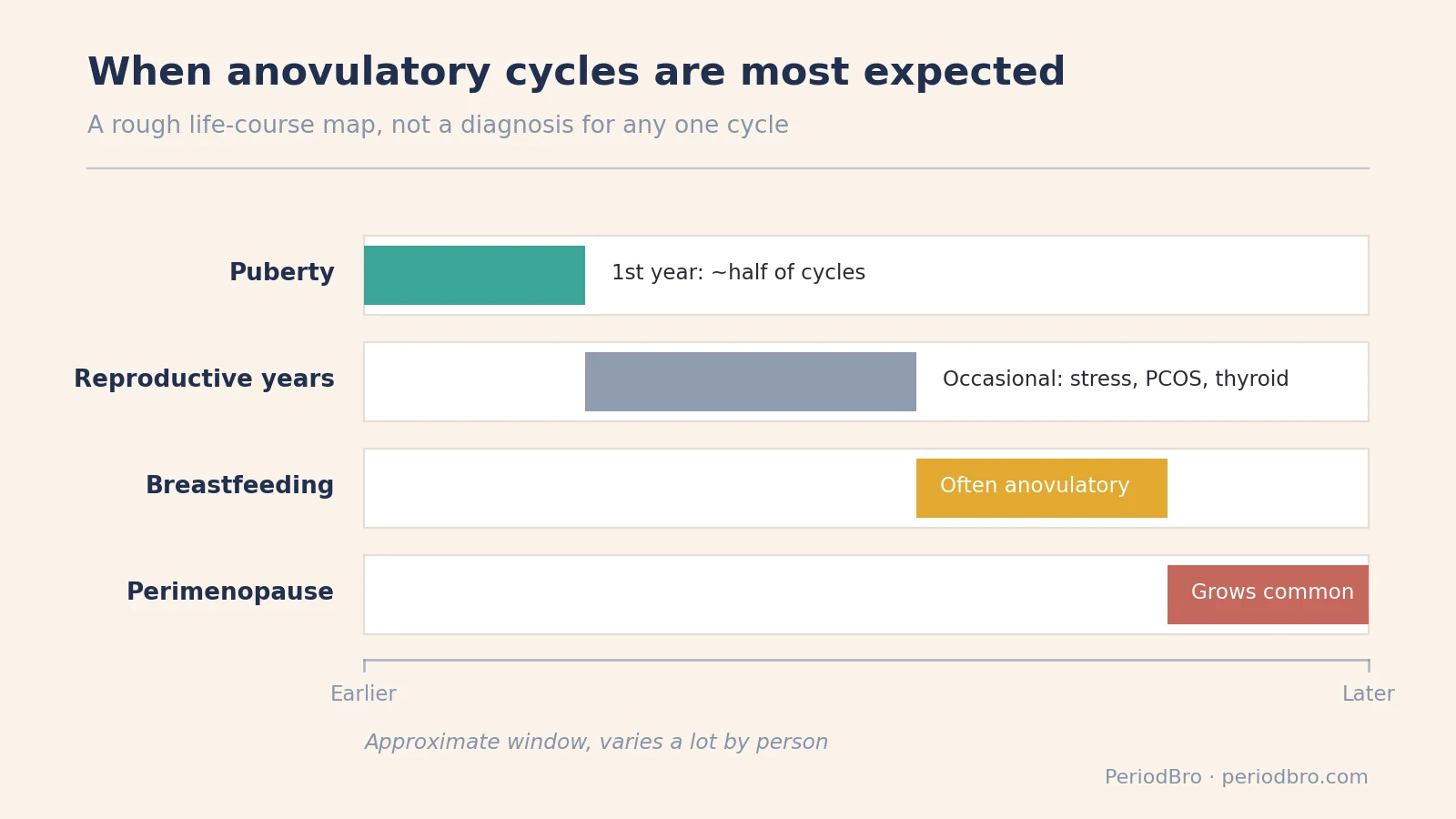
The first year or two after her first period. The hormonal signaling between brain and ovary is still calibrating, and research cited by the American College of Obstetricians and Gynecologists puts roughly half of cycles in that first year as anovulatory, dropping as the system matures.
The months after having a baby, if she is breastfeeding. Nursing keeps prolactin elevated, and prolactin suppresses the hormone pulses that trigger ovulation. Research on lactational amenorrhea shows that in the first six months of frequent breastfeeding, most cycles that do occur are anovulatory. This is a mechanism, not a birth control plan, and it is not reliable as one.
Perimenopause, as ovarian hormone production becomes less consistent year to year and cycles space out or bunch up before stopping for good.
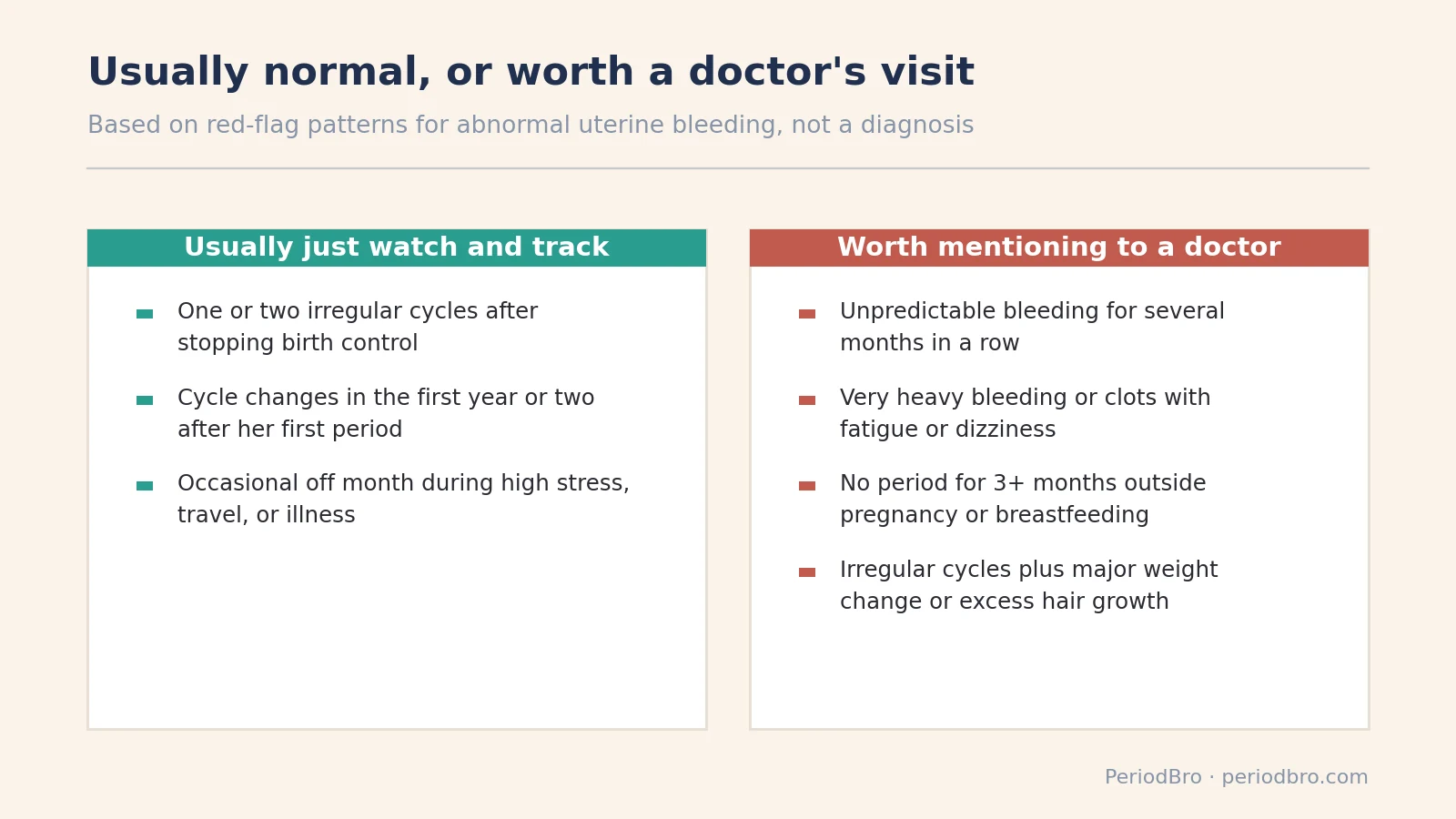
Coming off hormonal birth control. The pill, ring, or IUD was suppressing her natural cycle, and it can take a few months for her own hormonal signaling to restart consistently once she stops. A few irregular cycles right after stopping is common and usually not a red flag on its own.
PCOS, thyroid dysfunction, high prolactin unrelated to breastfeeding, big swings in weight, and heavy stress or exercise load can all disrupt the same signaling pathway, according to Mayo Clinic and Cleveland Clinic. PCOS alone accounts for a large share of anovulation cases, tied to elevated androgen hormones that block the normal FSH and LH pattern before it can trigger release.
None of that is a diagnosis you can make by watching an app. It is context for why “her cycle has been weird for months” is common enough that it has its own name, not automatically a five-alarm situation.
What it looks like on her tracking app or a chart
An anovulatory cycle tends to show up as an absence of the usual signals rather than a dramatic new one, and that absence is what a paying-attention partner can actually catch.
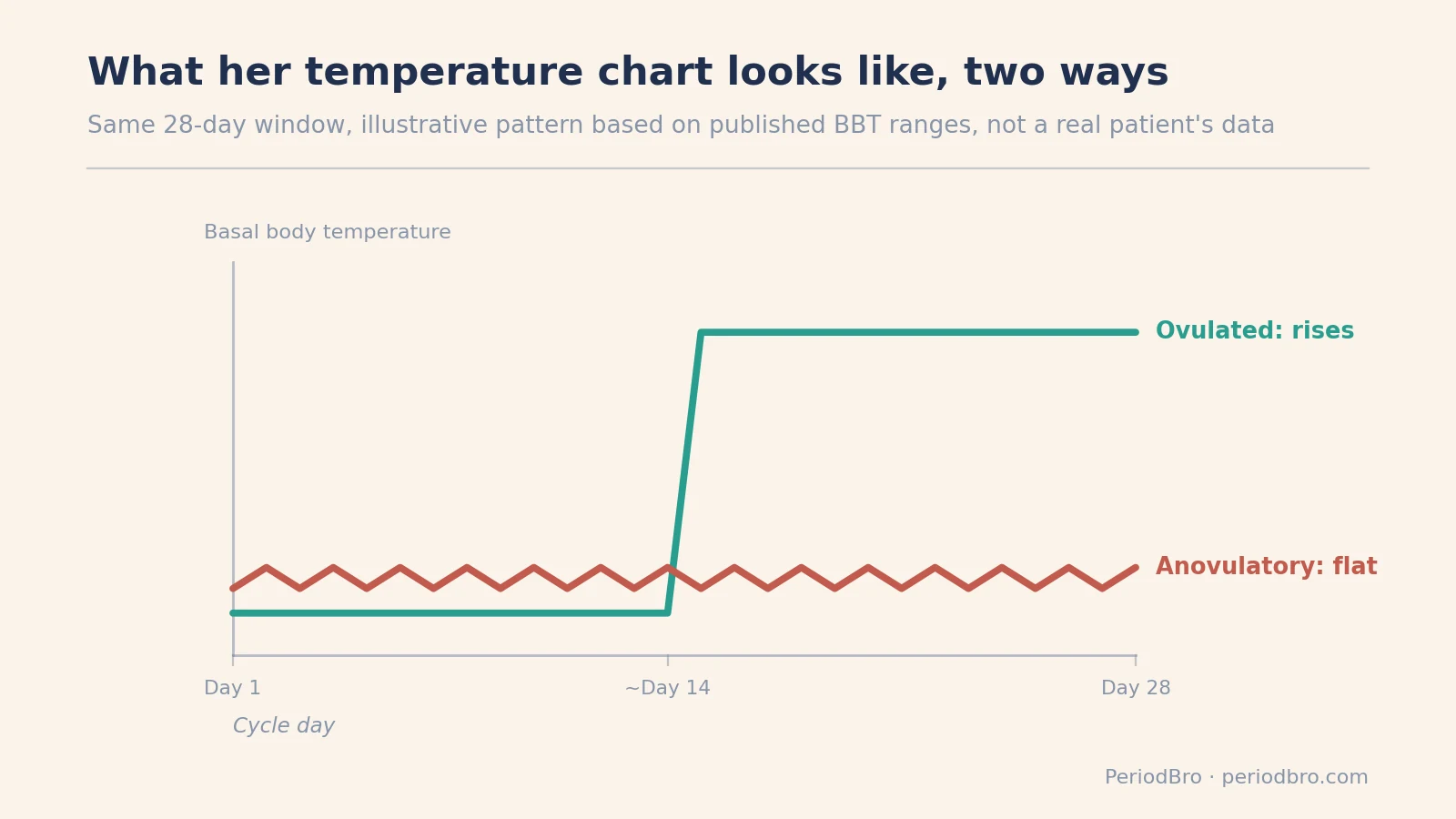
If she tracks basal body temperature, an anovulatory cycle usually will not produce the sustained rise that follows ovulation in a typical cycle. No corpus luteum means no progesterone, and progesterone is what drives that shift in the first place. A flat chart for month after month, instead of the usual pattern of a low first half and a slightly higher second half, is one of the more concrete signs something is off in the ovulation step specifically, more concrete than a “late” period alone.
Cervical mucus can be more confusing to read. The body can still ramp up estrogen and produce fertile-looking, stretchy mucus while trying, and failing, to trigger ovulation, sometimes more than once in the same stretch. So that signal alone will not confirm anything either way. It just means the two signals need to be read together over a few months instead of separately off one chart, which is most of what makes cycle tracking data genuinely useful compared to memory and a single data point.
None of this makes you a diagnostician, and it should not turn into you correcting her tracking or announcing your own theory over dinner. It is just useful to know that “the app was wrong again” sometimes means the app was working fine and the cycle itself skipped a step.

When it is worth more than a shrug
An occasional off cycle is not an emergency. Research on abnormal uterine bleeding points to a few patterns worth an actual appointment rather than a wait-and-see approach: bleeding that stays unpredictable for months rather than settling down, very heavy bleeding or clots with signs of fatigue or dizziness (possible anemia), periods absent for three months or more outside of pregnancy or breastfeeding, or a pattern showing up alongside other symptoms like major weight change, excess hair growth, or heat or cold intolerance. None of this is something to self-diagnose from an article. It is a reason to say “maybe worth mentioning to your doctor,” not a reason to panic.

What actually helps, as her partner
Reading one article will not fix this. A few things help.
Stop treating one weird cycle as data. Ovulation and hormone signaling respond to sleep, stress, travel, illness, and training load, so a single off month rarely means anything on its own. Patterns over three or more months are what matter, which is why consistent tracking beats any single reading.
If she is dealing with a condition like PCOS or moving through perimenopause, anovulatory cycles are part of that picture, not a separate problem stacked on top of it. Understanding the condition helps more than treating each irregular cycle as its own mystery, and it usually explains months of “weird cycles” in one conversation instead of a dozen separate worries.
Bring pattern information to appointments, not conclusions. “It’s been unpredictable for about four months, and the temperature chart has been flat the whole time” is useful to a doctor. A diagnosis you read online and repeated to her over dinner is not, and it can come across as more controlling than supportive, even when the intent behind it is good.
When a cycle does come back to something recognizable, that does not automatically mean the last few irregular months meant nothing. Anovulatory stretches often resolve on their own, especially around puberty, postpartum, or coming off birth control. They can also be the first visible sign of something worth a checkup, and telling those two apart is her doctor’s call, not yours.
Real tracking makes this easier to notice than memory and vibes do. A chart that shows temperature, mucus, and cycle length side by side over a few months turns “something’s been off” into an actual pattern you can both talk about, and eventually hand to a doctor if it does not resolve.
None of this needs a diagnosis attached to it. Most of the time, the useful version is small: noticing out loud that this month felt different, asking if she wants help remembering to log the chart, or just not being alarmed the next time a “period” shows up two weeks off schedule for no obvious reason. That is a low bar, and it is most of the job.
PeriodBro provides educational information and is not a substitute for professional medical advice. Always consult a qualified healthcare provider for personal medical decisions.