
Basal Body Temperature: The Old-School Way to Track Her Cycle
She’s been leaving a thermometer on the nightstand and taking her temperature before she even sits up, three mornings running. You’ve noticed, and you have questions. Here’s what basal body temperature tracking does, and where it falls short.
What basal body temperature tracking actually measures
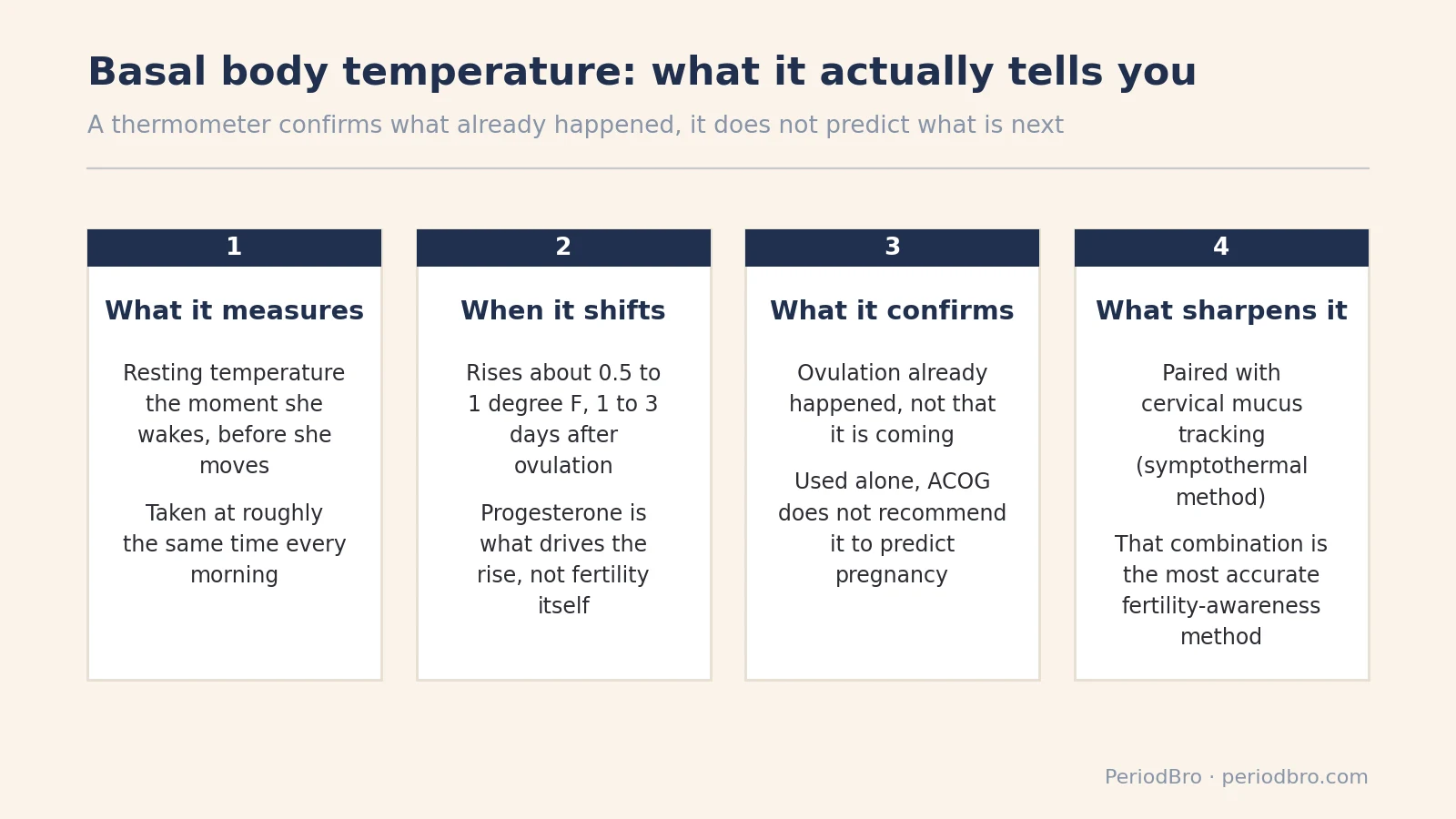
Basal body temperature (BBT) is her resting temperature, taken the moment she wakes up, before she gets out of bed, drinks anything, or checks her phone. It has to happen at roughly the same time every morning, because even getting up twenty minutes later than usual can shift the number enough to matter.
The idea is simple. In most cycles, temperature rises slightly, about 0.5 to 1 degree Fahrenheit, in the day or two after ovulation, and stays elevated until her next period starts. Progesterone drives that rise. It’s not fertility itself showing up on the thermometer, it’s a hormone that only shows up after the fact.
That lag is the whole story with BBT.
Why the shift confirms ovulation instead of predicting it
A rising temperature tells you ovulation already happened. It doesn’t tell you it’s coming, which surprises most partners the first time they see the chart. By the time the chart shows the shift, the fertile window that mattered for that cycle is closing or already closed. The American College of Obstetricians and Gynecologists is direct about this: it does not recommend the temperature method on its own to predict pregnancy, precisely because it’s a rearview mirror, not a forecast.
That’s why people who take BBT seriously usually aren’t using it to catch the fertile window in real time. They’re using it to build a picture of her cycle over several months: how long her luteal phase runs, whether ovulation is happening at all, whether it’s shifting later or earlier than it used to. That’s genuinely useful information, just not the kind that helps on the day it matters most.
The accuracy question: perfect use versus typical use
Fertility awareness methods, BBT included, have a split personality when it comes to numbers. Used exactly as taught, with a consistent wake time and careful charting, fewer than 1 to 5 women out of 100 get pregnant in a year while relying on the method. Used the way most people actually manage it around a real schedule, work trips, and bad sleep, that number climbs to 12 to 24 out of 100.
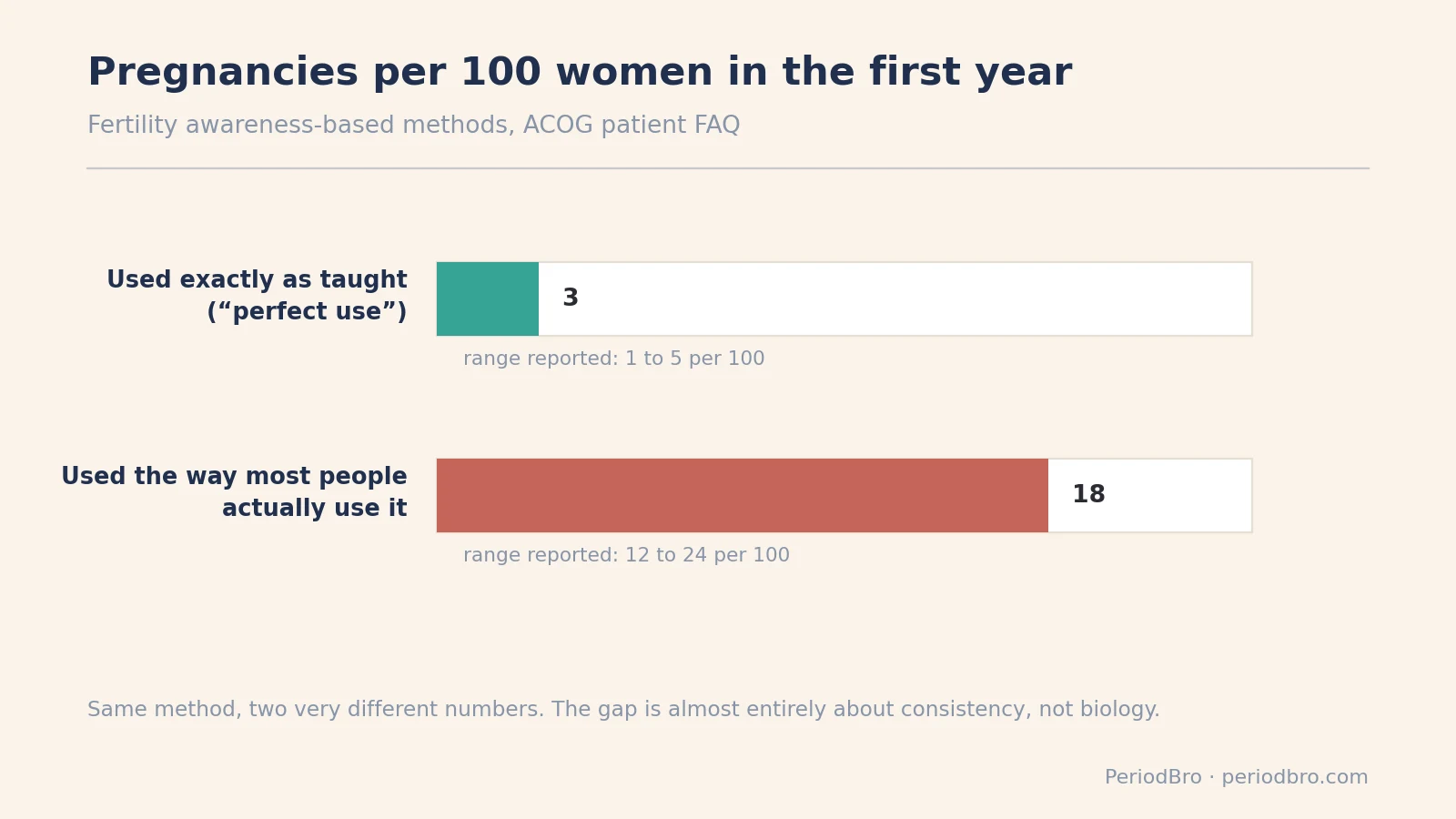
That gap isn’t really about the biology being unreliable. It’s about how unforgiving the method is to any inconsistency. A late Sunday morning, a fever, a glass of wine the night before, jet lag: any of these can nudge a reading and throw off the whole picture for that cycle. The method rewards discipline more than almost anything else in reproductive health, which is exactly why most clinicians don’t recommend using it alone.
Pairing it with the mucus check moves the needle
The fix, if you can call it that, is combining BBT with tracking changes in cervical mucus across the cycle, a combination known as the symptothermal method. Cervical mucus changes in texture and appearance as estrogen rises toward ovulation, which gives an earlier signal than temperature alone, and pairing the two closes a lot of the gap. Reviews of fertility awareness methods put symptothermal effectiveness with typical use as high as 98%, well above single-indicator methods like temperature or calendar counting on their own.
It’s more to track, and it asks more of her, which is worth knowing if you’re the one occasionally teasing her about “yet another app.” What looks like overkill is her compensating for a real limitation in the method.

How this fits next to apps and wearables
If you’ve read anything about wearable cycle tracking, you’ve probably seen the accuracy numbers side by side: a 2026 Bayesian meta-analysis in npj Digital Medicine, covering 27 studies and over 6,000 women, found wearable-based prediction hit about 88% accuracy, against roughly 75% for self-reported BBT and 72% for calendar counting alone. Wearables that track temperature continuously overnight solve the “same time every morning” problem by removing the morning part entirely. That’s a real advantage, and it’s part of why smart rings and similar devices have gotten popular for people who want the temperature signal without the discipline it usually demands.
That doesn’t make BBT obsolete. Some people prefer a method that doesn’t sync anywhere, doesn’t need charging, and doesn’t hand a health-data company a picture of their cycle. If she’s one of them, the thermometer-and-notebook approach is a legitimate choice, not a stubborn one.
What to actually do as the partner
You’re not the one taking the reading, so your job is smaller than it might feel. Protect the routine: if a wake-up time keeps drifting because of your schedule, that’s a cost she’s absorbing. Learn to glance at the chart with her instead of asking her to summarize it out loud every time, it respects the effort she’s putting in. And when a single morning looks off, a late night, a cold coming on, treat it as noise instead of a crisis. One weird data point doesn’t undo a month of consistent charting.
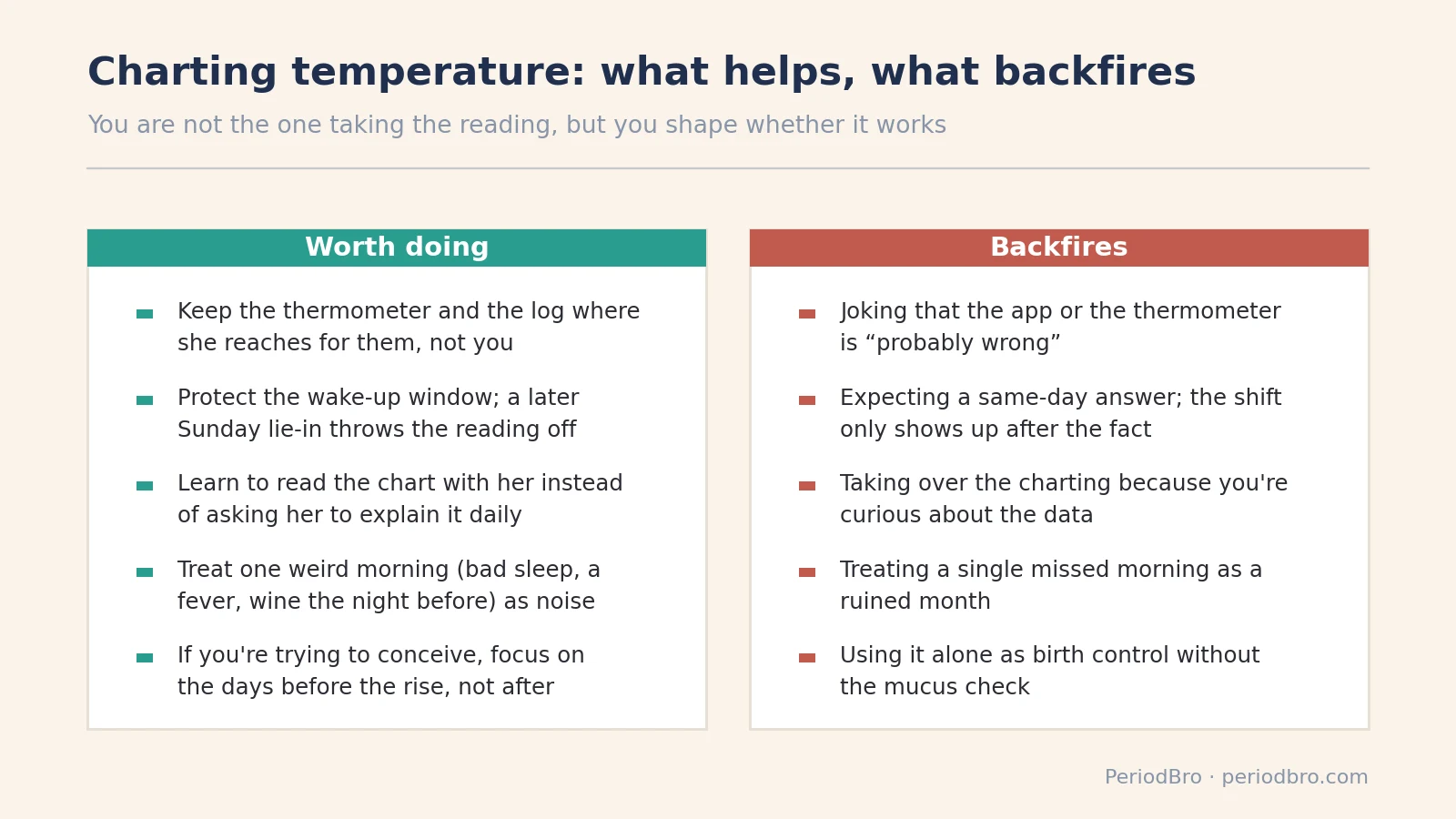
If the two of you are using this to try to conceive, the useful window is the days leading up to the rise, not after it. If you’re using it as your only method to avoid pregnancy, know what the ACOG numbers above actually mean for your particular tolerance for risk, and talk about whether the mucus check needs to be part of the picture too.
What throws off a reading, and why it’s not her fault
A chart with a strange morning in the middle of it isn’t a broken method, it’s basal body temperature doing exactly what it’s supposed to do: reflecting anything that touches her body overnight. A late night out, a fever, a poor night’s sleep, alcohol, even a different blanket weight can shift the number by a few tenths of a degree, which is enough to blur a signal that’s already subtle. Travel across time zones is its own problem, since “the same time every morning” stops meaning anything once her body clock is a few hours off from the local clock.
This is where a little patience from you matters more than it sounds like it should. If she mentions the chart looks off after a rough week, the useful response isn’t “so the app doesn’t work,” it’s asking whether anything unusual happened that morning. Most confusing charts have a boring explanation once you look for one.
It’s also worth knowing that BBT charts don’t read the same for everyone. Illness aside, some women naturally run a flatter curve with a smaller shift, which makes the post-ovulation rise harder to spot even when the method is being followed correctly. If a few months of careful charting still produce an unclear pattern, that’s a reasonable thing to mention at her next appointment, not a sign she’s doing it wrong.
Quick answers
Does the temperature shift happen on the same day every cycle?
No. Ovulation timing varies cycle to cycle even in women with regular periods, so the day the temperature rises moves around too. That’s part of why BBT is better at describing a pattern over several months than predicting any single day.
Can stress or illness fake an ovulation-like temperature rise?
Yes. A fever, in particular, can produce a temperature rise that has nothing to do with progesterone or ovulation. It’s one of the more common reasons a chart looks confusing for a cycle or two.
Is BBT worth using if she’s already on a wearable that tracks temperature?
Usually not as a duplicate. If a wearable is already capturing overnight temperature continuously, manual BBT charting adds effort without adding much new information. It’s more useful for people who specifically don’t want a connected device tracking this data.
Cycle awareness is more than one number on a chart, and it changes what “supporting her” looks like day to day. If you want the wider picture of how tracking fits into a relationship, the complete guide to cycle tracking for partners covers the apps, the consent questions, and the privacy side that BBT charting alone doesn’t touch. For the phase-by-phase basics behind why the numbers move at all, our guide to the menstrual cycle is the place to start. And if she’s weighing a wearable against the notebook approach, our smart ring breakdown walks through what those devices actually measure differently.
BBT charting won’t tell either of you what’s coming next. What it will tell you, slowly and only in hindsight, is the shape of her cycle: how long the second half runs, whether it’s consistent month to month, and whether something’s worth mentioning to a doctor. That’s a smaller promise than most apps make, but it’s one the method keeps.
PeriodBro provides educational information and is not a substitute for professional medical advice. Always consult a qualified healthcare provider for personal medical decisions, including questions about fertility awareness methods and contraception.