
Perimenopause for Partners: What Actually Changes
Her cycle used to be predictable. Now it arrives early, then skips a month, then shows up heavy. Sleep is worse, the thermostat is a live issue, and something in the emotional weather has shifted. If she is in her forties, perimenopause for partners is the manual nobody handed you.
The confusing part is that perimenopause is a transition running for years rather than a switch, with hormones fluctuating instead of declining smoothly. Most of what feels chaotic about it follows from that.
What perimenopause is, and when it starts
Perimenopause is the stretch where the ovaries wind down hormone production and the cycle stops behaving. Cleveland Clinic puts the usual start in the mid-40s, though it can begin earlier, and describes it as beginning roughly 8 to 10 years before menopause itself.
Duration averages about four years and can stretch to eight, with some people passing through in a matter of months. That range is worth holding onto, because “how long does this last” is a question neither of you can answer at the start.
Menopause is the endpoint and it has a precise definition: twelve consecutive months with no period. Everything before that line is perimenopause, including the year that felt like it must be the end.
What changes, in order
Cleveland Clinic names irregular periods as the first sign. Cycles get longer or shorter, bleeding gets heavier or lighter, and periods start skipping. The predictability you both organized around quietly disappears.
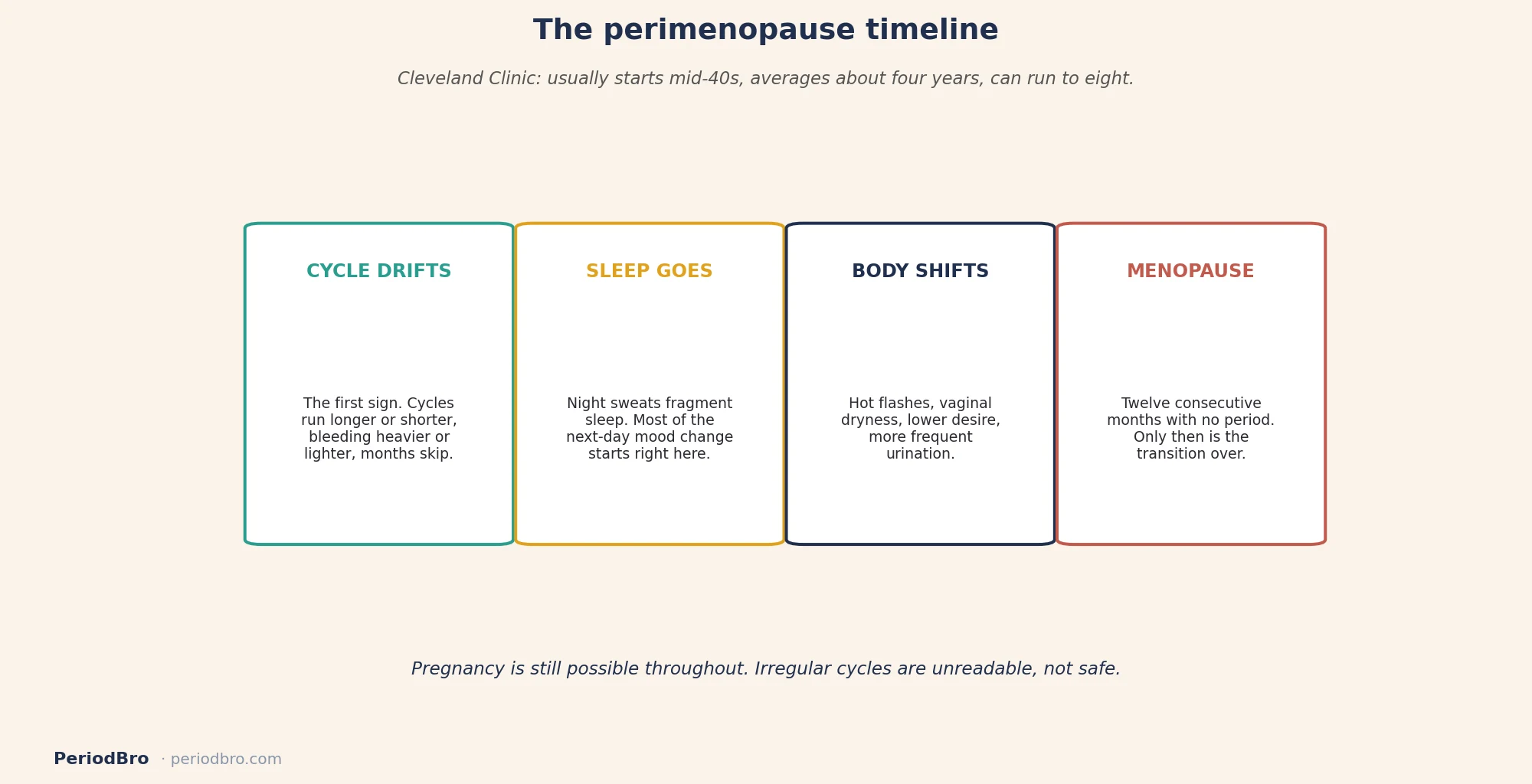
After that the list broadens: hot flashes, night sweats, sleep disruption, mood changes including irritability and low mood, vaginal dryness and discomfort during sex, reduced desire, and more frequent urination.
Sleep deserves separating out, because it drives more than people credit. Night sweats fragment sleep, fragmented sleep wrecks mood and patience the next day, and the mood change then gets attributed to hormones directly when a good part of it is simply exhaustion. We went through the same mechanism in period night sweats and how sleep changes through her cycle.
The two things partners get wrong
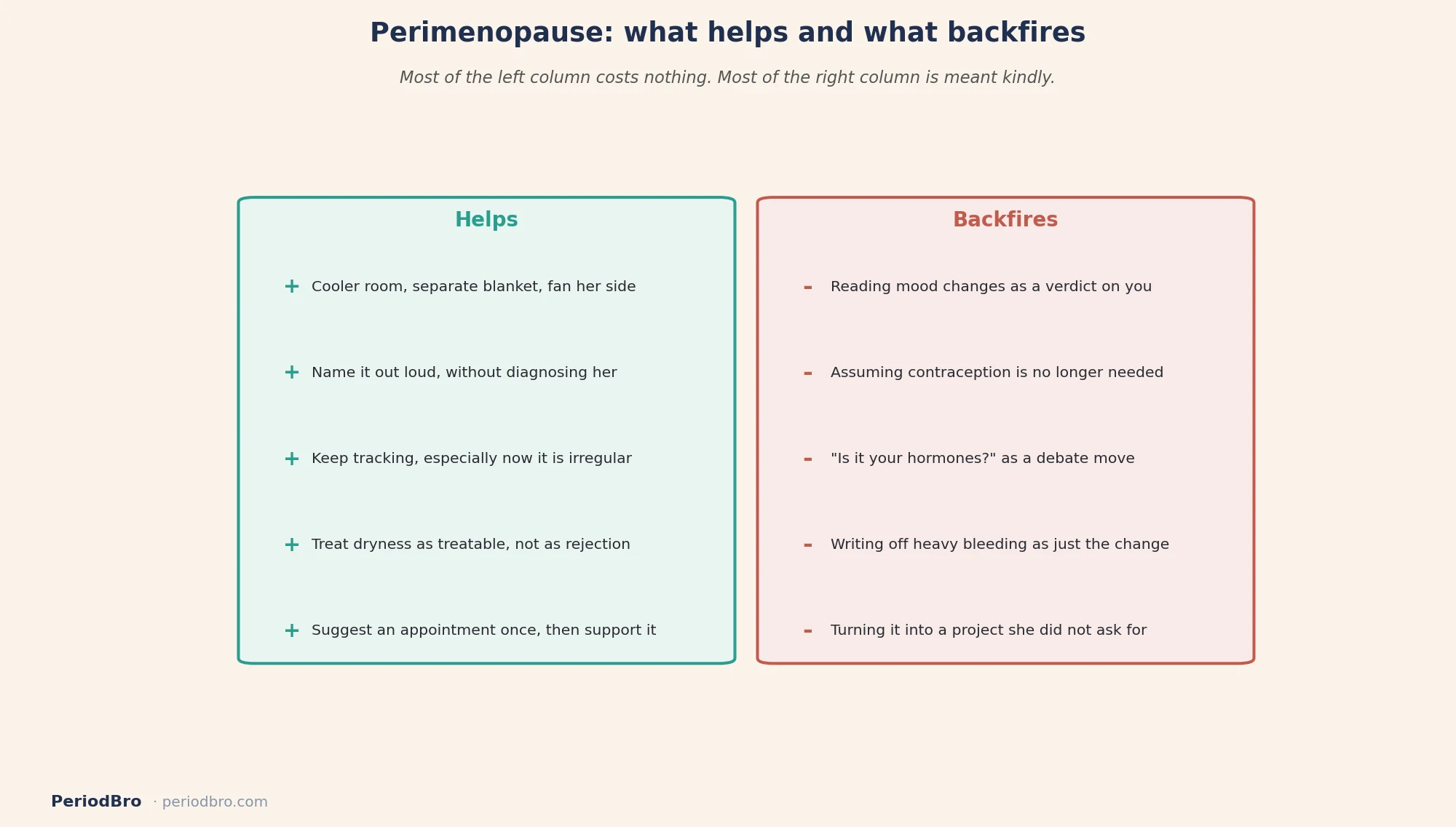
The first is treating it as a personality change. It reads like one from the outside, especially when irritability and low mood arrive alongside less interest in sex. Attributing that to the relationship, or to how she feels about you, is the single most common misread of this period, and it turns a physiological transition into a marital problem.
The second is assuming contraception is now optional. Cleveland Clinic is explicit that pregnancy remains possible during perimenopause, and irregular cycles make timing unreadable rather than safe. That conversation belongs with her clinician, and our piece on how birth control changes her cycle covers the background.

What is worth tracking now
Tracking gets abandoned exactly when it becomes most useful. Once cycles stop being predictable, a lot of people stop logging them, and that removes the only record of how the transition is progressing.
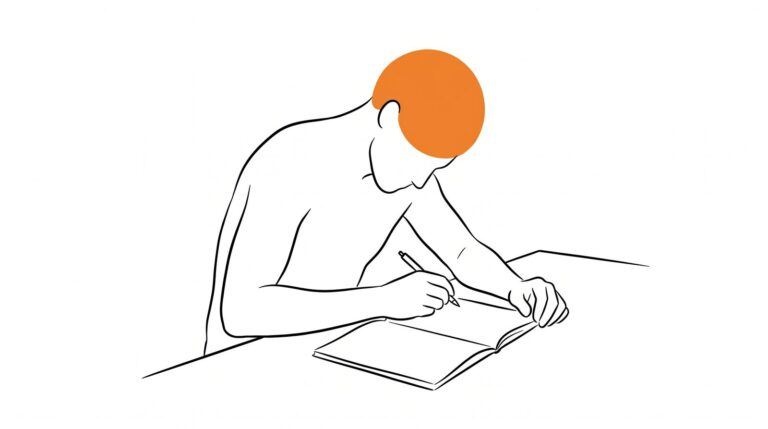
Four things are worth capturing. Start dates, even when they are wildly spaced. How heavy each bleed was relative to her normal. Nights broken by sweats. And any bleeding that turns up outside a period.
That last one carries clinical weight. Bleeding between periods, bleeding after sex, and any bleeding after twelve period-free months are the ones a clinician wants to hear about specifically, and the first two are covered in our guide to spotting between periods. Six months of dates turns a vague “things have been odd for a while” into something a doctor can work with in ten minutes.
What helps, medically and otherwise
There is more available than most people assume. Cleveland Clinic lists hormone replacement therapy, birth control pills, antidepressants, gabapentin, oxybutynin, the Mirena IUD, and vaginal creams, alongside exercise, diet, and stress management.
The relevant point for you is that suffering through it is not the only option, and a lot of people believe it is. If she has decided this is something to endure, the useful contribution is suggesting an appointment once, and then supporting whatever she decides, including deciding against treatment.
What you can actually do
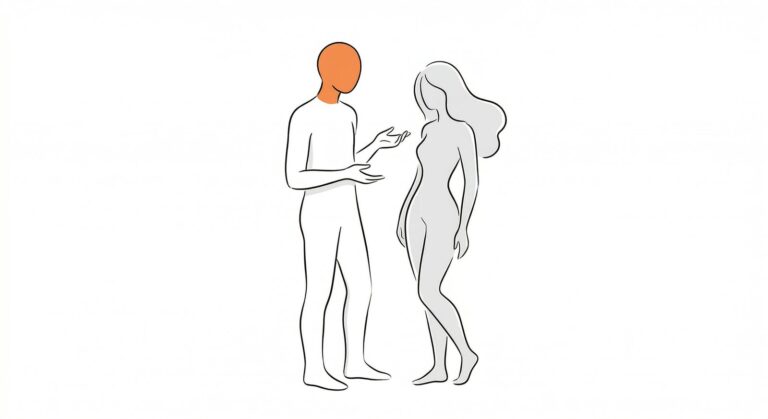
Say the word out loud. Naming perimenopause is not diagnosing her. It gives a chaotic stretch a category, and a category is easier to live inside than a mystery.
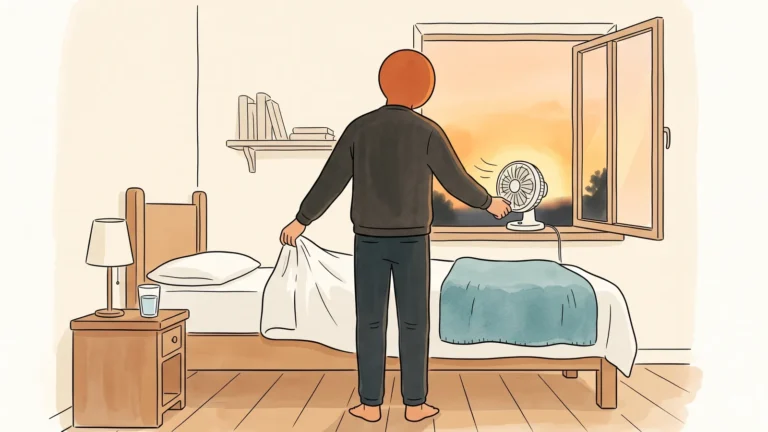
Fix the temperature problem. A cooler bedroom, a separate blanket, a fan on her side. This sounds trivial and consistently ranks among the most appreciated things a partner does, because it addresses sleep, and sleep drives everything downstream.
Keep tracking, even though it is irregular. Especially because it is irregular. Cycle dates and symptoms across months are what a clinician uses to work out where she is in the transition.
Handle the intimacy shift as a shared problem. Vaginal dryness and discomfort are physical, treatable, and nothing to do with attraction. Treating them as a rejection is how a solvable problem becomes a permanent one.
Take the mood personally as rarely as you can manage. Some of it is hormonal, some is exhaustion, and some is the ordinary irritation of a body doing something unfamiliar for years on end. None of it is a message about you.
The same principle that works earlier in life still works here: knowing what is happening turns a personal slight into a predictable pattern. That is what being a better partner through her cycle means at forty-five as much as at twenty-five, and how cycle awareness changes a relationship covers the longer arc.
The conversation worth having once
Most couples never have it, and the ones who do describe the same relief afterwards. It takes five minutes and it is not a summit meeting.
Three things belong in it. That you have noticed things have been harder and you are not keeping score. That you would rather she saw someone than toughed it out, and that you will back whichever way she decides. And that if she wants to tell you which days are bad, you will use that to plan around rather than to explain her to herself.
What you are really offering is the removal of a suspicion she may already be carrying: that this transition is quietly costing her your patience. Saying otherwise out loud, once, does more than a year of being tactful about it.
Common questions
How long does perimenopause last?
About four years on average, up to eight, and occasionally only months. It ends at menopause, defined as twelve consecutive months without a period.
Can she still get pregnant?
Yes. Cleveland Clinic is clear that pregnancy remains possible throughout perimenopause, and contraception is still needed if pregnancy is not the goal.
Is heavy bleeding normal in perimenopause?
Bleeding often gets heavier or lighter than usual during the transition. Bleeding that soaks through protection quickly, lasts unusually long, or comes with severe pain still deserves an appointment rather than being written off as the change. Our guide on helping with heavy periods covers what to watch.
Is hormone replacement therapy safe?
That is a question for her clinician, weighed against her own history. It is a mainstream option rather than a fringe one, and the risk picture is individual.
Could it be something else?
Thyroid problems produce a similar mix of fatigue, mood change, and cycle disruption, which is one reason a clinician takes bloods rather than assuming. Age alone does not settle it.
Do symptoms stop at menopause?
Periods do, by definition. Hot flashes, sleep disruption, and vaginal dryness can continue past that line for years, so the twelve-month mark is a boundary on the calendar rather than the end of every symptom.
What if she does not want to talk about it?
Then do not make it a project. Adjust the room temperature, take things off her plate, and leave the door open. Plenty of people would rather be quietly supported than analysed.
This article is general information, not medical advice. Perimenopause symptoms overlap with thyroid conditions and other issues, and any new heavy bleeding, bleeding after sex, or bleeding after twelve period-free months should be assessed by a clinician.