
How Infertility Affects Relationships, and How to Stay on the Same Side
A friend of mine spent two years trying for a baby with his wife. He told me the hardest night wasn’t a doctor’s appointment. It was a Tuesday when her period showed up, again, and he said “we’ll try next month” in the most upbeat voice he could manage. She went quiet for two days. Later she told him that “next month” had sounded like he hadn’t noticed this month was a loss.
If you’re in the middle of it, you already know how infertility affects relationships. It turns sex into a schedule, turns every period into bad news, and puts two people who love each other on slightly different emotional timelines. Your relationship can survive it, and plenty get stronger. You’re dealing with one of the harder things a couple can go through, and it helps to know what the research says about which couples come out closer.
You’re not the only ones
The World Health Organization estimates that about one in six people worldwide experience infertility at some point in their lives, with similar rates across rich and poor countries (WHO). The American Society for Reproductive Medicine recommends a fertility evaluation after 12 months of trying when she’s under 35, or after 6 months when she’s 35 or older (ASRM).
The emotional weight is heavy. A review in Dialogues in Clinical Neuroscience notes that depression levels in infertility patients have been compared to those of people diagnosed with cancer (PMC). If it feels bigger than the people around you seem to realize, the research backs you up.
How infertility affects relationships, month by month
Most couples describe the same loop. It starts with the fertile window, when sex goes on the calendar and starts to feel like a task with a grade attached. Then comes the two-week wait, when she’s reading every twinge as a possible sign and you’re trying not to ask. Then her period arrives or the test is negative, and the loss lands. A few days later the planning starts again, usually before either of you has recovered.
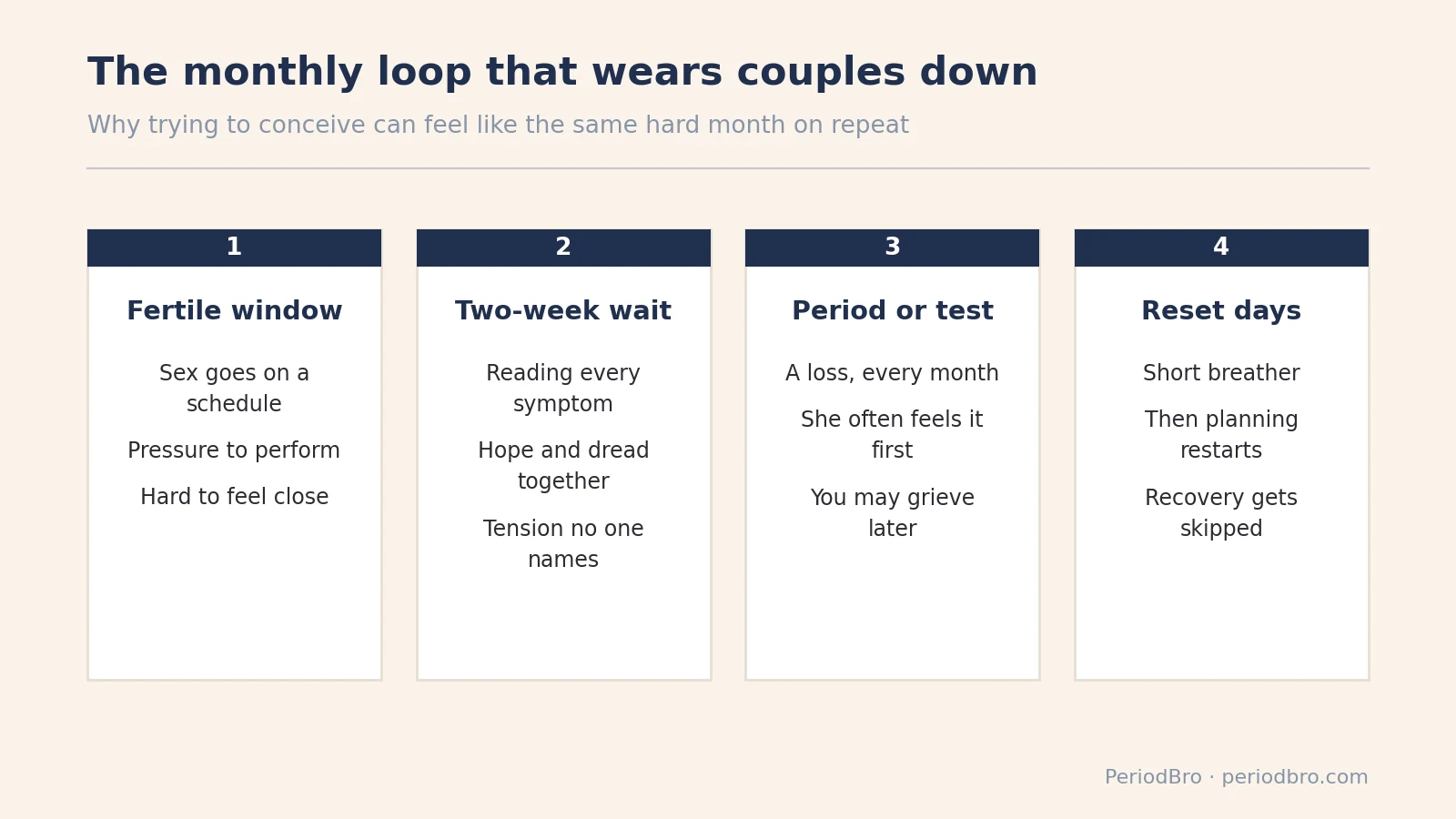
Repeated for twelve, eighteen, or thirty months, that loop wears on a couple in predictable ways.
Sex stops being yours. When intimacy is mostly timed around ovulation, it can start to feel like homework. Both partners can feel pressure to perform, and spontaneous closeness gets crowded out. If you’re tracking her cycle for conception, our guide to using cycle data while trying covers the practical side without turning every month into a project.
You grieve on different clocks. She’s often living it in her body every day, symptom by symptom. Many partners feel the loss later, or quietly, or not in a way that looks like grief. That gap can read as “he doesn’t care” on one side and “she’s shutting me out” on the other, when both of you are hurting.
Blame shows up, even unspoken. There’s often an assumption that the problem is in her body. It frequently isn’t. Male factors are the sole cause in about 20 percent of infertile couples and contribute in another 30 to 40 percent (AUA/ASRM guideline). Getting tested yourself, early, takes some of that weight off her.
Money and decisions pile up. Treatment choices, costs, and “how long do we keep going” questions put pressure on any couple, especially when the two of you want different answers.

What the research says about couples who get closer
Infertility doesn’t wreck every relationship. Some couples come out of it tighter, and the research gives useful clues about why.
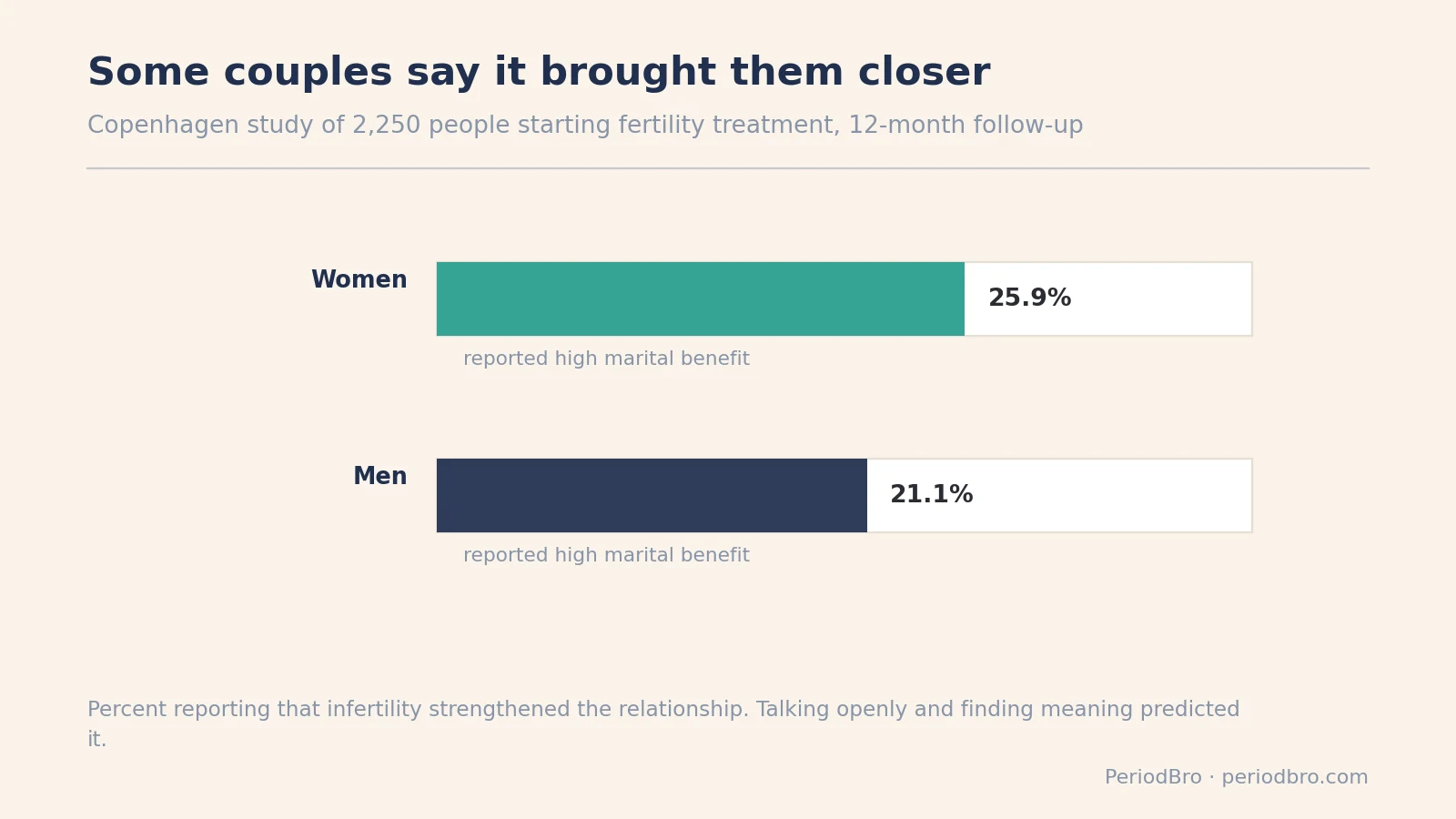
The Copenhagen Multi-centre Psychosocial Infertility study followed 2,250 people starting fertility treatment. After a year, 25.9 percent of women and 21.1 percent of men reported what researchers called high “marital benefit,” meaning the experience had brought them closer (PubMed). For men, the strongest predictors were talking about their feelings and asking others for advice, along with finding some meaning in the experience.
The other side of the picture is harder. A Danish study of more than 47,000 women evaluated for fertility problems found that those who didn’t have a child afterward were about three times more likely to have their relationship end than those who did (PubMed). That’s a population-level risk, not a prediction for your marriage. It does say the strain is real enough to take seriously while you’re in it, rather than waiting for it to pass.

What helps you stay on the same side
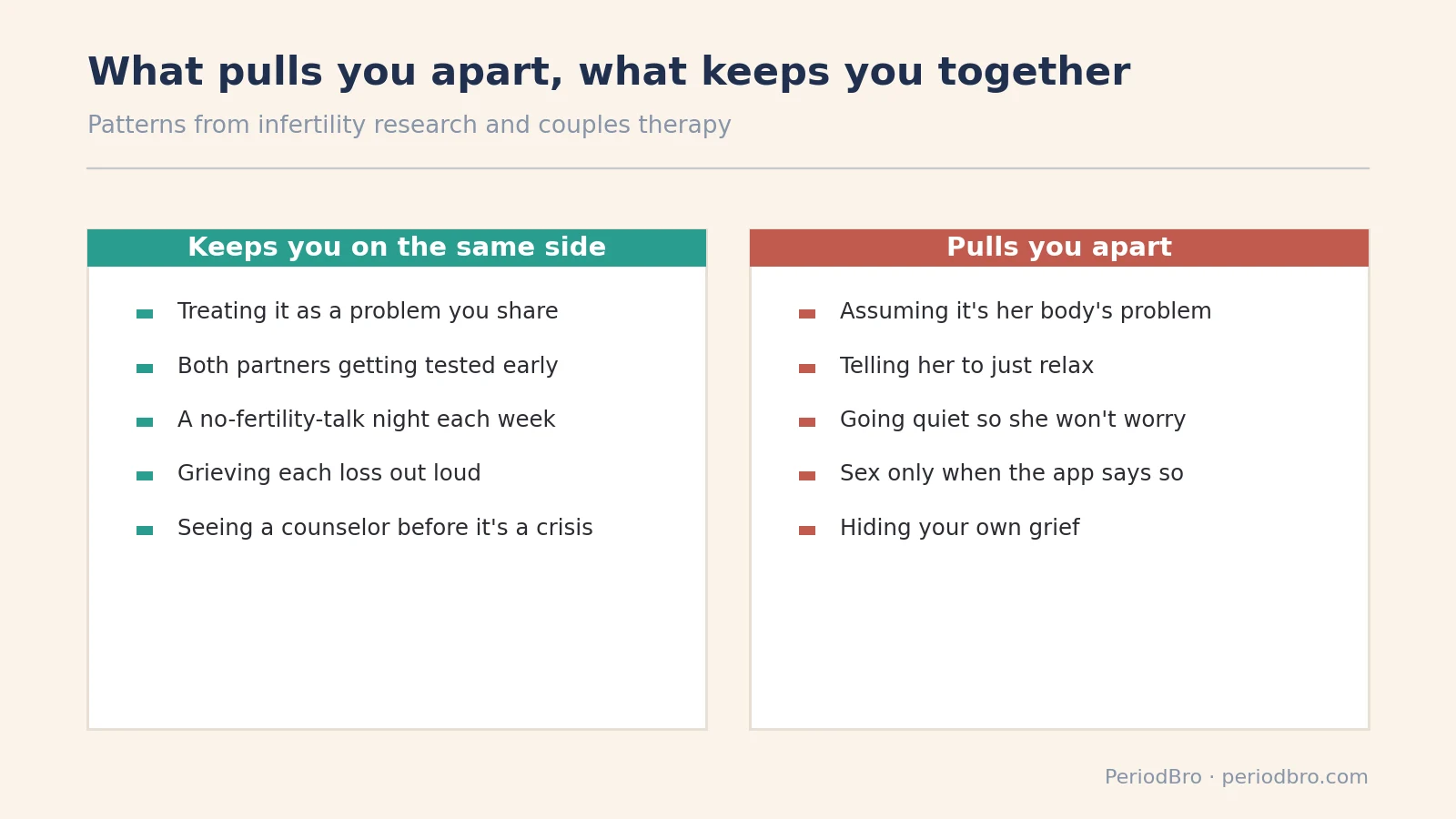
Treat it as a shared problem. Say “our fertility,” go to appointments when you can, and get your own testing done early. Nothing says “this is ours” more clearly than showing up for your half of the workup.
Don’t tell her to relax. “Just relax and it’ll happen” is the most common unhelpful line couples hear. The research on whether stress causes infertility is unclear, while the evidence that infertility causes stress is solid (PMC). Telling her to relax hands her one more thing to fail at.
Name the loss each month. When her period comes, skip straight past the pep talk. Something like “I’m sorry, this one hurts” and staying close does more than any plan for next cycle. My friend learned that the hard way on that Tuesday.
Protect a no-fertility zone. One evening a week, or one weekend a month, where nobody mentions ovulation, tests, or clinics. Couples who keep some part of their life that isn’t about trying tend to remember why they’re doing this together.
Let yourself grieve too. Going quiet to protect her usually backfires. When you hide your sadness, she can read it as indifference. Research on infertile couples finds that each partner’s stress, anxiety, and depression are linked to the other’s (PMC), so you’re both in this whether or not you say it out loud. If she tends to go silent after bad news, how to handle it when she goes quiet may help.
Get support before it’s a crisis. Many fertility clinics have counselors who specialize in exactly this. A few sessions early on, while you still like each other, work better than waiting until you’re barely talking.
When you want different things
At some point most couples hit a decision one of them is readier for than the other: starting IVF, trying donor options, taking a break, or stopping. These conversations go badly when they happen in the raw days right after a negative test, and better when you set a time for them in a calmer week.
It helps to talk about limits before you reach them. How many rounds, how much money, how much time before you reassess. Writing down a rough plan together means that when the hard moment comes, you’re revisiting a decision you made as a team instead of one person talking the other into or out of something. If either of you starts to feel like the one always pushing or always holding back, say it out loud. That pattern is easier to fix when it’s named early, and a fertility counselor can help you work through it if you get stuck.
When the diagnosis has a name
Sometimes infertility comes with a known cause, and understanding it can help you feel less helpless. If she’s been diagnosed with endometriosis or PCOS, our partner guides explain what’s going on and how it can affect her day to day. If you’ve been through a loss along the way, her period after a miscarriage covers what to expect physically and emotionally.
My friend and his wife did have a baby eventually, through IVF, on the third round. When I asked him what he’d do differently, he didn’t mention a clinic or a supplement. He said he’d have stopped trying to be the cheerful one so early, and let her see that he was sad too.
Whatever your outcome ends up being, you still get to decide whether you go through it side by side, and that part is worth protecting.
PeriodBro provides educational information and is not a substitute for professional medical or mental health advice. If either of you is struggling with persistent low mood or hopelessness, reach out to a doctor or counselor. In the US, you can call or text 988 any time.