
How to Get a PMDD Diagnosis: A Partner’s Guide to the Process
If the week before her period turns into something that looks less like a bad mood and more like a different person, and then it lifts the day she bleeds, you have probably already wondered whether this is PMDD. Figuring out how to get a PMDD diagnosis is worth understanding because the process is specific, it is not fast, and the single most important part of it is something you can genuinely help with.
I want to be careful here. I build a cycle app, I am not a clinician, and nothing below diagnoses anyone. But I have watched enough couples get stuck in the “is it real, is it just PMS, is it something else” loop that I think it helps to lay out the actual path a diagnosis takes, so you can support her through it instead of guessing alongside her.
First, what PMDD is and why it gets missed
Premenstrual dysphoric disorder is a severe, cyclical mood condition tied to the luteal phase, the stretch after ovulation and before her period. It is not a heavier version of a bad week. It is a recognized disorder that, by one widely cited estimate, affects somewhere between 1.8 and 5.8 percent of women who menstruate (StatPearls, 2024). It gets missed constantly because the symptoms come and go, so on a good week nothing looks wrong, and because the mood side can look identical to depression or anxiety if nobody is watching the timing. The line between ordinary PMS and PMDD is exactly the thing a diagnosis exists to draw, and we walk through it in the difference between PMS and PMDD.

The one thing that makes or breaks a PMDD diagnosis: prospective tracking
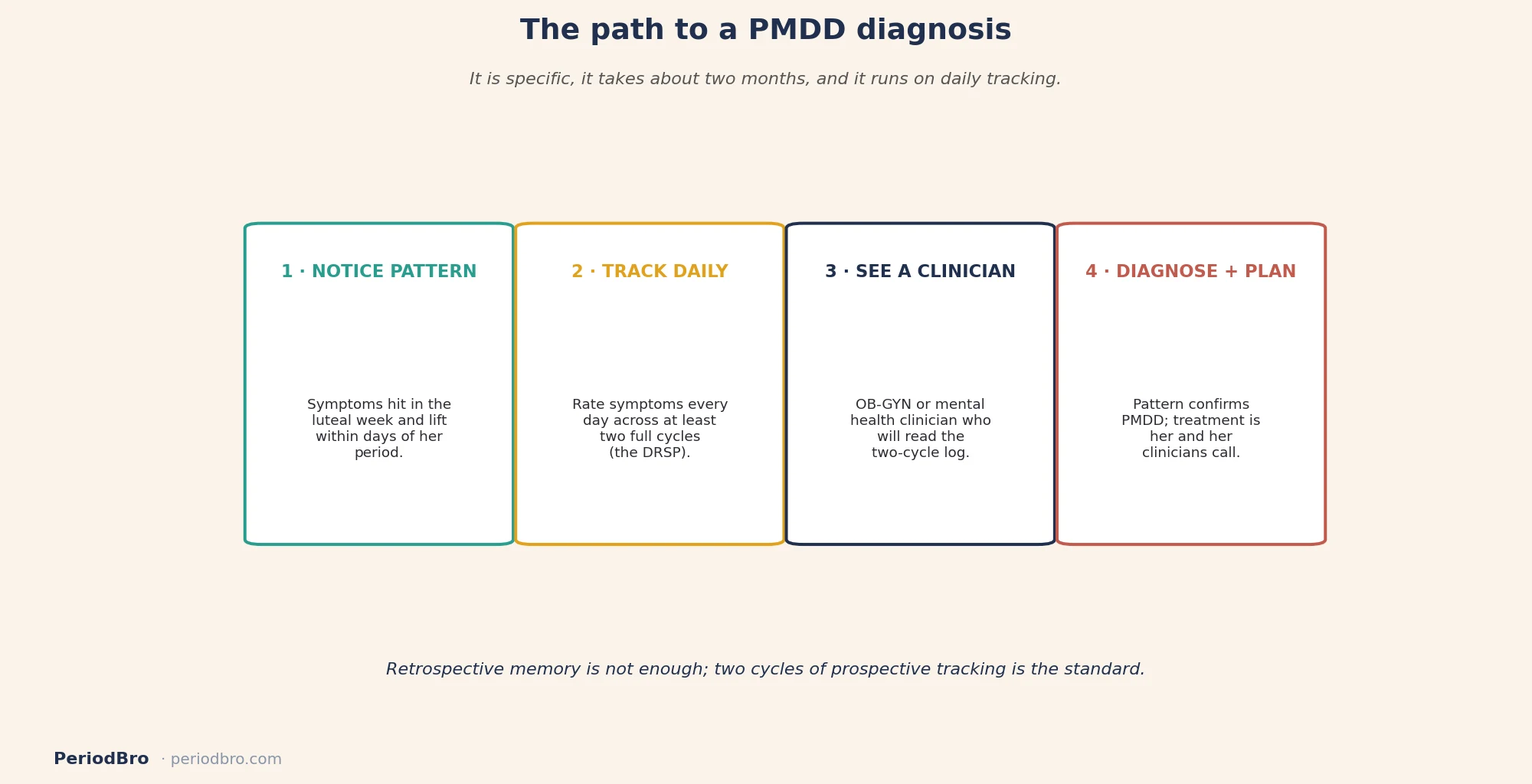
Here is the part most people do not know going in. You cannot get a solid PMDD diagnosis from memory. A clinician will not, or at least should not, diagnose it off a description of how the last few months felt, because retrospective recall of premenstrual symptoms is unreliable and tends not to hold up when it is actually checked. The standard is prospective daily tracking: she rates her symptoms every day, through at least two full menstrual cycles, before a diagnosis is confirmed (StatPearls, 2024).
The instrument clinicians trust for this is the Daily Record of Severity of Problems, or DRSP, a standardized daily questionnaire that a scoring system called the C-PASS uses to make a formal DSM-5 diagnosis from two or more months of ratings (Eisenlohr-Moul et al., American Journal of Psychiatry, 2016). In plain terms, those two months of honest daily logging are the diagnosis itself, not a preamble to it. This is the exact point where a partner is useful, because keeping a daily habit going for two cycles is hard when you feel awful, and a gentle shared reminder to log makes the difference between arriving with real data and arriving with a shrug.
What the diagnosis actually requires
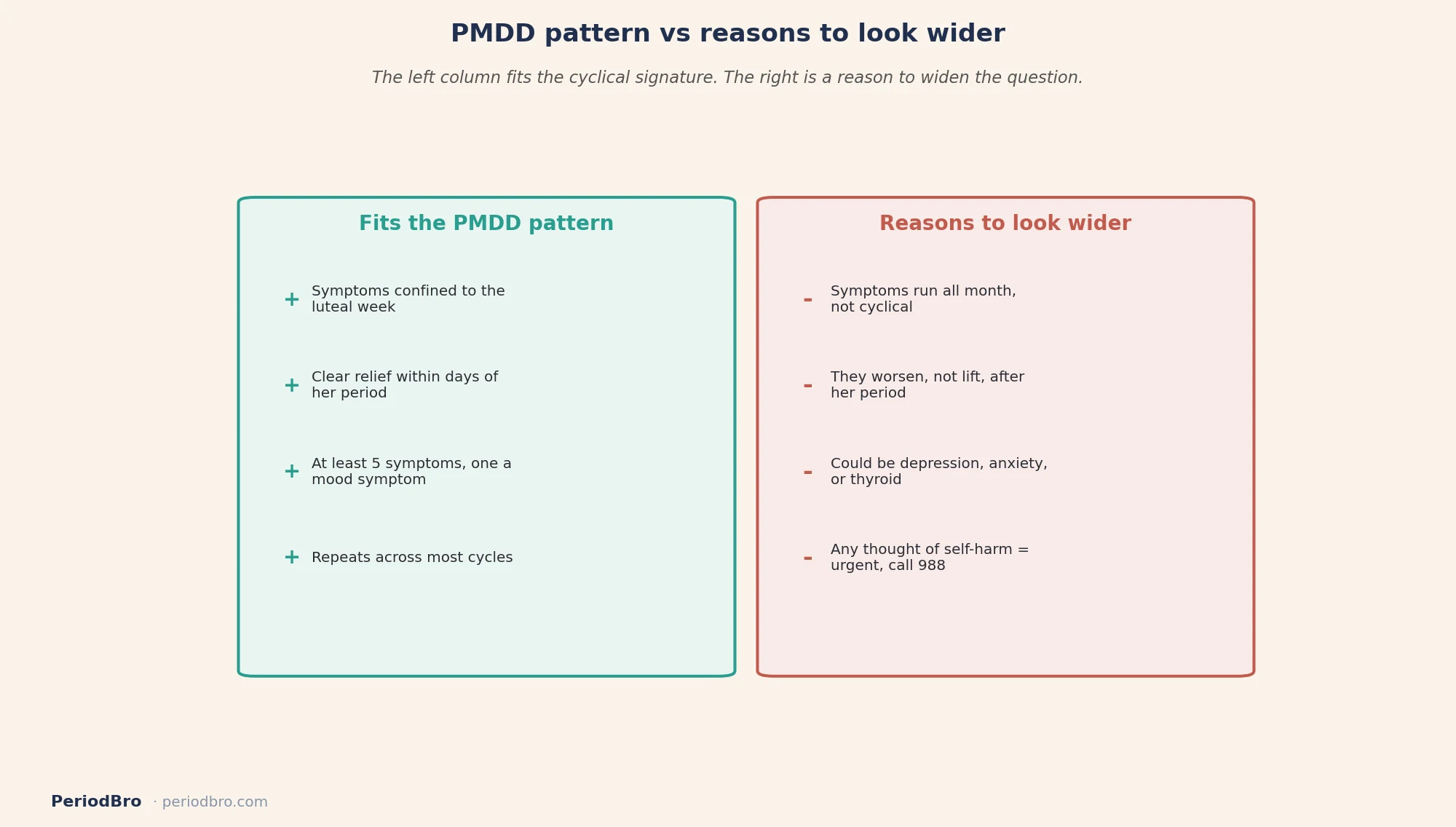
The formal criteria come from the DSM-5, and it helps to know roughly what a clinician is looking for so the process does not feel like a black box. She needs at least five symptoms in the premenstrual week, and at least one has to be a core mood symptom: marked irritability, mood swings, depressed mood, or anxiety and tension. The symptoms have to show up in the luteal phase, ease off within a few days of her period starting, and be minimal or gone in the week after (StatPearls, 2024). That timing is the whole signature. It is why the daily log matters so much: the pattern of when symptoms arrive and leave is what separates PMDD from a mood disorder that runs all month.
Who she should actually see
There is no single “PMDD doctor,” which trips people up. A good starting point is her OB-GYN or primary care clinician, especially one who takes cyclical mood symptoms seriously, and a mental health clinician can be part of the picture too, particularly if depression or anxiety are tangled up in it. What matters more than the specialty is that whoever she sees is willing to look at two cycles of daily data and reason from the pattern, rather than treating it as generic PMS or generic depression. She can ask directly whether the clinician uses prospective symptom tracking to assess PMDD. If the answer is no, that is a reason to find someone else.
It is also worth knowing that PMDD gets misread. Because the mood symptoms can look like major depression or the swings of bipolar disorder, women are sometimes handed one of those labels instead, or treated for the wrong thing entirely. The tell that a good clinician leans on is the timing: if the low mood or irritability clears reliably in the week after her period and comes back the next luteal phase, that cyclical rhythm points somewhere a flat depression diagnosis does not. If she has been told before that it is “just depression” but she can see it lift every month, that pattern is exactly what is worth raising, log in hand.
When she goes in, the useful things to bring are the completed daily log, a short note on how the symptoms affect her life and the relationship, and any history of depression or anxiety, since PMDD can amplify an underlying condition. Going in prepared shortens the whole thing, and it is the practical support you can offer without overstepping. The wider job of showing up well is in our guide to supporting a partner with PMDD.

A safety note that is not optional
PMDD carries a real, elevated risk of suicidal thoughts, and that is not a detail to soften. If she ever talks about not wanting to be here, or you see the signs, treat it as urgent and do not wait for a diagnosis to run its course. In the US she can call or text 988 for the Suicide and Crisis Lifeline, any time. A diagnosis process is a calm, structured thing, but a crisis is not, and the two do not wait for each other.
After the diagnosis
Getting the label unlocks a real plan, which is the whole reason the two-month slog is worth doing. Once PMDD is confirmed, there is an actual menu of treatments that work, from first-line options to more involved ones, and it is a decision for her and her clinician. We laid out that menu in PMDD treatment options explained for partners. The reason the diagnosis is worth the two-month slog is that it turns a fog into a named thing with known paths through it, and that alone tends to take some weight off both of you.
Where I land (founder note)
Disclosure: I build PeriodBro, so read this as the interested party talking. Daily logging is the least glamorous feature I could possibly talk about, and it is also the one that matters most here, because a diagnosis literally runs on it. I would rather the log live somewhere she controls and trusts than nag her about a feature. If you take one thing from this: the kindest, most concrete thing you can do is help her keep the daily record going for two cycles, and then get out of the way of the professionals.
The short version
- PMDD is a severe, cyclical mood disorder tied to the luteal phase, not a bad case of PMS.
- A diagnosis requires prospective daily symptom tracking across at least two cycles, because memory alone is not reliable enough.
- The DSM-5 needs five or more symptoms in the premenstrual week, including a core mood symptom, that clear soon after her period.
- Start with an OB-GYN or clinician who takes cyclical symptoms seriously and will read the daily data.
- Any talk of self-harm is urgent; in the US, 988 is available any time.
This article is general information, not medical advice, and only a qualified clinician can diagnose PMDD. If you recognize this in your relationship, the right next step is a conversation with a professional. If she is in crisis, contact 988 (US) or your local emergency services.