
PMDD Treatment Options: What Actually Helps, Explained for Partners
If your partner has just been told she might have PMDD, the next question is usually the practical one: what actually happens now. The good news is that PMDD treatment options are better defined than most people expect, and one of them works far faster than anything you have heard about antidepressants. The harder news is that none of it is your decision to make, and knowing that from the start will save you both a lot of friction.
I have watched a friend go through this with his wife, mostly by getting it wrong first. He researched hard, arrived with a plan, and could not understand why a plan handed over at the wrong moment landed as pressure rather than help. What follows is what the evidence says, and where a partner actually fits.
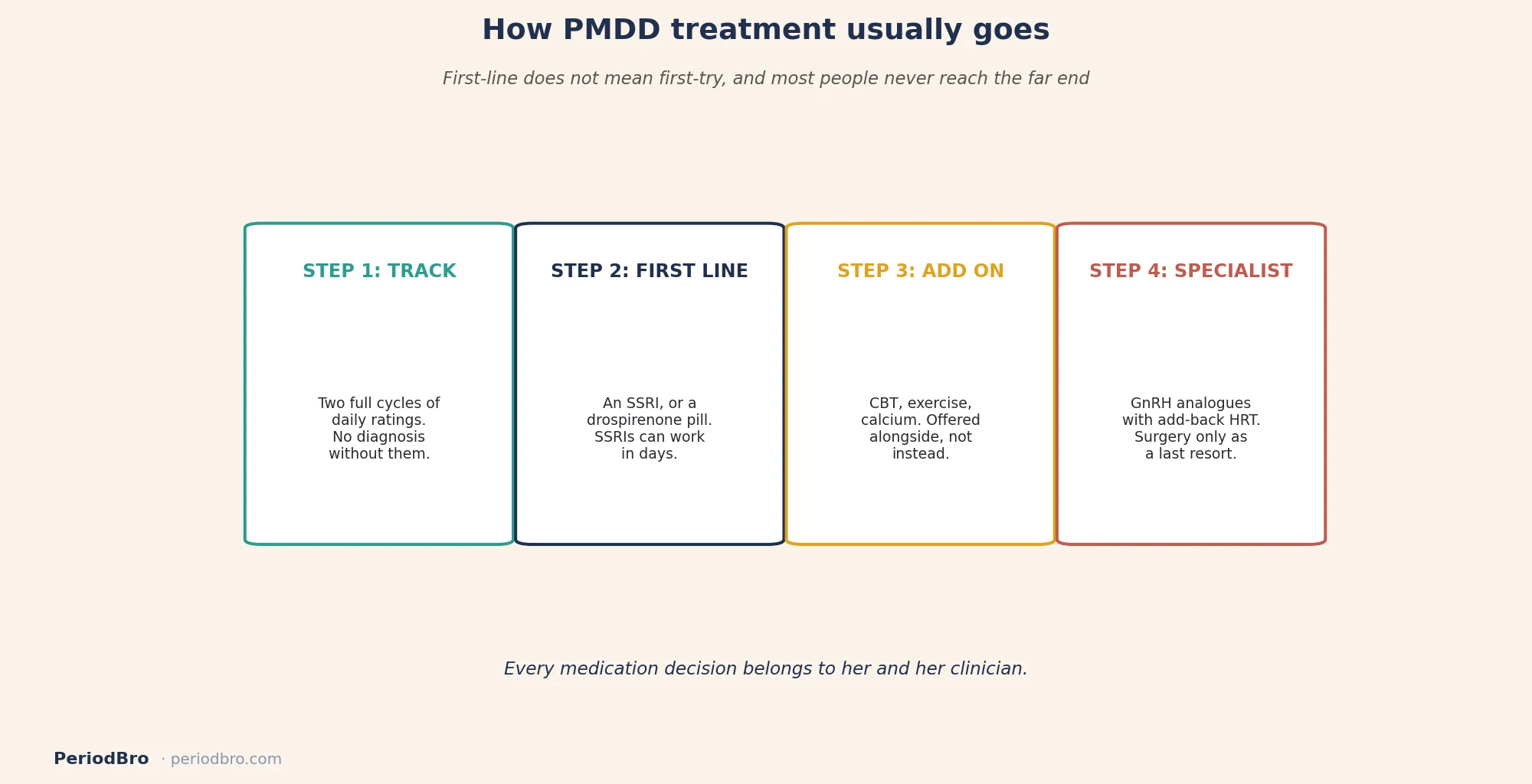
Nothing starts until she has tracked two cycles
This is the step people skip, and it is not optional. The diagnostic criteria require symptoms be confirmed by prospective daily ratings across at least two consecutive symptomatic cycles. Prospective is the operative word. A diagnosis cannot be made from memory, from one catastrophic month, or from a partner’s account of a bad week.
The reason is that memory is unreliable here in a specific direction: people recall the worst days and lose the good ones, which makes an ordinary cycle look like PMDD and a genuine case look inconsistent. The standard tool, the Daily Record of Severity of Problems, is 24 items covering symptoms plus how much they interfered with work, relationships and daily life.
PMDD itself affects roughly 2 to 5% of menstruating people, with around 5 to 8% having moderate to severe premenstrual symptoms that meaningfully disrupt life. So it is real, it is not common, and the distinction from ordinary PMS matters. We covered that boundary in the difference between PMS and PMDD.
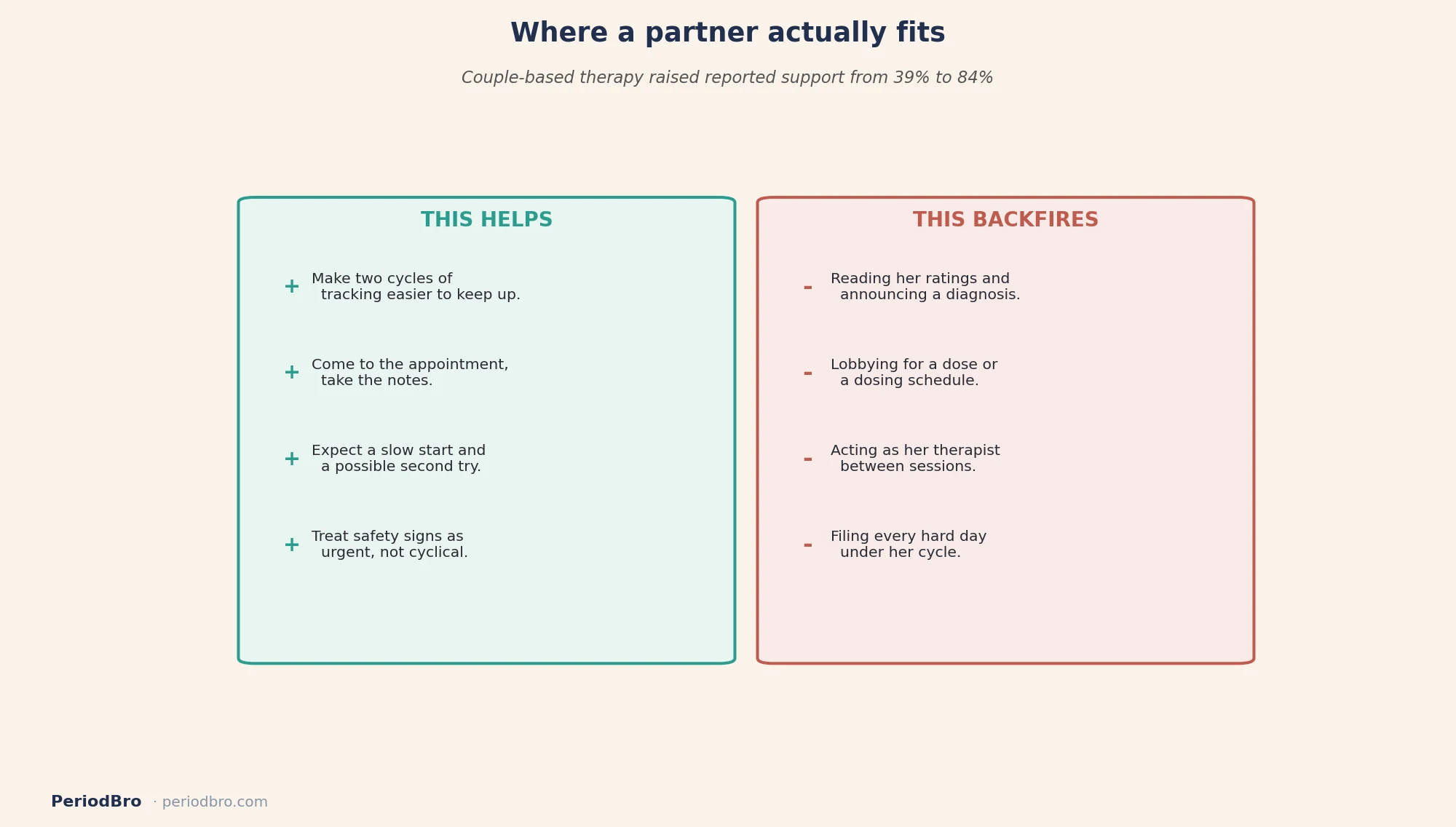
Your job in this phase is logistics, not diagnosis. Two months of daily ratings is a genuine chore. Making it easier to keep up is help. Reading the ratings and announcing a conclusion is not.

The first-line treatment, and the part that surprises people
SSRIs are the standard first-line medication. Cleveland Clinic names sertraline, fluoxetine and paroxetine as the ones used for PMDD. A 2024 Cochrane review pooling 34 randomised trials and 4,563 women found them clearly better than placebo, with a standardised mean difference of −0.57 and moderate certainty.
The timing is where partners get confused. When SSRIs are used for depression they typically take four to eight weeks to work. For premenstrual disorders, the same Cochrane review notes they can be effective within days to weeks, and other trial data puts the onset inside 24 to 48 hours. That is a different mechanism doing something different, and it is why some people take them only in the second half of the cycle rather than every day.
Whether luteal-only dosing matches continuous dosing is genuinely unsettled. One head-to-head meta-analysis of 8 trials found no significant difference. The Cochrane subgroup analysis found continuous did better than luteal-phase dosing, with the difference reaching significance. So both are legitimate, and which one suits her is a conversation for her and her clinician, not a thing to lobby for at home.
Side effects are real and worth expecting rather than being alarmed by. Cochrane put nausea at roughly 7% on placebo rising to 20% on treatment, and reduced energy at 5% rising to 14%. Also worth knowing: 68% of the trials in that review were industry-funded, and the authors flagged suspected publication bias. Even the good evidence has caveats.
The contraceptive pill option
The other first-line medical route is a combined pill containing drospirenone. A 2023 Cochrane review of 5 trials and 858 women found it better than placebo for premenstrual symptoms, with a standardised mean difference of −0.41, and small improvements in productivity, social activities and relationships. The evidence was graded low quality, and withdrawals due to side effects were substantially higher than placebo.
One number from that review is worth carrying around: in one trial, 48% of women responded to drospirenone and 36% responded to placebo. Placebo response in this condition runs somewhere in the 36 to 43% range. That is a reason to keep tracking after starting something rather than a reason to dismiss treatment, because feeling better in month one is not by itself proof that the thing is working.
I would also flag what Cochrane did not find: no trial evidence comparing continuous dosing against the standard cyclic pattern. Clinical guidance sometimes suggests running packs back to back for better symptom control, and that is reasonable advice, but it is guidance rather than head-to-head trial data.
Therapy, and the one place the evidence actually mentions you
Cognitive behavioural therapy is a legitimate option in its own right, and UK guidance from the Royal College of Obstetricians and Gynaecologists says it should be offered as a treatment option.
There is one trial that speaks directly to partners, and it is worth being precise about what it found. A randomised trial comparing couple-based CBT with one-to-one CBT found both beat a wait-list on symptoms and distress, with no significant difference between them. So couple therapy did not shrink the symptoms more than solo therapy did.
What it did change was everything around the symptoms. In the couple arm, 84% reported increased partner support, against 39% in the one-to-one arm and 19% on the wait-list. Improved relationship: 57%, against 26% and 5%. Active behavioural coping was significantly higher too.
That is the honest version of the partner story. Your involvement has not been shown to make her symptoms smaller. It has been shown to make her feel supported and to change how the two of you handle it, which is not a consolation prize when you are living with something that returns every month. The long game is covered in how PMDD affects a relationship long term.
The caveat is sharp: that evidence supports partner involvement in structured therapy run by a clinician. It does not support you acting as the therapist.

Lifestyle and supplements: what holds up
Two things have reasonable support. Calcium at 1,200 mg a day was tested in a trial of 466 women over three cycles and cut total symptom scores by 48% against 30% on placebo, though a later trial found no significant difference, so treat it as promising rather than settled. Exercise came out well in a meta-analysis of 15 trials and 717 participants, with a large effect on overall symptoms, but 87% of those trials were at high risk of bias and the authors said plainly that uncertainty remains.
Chasteberry is where I would push back on the internet. A review of 17 trials produced a big pooled effect, but heterogeneity was 91%, most trials were at high risk of bias, and the authors described their own result as explorative and at best an overestimate. Evening primrose oil may help breast tenderness, and beyond that RCOG says there is little evidence supplements are effective.
The options at the far end, so nothing blindsides you
If first-line treatments fail, GnRH analogues can be used to switch the cycle off. RCOG notes that beyond six months they can affect bone strength, so add-back HRT and regular bone density scans come with them.
Surgery means removing the uterus along with both ovaries and tubes, and it is considered a last resort. The detail worth knowing is that RCOG describes a trial run first: three to six months on GnRH analogues plus HRT, to see whether removing the cycle actually helps and whether HRT suits her before anything irreversible happens. If you hear the word surgery, that trial period is almost certainly what comes first.
The safety part, which is not optional
PMDD carries a suicide risk that is far higher than most partners realise, and skipping this to keep the article upbeat would be irresponsible.
In a global sample of 599 people with prospectively confirmed PMDD, 72% reported lifetime active suicidal ideation, 49% had made a plan, and 34% had attempted suicide. General population lifetime figures for comparison in the same paper are 9.2% and 2.7%. That sample skews toward severely affected people who sought out research, so read it as the shape of the risk rather than a population estimate. A cleaner clinical figure comes from a separate study where 39.1% of 110 women with confirmed PMDD had current suicidal ideation. The elevated risk persisted in the 30% of participants who had no other psychiatric diagnosis, which suggests it tracks with PMDD itself.
Cleveland Clinic lists severe depression or suicidal thoughts, thoughts of harming herself or others, and extreme anxiety or panic attacks as reasons to contact a provider. If you are in the US and either of you is having suicidal thoughts, call or text the Suicide and Crisis Lifeline at 988. Do not wait for the next appointment, and do not decide on her behalf that a bad luteal phase explains it.
What your job actually is
Make the two cycles of tracking easier. Go to the appointment if she wants you there, and take notes so she is not carrying the whole conversation. Expect a slow start and a possible second attempt, because first-line does not mean first-try. Watch for the safety signs above and treat them as urgent rather than cyclical. And keep every decision about starting, stopping or changing a dose where it belongs, which is between her and her clinician.
The unglamorous piece underneath all of it is knowing where she is in her cycle before the hard week arrives rather than after. That is the whole reason I built what I build. It turns a treatment plan from something she has to remember alone into something you are both quietly running, and it is the same principle behind supporting a partner with PMDD day to day and being a better partner through her whole cycle.
This article is general information, not medical advice. PMDD cannot be diagnosed from memory or a single cycle, and all treatment decisions belong to the patient and her clinician. If you or your partner are having thoughts of suicide or self-harm, seek help immediately. In the US, call or text 988.