How to Support a Partner With PMDD (Without Losing Yourself)
There’s a specific kind of tired I hear from guys whose partners have PMDD. It’s not “we had a fight” tired. It’s calendar tired: two good weeks, then the same handful of days when the floor drops out of the house, then her period starts, the sky clears, and everyone quietly agrees not to talk about it until it happens again. If that shape sounds familiar, this article is for you. Because how you support a partner with PMDD has less to do with what you say in the hard moments and more to do with what you both build in the easy ones.
I’ll be straight about my own lane here: what I lived with in my relationships was ordinary PMS territory, and I’m not going to retro-diagnose anyone. But the thing that changed everything for me applies double here: once I could see the cycle on a calendar, the “random” bad days stopped being random. For PMDD, that predictability isn’t just comforting. It’s the closest thing you have to a superpower.
PMDD is neurobiology, not a bad mood
First, the definition, because the internet blurs it constantly. Premenstrual dysphoric disorder affects an estimated 3 to 5 percent of people who menstruate, according to the International Association for Premenstrual Disorders. “Bad PMS” undersells it badly. PMDD is a recognized psychiatric condition where the week or two before her period brings severe irritability, anxiety, depression, or a sense of being completely overwhelmed, at a level that disrupts work, home, and the relationship itself.
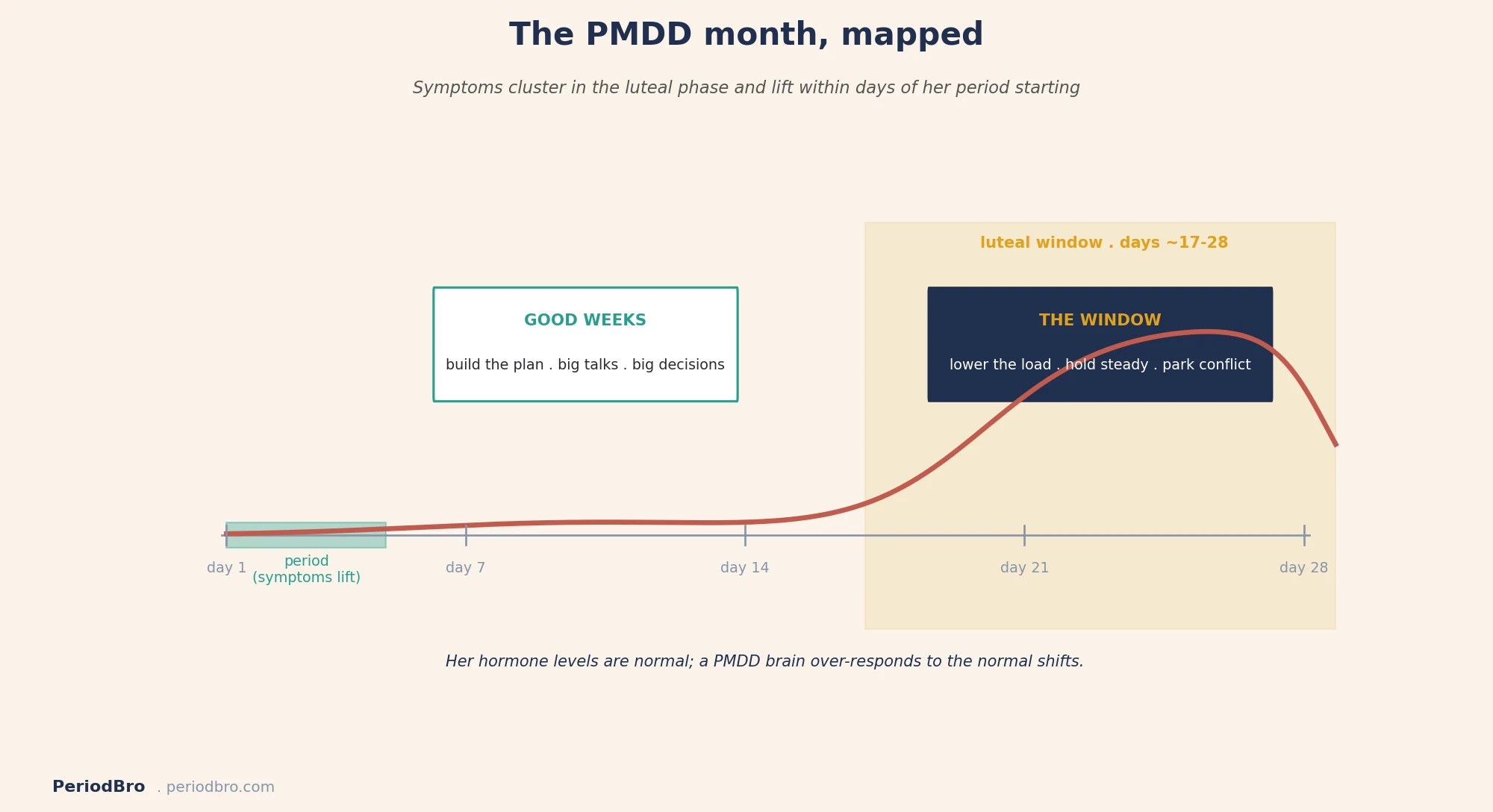
Here’s the part most partners never get told. Her hormone levels are normal. Research points to the brain’s response to those normal hormonal shifts: in PMDD, the nervous system appears to be abnormally sensitive to allopregnanolone, a progesterone byproduct that acts on the same brain receptors as sedatives. Most brains ride those luteal-phase waves without much drama. A PMDD brain reacts to them like a storm system.
Why does that matter to you? Because it kills the two worst interpretations at once. She’s not choosing this, so “she just needs to control herself” is off the table. And you’re not causing it, so the week where everything you do is wrong isn’t evidence that the relationship is broken. If you two are still figuring out whether this is PMS or something more, start with our plain-language guide to the difference between PMS and PMDD.
Why tracking changes everything
PMDD is brutal partly because it ambushes. The good weeks feel so normal that the bad week arrives like a betrayal, every single month. Tracking takes the ambush away.
Tracking is more than a coping trick here: it’s how the condition gets diagnosed. Clinicians ask for daily symptom ratings across at least two full cycles, because the timing is the diagnosis. Symptoms that cluster in the luteal phase and lift within days of her period starting point to PMDD. Symptoms that stay all month point somewhere else. If she ever takes this to a doctor, two months of honest tracking data is the most useful thing either of you can carry into that appointment.
For you, day to day, tracking turns vague dread into a weather forecast. Knowing that the luteal phase starts around day 21 means you can front-load the hard conversations, the social plans, and the big decisions into the good weeks, and clear the deck for the rough ones. If you want the full month-by-month picture of how hormones drive her mood, we’ve mapped it week by week.
Build the support plan together, in a good week
The single biggest mistake partners make is improvising support in the middle of the storm. Day 24 is the worst possible time to ask “what do you need?” She may not know. She may not be able to say. And anything you try that misses will land as more evidence that nobody gets it.
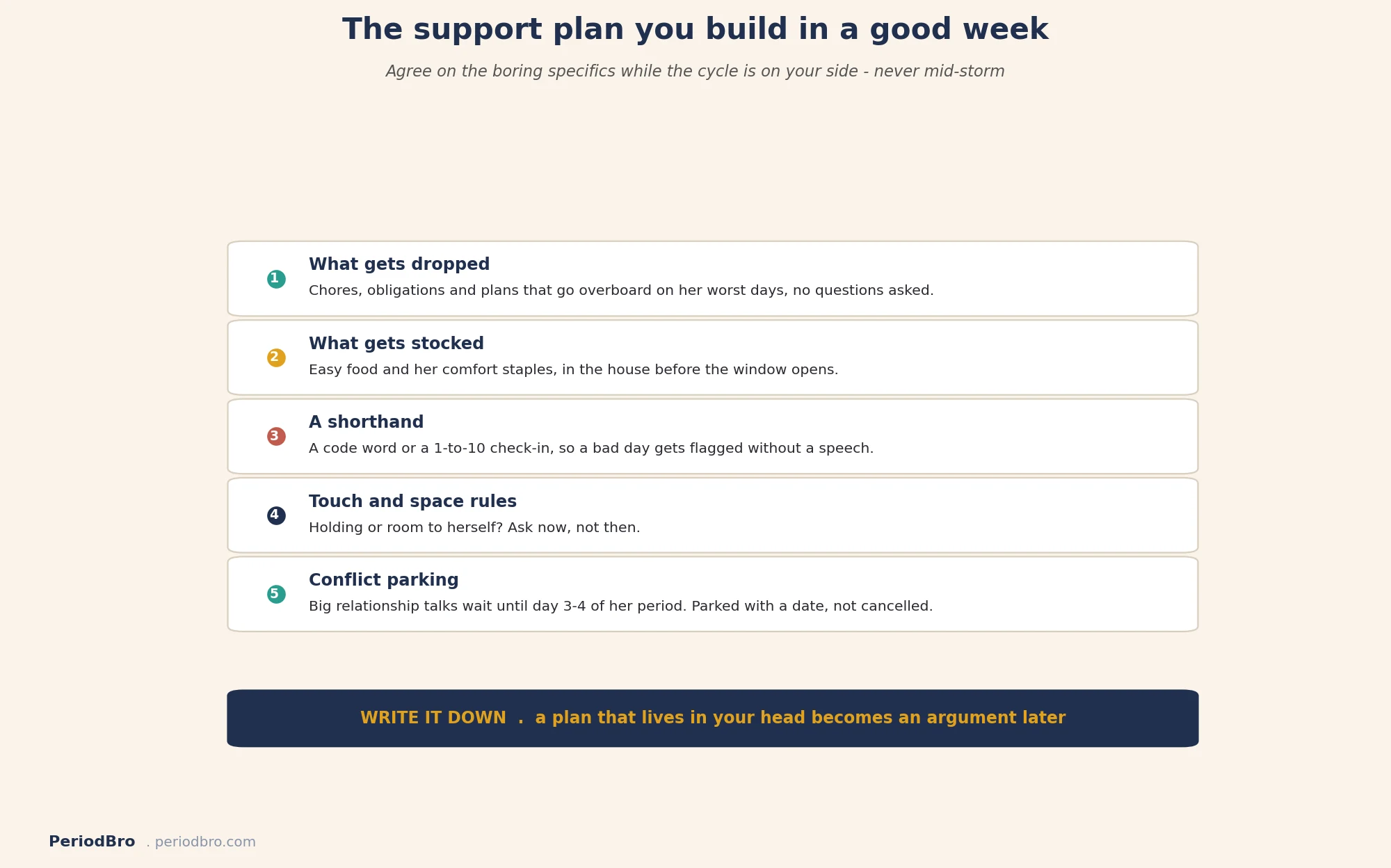
So build the plan when she feels like herself. Sit down in the follicular phase, when the cycle is on your side, and agree on the boring specifics:
- What gets dropped. Which chores, obligations, and social commitments go overboard during her worst days, no questions asked.
- What gets stocked. Easy food, her comfort staples, whatever makes the house lower-friction. Do it before the window opens.
- A shorthand. Many couples use a code word or a simple 1-to-10 check-in so she can flag a bad day without having to perform an explanation while drowning.
- Touch and space rules. Some people want holding. Some want the room to themselves. Ask now, not then.
- What you’ll both do with conflict. A genuinely useful agreement: big relationship conversations get parked until day 3 or 4 of her period. Not cancelled. Parked, with a date.
Write it down somewhere you’ll both see. A plan that lives in your head becomes an argument about what was agreed.

How to support a partner with PMDD in the moment
Inside the window, your job shrinks to one thing: keep the ground steady. Fixing her mood, arguing her out of it, defending yourself against every hard sentence – none of that is on the list.
What helps: lowering the volume of the household instead of raising it. Short, concrete offers (“I’m making tea, want one?”) instead of open questions. Believing her when she says the anger or despair feels chemical and enormous, because for her it is. Remembering that premenstrual rage is a symptom with a mechanism, and that when she pulls away, following her with demands for closeness usually backfires.
What makes it worse: “calm down” in any packaging. Quoting the calendar at her mid-argument (“you’re only saying that because it’s day 25”) – even when the calendar is right, using it as a weapon teaches her that tracking is surveillance instead of support. Taking the bait on relationship-ending statements made in the depth of the window. A hard but useful rule many PMDD couples land on: hear the pain in those statements without treating them as final verdicts, and revisit anything that still stands once the phase lifts.
Don’t lose yourself in the helper role
This part gets skipped in almost everything written about PMDD, and it’s why I wanted a man-to-man version of this article to exist. Loving someone with PMDD means absorbing a real, repeating strain. If you white-knuckle it in silence, you don’t become a hero. You become resentful, then distant, then part of the problem.
So take your own maintenance seriously. Keep the friendships and the gym sessions and whatever else keeps you level, especially during her good weeks, so you enter the hard ones with a full tank. Say true things to her in calm moments, kindly: “that week is hard for me too, and I want us to have a plan” is not an accusation. And if the cycle is chewing through both of you, a couples therapist who knows premenstrual disorders is pit crew, not a verdict on the two of you.
When it’s time for professional help
PMDD is treatable, and the treatments are better than most couples expect. SSRIs are the first-line medication, and they behave unusually well here: for many people they work within days rather than weeks, and can be taken during the luteal phase only. Certain birth control pills, lifestyle changes, and therapy are also part of the standard toolkit, per the Cleveland Clinic. If she’s suffering monthly and has never brought it to a doctor with the word “PMDD” attached, that conversation is worth having.
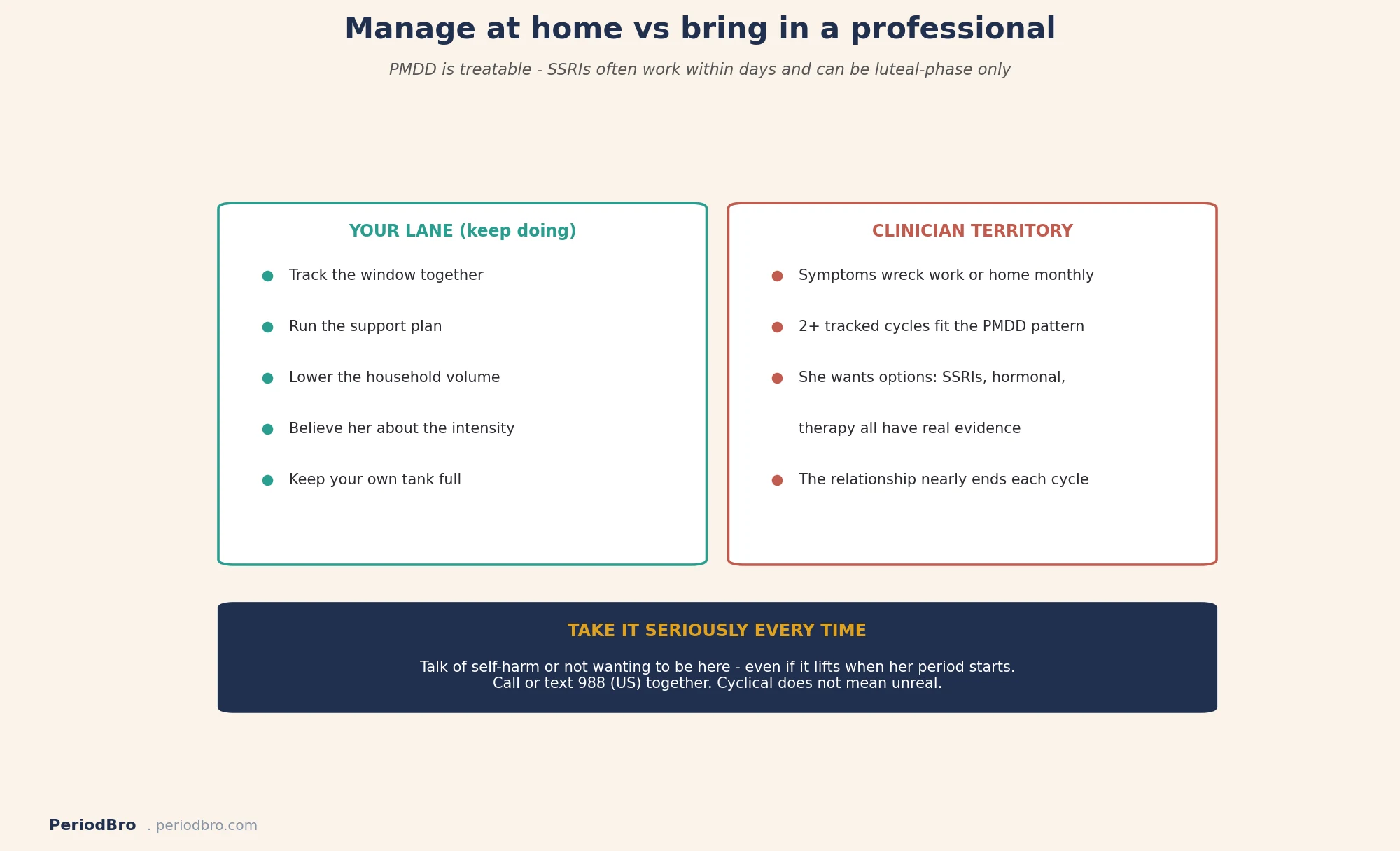
And one thing I won’t soften. PMDD carries a real risk of suicidal thoughts: in one study, 39 percent of people with confirmed PMDD reported suicidal ideation in the late luteal phase, and the IAPMD treats this as a core feature to screen for, not a rare complication. If she talks about not wanting to be here, take it seriously every time, even if it lifts when her period starts. In the US you can call or text 988 together. Cyclical does not mean unreal.
FAQ
Is the PMDD week the “real her”?
No, and neither is it fake. The kindest accurate frame: it’s her, under a neurochemical load you’ll never feel firsthand. The things she feels in the window are real feelings. The conclusions drawn inside it are unreliable, and she’d usually be the first to say so afterward.
Can PMDD be cured?
Managed, often very well. Between tracking, SSRIs, hormonal options, and therapy, most couples can shrink the blast radius dramatically. What doesn’t work is pretending next month will be different on its own.
Should I be the one to bring up PMDD with her?
Carefully, and never mid-window. In a good week, lead with the pattern, not the label: “I’ve noticed the same stretch is really hard every cycle. Want to track it together and see?” Let a clinician do the diagnosing.
The short version
You can’t take PMDD away from her. You can take away the ambush, the loneliness, and the monthly damage control. Track the pattern together, build the plan in the good weeks, hold the ground in the hard ones, and keep yourself resourced enough to do it again next month. Tracking the pattern is step one, and it’s the one you can start today: PeriodBro shows you the luteal window before it hits, so you can prepare instead of react.
This article is for information only and isn’t medical advice. PMDD is a medical condition: diagnosis and treatment belong with a qualified clinician. If she or you are in crisis, call or text 988 (US) or your local emergency number.