
Periods in a New Relationship: When and How It Comes Up
Six weeks in, she cancels on you. The message is vague and slightly apologetic and you have no idea whether you are being let down gently. That is periods in a new relationship in one scene, and the reason it lands badly is not that either of you handled it wrong. It is that neither of you has enough history yet for the obvious explanation to be obvious.
This is not the same problem as talking about it in a settled relationship, which we covered in how to talk to a partner about her period. Early on, the difficulty is different: nothing has a baseline, everything is a signal, and she is deciding how much of herself is safe to show you.
Why periods in a new relationship are their own problem
In a long relationship, a cancelled Friday is data you can read. In month two, it is an unknown, and both of you fill the gap with the worst available interpretation.
She has a reason to keep it vague. The Wellbeing of Women survey of 3,000 women and girls found that over half, 53%, had been shamed in relation to their period symptoms, and almost a third said it had happened more than once. Only 37% felt comfortable talking to someone they know about period mishaps. Someone who has been laughed at for this once tends not to lead with it on date four.
So when the message comes back vague, the odds are that you are watching someone manage a risk you cannot see yet rather than someone pulling away.
The four moments it actually comes up
It rarely arrives as a conversation. It arrives as a situation, and there are four of them.
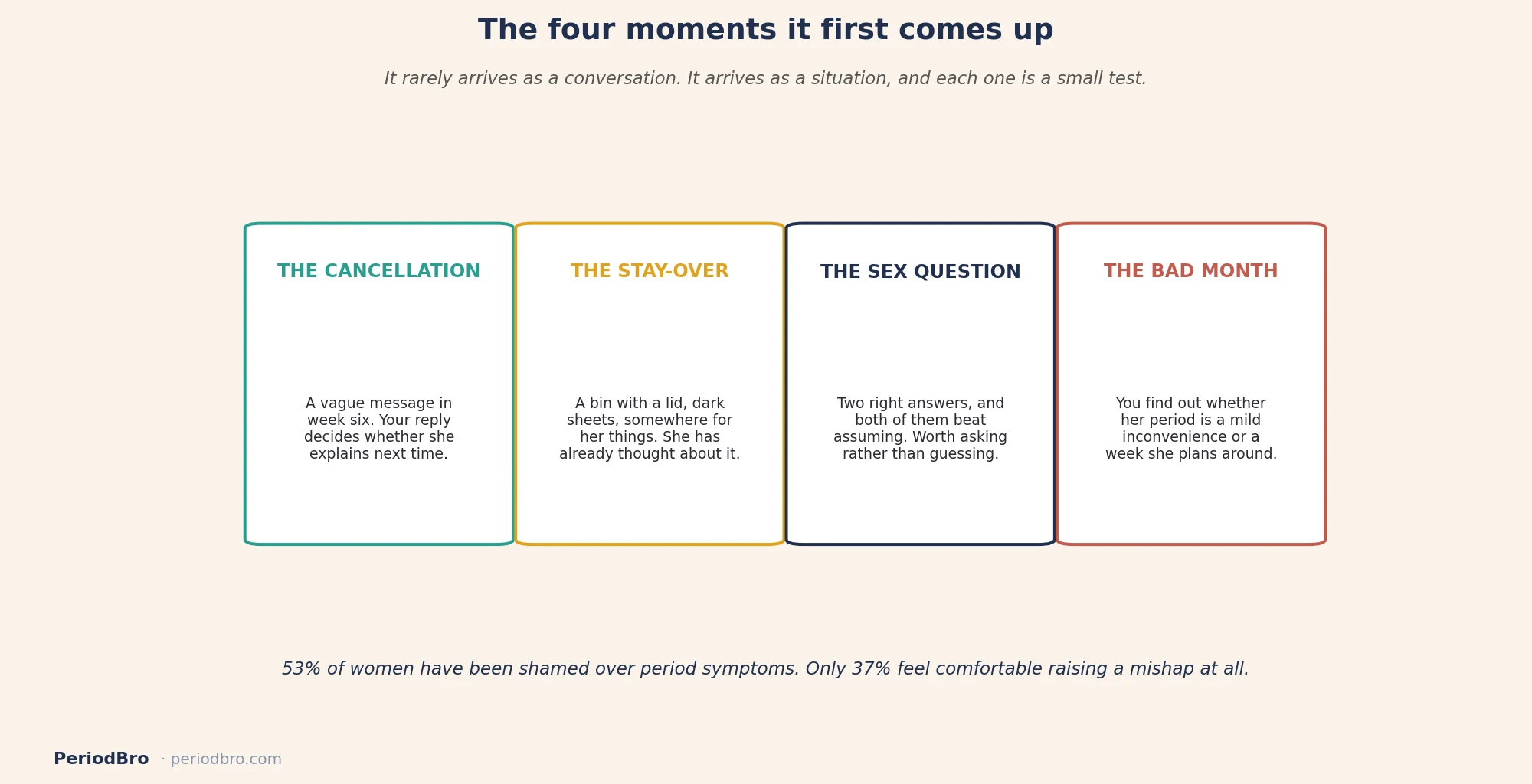
The first vague cancellation. Handled well, this is the one that does most of the work for you, because your response here sets whether she bothers explaining next time.
The first stay-over. Suddenly there are logistics: a bathroom bin, where her stuff goes, whether your sheets are dark. She has already thought about all of this and assumed it would be awkward.
The first sex conversation. Whether period sex is on the table is a question with two right answers, and it is worth asking rather than assuming either way. Our guide to period sex for partners goes through it properly.
The first genuinely bad one. The month she is not just tired but wiped out, and you find out whether her normal period is a mild inconvenience or a monthly event that reorganises her week. The range here is enormous and people assume their own experience is universal, which is how partners end up thinking someone is being dramatic about something that would flatten them.
None of those four gets flagged as a milestone at the time. You notice them in retrospect, usually because of how a later one went. The useful thing is knowing they exist, so that when the vague text arrives in week six you recognise it as moment one rather than a verdict on you.
What lands well early on
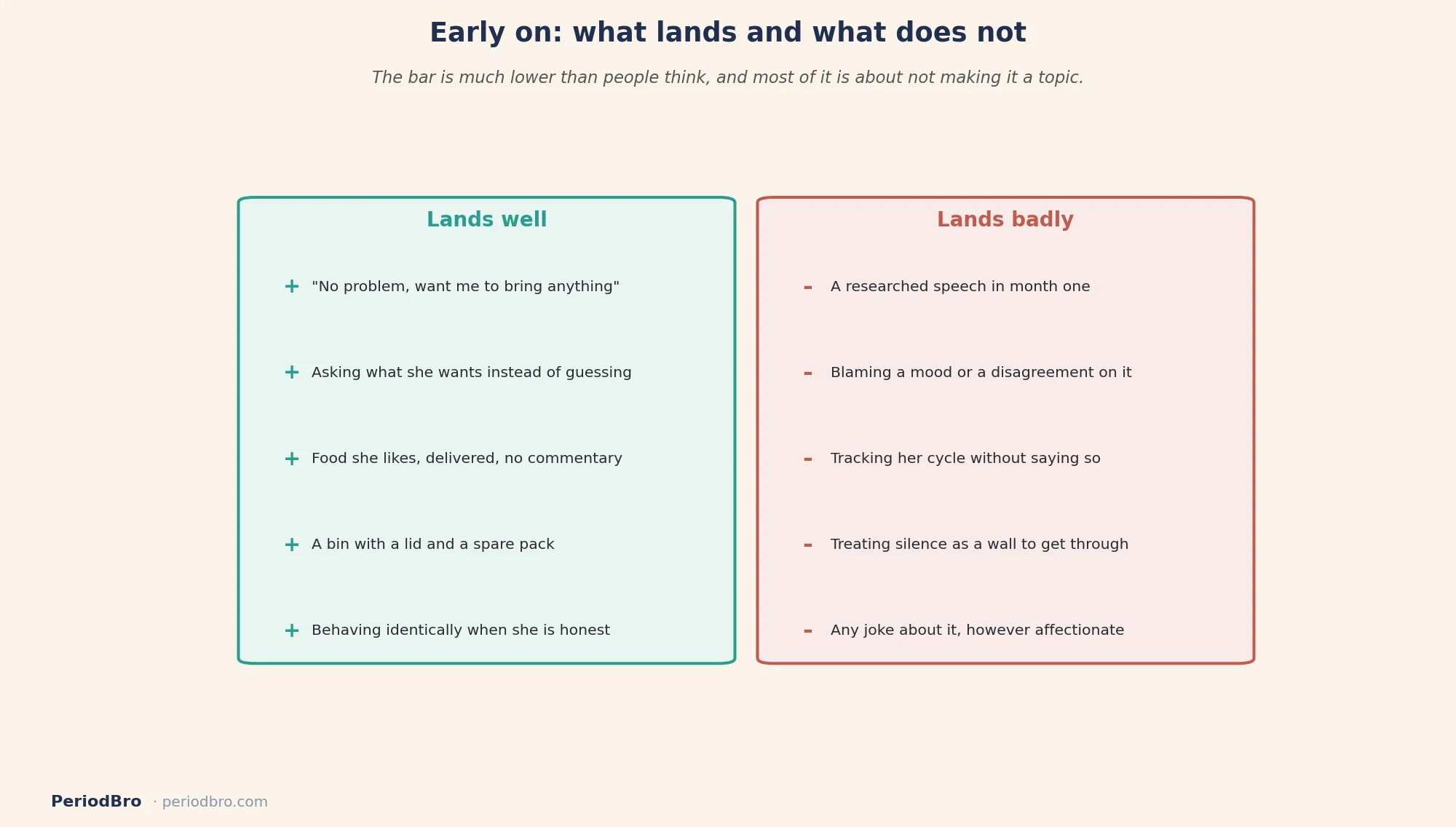
The bar is much lower than people think, and most of it is about not making it a topic.
Be unremarkable about it. When she cancels and mentions why, “no problem, want me to bring anything over” does more than any thoughtful speech. Treat it like a headache. Neutral beats caring here, because caring in month two can read as a bit much.
Ask what she wants rather than guessing. Some people want company, some want to be left alone entirely, and the split is nearly even. Guessing wrong twice teaches her that telling you is more trouble than it is worth. Giving her space is a real skill and not the same as disappearing.
Do a small material thing. Food she likes, delivered, no commentary. Our list of what to buy before her period is the cheat sheet. A small correct object outperforms a large correct sentence at this stage of a relationship.
Get your own bathroom sorted. A bin with a lid, and a spare pack in the cupboard after the first time she stays. Nobody has ever thanked a partner out loud for a bin with a lid, and everybody notices.

What lands badly
Two deserve spelling out because they are so common.
The first is over-performing. Turning up with a hot water bottle and a researched speech in month one is a lot. It signals that you have decided something about the relationship that she may not have decided yet. Do the small version and let it grow.
The second is the diagnosis reflex. Attributing a mood, an opinion or a disagreement to her cycle is the single fastest way to make her stop mentioning it at all, and it is wrong most of the time anyway. We wrote about that trap in is she mad at me, or is it her period, and the wider version is in the worst things to say.
What if she never brings it up at all
Some people will go a year without mentioning it, and that is a preference rather than a problem to be solved. Plenty of people find their period genuinely uninteresting and would rather not make it a topic in a new relationship, and reading that as a wall to get through is its own kind of pressure.
What you can do is make the door obvious and then leave it alone. Once, casually, in a calm moment: “if you ever want to just say you’re on your period rather than making something up, that’s fine with me.” Then never raise it again. If she takes it, good. If she does not, you have still removed the cost of honesty, which is the only bit you control.
The tell that something is actually wrong is not silence about periods. It is a pattern of cancelled plans with no reason at all attached, over months, which is a different conversation entirely and not one this article can help with.
Should you track her cycle this early
Short answer: not on your own, and not without saying so.
Quietly building a record of a new partner’s cycle without mentioning it is the kind of thing that seems efficient and reads as surveillance if she finds out later. In an established relationship it is a shared tool. In month three, discovered rather than offered, it is a bad afternoon.
If you want the heads-up, say the sentence out loud. And if that feels premature, it is, which is useful information. Our guide on tracking her cycle with consent covers the whole question, including the privacy side.
The version of this that works
A mate of mine spent three months reading every cancellation as a signal the thing was dying. It was not. She had a rough couple of days each month and had learned from an earlier relationship that saying so out loud got her a sigh. Six weeks after he said “just tell me the actual reason, I genuinely do not mind”, she started telling him, and the whole thing got quieter.
That is the entire move. One sentence that makes the honest answer cheaper than the vague one, then behaving exactly the same way when you get it.
Everything else is downstream. If you want the mechanics of what is going on in a cycle, the menstrual cycle guide is the place to start, and being a better partner through her cycle is the long game. Neither matters much in month two if she has not worked out yet that this is safe with you.

This article is general information and not medical advice. Periods that regularly stop someone doing their normal day, or that come with severe pain or very heavy bleeding, are worth a clinician’s opinion rather than a partner’s patience alone.