

Period Blood Color: What Each Shade Actually Means
The first time I noticed, I said nothing. We had been together about four months, I was loading the washing machine, and the only thought in my head was: that is brown, and I have no idea whether brown is fine. So I stood in the kitchen at half past eleven and typed it into my phone, which is how most of us learn anything about this.
Brown is fine, and the reason takes about ninety seconds to understand. Period blood color is mostly a clock. It tells you how long the blood took to leave her body rather than how bad her month is going to be. Once that lands, the whole subject shrinks down to two shades worth a phone call and a lot of shades that are not.
What period blood color actually tracks
Blood darkens as it meets air. Iron oxidizes, the red goes rusty, and given long enough it goes near black. That is the same chemistry that turns a cut on your hand from bright red to a dark scab, and it is the whole story here too.
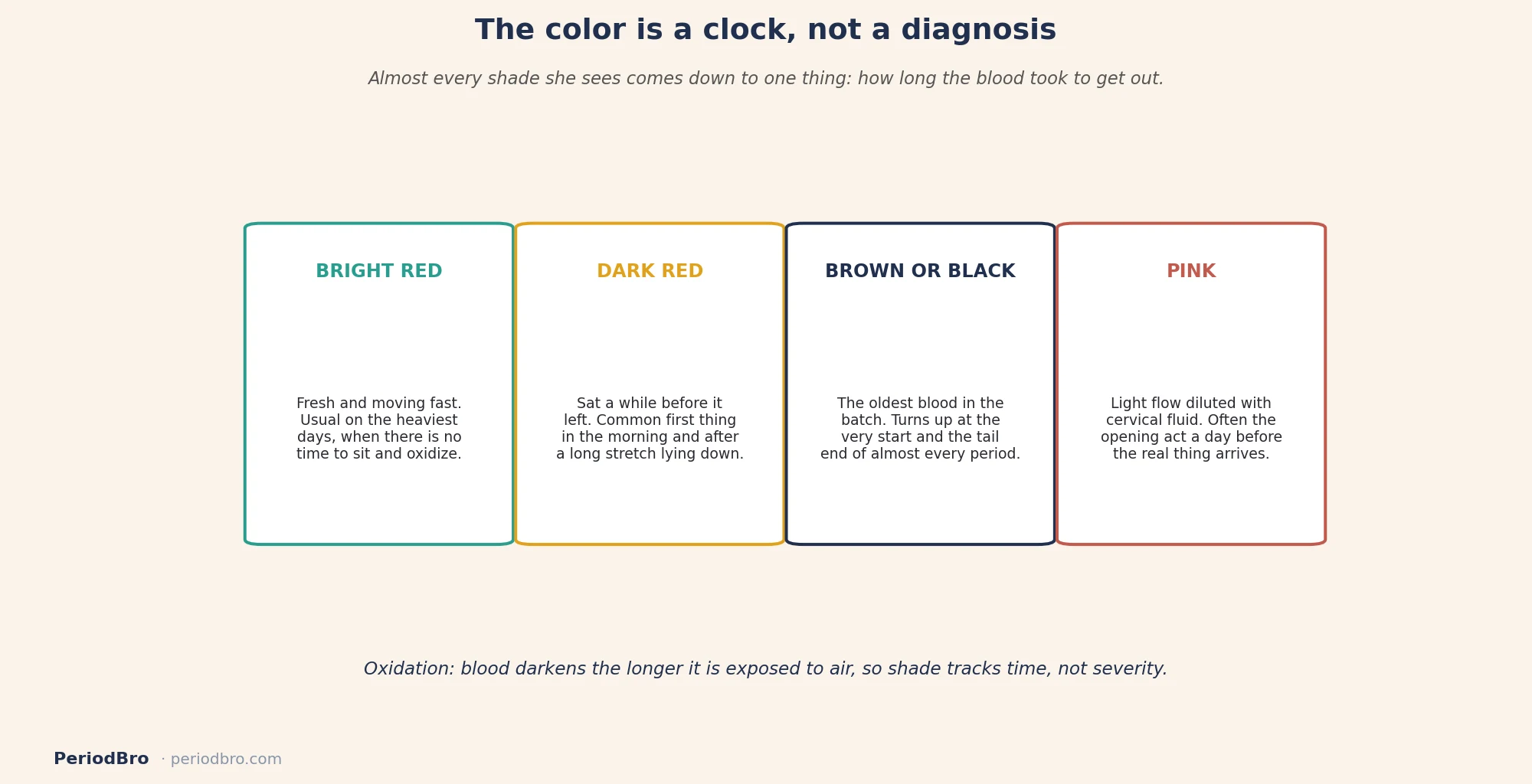
Cleveland Clinic puts it plainly: the color depends on how long the blood sits in the uterus and vagina before it comes out. Fast exit, bright red. Slow exit, dark red. Sitting around since yesterday, brown. Sitting around a good while longer, something close to black.
Shade is a clock reading. A dark period is rarely a worse period, just a slower morning.

Shade by shade, roughly in the order she sees them
Brown, at the very start. The first hours are often the tail end of last month’s lining plus whatever has been sitting there since. Brown at the opening of a period is so common it barely counts as information. If it shows up outside her period entirely, that is a different question, and I wrote about it in spotting between periods.
Bright red, on the heavy days. Days one and two usually move fast enough that the blood never gets time to oxidize. Bright red mostly means the flow is quick, which is why it turns up exactly when she is least interested in a conversation about it.
Dark red or near black, first thing in the morning. Eight hours lying down slows everything, so what comes out at 7am has been queued since about midnight. Same for a long car journey or a day at a desk. Cleveland Clinic lists black blood as old blood, and old blood is a normal part of most periods rather than a red flag.
Pink. Light flow diluted with cervical fluid reads pink. It often turns up the day before the real thing starts, which is why Clue and most clinical sources treat it as an opening act rather than an event. Persistent pink spotting mid-cycle, on the other hand, is worth mentioning to a doctor.
All four of those can appear inside a single period. She can go brown, bright red, dark red, brown again in five days and nothing has gone wrong at any point. That variety is the norm, not the exception, and once you know it you stop reading the laundry like tea leaves.
The two shades that are actually saying something
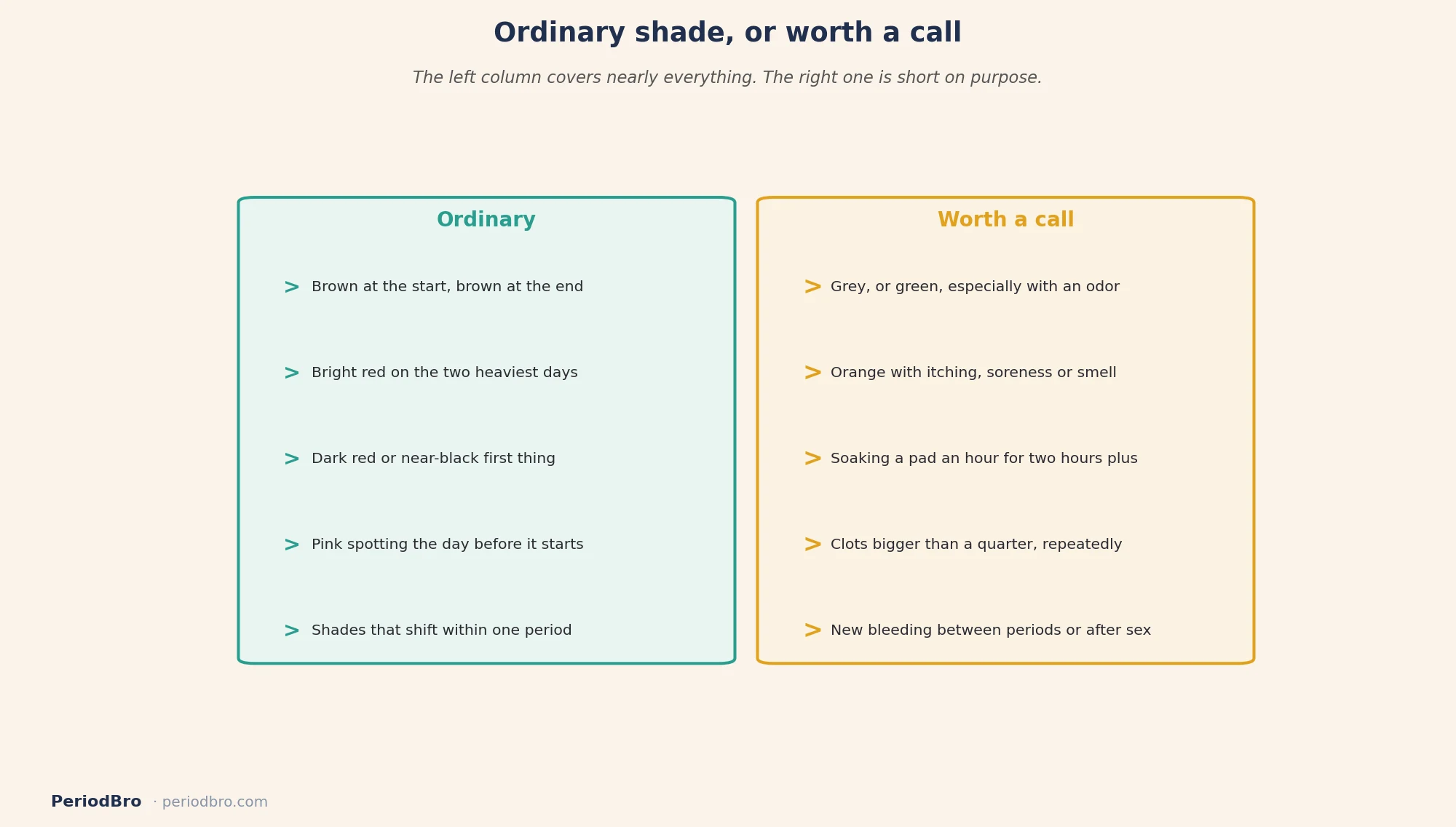
The list is two entries long, and it stays that way on purpose.
Grey, or grey-green. This one leaves the color-is-a-clock rule behind. Cleveland Clinic’s guidance on vaginal discharge lists yellow, grey and green as possible signs of a bacterial infection or an STI, particularly alongside an odor, itching or burning. Grey discharge with a strong smell is the classic presentation of bacterial vaginosis, which is common, treatable, and not something to wait out.
Orange, with symptoms. Orange is usually blood mixed with cervical fluid, which is unremarkable on its own. Paired with an unusual smell, soreness or itching, it lands in the same bucket as grey and deserves the same appointment.
Black, brown, and a period that starts dark and finishes darker are all missing from that list on purpose. Those are the shades people panic about, and they carry the least information of any of them.

Why her normal is not the same normal it was three years ago
The other thing nobody mentions is that the baseline moves. What her periods looked like at twenty-two is not what they look like at thirty-one, and the reason is usually boring rather than alarming.
Hormonal contraception is the biggest single cause. The pill, the implant, the injection and the hormonal coil all thin the uterine lining, and a thinner lining means less to shed. Periods get lighter, shorter, browner, and on some methods they stop showing up at all. Cleveland Clinic lists hormonal birth control among the ordinary causes of brown discharge for exactly that reason. If she has switched methods recently and the color has gone rusty, the timeline usually explains itself. There is more on what each method does to the month in birth control and her cycle.
Life stage does the same job more slowly. Cycles in the first couple of years after they start are meant to be erratic. Cycles in the run-up to menopause get erratic again, sometimes dramatically, and I went through that shift in perimenopause for partners. In both windows the shade wanders because the timing wanders.
Which is a long way of saying: compare her to her. A chart on the internet describing an average period is close to useless for one specific person. What she looked like six months ago is the only baseline that means anything.
The part that has nothing to do with color at all
If you are going to worry about something, worry about volume. That is where the actual medicine lives, and it is measured in pads and hours rather than shades.
ACOG defines heavy menstrual bleeding as soaking through a pad or tampon every hour for several hours in a row, needing to double up on protection, waking up at night to change, or passing clots the size of a quarter or bigger. Any of those, month after month, is a reason to see someone. Not because of how it looks, but because of what it drains.
The CDC makes the same point from the other end: heavy bleeding is a leading route into iron deficiency anemia, which is the reason a lot of women spend years exhausted with no explanation anyone connects to their cycle. There is more on the practical side of that in how to support her through a heavy period, and on the clot question specifically in period blood clots.
Heavy and dark often travel together, which is where the confusion comes from. Slow-moving blood gets darker and heavy months produce more of it. The darkness is a side effect. The volume is the thing.
What a partner is supposed to do with any of this
Almost none of it, and that is the honest answer.
You are not going to be running a color audit. You should not be inspecting anything. Nine times out of ten this reaches you as a comment, not a sighting: she says it has been weird this month, or heavier, or the words “I don’t know what that is.” What the knowledge buys you is not surveillance. It is the ability to answer that comment without either panicking or shrugging.
Three things that hold up in practice.
Do not diagnose out loud. “That’s fine, it’s just old blood” is technically right and lands like being brushed off. “That one’s usually just timing, but if it keeps up, worth asking someone” is the same information with the door left open.
Know the two-column version, not the whole chart. Shade is timing, grey and orange with symptoms are the exceptions, and volume is the signal that counts. Everything past that is trivia you will never use in an actual conversation.
Notice a change, not a shade. One dark period is nothing. A pattern that is new for her is worth naming gently, because she may well have clocked it too and said nothing, in the same way I stood in that kitchen and said nothing. If you already track the month, the change is obvious. If you do not, it is invisible until it is dramatic.
My daughter asked me a version of this question a couple of years after that night in the kitchen, and I was glad I had already looked it up, because “I don’t know, ask your mum” is a terrible answer to give a fourteen-year-old who is trying to work out whether her body is broken. It almost never is, and the shade that scared her was almost certainly just a clock.
If you want the wider picture of what the month is doing and why, start with the menstrual cycle guide for men. I built PeriodBro so this stuff is on your phone before it becomes a 2am search in a dark kitchen.
This is general information, not medical advice. Anything unusual, persistent or frightening is a conversation for a doctor rather than a partner with a search engine.