
Working Out on Her Period: What Training Through Her Cycle Actually Does
She skipped the gym again because it’s day two, and then apologized for it like it was a missed deadline. Or the opposite is happening in your house: she’s running a plan she found online that assigns heavy lifting to one week of her cycle and gentle stretching to another, because the calendar said so.
Both habits rest on the same assumption, that her cycle decides what her body is capable of that week. The research on working out on her period, and on training through the rest of the month, says something much less dramatic than that.
Averaged across the studies we have, the cycle moves her performance so little that it mostly disappears into the ordinary noise of sleep, stress and how the last session went. Some weeks still feel heavier, and she isn’t imagining that. What’s moving in those weeks is rarely her muscle.
What the research actually found
The biggest pooled look at this is a 2020 systematic review and meta-analysis in Sports Medicine, covering exercise performance across the cycle in women with natural cycles. The finding: performance may be trivially reduced in the early follicular phase, which is the bleeding week and the days just after, compared with every other phase. The authors were blunt that the average effect was trivial and that the ranges around each comparison overlapped heavily. In plain terms, the group average shifts a hair, and any individual woman can sit anywhere across that spread.
Strength work gets an even flatter answer. A 2023 review in Frontiers in Sports and Active Living concluded that current evidence shows no influence of cycle phase on acute strength performance, and none on the adaptations she gets out of a resistance training program either.
The most recent word is also the most careful. A 2025 systematic review in the Journal of Applied Physiology accepted only studies that actually measured estradiol, progesterone and luteinizing hormone instead of counting days on a calendar. Nineteen studies cleared that bar, most of them looking at maximal strength. The reviewers’ main conclusion was about the state of the field: once you insist on hormone-verified phases, there is very little high-quality evidence left, and what survives does not support confident day-by-day rules.
So an app that tells her exactly what to train on day 19 is selling a precision the underlying science doesn’t have.
Working out on her period is usually the thing that helps
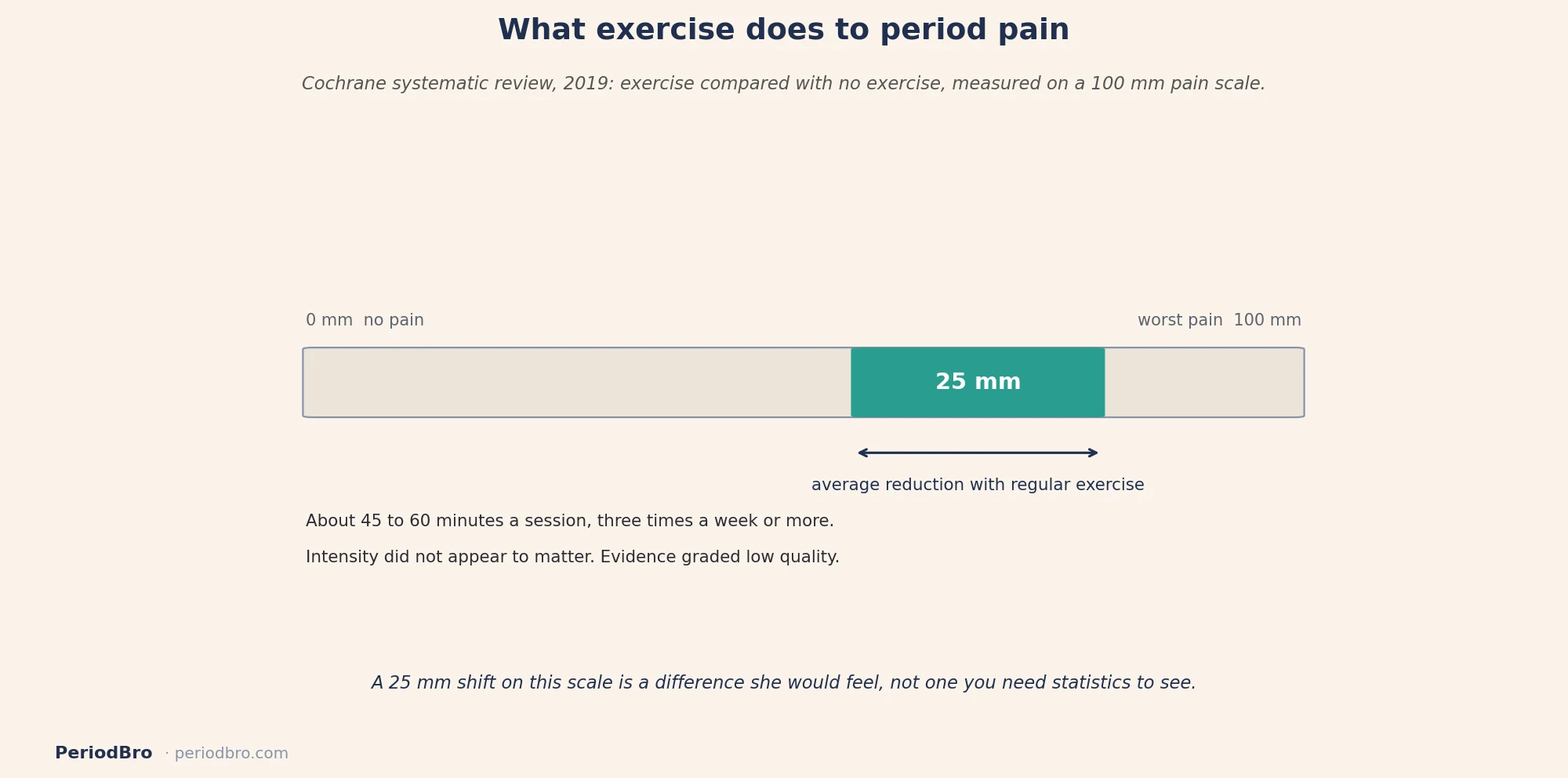
Exercise is also one of the better-supported drug-free options for period pain, which is the opposite of how most people treat the bleeding week. A 2019 Cochrane review pooled trials of exercise for painful periods and found a reduction of roughly 25 mm on a 100 mm pain scale compared with no exercise, which is a gap she would feel rather than one you need statistics to see. The protocol behind that number was unremarkable: about 45 to 60 minutes a session, three times a week or more, and intensity did not appear to matter much.
Two honest caveats sit next to it. The reviewers graded the evidence as low quality, so the size of that effect could move once better trials arrive. And it was about exercising regularly across the month, not about pushing through a session while she’s curled up on the couch with a heat pack. Nothing in that review says a rest day is a failure.
What it does mean is that writing off the entire bleeding week is backwards. For most people, moving during those days is neutral at worst and useful at best. The rest of what has evidence behind it, we went through in the best pain relief for period cramps.
Why the same session still feels harder some weeks
If measured output barely moves, why does she describe a training week before her period as heavier? Because the conditions around the session change, and those are real even when the numbers on the bar are not.
Sleep. The nights before her period are the worst of the month for a lot of women, and a bad week of sleep shows up as a bad week of training long before hormones do. We mapped the pattern in how sleep changes through her cycle and in period insomnia.
Heat. Her core body temperature runs a few tenths of a degree higher after ovulation. On a cool morning that is invisible. In a hot gym or a July run it makes the same pace cost more.
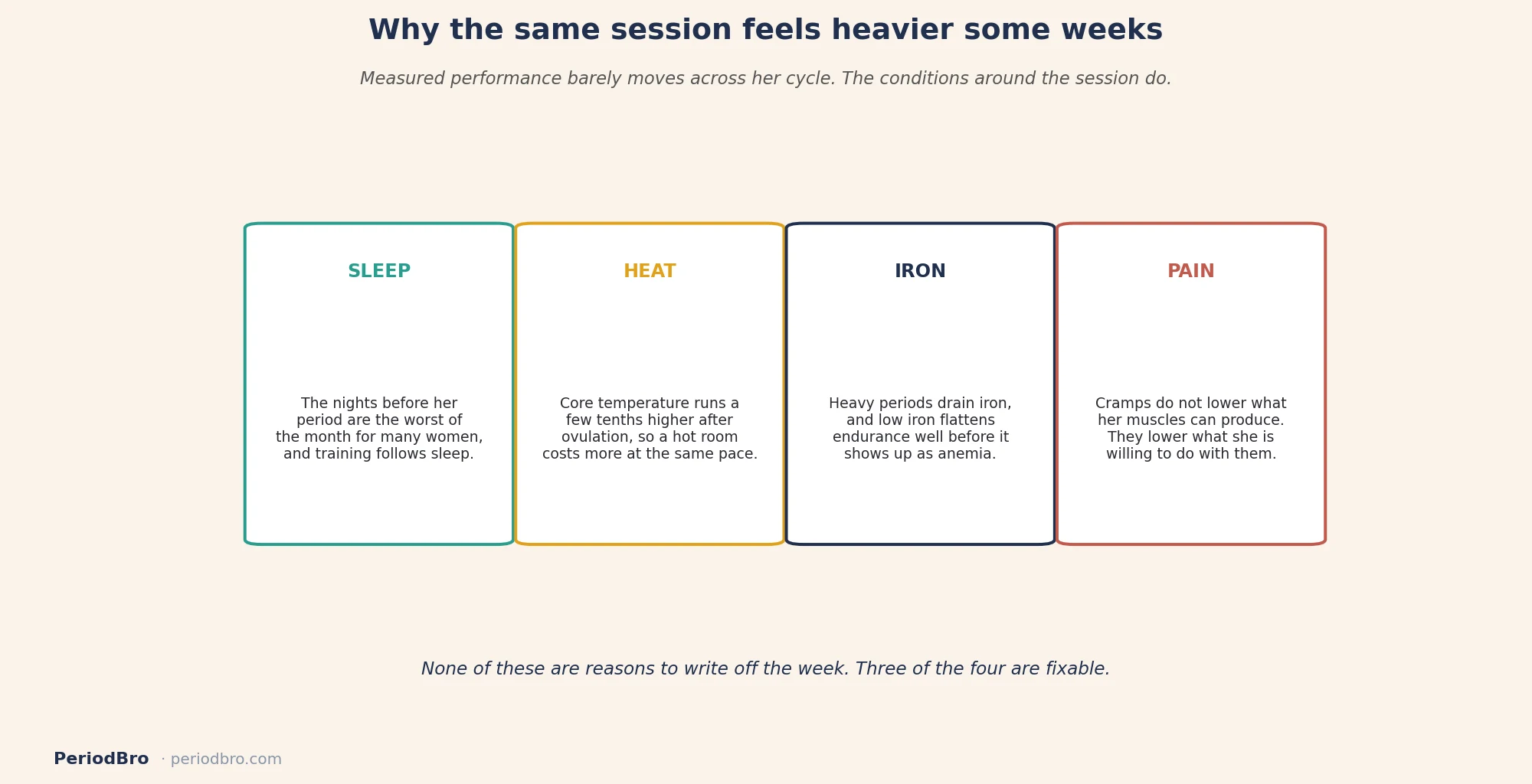
Iron. If her periods are heavy, the flatness she reports is not motivation, it’s supply. Low iron blunts endurance before it ever shows up as anemia on a blood test, and it’s the most commonly missed cause of a training slump in women who bleed a lot. That is a doctor and a blood test, not a pep talk, and we covered it in iron deficiency and heavy periods.
Pain. Cramps on day one do not reduce what her muscles can generate, but they absolutely reduce what she is willing to do with them, which comes to the same thing on a Tuesday evening.

The bleeding week, concretely
Assume she wants to train and the question is only what makes it easier. Four things carry most of the load.
Leak anxiety does more damage than cramps. A lot of missed sessions are not about pain at all, they’re about light shorts, a long class and no bathroom. That’s the same calculation girls run before they quit sport, and it’s the one worth solving first. If she’s had a bad experience with it, what to do when she bleeds through covers the practical side without the drama.

Warm-ups matter more than usual. Not because anything is fragile, but because the first ten minutes are when she decides whether the session is happening. Long, easy, boring warm-ups win that argument more often than a strong opinion does.
Heavy days and heavy lifts don’t have to be the same day. Moving her hardest session by 48 hours costs nothing across a training month, and she can do that herself without anyone’s permission or a color-coded calendar.
Water and food are not a footnote. Appetite and hydration both shift around her period, and under-fueling turns an ordinary session into a bad one faster than any hormone does.
What cycle syncing gets right, and where it overreaches
Cycle syncing is the idea that she should match her training to the phase she’s in: build in the follicular phase, back off in the luteal one. The instinct underneath it is sound. Her month is not flat, energy does move, and a plan that leaves room for that is better than a plan that treats every Tuesday as identical. We wrote about the couples version of that in cycle syncing for couples.
Where it overreaches is precision. The phase-specific prescriptions are drawn from group averages in studies that barely detect a difference, then applied to one specific woman as if they were personalized. They also assume a textbook cycle. If hers is irregular, or she’s on hormonal birth control, the phases the plan is built around may not be happening at all in the way the app draws them.
The version that survives contact with reality is simpler. Track how she actually feels and performs for a couple of months, and let her own pattern set the plan. If she reliably has a flat Thursday before her period, build around that, since it’s her data rather than a population average drawn by someone selling a program.
Your actual job here
Short list, and most of it is logistics rather than opinions.
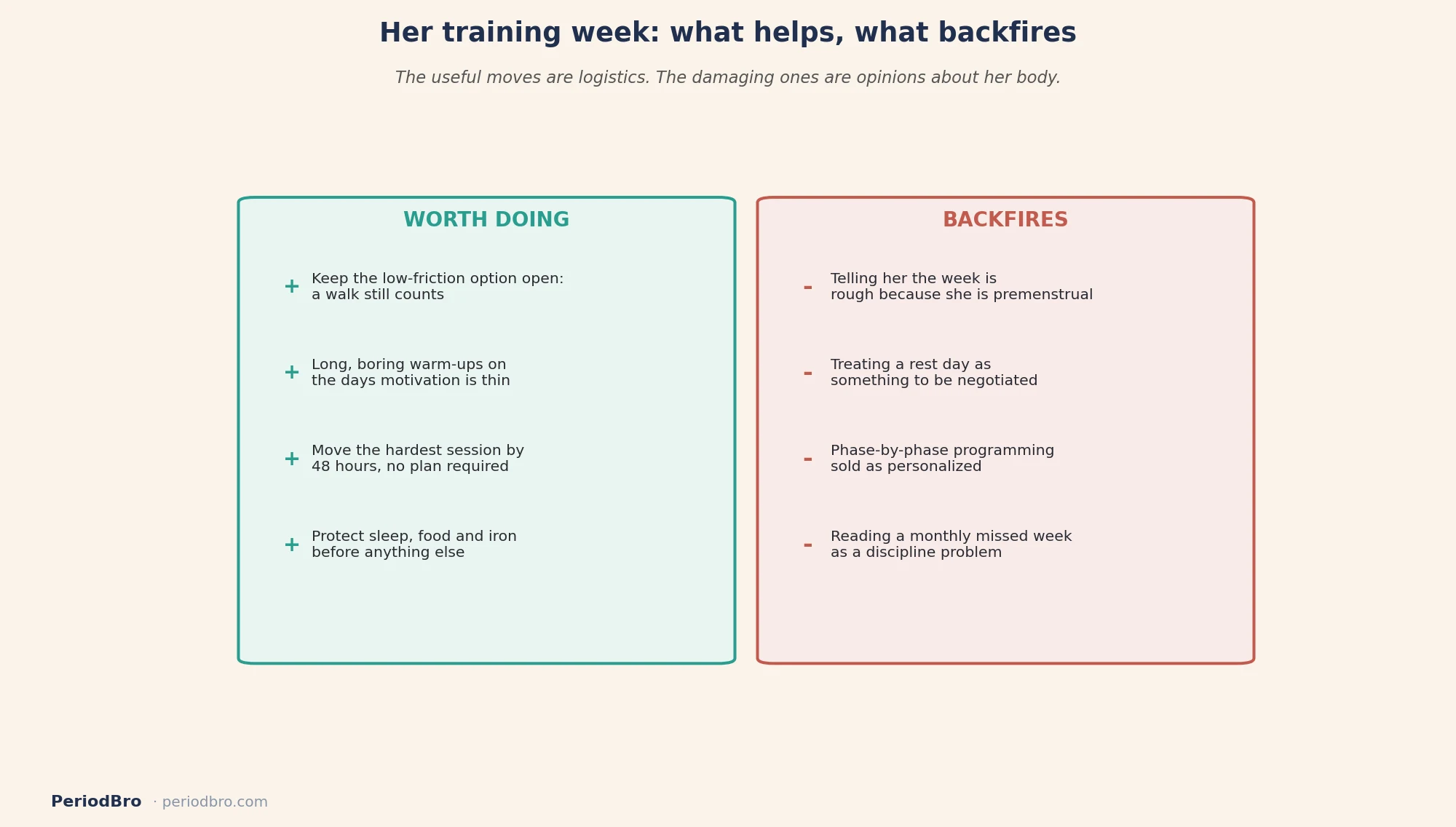
Make the low-friction option available. On the days a full session isn’t happening, a walk is not a consolation prize. The Cochrane data covered light exercise too, and the hardest part of any of it is getting out the door.
Do not narrate her hormones. Telling a woman that she’s tired because she’s premenstrual is a way to lose an evening, even when the timing lines up. There’s a whole guide to that failure mode in what to say when she has PMS.
Don’t audit her training. A rest day is not a negotiation, and a hard session on day two is not reckless. She gets to make that call in either direction.
Protect the boring inputs. Sleep, food, and iron do more for her training week than any phase-based programming will.
If you have a daughter in sport, the same logic applies with higher stakes, because this is the age when girls quit teams over exactly this. That one is in daughter, period, and sports.
When it stops being a training question
There’s a line worth knowing. Pain that regularly stops her from moving, bleeding heavy enough to plan her week around, or a slump that doesn’t lift when she sleeps and eats well, are all medical questions rather than discipline questions. Missing training every single month is a symptom, not a character trait.
If that’s the pattern, the useful move is a doctor’s appointment with dates written down, which is far harder to dismiss than a description. We covered what to do when that conversation goes badly in when a doctor dismisses her period pain, and where the line sits in is her period pain normal.
For everything else the answer is unglamorous. Working out on her period is fine if she wants to, and it will probably help.

PeriodBro keeps a quiet private log of where she is in her cycle, which is what turns “this week was rough” into a pattern you can actually plan around. Try it free.
This article is general information, not medical advice. Period pain that stops her from working, training or sleeping is worth a doctor’s appointment.