When She Bleeds Through: What to Do in the First Thirty Seconds
It happens on the sofa, in the bed, in a restaurant, in the passenger seat of your car. She goes quiet, or she goes straight to the bathroom, and you work out what happened about ten seconds later. What to do when she bleeds through is a small problem with a large emotional multiplier, and most partners get the practical bit right and the tone completely wrong.
So: the thirty seconds that matter, the stains, and the one version of this that is actually a medical signal rather than an accident.
It happens to nearly everyone
Worth knowing before you react, because your reaction is the whole ballgame here.
A survey of 3,000 women and girls for the Wellbeing of Women “Just a Period” campaign found that 86% of those who have had a period have had a period mishap. Over three quarters, 77%, said they would feel ashamed if it happened in public. Even in private, 45% said they would feel ashamed.
Sit with that second set of numbers. The shame does not need an audience. It shows up on your sofa with nobody watching, which means the thing she is managing in that moment is not the laundry.
What to do when she bleeds through: the first thirty seconds
Everything that goes wrong here goes wrong in the first half minute, and it is almost always tone rather than content.
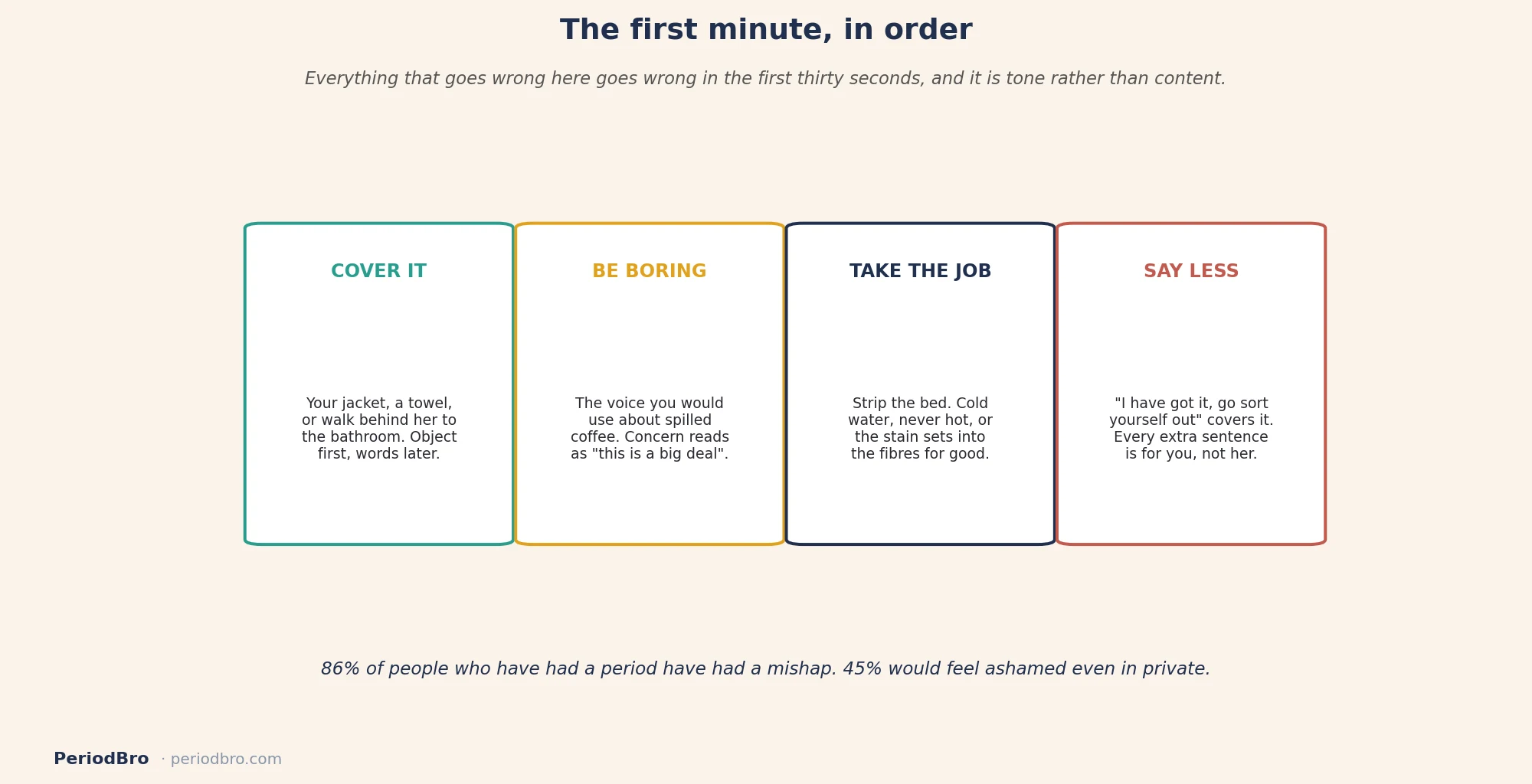
Be boring about it. Flat, unbothered, the same voice you would use about spilled coffee. Kindness and concern both overshoot here, and gentleness overshoots worst of all. Concern reads as “this is a big deal”, which is the exact thing she is hoping it is not.
Solve the exposure first. In public, hand her your jacket or walk behind her to the bathroom without narrating it. At home, get her a towel and something to change into. Object first, words later.
Take the cleanup off her. Strip the bed yourself. Put the trousers in cold water yourself. Do it without being asked and without a performance about doing it.
Say almost nothing. “I’ve got it, go sort yourself out” covers everything that needs covering. Every extra sentence in that moment is for you, not her.

The stains, practically
Cold water, immediately, and that is genuinely most of it. Blood is protein, and hot water sets protein into the fibres permanently. Rinse it in cold, then wash normally. If it has already dried, soak it in cold water first rather than attacking it with heat and effort.
Mattress rather than sheet: cold water on a cloth, blot rather than rub, do not soak the thing through. A dark towel folded under her at night stops the same problem happening twice.
The only wrong move is throwing it in a hot wash to be helpful and turning a stain into a permanent one.
What actually helps happen less
Prevention is not your department, but two of these are things a partner can quietly set up.
Overnight is the common one, because eight hours flat on her back is longer than any product is designed for. Period underwear as a backup layer under normal protection, a dark towel on the bed, and a change of pad set out on the nightstand so she is not hunting for one at 3am. Our piece on sleeping through period cramps covers the rest of the night-time setup.
Out of the house, the fix is a spare in her bag and a spare in the car, replaced by you when it gets used. Nobody has ever regretted the spare in the car.
And if she has a daughter or you do, the same logic applies at school, which we went through in her period at school.
The public version, which is a different problem
At home it is laundry. Out of the house it is exposure, and the two need different handling.
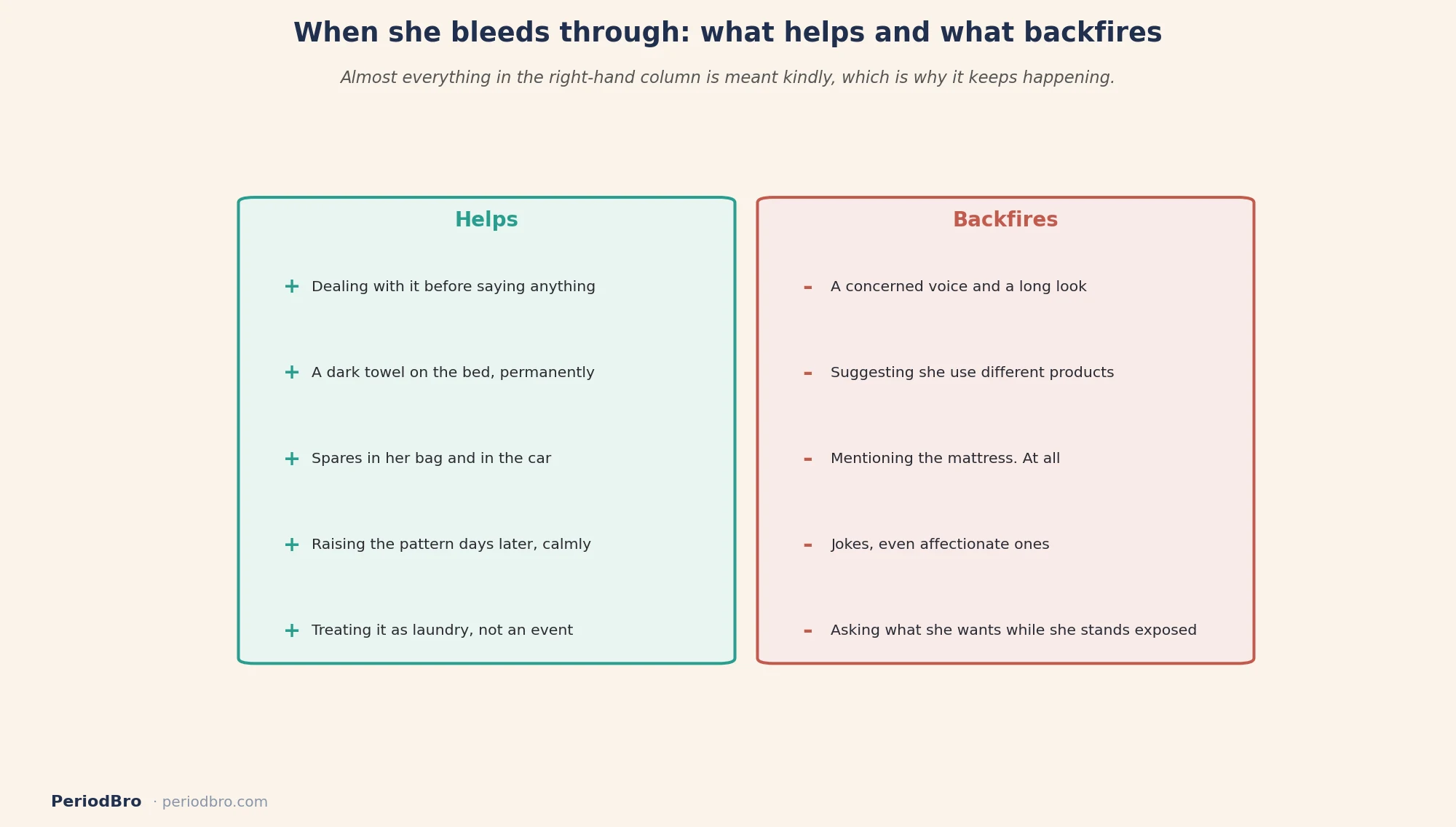
The move is to solve it without turning it into a scene. Jacket around the waist, or you walk directly behind her, and neither of those needs announcing. If you are in a restaurant, you deal with the bill while she goes, so there is no standing around at the table afterwards. If it is the car seat, say nothing about the car seat. Ever, actually. A towel appears there permanently a week later and nobody mentions why.
The thing to avoid is asking her what she wants to do while she is standing in the open working out whether anyone has noticed. Decide something, say it in one short sentence, move.

A friend of mine got this exactly right once by accident, at his own wedding reception of all places, when his wife realised in the middle of it. He walked her out through the kitchen rather than the room, found a bathroom nobody was using, went and got her bag himself, and came back with a gin and tonic and no questions. She has told that story more times than she has told the one about the vows. He did not do anything clever. He removed an audience and stayed boring.
When it is not an accident
Here is the part that turns a laundry article into a health one. Leaking through repeatedly is one of the actual clinical markers for heavy menstrual bleeding, not a sign she is bad at managing it.
Cleveland Clinic’s criteria for menorrhagia include needing to wear multiple pads at once to stop leaking, changing pads in the middle of the night, soaking through a pad or tampon every hour for several hours, periods running longer than seven days, and passing clots the size of a quarter or larger several times a day.
Heavy menstrual bleeding affects somewhere between 27% and 54% of people who menstruate, so this is not a rare diagnosis. It also has treatable causes, which we have covered separately: fibroids, PCOS, thyroid problems, and bleeding disorders among them. Our guide on helping with heavy periods is the practical companion, and period blood clots covers the clot side.
One line to hold onto: bleeding through two or more pads or tampons an hour for two to three hours in a row is urgent care, not a wait-and-see. That is Cleveland Clinic’s threshold, not ours.
The conversation, later
Not in the moment. Days later, when nothing is happening and there is no stain in the room.
Something like: I noticed that’s been happening more this year, is it worth getting looked at. Then let her answer without adding a second sentence. If the answer is no, drop it and try again in a few months.
Two things to never do. Do not tell her she should use something different, because she has thought about her own products considerably more than you have. And do not raise it as a complaint about the mattress. The mattress is replaceable and the trust is not, which is more or less the argument in our piece on supporting her when you cannot fix it.
What people remember years later is rarely the sheet. It is who they were with when it happened, and whether that person made the whole thing smaller or bigger. That is a genuinely low bar and a surprising number of partners trip over it. For the wider version of getting this right, see being a better partner through her cycle and our list of the worst things to say.

This article is general information and not medical advice. Repeated leaking, soaking hourly, bleeding longer than seven days or passing large clots are all reasons to see a clinician, and heavy bleeding can cause iron-deficiency anaemia. Bleeding through two or more pads or tampons per hour for two to three hours in a row needs urgent care.