
Thyroid and Periods: The Cause Nobody Checks First
She is exhausted in a way sleep does not touch. She is cold when nobody else is. Her periods have got heavier, or they have started skipping. Each of those gets its own explanation, usually work, and the connection between thyroid and periods almost never comes up until somebody finally runs a blood test.
It is a small gland in the neck that sets the pace for the whole body, and when it drifts, the cycle is often the first thing to show it. Here is how that works and what to do with it.
What the thyroid actually does
Think of it as the thermostat. It produces hormones that set how fast everything runs: heart rate, temperature, digestion, how quickly energy gets burned. Turn the dial down and the whole system slows. Turn it up and everything races.
The reproductive system is wired into that same dial. Thyroid hormones affect ovulation and the lining that builds and sheds each month, so a thermostat problem reads out as a cycle problem. It just does not announce itself as one.
Thyroid and periods: the two directions
There are two ways it goes wrong, and they push the cycle in opposite directions.
Underactive, hypothyroidism. Everything slows. Cleveland Clinic lists frequent or heavy menstrual periods right alongside fatigue, cold intolerance, unexplained weight gain, dry skin and hair, brain fog, and depression or anxiety. It is most common in women over 60, particularly after menopause, but it turns up plenty earlier than that.
Overactive, hyperthyroidism. Everything speeds up. Cleveland Clinic puts it at about 1.3% of the US population and lists lighter or missed periods, weight loss despite eating normally, sweating and heat sensitivity, a racing heart, and feeling anxious or irritable.

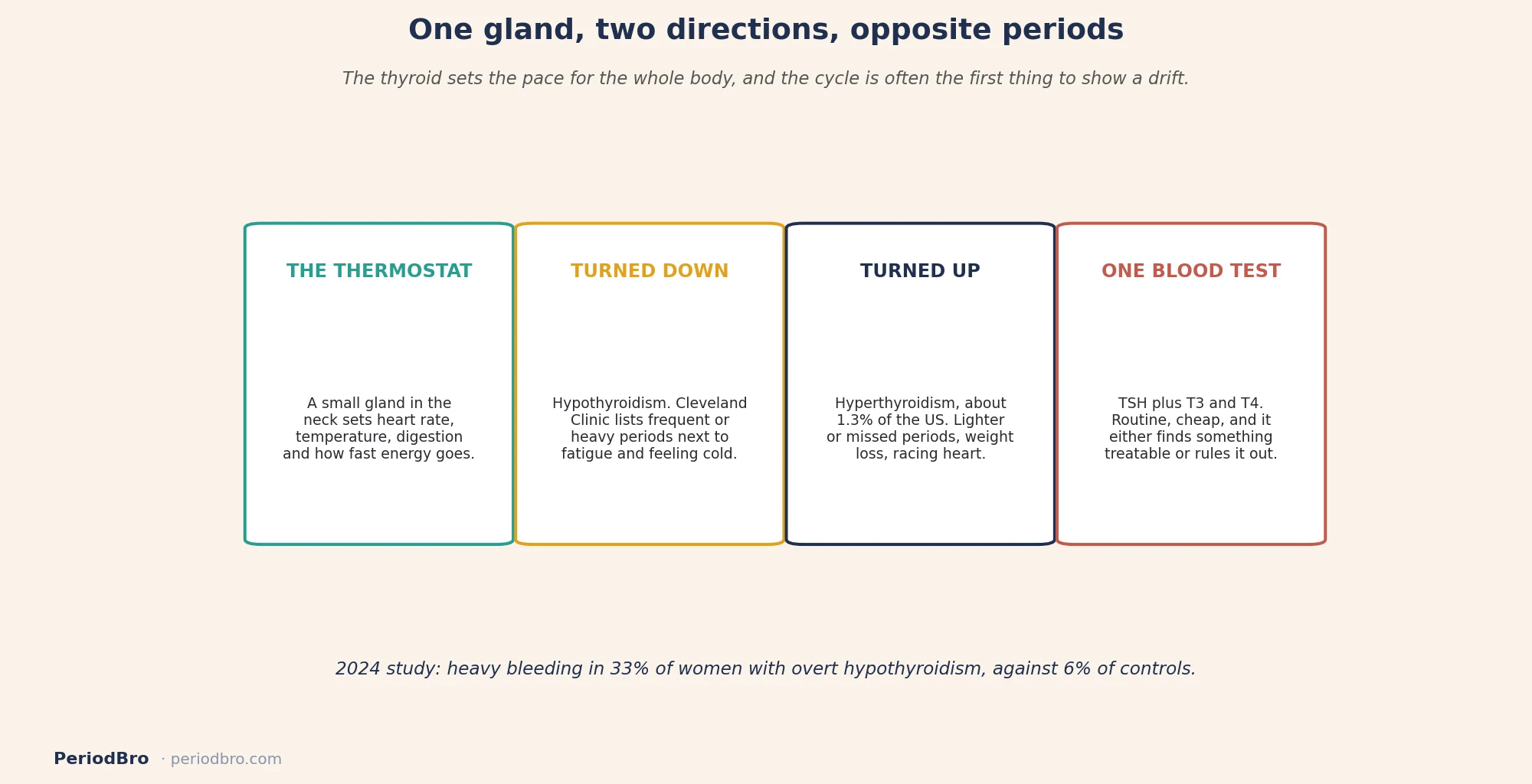
Read those two lists next to each other and something obvious falls out. Almost every symptom on them gets attributed to something else first. Tired means work, cold means the flat, anxious means life, and a heavy period means bad luck. Every one of those explanations is reasonable on its own, which is exactly why nobody stacks them up and asks whether a single gland accounts for all four.
How strong is the link, actually
Strong enough to be worth a test, and specific about which symptom to watch.
A 2024 study compared menstrual patterns in 485 women with thyroid dysfunction against 108 healthy controls. Hypermenorrhea, meaning an unusually heavy bleed, showed up in 33% of women with overt hypothyroidism versus 6% of controls. The worse the thyroid function, measured by TSH, the more common the heavy bleeding got.
Menorrhagia, polymenorrhea and oligomenorrhea also ran higher in that group without reaching statistical significance, and the hyperthyroid group did not differ much from controls in this particular study. So the cleanest signal is this: an underactive thyroid and a period that has become genuinely heavy.
Cleveland Clinic backs that up from the other end. On its page on heavy menstrual bleeding, which affects somewhere between 27% and 54% of people who menstruate, thyroid disease is listed among the hormonal causes, next to anovulation and PCOS.
What this means in practice
Two things, and they are both cheap.
The first is a blood test. TSH, plus T3 and T4. It is one of the most routine tests in medicine, it costs almost nothing, and it either finds something treatable or rules out a whole category of explanation. Treatment for the underactive version is usually a daily tablet of levothyroxine, with improvement showing up after a few weeks and dose adjustments guided by repeat bloods.
The second is a record, which is the part you can do. If her periods have changed, the useful question is not whether they are heavy but how they have changed compared with two years ago. Dates, days of bleeding, how often she is changing protection on the worst day. That turns a vague complaint into a pattern a doctor can act on, and it is the same record that makes our guide to heavy periods useful.

The symptoms that get filed under something else
This is the part worth reading slowly, because we have written about most of these individually as period symptoms, and they are also the thyroid symptom list almost word for word.
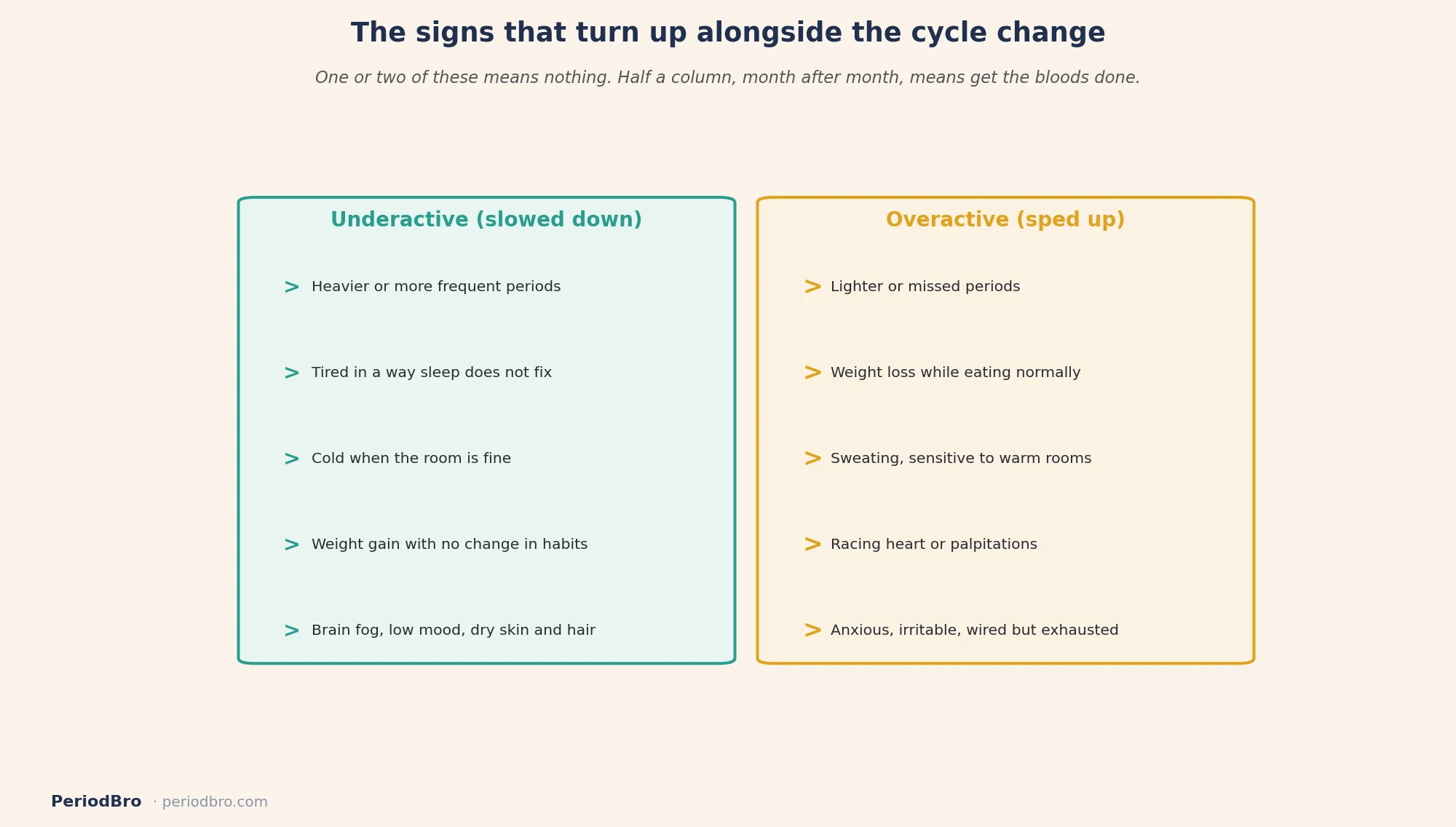
Fatigue that does not lift after the period ends. Brain fog that is not confined to the luteal week. Feeling cold when the room is fine. Anxiety that does not track the cycle at all.
The distinguishing feature is timing. Cycle symptoms come and go with the cycle. Thyroid symptoms sit there the whole month and get worse gradually over a year or two. If you have been tracking anything at all, you already have the data to tell those apart, which is most of the argument for tracking in the first place.
The window most people miss: after a baby
Postpartum thyroiditis is worth knowing about specifically because the timing hides it perfectly. Cleveland Clinic puts it at 5% to 10% of women in the first year after a pregnancy, and it runs in two phases: overactive somewhere between one and six months after birth, then underactive from around four to eight months, which can last up to a year. Seventy to eighty percent recover fully and come off medication, while 20% to 30% stay hypothyroid and need ongoing treatment.
Look at what those symptoms are. Exhaustion, mood changes, weight that will not behave, hair falling out, and a cycle that has not come back to anything recognisable. Now look at what everyone assumes about a woman four months after having a baby. The two lists are identical, which is why it goes unchecked for months at a time.
If she has had a baby in the last year and something feels off beyond ordinary new-parent wreckage, that is a reasonable moment to ask for the bloods rather than assuming it is just the stage.
Where it fits with everything else
A changed period has a short list of usual suspects, and thyroid sits on it alongside PCOS, fibroids, and simple things like stress or weight change. Our piece on why her period is late covers the skipping end of it.
The reason thyroid deserves its own article is that it is the one on that list which is easiest to test for and easiest to treat, and the one most likely to be missed because its symptoms are so unglamorous that everybody, including her, explains them away.
Fertility is the other reason to take it seriously. Cleveland Clinic notes that untreated hypothyroidism raises the risk of infertility and pregnancy complications, and that regular thyroid testing plus medication supports a healthy pregnancy. If children are anywhere on the horizon, that alone justifies the test.
Your part
You cannot diagnose this and you should not try. What you can do is notice the stack.
Nobody sees the whole picture from inside it. She experiences a tired Tuesday, a cold Thursday, a rough period in March, and each one gets a local explanation. You are standing outside it and can see all of them at once, across a year. That is genuinely useful information and almost nobody collects it.
A colleague of mine spent about eighteen months watching his wife get slower. She was going to bed at nine, wearing a jumper in July, and her periods had turned into something she planned her month around. They had separately decided it was her job, the flat being cold, and her getting older, which is three explanations for what turned out to be one number on a blood test. She was on levothyroxine within a fortnight of anyone thinking to check. What he says now is not that the doctors missed it. Nobody had ever put the three things in the same sentence, because he was the only person in a position to and it had not occurred to him that they were related.
So: keep the record, notice when several unrelated things move in the same direction over months, and when she next sees a doctor for anything at all, ask whether the thyroid has been checked recently. It is one line in a conversation.
Symptoms this vague get dismissed, including by her. A partner saying “you’ve been cold and shattered since spring, might be worth a blood test” carries weight precisely because it comes from outside her own head. Then let the professionals take it from there, and read our guide on being a better partner through her cycle for the day-to-day part. If you want the underlying mechanics of what a normal cycle is doing, start with the menstrual cycle guide.

This article is general information and not medical advice. Thyroid symptoms overlap with many other conditions, and a changed cycle has causes ranging from harmless to serious. Only a clinician with blood results can tell you what is going on. If she is soaking through protection hourly for two to three hours in a row, that is an urgent-care situation rather than a scheduling one.