Cannabis and Her Period: What Helps and What Changes
She reaches for a gummy on day one instead of ibuprofen, and it seems to work. Or a friend told her it works, and she’s asking you what you think. Either way you’re in the same spot: there’s a lot of confident talk about cannabis and her period, and almost none of it comes with numbers attached. The research supports less than the confidence suggests, and it points at one change in her cycle that rarely comes up.
The pain relief is real to the women reporting it and badly under-tested. The cycle effect runs the other way: smaller, but consistent across the few studies that exist.
What cannabis and her period do to each other
Two separate things are going on, and mixing them up is where most of the confusion starts.
The first is pain. Cannabinoid receptors sit in tissue all over the body, including the uterus, and they’re part of how pain signals get turned up or down. That’s the mechanism people point at when they say it helps cramps, and it’s plausible.
The second is the cycle itself. The same receptor system sits in the hypothalamus and pituitary, the two organs that time ovulation. Cannabis doesn’t only land on the pain. It lands on the clock.
Most conversations about this only cover the first half. The second half is the part worth knowing, especially if she’s tracking, if her luteal phase already looks short, or if the two of you are trying for a baby.
Why the pain evidence is thinner than it looks
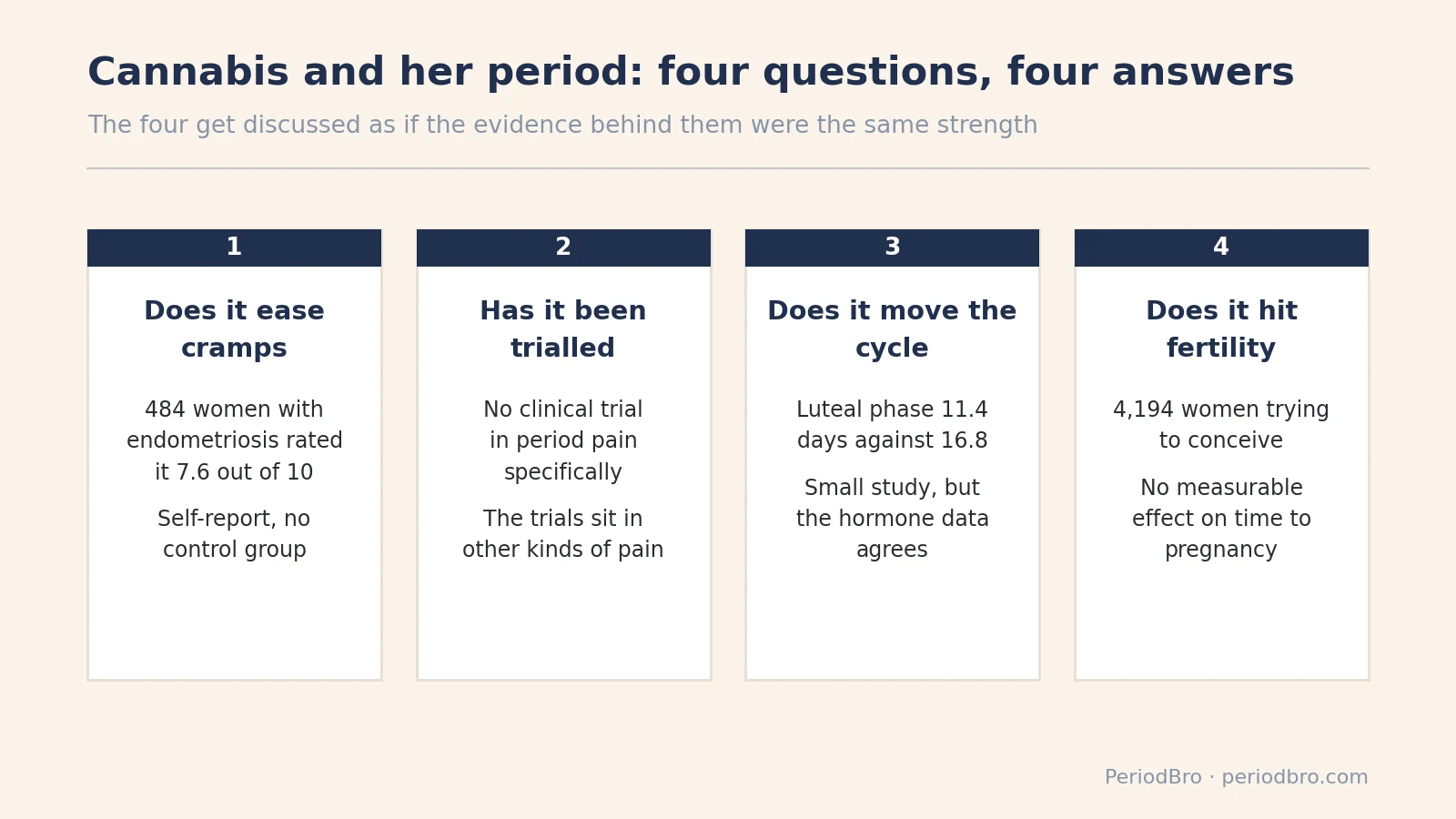
The strongest data we have is self-report, and it’s genuinely striking. A 2019 survey of 484 Australian women with endometriosis asked which self-management strategies they used and how well each one worked on a ten-point scale. Cannabis came out on top at 7.6, ahead of heat at 6.52, CBD oil at 6.33 and dietary change at 6.39. Three quarters of the women were managing pain themselves in some form, and the ones using cannabis rated it more effective than anything else on the list.
That’s worth taking seriously. It’s also not a trial. Nobody was randomised, nobody was blinded, and the women answering had already chosen what to use. People who found something useless stopped and stopped talking about it.
The gap gets clearer in the review literature. A 2022 review in the International Journal of Molecular Sciences went looking for clinical trials of medicinal cannabis for period pain and found the trials had been run in other kinds of pain instead. Roughly two thirds of those showed a positive analgesic result, with nausea, drowsiness and dry mouth as the common side effects. For dysmenorrhoea specifically, a condition affecting up to 90% of women of reproductive age, the trial was still missing.
Plenty of women say it works and the biology gives a reason it might. Nobody has tested it properly in the situation she’s using it for.
The signal that shows up in the cycle itself
The studies on this are old and small, and they point the same way.
In a 1986 double-blind experiment, women smoked either a single cannabis cigarette containing 1.8% THC or a placebo during the luteal phase. The real one dropped plasma luteinising hormone by 30%. The placebo did nothing. Luteinising hormone is the signal that triggers ovulation and supports the corpus luteum afterwards, so suppressing it isn’t a neutral event.
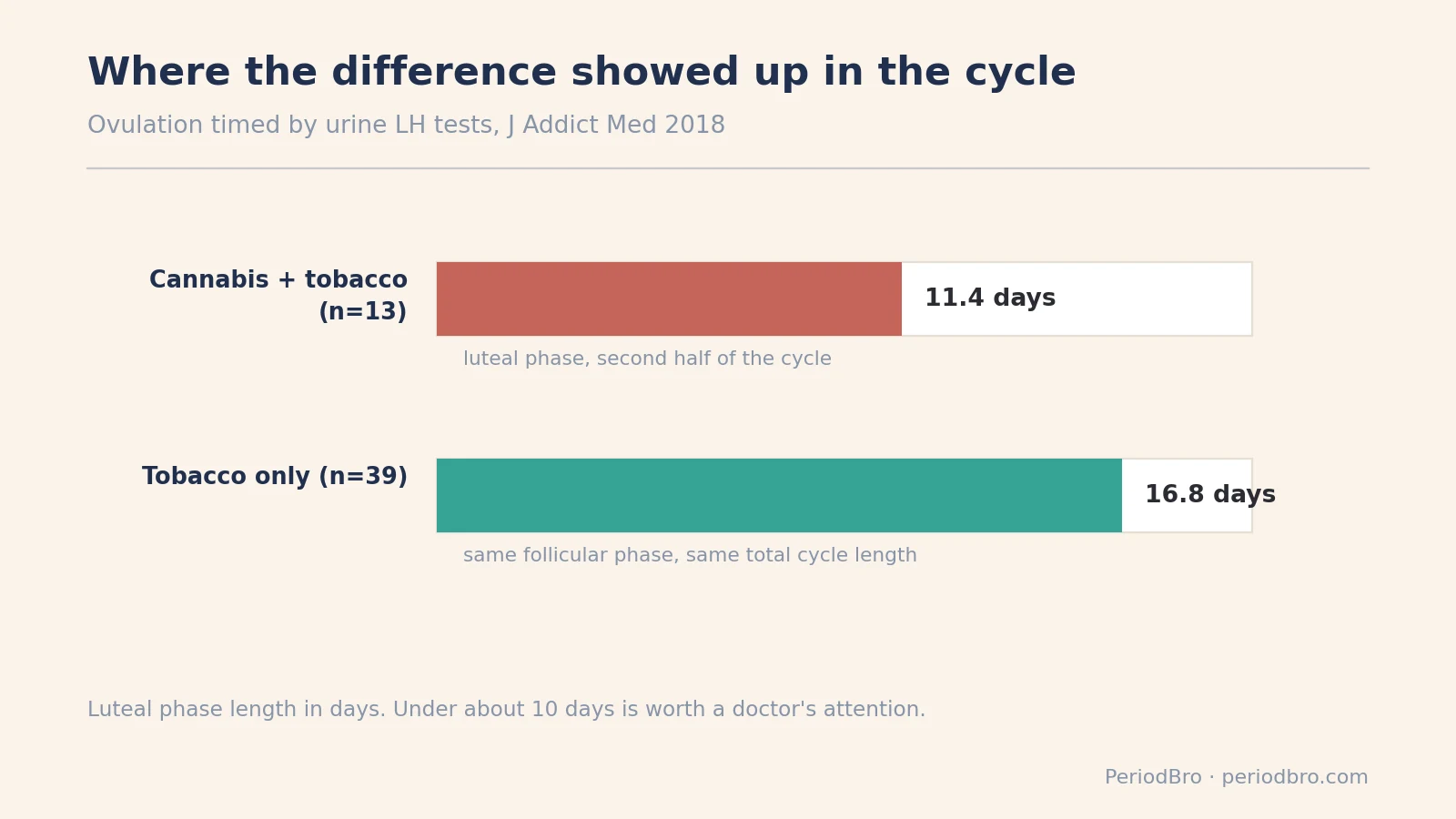
Thirty years later the effect showed up in cycle length. A 2018 analysis in the Journal of Addiction Medicine compared 13 women who used both cannabis and tobacco against 39 matched women using tobacco alone, timing ovulation with urine LH tests. The luteal phase in the cannabis group ran 11.4 days against 16.8 days in the tobacco-only group, and the difference held up statistically. Follicular phase length and total cycle length showed no difference at all.
Thirteen women is a very small group, all of them smokers, so this is a signal rather than a settled fact. But it’s the same direction the hormone experiment predicted, and a luteal phase that keeps coming in under about ten days is something a doctor would want to look at anyway.

If the two of you are trying for a baby
This is where people panic, and the population data says they shouldn’t, at least not on the basis of fertility alone.
The Pregnancy Study Online cohort followed 4,194 women in North America and Denmark who were trying to conceive, and asked about cannabis use at the start. Women using it at least once a week had a fecundability ratio of 0.98 against non-users, with a confidence interval running from 0.80 to 1.20. In plain terms, no detectable effect on how quickly they got pregnant. The same held for the men.
Both findings can hold at once. Cannabis can shorten a luteal phase in some women without moving the average time to pregnancy across thousands of couples. If she’s already having trouble conceiving, or her cycle charts show a short second half, it belongs on the list of things to mention at the appointment. If neither of those applies, the evidence doesn’t support treating it as a fertility problem.
The vomiting that gets misfiled
One caveat matters more than the rest because it gets misread as a period symptom.
Regular cannabis use can produce cyclic vomiting, a pattern known as cannabinoid hyperemesis syndrome. A systematic review covering 183 papers found it only ever appears in people with a history of regular use, and one of its stranger features is that hot showers or baths bring relief while anti-sickness drugs often don’t. If she’s using cannabis for cramps and the nausea is getting worse rather than better, that pattern is worth a doctor’s eyes rather than a stronger dose.
It’s easy to file under period nausea and leave it there, especially when the vomiting arrives near the same days each month.
What’s actually driving the use
A small 2025 study of 56 women in inpatient treatment for substance use disorders asked about menstrual pain directly. Half reported using substances specifically to manage it, most often cannabis, alcohol and nicotine. The worse the pain and the more it interfered with daily life, the higher the odds of reaching for something.
That’s a specific clinical population, so don’t stretch it. But the pattern underneath is ordinary: untreated pain gets self-treated, with whatever’s nearby. If she’s leaning on cannabis every cycle, the question to sit with is whether anyone has ever properly treated her pain. Cramps that are worse some months than others and pain that turns out to be endometriosis both get parked for years this way.
What actually helps here
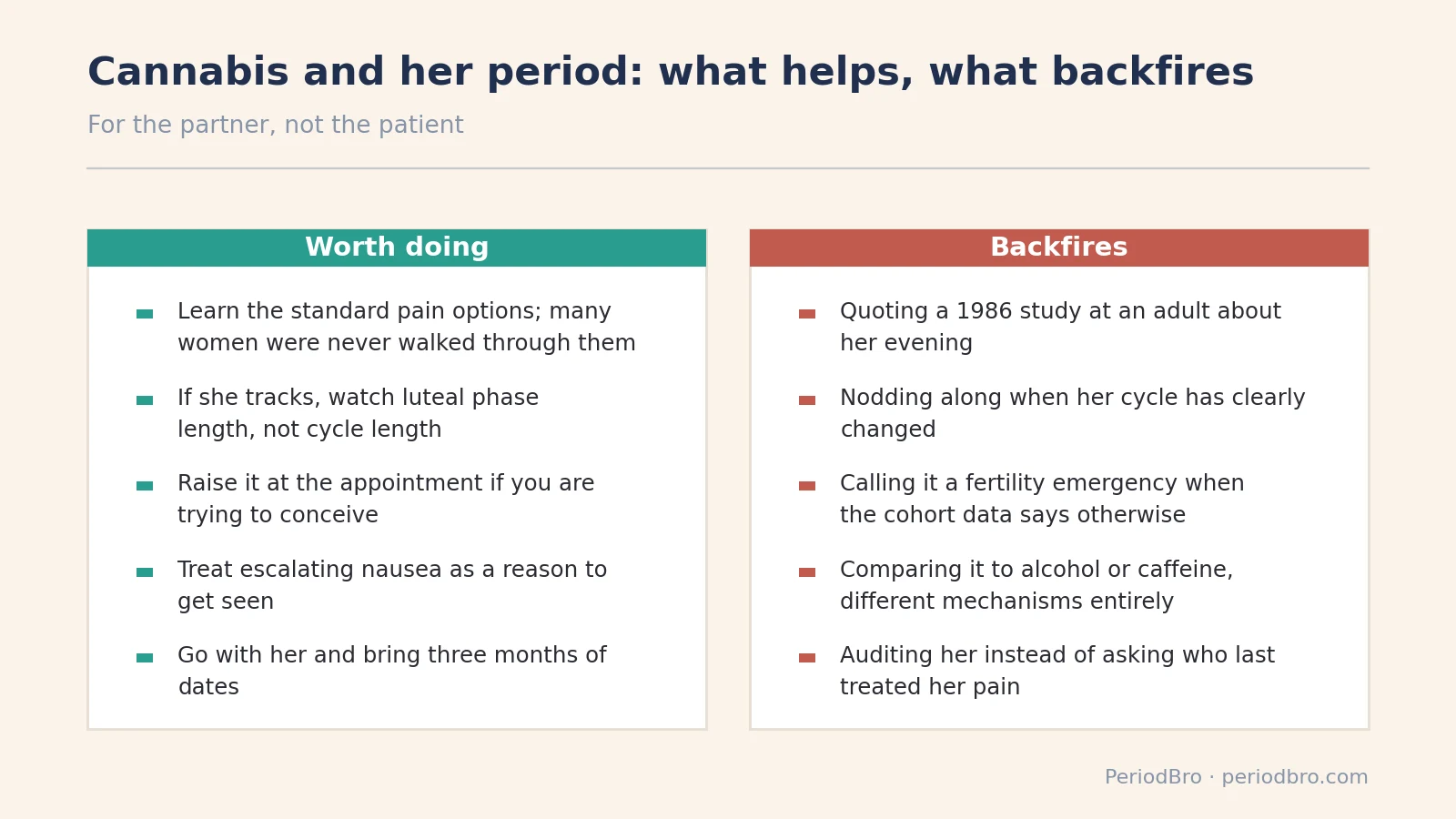
Don’t audit her. A partner arriving with a printout has never once talked anyone out of a coping strategy.
Do know what the standard options are, because plenty of women have never been walked through them properly. Timed NSAIDs started before the pain peaks, heat, and hormonal options are all on the table, and the evidence behind each one is stronger than what we have for cannabis.
If she tracks her cycle, the luteal phase is the number to glance at, not the total cycle length. That’s the half where the signal showed up.
And if her pain is the reason she’s using anything at all, the appointment is the move. Bring the dates. Doctors move faster when someone hands them a pattern instead of a description, and pain that gets waved off once often needs a second run at it.
What to skip
Skip the lecture about the LH study. One 1986 experiment with a single cigarette is not a reason to tell an adult what to do with her evening.
Skip the opposite move too, which is nodding along because it’s easier. If she’s throwing up every cycle, or her periods have gone strange since she started, saying nothing isn’t loyalty.
Skip the internet’s two settings on cannabis and her period, which are miracle cure and hard no. Neither survives contact with the actual papers.
Skip comparisons to alcohol or caffeine. Different substances, different mechanisms, different evidence bases. The only thing they share is that they all get blamed for whatever the cycle does that month.
When it needs a doctor
Book the appointment if her luteal phase is consistently coming in under ten days, if her cycle has changed noticeably since she started using, if the nausea or vomiting is escalating, or if she’s using something every single cycle to get through the pain. That last one points at untreated pain rather than at the cannabis.
Go with her if she wants you there, and bring three months of dates. It’s a smaller contribution than an opinion and a considerably more useful one.
This article is general information, not medical advice. Cannabis is regulated differently depending on where you live. For anything specific to her cycle, her pain or her medication, talk to a doctor who knows her history.