
She Was Sent for a Pelvic Ultrasound: What Happens and What It Can Miss
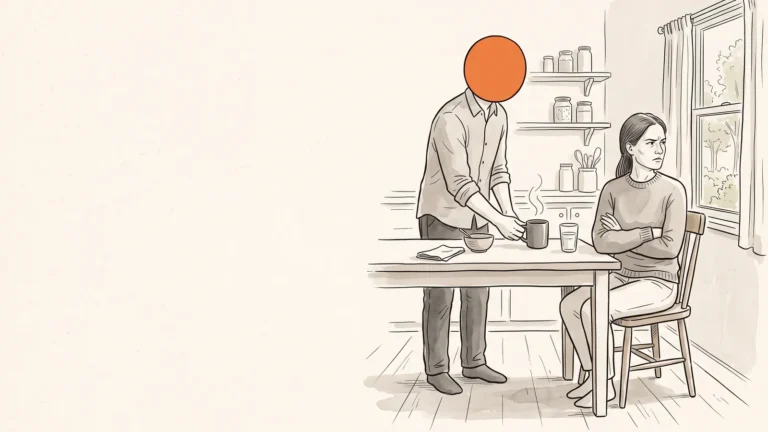
The appointment came out of a five-minute conversation. She described the bleeding, the doctor nodded, typed for a while, and said they’d get her booked in for a scan. Now there’s a date on the fridge three weeks out, and neither of you has said much about it since.
So here’s the room, the equipment, and the thing that rarely gets explained before she walks in, which is how much a clean result actually settles.
Why a pelvic ultrasound for period problems is the first thing they order
When bleeding is heavy, painful or unpredictable, imaging comes before anything invasive. Transvaginal ultrasound is the first-line imaging test for abnormal uterine bleeding in both premenopausal and postmenopausal women, because it’s quick, it needs no anesthetic, and it answers the structural questions in one sitting.
Those questions are specific. Are there fibroids, and if so where are they sitting relative to the cavity. Is there a polyp. Does the muscle wall look like adenomyosis. Is there a cyst on an ovary, and is it the kind that builds and clears every month or the kind that needs watching. How thick is the lining, and does that fit the point she’s at in her cycle.
That list covers most of what makes periods heavy. It’s a reasonable first move, not a brush-off, which is worth saying out loud if she’s arriving at this after months of being told her periods are just bad luck.

The two scans, and why the internal one is the useful one
A pelvic ultrasound comes in two forms, and she may get both in the same appointment.
The abdominal scan goes over the lower belly with gel, the way people picture ultrasound from pregnancy scenes. It usually requires a full bladder, which is the part everyone remembers, because the clinic asks her to drink a liter of water beforehand and then hold it. The bladder pushes the bowel out of the way and gives the sound waves a clear window.
The transvaginal scan uses a thin probe, covered and lubricated, placed inside the vagina. Bladder empty for this one. It sits much closer to the uterus and ovaries, so the picture is far better, which is why it’s the one that answers the question she came in with. Cleveland Clinic describes the sensation as similar to inserting a tampon: uncomfortable for some people, painful for a minority, over in about fifteen to twenty minutes.
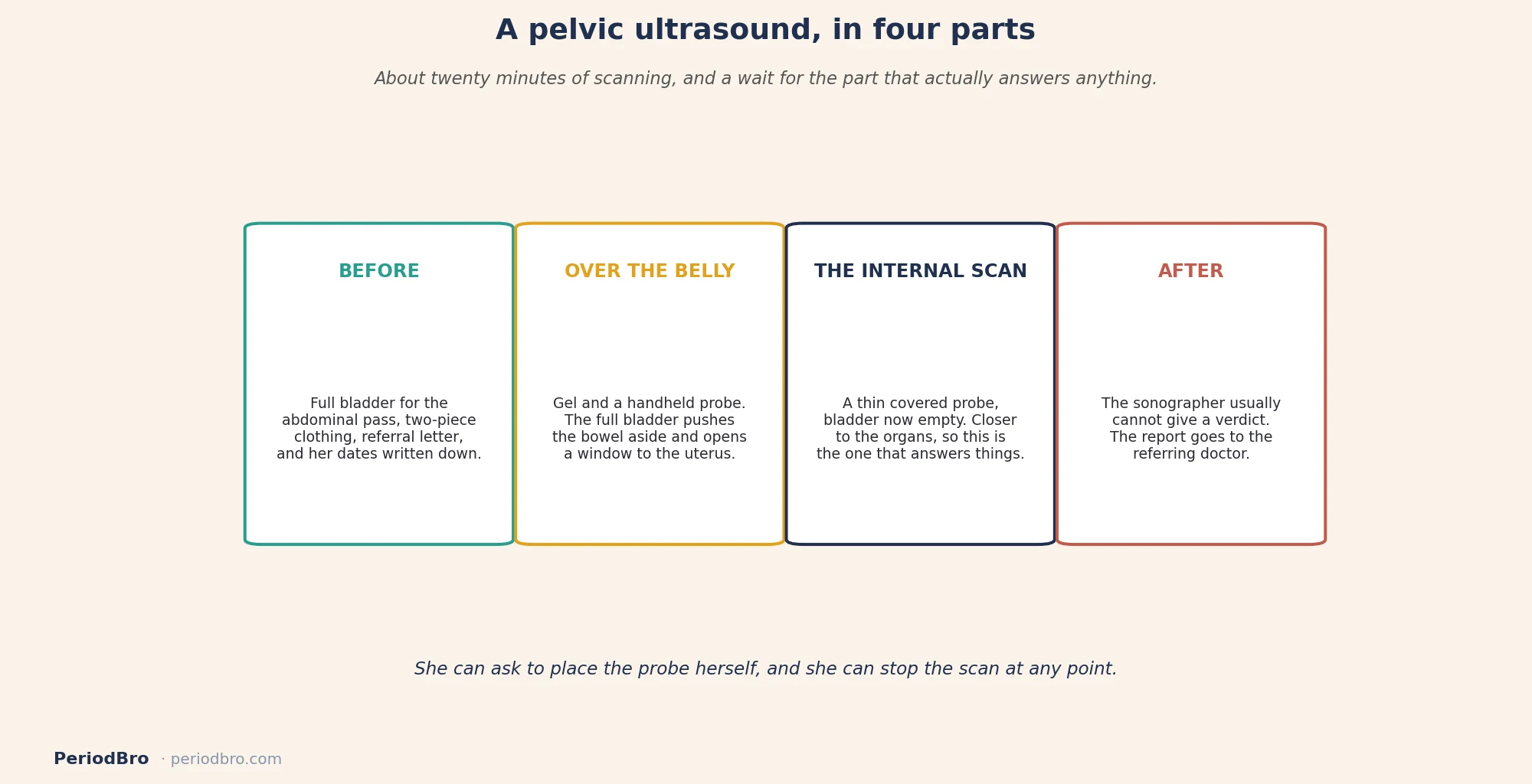
Two things worth knowing before she goes. She can ask to place the probe herself, and many sonographers offer this without being asked. And she can stop the scan at any point, which is not a dramatic act. If she’s had a rough experience with pelvic exams before, saying that at the start changes how the whole appointment runs.
Timing, bleeding, and what to take
Being on her period usually does not cancel the scan. Clinics image through bleeding routinely, and some prefer the first half of the cycle because the lining is at its thinnest then, which makes a polyp or a fibroid easier to see against it. If the appointment lands on day two and she’d rather not, she can ask to move it. If she doesn’t mind, it goes ahead.
Practical bits: two-piece clothing, so she keeps her top on. The referral letter and any previous scan reports. A list of what her periods actually do, with dates, rather than “they’re heavy”. That last one carries more weight in a seven-minute follow-up than any description she gives from memory, and it’s the single most useful thing a partner can help assemble beforehand.

What a normal scan does not rule out
A clean report can land as a letdown instead of relief, and the reason is in the physics.
Ultrasound sees endometriomas and deep endometriosis reasonably well. It cannot reliably see superficial endometriosis, the small implants scattered on the surface of the pelvic lining, because the lesions are too small and too flat to show. Superficial disease is also the most common form. A normal scan in a woman with textbook endometriosis symptoms is a routine event, not a contradiction, and it does not mean the pain has been ruled out or imagined. The condition itself we covered in endometriosis for partners.
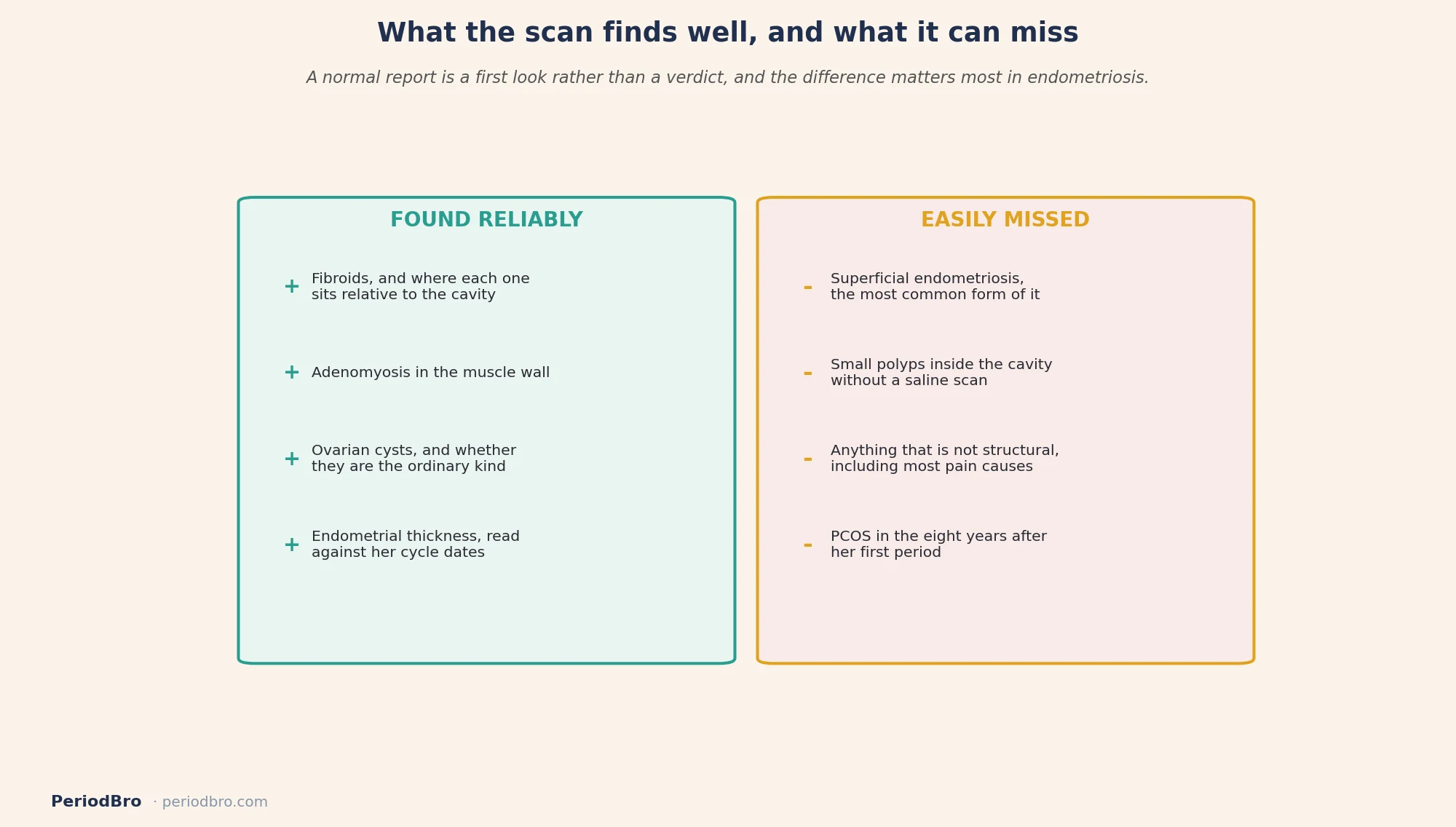
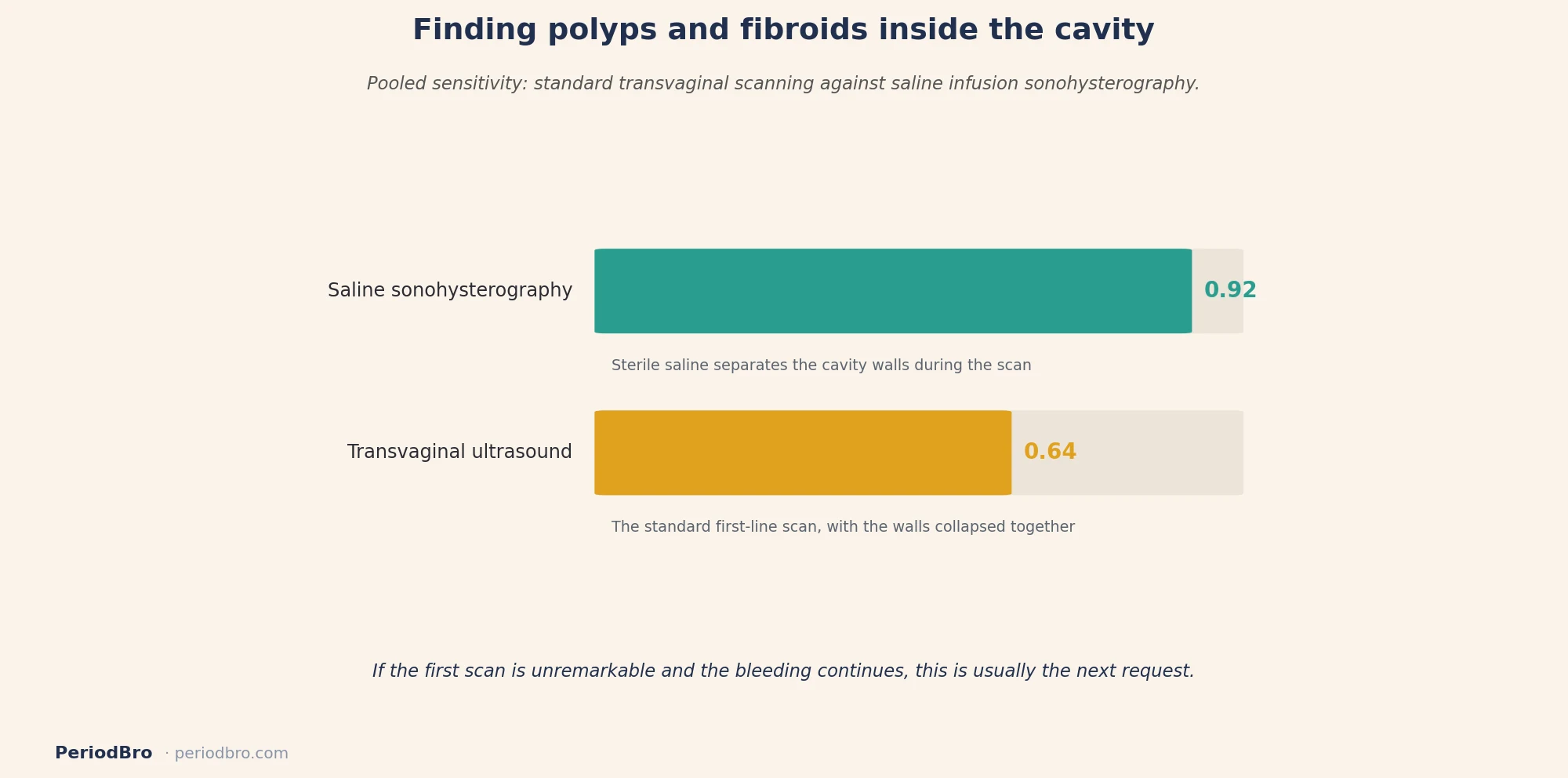
Two other limits travel with this scan. Ultrasound is not how PCOS gets diagnosed in a teenager or a young woman: the 2023 international guideline says not to use pelvic ultrasound for PCOS diagnosis within eight years of a first period, because polycystic-looking ovaries are common and unremarkable at that age. And for lesions sitting inside the cavity, standard transvaginal scanning is weaker than the follow-up test. Saline infusion sonohysterography, where sterile saline is instilled to separate the cavity walls during the scan, reaches a pooled sensitivity around 0.92 for polyps and submucosal fibroids against roughly 0.64 for ultrasound alone. So if the report comes back unremarkable and the bleeding continues, the next request is usually that scan rather than a shrug.
The words that will be in the report
She’ll likely see the report before anyone explains it, either through a patient portal or because the clinic hands it over. A few terms come up constantly, and knowing them takes the edge off the wait.
Endometrial thickness, given in millimeters, is the lining. What counts as normal depends entirely on where she is in her cycle, which is why the report notes the date of her last period. A number on its own means nothing without that context.
Subserosal, intramural, submucosal describe where a fibroid sits: on the outer surface, inside the muscle wall, or bulging into the cavity. The last group is small but causes the heaviest bleeding, because it’s in direct contact with the lining that sheds.
Simple cyst usually describes a thin-walled, fluid-filled structure, and most of them are the ordinary monthly kind that resolve on their own. Complex means it has features worth a repeat scan in six to twelve weeks, which is a follow-up instruction rather than an alarm.
Unremarkable or no acute abnormality means nothing structural showed up. Read alongside the section above, that sentence is compatible with her still being in real pain every month.
None of these are things to argue about at home. They’re things to have written down, in her words, for the appointment where someone qualified reads the whole picture at once.
What you actually do on the day
The logistics of a pelvic ultrasound for period problems are simple enough that they get skipped, and then go wrong. Drive her if the clinic is awkward to get to, and take the full-bladder instruction seriously, because a liter of water plus a running-late waiting room is its own small ordeal.
In the room, expect not to be invited in. Many services don’t allow partners during the transvaginal portion, and that isn’t personal.
Afterwards, resist the obvious question. The sonographer is generally not allowed to interpret findings, and pressing for a verdict puts them in an awkward spot and gives her nothing usable. The report goes to the referring doctor, and the conversation that matters happens days or weeks later with them.

Then leave the images alone. Reading a radiology report line by line without the person who ordered it is how a routine phrase turns into a weekend of dread. Write the questions down instead and take them to the follow-up. If that follow-up goes badly and she gets waved off, when a doctor dismisses her period pain covers what to do next, and if a procedure ends up on the table, the same preparation logic applies.
The short version
A pelvic ultrasound for period problems is a first look, not a verdict. It’s very good at finding structural causes, it’s poor at ruling out the most common form of endometriosis, and the meaningful conversation is the follow-up rather than the scan itself.
What she needs from you around it is unglamorous: a lift, an accurate record of what her periods have actually been doing, and someone who doesn’t treat a normal report as the end of the discussion when she’s still in pain. Practical support around heavy bleeding in the meantime is in how to support her through a heavy period, and the iron question that rides along with it is in iron deficiency and heavy periods.

PeriodBro keeps a private log of flow, pain and dates, which is exactly the record a specialist asks for and nobody can reconstruct from memory. Try it free.
This article is general information, not medical advice. Sudden severe pelvic pain, fainting, or bleeding that soaks a pad an hour needs same-day medical care rather than a scheduled scan.