
Period Tracking on Birth Control: What the App Is Actually Showing You
She has been on the pill for two years, and her app is still drawing a fertile window across the middle of the month with a little flame icon on the peak day. It looks like information, but it is closer to a screensaver. The app is modelling a cycle that her medication is specifically preventing from happening. Period tracking on birth control is still worth doing, just not for the reason the interface implies.
This confused me for an embarrassingly long stretch with my own partner. I had built a decent mental model of where she was in the month, felt quite pleased with myself about it, and had not registered that the model stopped meaning anything the day she started a combined pill. I was reading a forecast for weather in a building.
The bleed in the placebo week is not a period
Start here, because almost everything else follows from it.
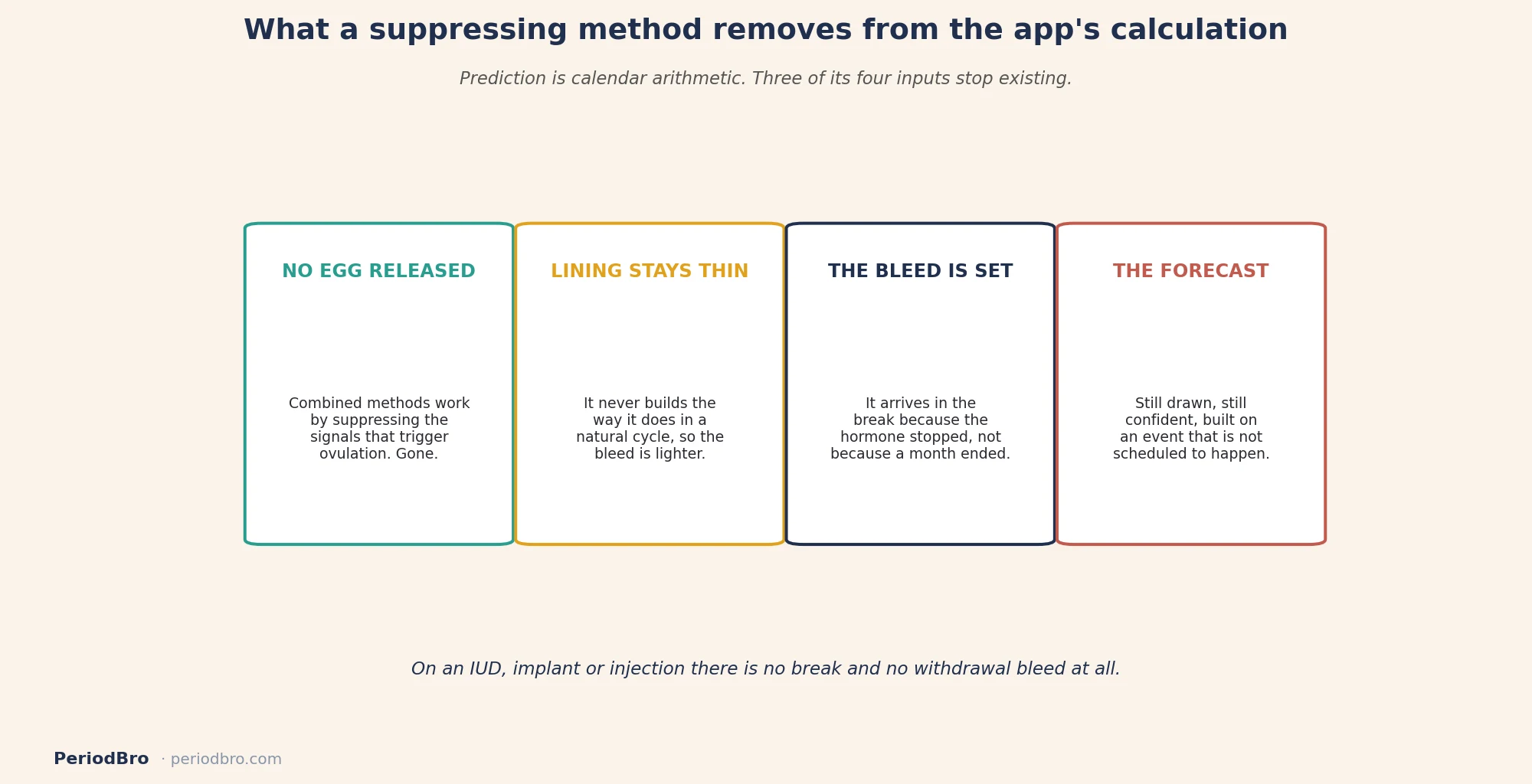
A natural cycle bleeds because an egg was released, the lining thickened in case it was needed, no pregnancy happened, hormone levels dropped, and the lining shed. On a combined pill, ring, or patch, the first step never occurs. These methods work mainly by suppressing the hormonal signals that trigger ovulation, so there is no egg release, and the lining stays thin rather than building up.
What happens in the placebo week is a withdrawal bleed, triggered by the hormone level dropping when the active pills stop. Cleveland Clinic puts it plainly: because the lining does not thicken the way it does in a natural cycle, a withdrawal bleed is typically lighter and milder than a period, though it tends to last a similar four to seven days. It is also, medically speaking, optional. There is no health requirement to have one, and skipping it is generally safe, which is a conversation for her and her doctor rather than a decision to make off an article.
The monthly bleed on her app is real, in the sense that it happens and it is worth logging. It is just not reporting what the app thinks it is reporting. What actually changes on hormonal birth control covers the biology side in full.

The fertile window on screen is decorative
This is the part worth being direct about, because it is the feature most people read first and it is the one carrying the least meaning.
Fertile window predictions in most consumer apps are calendar arithmetic. They take her recent cycle lengths, assume ovulation happened at a textbook point, and shade the days around it. That method struggles even in a natural cycle. In a study published in Obstetrics and Gynecology in 2016, researchers ran a standardised 28-day cycle through 20 websites and 33 phone apps and found that only one website and three apps predicted the precise fertile window. That was on the easiest possible input, a perfectly regular textbook month.
Now apply the same arithmetic to someone whose ovulation is being suppressed on purpose. The calculation still runs, because the app is counting days rather than measuring anything, and it produces a confident shaded band around an event that is not scheduled to occur. Our honest look at whether tracker apps work goes further into why prediction is the weakest thing these apps do even under good conditions.
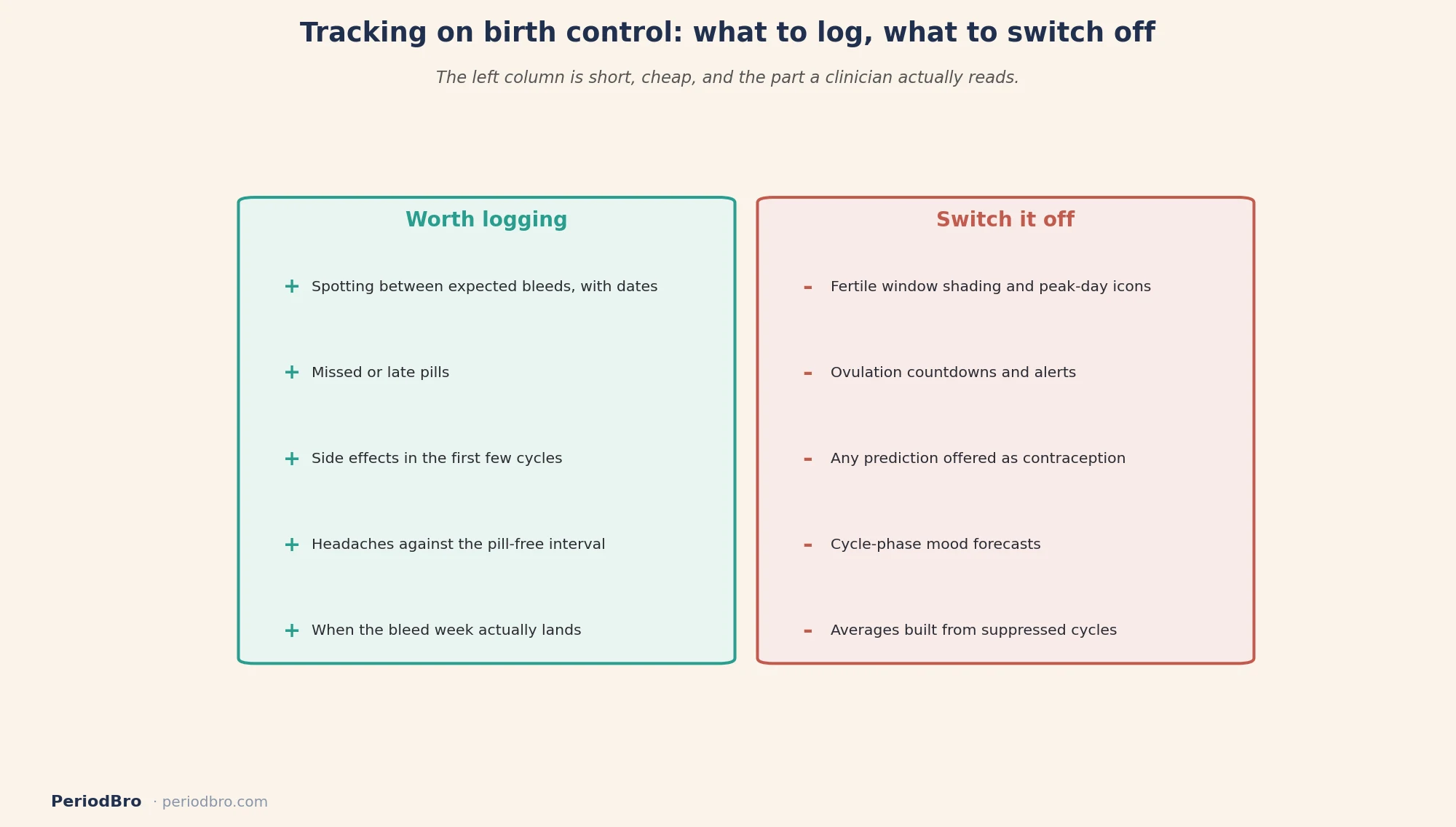
The practical instruction is short: if she is on a method that suppresses ovulation, turn the fertility features off if the app allows it, and mentally ignore them if it does not. And the obvious corollary, which is worth saying because people do get this wrong in both directions: an app is not contraception, and her contraception is not made better or worse by what the app displays.
What period tracking on birth control is actually good for
None of this means she should close the app. It means the app changes jobs, from forecasting to record-keeping, and the record turns out to be worth more than the forecast ever was.
Breakthrough bleeding is the main one. Spotting between expected bleeds is common in the first few months on a new method and usually settles, but the pattern is genuinely useful information, and it is impossible to reconstruct from memory three months later at an appointment. Logged, it is a two-second answer to a question her doctor will definitely ask.
Missed or late pills matter too, and most apps handle this better than a mental note does. So does the arrival of side effects, particularly in the first few cycles, since the question of whether a method suits her is usually settled by a pattern over months rather than by any single bad week.
Headaches deserve a specific mention. The timing of migraines relative to the pill-free interval is clinically relevant, and migraine with aura interacts with combined hormonal contraception in a way that matters, which makes a dated log more than a convenience. Menstrual migraines covers that in detail.
And the simplest one: knowing when her bleed week lands. That is still real, still predictable on most methods, and still the single most useful thing you personally get out of any of this.

It depends heavily on which method she is on
Lumping all hormonal contraception together is where most of the remaining confusion comes from, because the methods behave very differently on a calendar.
Combined pill, ring, and patch produce a scheduled bleed in the break, so there is a rhythm to track and the app looks roughly sensible even though the underlying cycle is suppressed. Extended-regimen pills do the same thing on a three-month interval instead of a monthly one.
Hormonal IUDs, implants, and the injection are a different situation entirely. These run continuously, so there is no break and no withdrawal bleed at all. Bleeding on these methods is irregular by design, often gets much lighter over time, and can stop altogether. That is expected rather than alarming, and it means a calendar view of her month will look like scattered dots or like nothing at all. On these methods, prediction is not merely inaccurate, it has no subject.
The progestogen-only pill sits in between, with bleeding patterns that vary widely between people and often stay unpredictable.
The one thing every method shares: when she comes off it, the app needs several months before its predictions mean anything again, because it has no recent natural cycles to learn from. What happens to her cycle after stopping birth control covers that stretch.
When a bleeding pattern is worth a call
Most changes on hormonal contraception are ordinary, particularly early on. A few are worth a conversation rather than a wait.
Bleeding that runs longer than a week, bleeding that turns up in the middle of an active pill pack rather than in the break, and breakthrough bleeding that is still going after the first several months on a method are all reasonable reasons to call. So is a bleed that stops appearing on a method that had been producing one reliably, since that is worth confirming rather than assuming. And any new headache with visual symptoms on a combined method deserves same-week attention rather than a logged note.
None of that is a reason to stop a method on your own initiative, and none of it belongs to you to decide. Spotting between periods covers the wider set of causes.
The version of this that stays healthy
One last thing, and it is the thing that goes wrong most often once a partner gets interested in the data.
Her contraception is her medical decision and her log is her record. Period tracking on birth control is genuinely more useful to her than to you, since most of its value is a clean history for appointments, and the appropriate posture is being the person who remembers rather than the person who monitors. Tracking with consent and how to do this without being creepy both cover where that line sits.
What you get, honestly, is smaller than the app’s interface suggests and more useful than you would think. You know when her bleed week lands, and you know whether a rough fortnight was the third one in a row or the first. That is the whole return, and it is enough.

PeriodBro logs what is actually happening rather than predicting what is not, which is the right way round when she is on a method that suppresses ovulation. Try it free.
This article is general information, not medical advice. Questions about a contraceptive method, and any change in bleeding on one, belong with her clinician.