
Menstrual Disc: What Partners Should Know Before She Tries One
The first time I saw a menstrual disc, it was sitting on the edge of a friend’s bathroom sink, and I honestly thought it was a lid for something. A soft, flat ring with a thin film stretched across it. His partner had switched to one a few months earlier, and he told me she’d stopped carrying a spare pair of pants in her work bag. That got my attention more than anything on the box.
If your partner has mentioned a menstrual disc, or you’ve seen them next to the tampons and wondered what the fuss is about, the short version is that it’s a period product that sits higher than a tampon or cup, holds a lot of fluid, and has a few tradeoffs worth knowing. This guide covers what it is, how it compares to the other options, and how you can be useful without being weird about it.
What a menstrual disc is
A menstrual disc is a flexible ring with a soft, shallow basin. It’s folded, inserted, and pushed back until it sits in the widest part of the vaginal canal, just below the cervix, with the front edge tucked up behind the pubic bone. It collects blood instead of absorbing it, which puts it in the same family as the menstrual cup, just with a different shape and a different spot.
There are two main kinds. Disposable discs are made from medical-grade polymer and are meant for one use (some brands allow reinsertion during the same period). Reusable discs are usually silicone and last for years with cleaning between uses.
The biggest thing they have going for them is capacity. A 2023 study in BMJ Sexual & Reproductive Health was the first to test 21 period products with actual blood instead of saline. Menstrual discs held the most, averaging about 61 ml. Tampons, pads and cups landed between roughly 20 and 50 ml, and period underwear held about 1 ml (DeLoughery et al., via PubMed; BMJ Group).
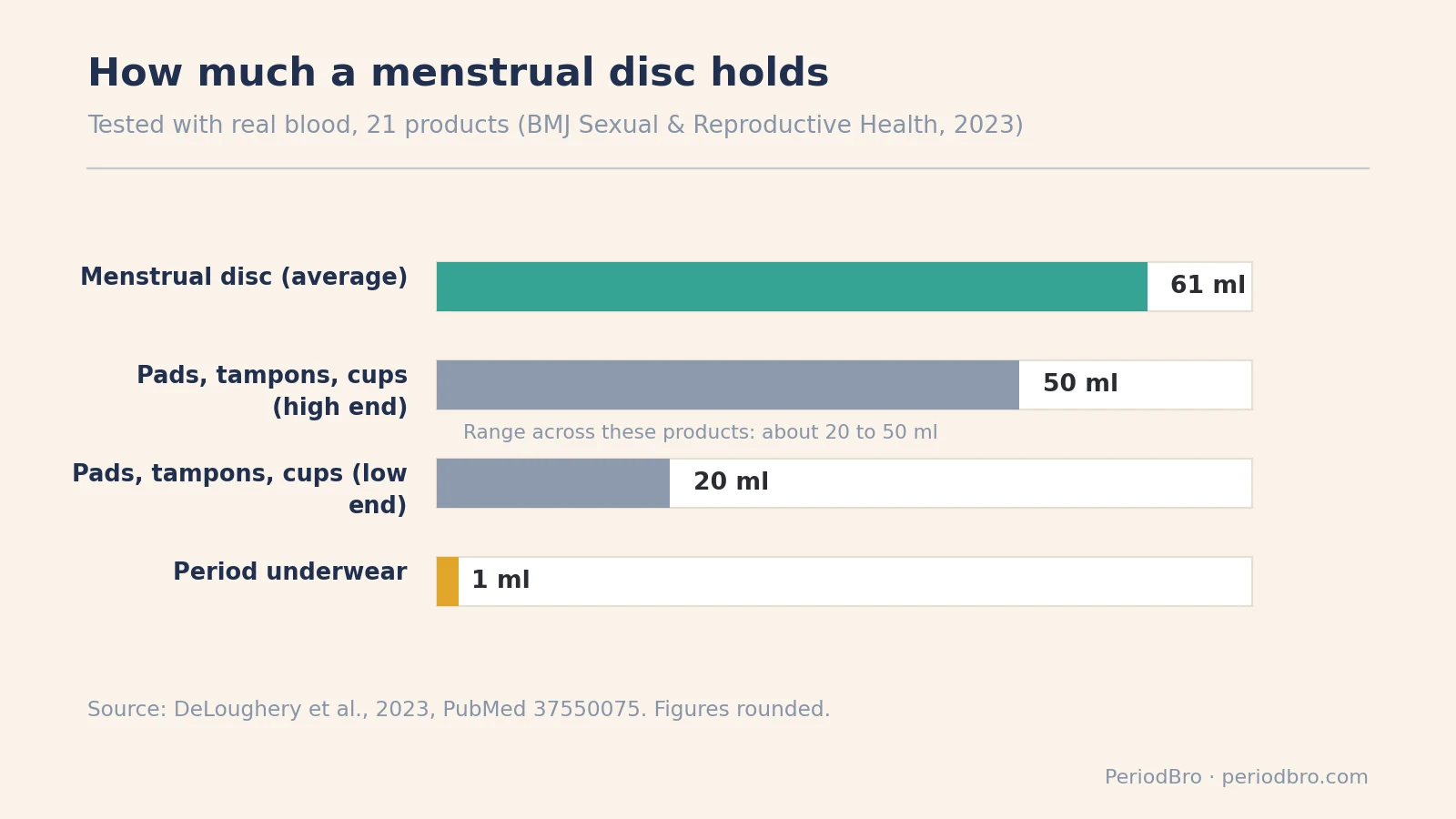
The researchers’ actual point was about heavy periods. Doctors often estimate bleeding by counting soaked tampons or pads, and the study showed that product capacities vary enough to throw those counts off. If she has heavy periods, that’s a useful thing to know. How to help with heavy periods covers the partner side of that.
Menstrual disc vs cup vs tampon
Here’s how the disc compares with the two options she’s most likely using now.
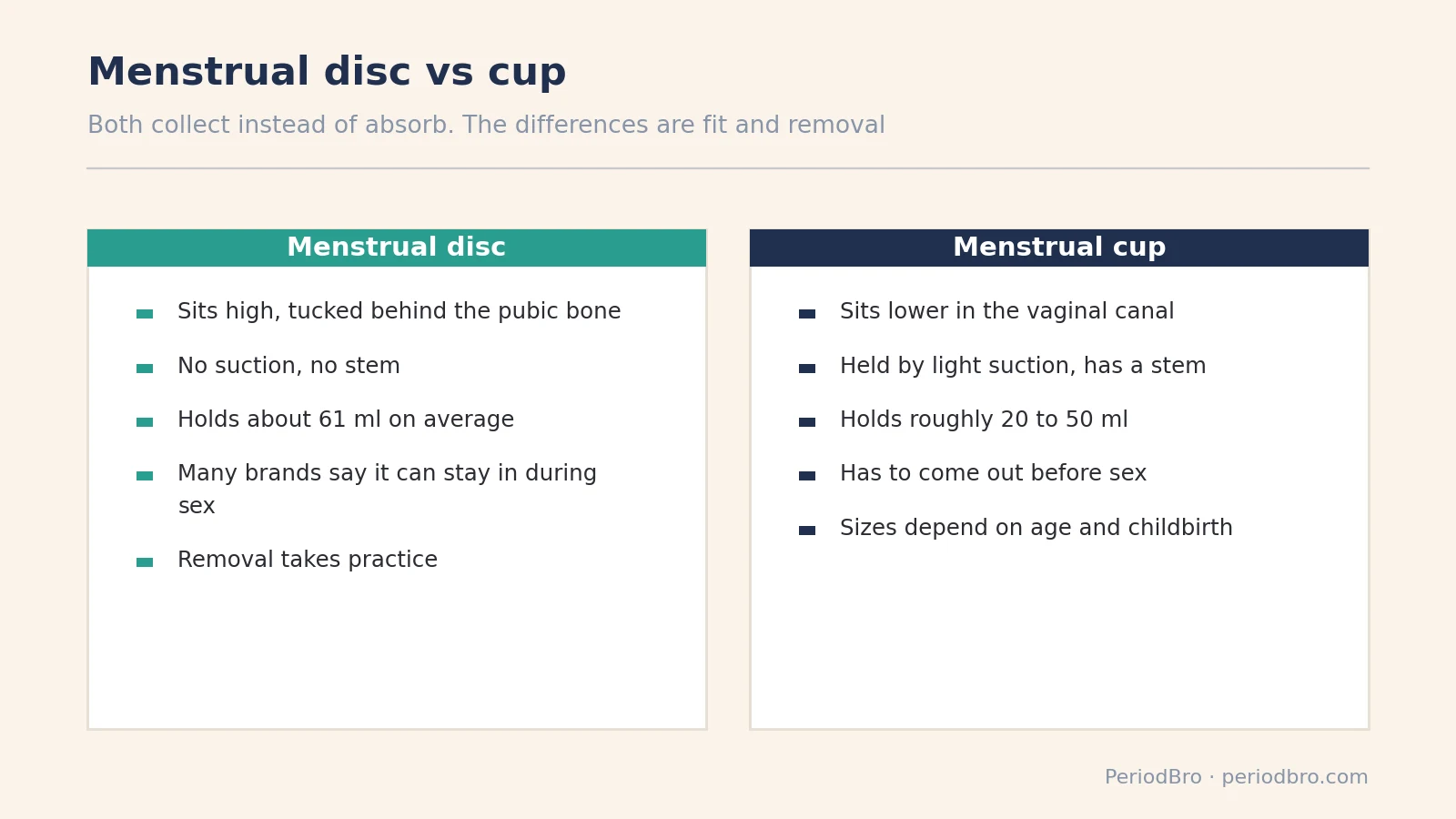
Where it sits. A cup sits low in the vaginal canal and holds itself in place with light suction. A disc sits higher, in the widest part, and stays put by tucking behind the pubic bone. No suction, which some people find more comfortable.
How long it lasts. Most disc brands say up to 12 hours, which is similar to cups. Tampons are usually 4 to 8 hours. Longer wear is part of the appeal, though it’s safer to treat “up to 12 hours” as a ceiling.
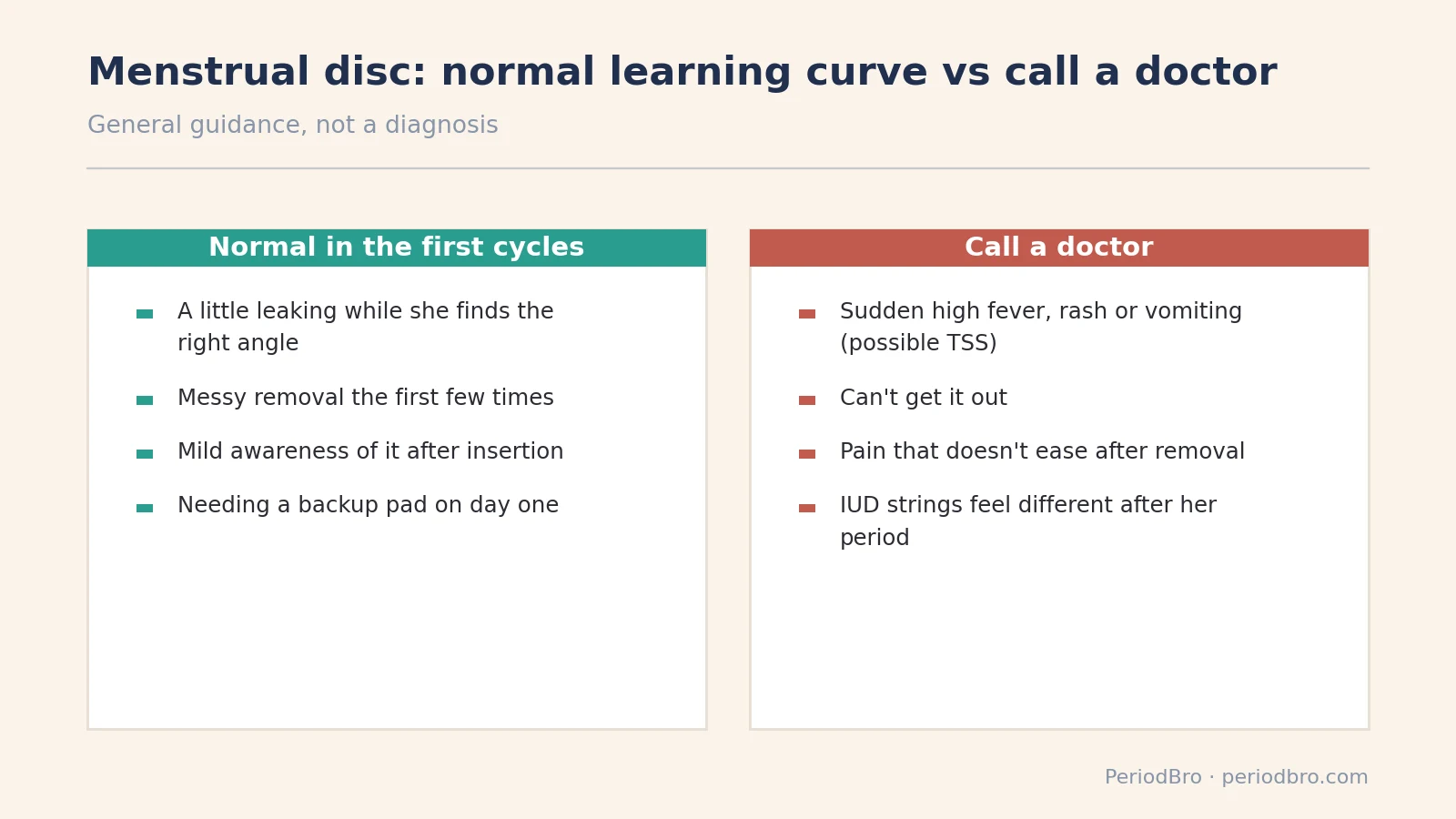
Removal. This is the weak spot. Discs are removed by hooking a finger under the rim and pulling out while keeping it level. There’s a learning curve, and the first few tries can be messy. Cups have a stem, which makes them easier to find.
Sizing. Cups come in sizes based on age, childbirth, and cervix height. Discs are more forgiving, often one or two sizes.
Sex. Because a disc sits up out of the vaginal canal, many brands market them as wearable during penetrative sex. A cup has to come out first. Two cautions: a disc isn’t birth control and doesn’t protect against STIs, and whether it’s comfortable is her call.

Is a menstrual disc safe?
For most people, yes, with the same basic rules as any internal product.
Toxic shock syndrome. TSS is rare, but Cleveland Clinic notes that anything left in the vagina too long can raise the risk, cups included (Cleveland Clinic). Discs are in the same category. Empty it within the time on the box, wash hands before and after, and clean reusable discs the way the maker says. Our TSS symptoms guide lists the warning signs, which include a sudden high fever, a sunburn-like rash, and vomiting.
IUDs. If she has an IUD, this is worth a conversation with her doctor. A systematic review of menstrual cups and IUD expulsion found that some studies reported higher rates of expulsion among cup users while others didn’t, and the evidence isn’t settled (PMC). Discs haven’t been studied as much. The usual advice is to be careful to break any seal and not to pull on the IUD strings, and to check the strings after the period.
Allergies. Reusable discs are usually medical-grade silicone, and disposables use polymers, so latex allergies are rarely an issue. Check the box if she has sensitivities.
Cleaning and storing a reusable menstrual disc
Disposable discs go in the trash, wrapped, never down the toilet. Reusable ones need a little care, and knowing the routine means you won’t accidentally wreck one with the wrong sponge.
During her period, the usual routine is to empty the disc, rinse it with cool water first so the blood doesn’t set, then wash it with warm water and a mild, unscented soap before putting it back in. Between periods, most makers suggest a longer clean, often a few minutes in boiling water, and then letting it dry fully before storing it in a breathable pouch rather than a sealed plastic box. Every brand has its own instructions, and hers are the ones that count.
If you share a kitchen, a small dedicated pot for boiling it saves an awkward conversation later. Scented soaps, oil-based cleaners and dishwashers are generally a bad idea for silicone that’s going back inside someone’s body. A disc that turns sticky, cracks, or starts to smell even after cleaning is due for replacement.
What a partner can do with this
You don’t need an opinion on which product she uses. That’s her decision, and she knows her body better than any comparison chart. What you can do is make trying something new easier.
Offer to cover the cost of experimenting. A reusable disc usually costs more upfront than a box of tampons. If she’s curious but hesitant, offering to split or cover the first one takes a small barrier away. Disposable discs are a cheaper way to see if she likes the idea at all.
Give her time to learn. The first cycle on a disc is often a practice round. She might want to try it on a day at home first, with a pad or period underwear as backup. Don’t plan a long hike for that weekend.
Keep backups in the house. Whatever she uses now, keep some in the cupboard while she’s switching. Our guide on period products for partners lists the basics, and period underwear makes a good backstop during the learning curve.
Don’t make it a bedroom sales pitch. If you’ve read that discs can be worn during sex, great, but let her bring that up. “I read you can have sex with these in” is a bad opener for a conversation about her period products.

Who a menstrual disc tends to suit
- Heavy flow, since it holds more than most other options.
- Long days away from a bathroom, like travel, shifts, or workouts.
- Anyone who found cups uncomfortable because of the suction or the stem.
- Couples who’d like to have sex during her period without a mess.
It’s probably less of a fit if she hates anything internal, if she has trouble reaching high enough to remove it, or if she has an IUD and her doctor isn’t comfortable with it.
My friend’s partner still uses a disc. He said the only thing he did was order a spare after she lost one in a hotel bathroom, which is about the right level of involvement. She picked the product, he kept the cupboard stocked, and neither of them had to think about it much after that.
If you want to go one step further and know when she’ll need any of this, here’s how to track her cycle without being creepy.
PeriodBro provides educational information and is not a substitute for professional medical advice. Always consult a qualified healthcare provider for personal medical decisions, especially if she has an IUD or a history of TSS.