Endometriosis for Partners: The Pain That Takes Years to Name
She has been told her periods are normal. She has been told to take ibuprofen and get on with it. She has spent days on the bathroom floor and then gone to work anyway. If that pattern sounds familiar, endometriosis for partners is worth understanding properly, because the thing most people get wrong about it is the timeline.
The misunderstanding is about the years rather than the biology. The average person with endometriosis spends a long stretch being disbelieved before anyone puts a name to it, and knowing that changes what you are useful for.
What endometriosis actually is
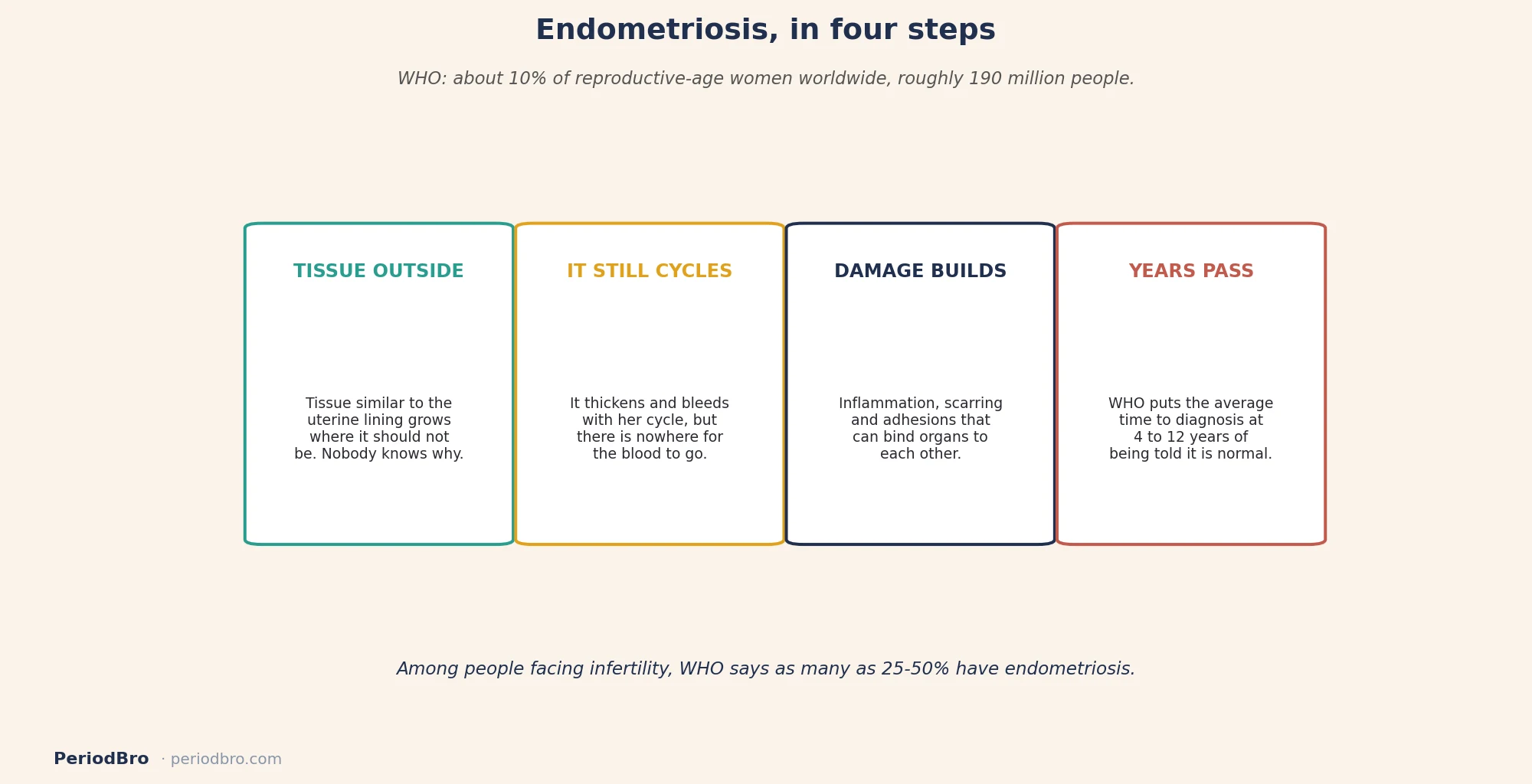
Tissue similar to the lining of the uterus grows outside the uterus. That tissue responds to the same hormonal cycle as the lining does, so it thickens and bleeds each month with nowhere for the blood to go. The result is inflammation, scarring, and adhesions that can bind organs to each other.
The scale is not small. The World Health Organization puts it at roughly 10% of reproductive-age women worldwide, about 190 million people. That is the same order of magnitude as diabetes, for a condition most people cannot describe.
The symptoms, and why they get dismissed
WHO lists severe pain during menstruation, heavy bleeding, chronic pelvic pain, infertility, abdominal bloating and nausea, plus effects on sex, bowel movements, urination, and mental health.
Every item on that list has an innocent explanation available, which is exactly the problem. Painful periods get filed under bad luck, bloating under diet, pain during sex under something being wrong with the relationship, and fatigue under stress. Examined one at a time, each symptom has a dismissive answer waiting for it.
WHO is direct about the consequence: the average time to diagnosis runs between 4 and 12 years. Symptoms vary widely between people, and awareness among health workers is uneven. Someone can spend most of their twenties being told this is normal.
The knock-on effects are real too. WHO notes that some people have symptoms severe enough to keep them from work or school, with lost income following. And among people struggling with infertility, as many as 25% to 50% have endometriosis.
Where the pain actually shows up
Calling it a period problem undersells it, and that mislabel is part of why it gets missed. Tissue can sit on the bowel, the bladder, the ligaments that hold the uterus, and elsewhere in the pelvis, so the pain follows those locations rather than staying politely menstrual.
That is why WHO’s symptom list reaches past bleeding into bowel movements and urination. It also explains pain that arrives on days when she is not bleeding at all, back pain that gets treated as a posture issue, and pain during sex that gets read as a relationship problem by both people involved.
There is a fatigue layer underneath all of it too. Chronic inflammation is tiring in its own right, and add broken sleep on the bad nights and the exhaustion becomes its own symptom rather than a side effect. If she seems to run out of energy faster than the pain alone would explain, that is consistent rather than strange, and period fatigue covers the mechanism.
How it gets diagnosed
Historically, definitive diagnosis meant laparoscopic surgery, which is a large part of why the wait was so long. Clinical practice has shifted toward presumptive diagnosis based on symptoms and imaging, with treatment started without waiting for surgical confirmation. That change matters because it removes the biggest bottleneck in the pathway.
What still helps most is a symptom record kept over months. Pain scores by cycle day, what stopped her doing, what did and did not help, whether pain shows up outside her period. A clinician can work with that. A description of a bad week cannot carry the same weight.
If you are still trying to work out where the line sits between rough periods and something more, we covered that in is her period pain normal, and the full picture on cramps is in our field guide to period cramps.

What treatment can and cannot do
WHO states plainly that there is no cure. Treatment manages symptoms, and the menu runs from NSAIDs through hormonal contraceptives, progestins, and GnRH analogues, to surgery that removes lesions, and IVF where conception is the goal.
Two implications follow, and both are worth absorbing before you talk about it with her. Treatment is a long-run management project rather than a fix, so expecting resolution sets both of you up for disappointment. And surgery can help substantially without being permanent, because tissue can recur.
Where you actually matter
Chronic pain conditions are lonely in a specific way: the pain is invisible, the diagnosis took years, and the people around her have a track record of not believing her. Being the person who does believe her counts for more than it sounds like.
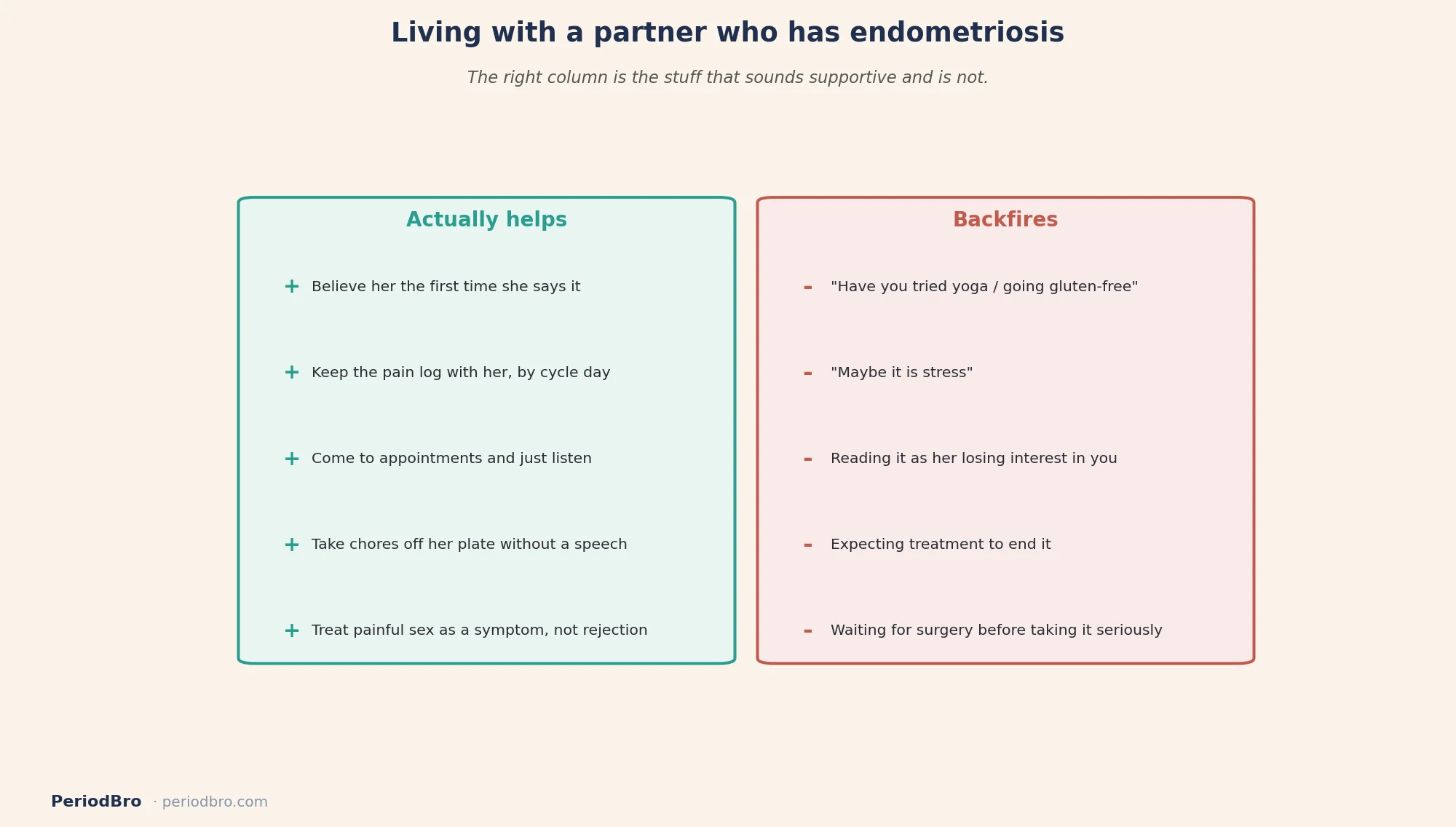
Believe her the first time. Not “have you tried” and not “maybe it is stress.” She has heard every version of that from professionals for years, and hearing it at home closes something.
Keep the record with her. Cycle days, pain scores, what she missed. This is the single most concrete thing a partner can hand a clinician.
Go to appointments. Not to speak for her. To listen, because being disbelieved in a room is easier to push back on with a witness in it.
Understand what pain during sex means. It is a documented symptom, not a verdict on you or on the relationship. Treating it as rejection is the most common and most damaging misread there is. Our guide to sex and her cycle covers the wider ground.
Take the load on bad days without a performance. Meals, laundry, cancelled plans handled quietly. Practical help beats sympathy every time, which is the theme running through being supportive when you cannot fix her pain.
Knowing where she is in her cycle also helps you predict the hard days rather than react to them, which is what showing up well through her cycle comes down to.
Common questions
How would I know if she has endometriosis?
You would not, and neither would she without a clinician. The pattern worth raising is pain that stops her functioning, pain outside her period, pain during sex, or heavy bleeding that has been dismissed more than once.
Does it mean she cannot have children?
No. It is strongly associated with infertility, with WHO noting 25% to 50% of people facing infertility have it, and plenty of people with endometriosis conceive. Fertility treatment exists specifically for the cases where it is a barrier.
Will surgery fix it?
Surgery can remove lesions and reduce pain substantially. It is not a cure, and recurrence happens, so it usually sits inside a longer management plan rather than ending one.
Why did nobody catch it earlier?
Because symptoms overlap with ordinary complaints, there is no simple test, and awareness varies. WHO puts the average diagnostic delay at 4 to 12 years.
Is endometriosis hereditary?
Having a close relative with it raises the odds, which is why family history is one of the first things a clinician asks about. It is worth knowing whether her mother or sisters had years of unexplained period pain, since that history is often undiagnosed rather than absent.
Does pregnancy cure it?
No, and this is advice people still receive. Symptoms sometimes ease during pregnancy because cycling stops, and they typically return afterwards. WHO is unambiguous that there is no cure.
What do I say when she is in the middle of it?
Less than you think. “What would help right now” beats any amount of research, and doing the thing she names beats saying anything at all.
This article is general information, not medical advice. Endometriosis is diagnosed and managed by clinicians. Severe pelvic pain, pain that stops her functioning, or heavy bleeding deserve a proper evaluation rather than a coping strategy.