

Implantation Bleeding vs Period: How to Tell the Difference
A friend of mine and his wife had been trying for a baby for about five months when she found a little pink on the toilet paper, three days before her period was due. He texted me at midnight: “Is that implantation bleeding or her period starting?” I didn’t know. Neither did Google, at least not with any confidence. If you’re in the same spot, this is the plain version of what’s known about implantation bleeding vs period bleeding, what you can actually tell from looking, and what to do while you wait.
You often can’t tell for sure by sight alone. A pregnancy test, taken at the right time, is what settles it. There are still real differences worth knowing, plus a few signs that mean “call a doctor” whatever it turns out to be.
What implantation bleeding is supposed to be
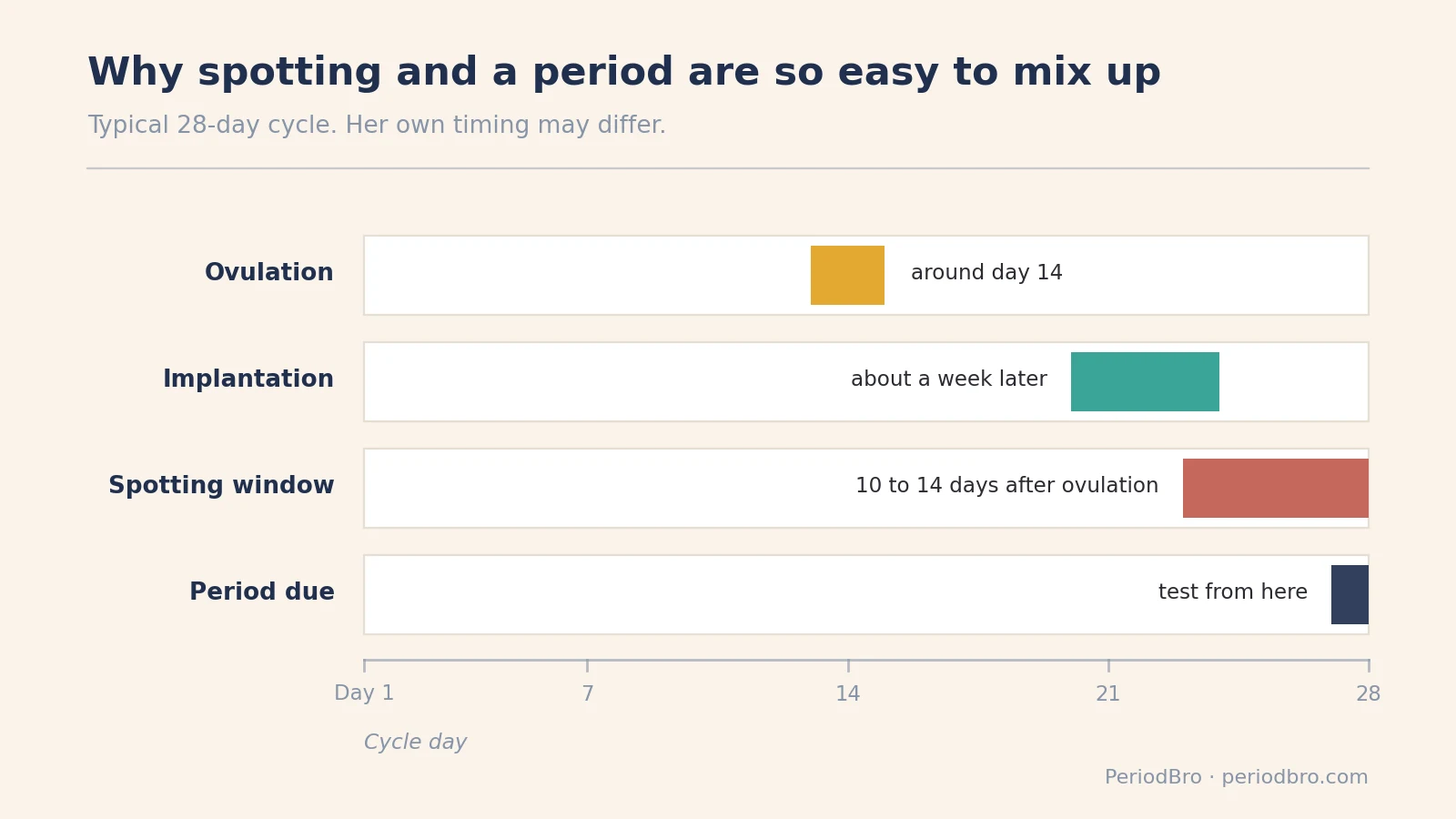
About a week after ovulation, a fertilized egg reaches the uterus and burrows into its lining. The idea behind implantation bleeding is that this can disturb a few tiny blood vessels and cause light spotting. Cleveland Clinic describes it as very light bleeding, usually pink or brown, that lasts anywhere from a few hours to about two days, and says it tends to show up around 10 to 14 days after ovulation (Cleveland Clinic).
Ten to 14 days after ovulation is also when a period is due, and that overlap is the whole reason this question is so confusing. If you want the background on what’s happening in her body during those two weeks, our explainer on the luteal phase covers it, and ovulation explained covers the day it all starts from.
The research is less sure than the internet
When researchers at the NIH followed 221 women who were trying to conceive, with daily diaries and daily urine samples, 14 of them (about 9%) had some bleeding in the first eight weeks of pregnancy. Twelve of those 14 pregnancies went on to a live birth. But the bleeding rarely lined up with the actual day of implantation. It tended to land around when a period would have been due, and the authors said they found no support for the idea that implantation itself causes bleeding (Harville et al., Human Reproduction, 2003).
That doesn’t mean spotting in early pregnancy isn’t real. It clearly is, and it’s common. It just means the neat story of “the egg implants, a drop of blood appears” is probably too tidy. For you, the practical takeaway is the same either way: light spotting around the expected period can happen in early pregnancy, and on its own it isn’t a bad sign.
Implantation bleeding vs period: the differences that matter
If you strip out the guesswork, three things tend to separate the two.
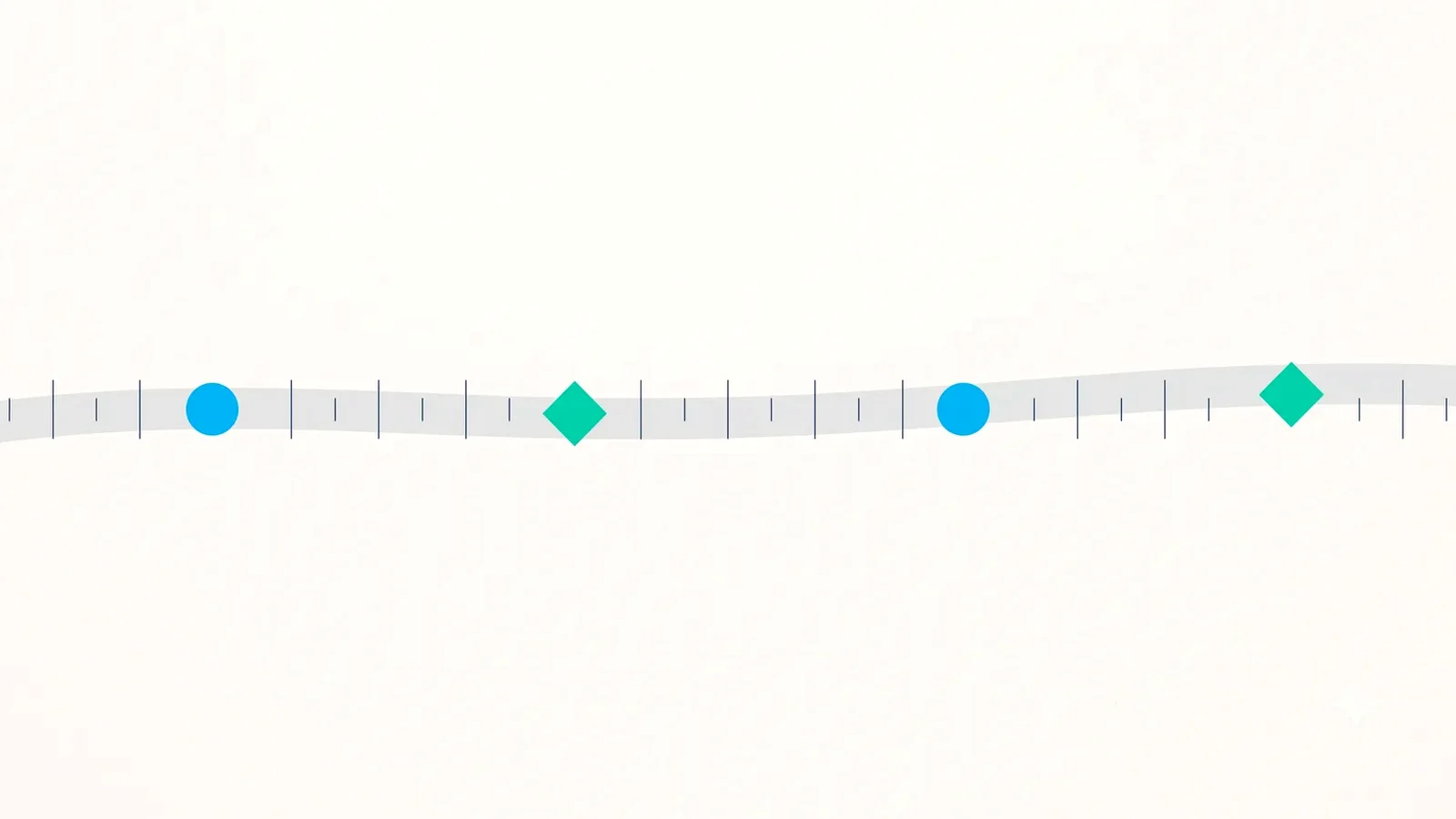
How much. Implantation-type spotting is light. It might show up only when she wipes, or as a few spots on a liner. Cleveland Clinic notes that heavy bleeding isn’t typical of implantation bleeding at all (Cleveland Clinic).
Where it goes. A period usually starts light and then picks up over a day or so into a normal flow. Spotting that stays light and then stops is the pattern people associate with early pregnancy. Clots point toward a period.
Color and length. Pink or brown, lasting a few hours to a couple of days, fits the implantation description. Bright or dark red that keeps going for several days fits a period. Our guide to period blood color goes into what different shades usually mean.
Still, plenty of periods start with a day of brown spotting, and plenty of people spot before every period for reasons that have nothing to do with pregnancy. That’s why none of these signs is a verdict. Our piece on spotting between periods covers the other common causes.

When a pregnancy test will actually tell you something
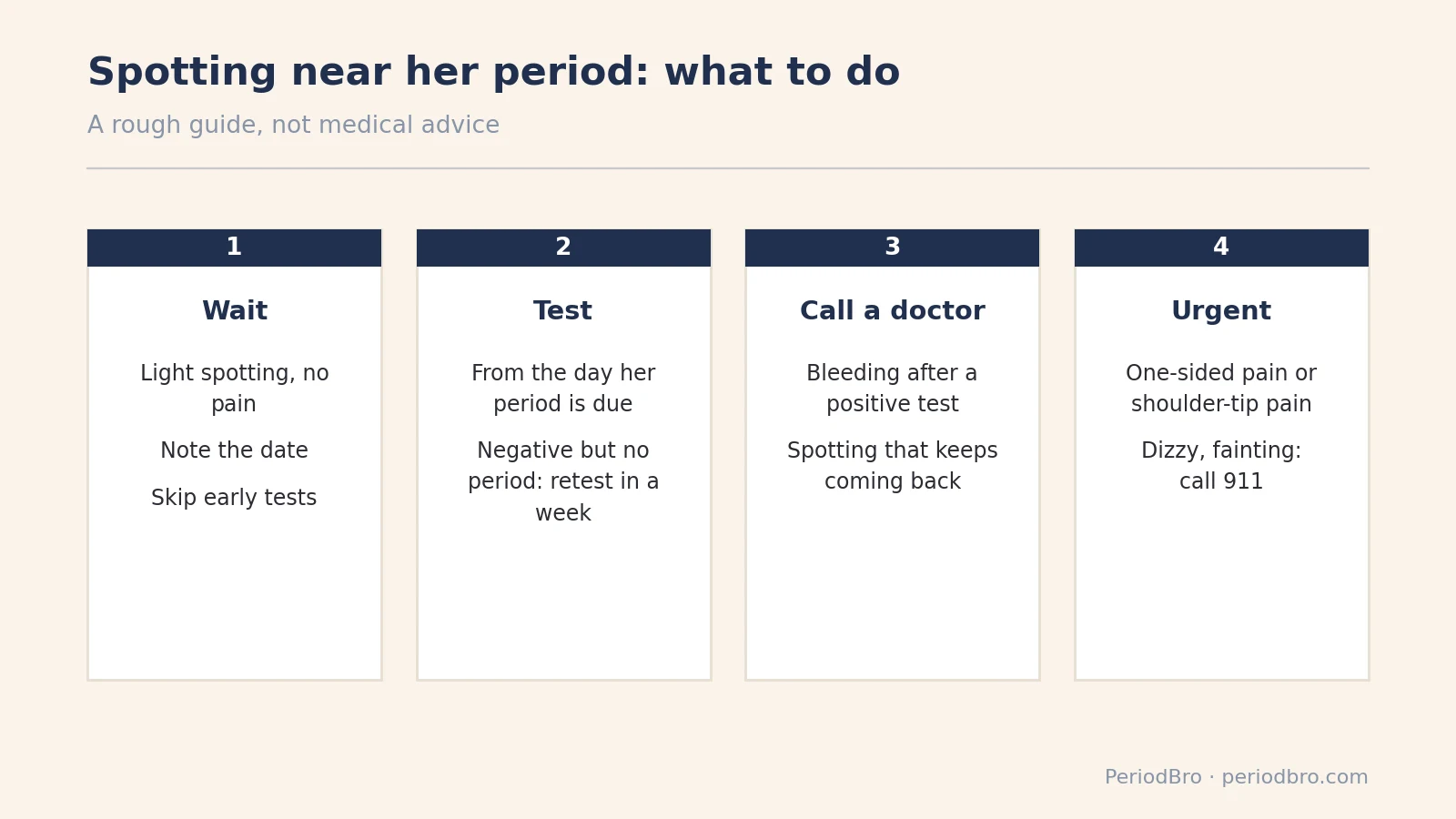
Pregnancy tests look for hCG, a hormone that only starts climbing after implantation and roughly doubles every two to three days early on. Mayo Clinic says that although some tests claim to work before a missed period, results are more likely to be accurate from the first day of the missed period, and waiting a day or two longer helps. If the test is negative and her period still hasn’t come, Mayo suggests testing again about a week after the missed period or calling a doctor (Mayo Clinic).
In practice, that means spotting three days before her period is due is too early for a test to answer the question reliably. A negative that day doesn’t mean much. A test on the day her period should have arrived, or a little after, means a lot more. If her cycles are irregular, the “day it was due” is fuzzy, which is one more reason a shared calendar helps. Our guide to cycle tracking when trying to conceive covers how couples set that up.
The wait, and what a partner can do with it
The few days between “is that blood?” and a test you can trust are rough, especially for a couple who’s been trying for a while. Every twinge gets analyzed. A few things helped my friend and his wife:
- Agree on a test day together, then stop testing every morning before it. Early negatives just add stress.
- Let her decide how much she wants to talk about it. Some people want to go over every symptom, others want a normal evening.
- Don’t play detective. Asking “what color is it now?” every few hours turns your partner into a lab report.
- Have a plan for both answers. If it’s a period, the disappointment is real, and a quiet evening and no pep talk often lands better than “next month for sure.”
If her symptoms are a mix of things that could be either, our comparison of PMS vs pregnancy symptoms walks through them sign by sign, and why her period might be late covers the non-pregnancy reasons a period gets pushed back.

When bleeding needs a doctor, whatever it is
Most light spotting around the expected period turns out to be either a period or a healthy early pregnancy. But some combinations deserve a call the same day, or the ER. The biggest worry with bleeding in early pregnancy is an ectopic pregnancy, where the pregnancy grows outside the uterus. The NHS lists pain low in the belly on one side, vaginal bleeding or brown watery discharge, pain at the tip of the shoulder, and discomfort when peeing or pooing as possible signs (NHS).
Get medical help if she has:
- Bleeding with strong or one-sided pain in the lower belly.
- Shoulder-tip pain, dizziness or fainting. Treat these as an emergency and call 911.
- Heavy bleeding, soaking a pad an hour, or passing clots after a positive test.
- Any bleeding after a positive test that worries her. Calling her doctor or a nurse line is always reasonable.
If you’ve been through a loss before, the anxiety around any spotting can be much higher, and that’s worth saying out loud to each other. Our piece on her period after a miscarriage may help if that’s part of your story.
How it turned out for my friend
The pink spotting stopped by the next afternoon. They waited, which was harder for him than for her, and tested on the morning her period was due. Faint line. A second test two days later was clearer. Their daughter is two now.
He told me afterwards that the waiting was easier once they’d agreed on a test day and he’d stopped asking for updates. “I was trying to read tea leaves,” he said. What actually helped was knowing which day a test would mean something.
For the full picture of how a cycle runs from start to finish, our guide to menstrual cycle phases is the place to start. And if you’d like a heads-up on where she is in her cycle, including when a period is actually due, PeriodBro does that for partners. You can try it free here.
PeriodBro provides educational information and is not a substitute for professional medical advice. If you’re worried about bleeding or pain, contact a healthcare provider, and in an emergency call 911.