
Wanting to Break Up Before Her Period: What Partners Should Know
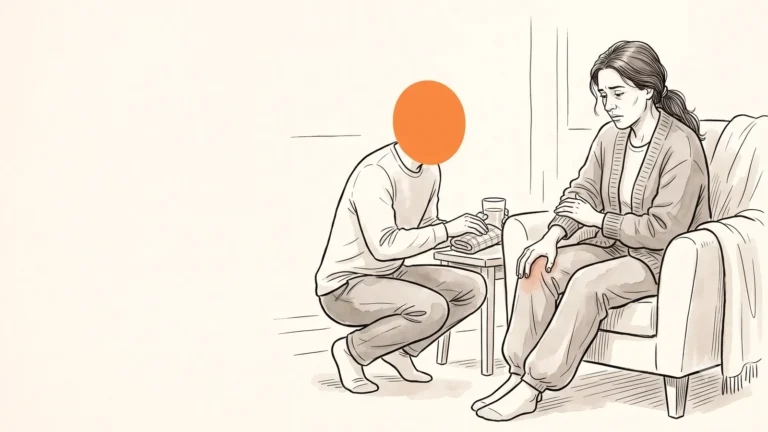
A buddy of mine got the “I’m not sure this is working anymore” talk on a Sunday night. He spent the next three days convinced it was over. On Thursday her period started, and by the weekend she was calmer and wanted to talk again, this time about one specific thing that had been bugging her for months. If your partner talks about wanting to break up before her period, you’re dealing with two things at once: a real feeling and a hormonal amplifier. This piece is about telling them apart without dismissing either one.
We’ll cover what happens in the days before a period, why relationship doubts get louder then, what not to say, what actually helps, and when the pattern points to something bigger, like PMDD.
Wanting to break up before her period: why the timing isn’t random
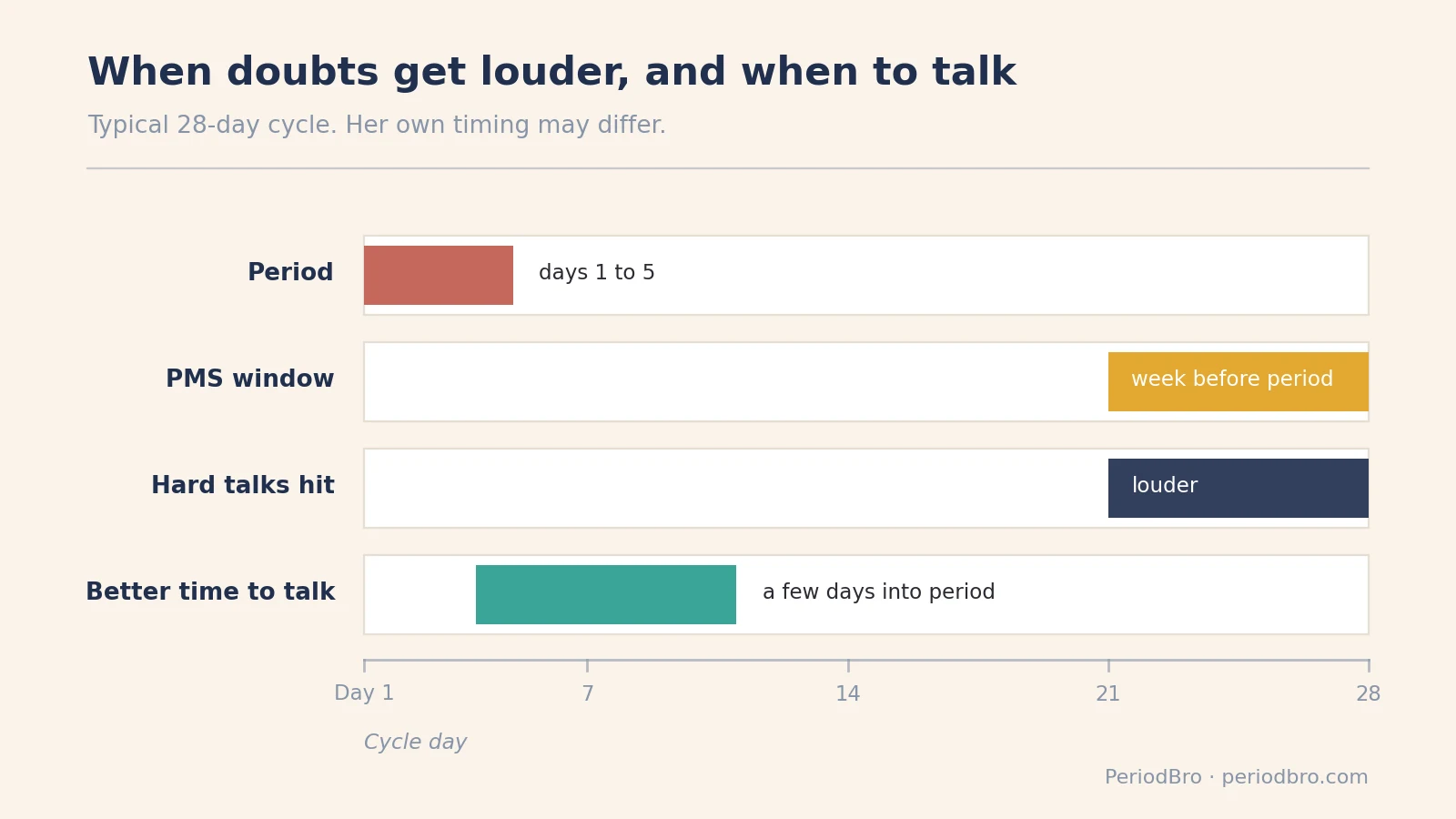
The week or so before a period is the late luteal phase. Progesterone and estrogen both drop sharply, and for many people that drop brings irritability, low mood, anxiety and a shorter fuse. ACOG lists mood swings, irritability, anxiety and feeling overwhelmed among the common emotional symptoms of PMS, and notes they ease within a few days after bleeding starts (ACOG). Our explainer on the luteal phase walks through what else is going on in her body during that stretch.
What those symptoms do is lower tolerance. The dishes you left out, the plans you keep forgetting, the feeling of carrying more of the household: none of that is new in the luteal phase. What changes is how much of it she can let slide. Researchers Jane Ussher and Janette Perz, who’ve studied premenstrual distress in couples for years, describe a pattern where relationship issues simmer for most of the month and then boil over in the premenstrual week (Ussher and Perz, 2017).
Said during that week, “I want to break up” can be a mood talking or a real concern finally getting airtime, and most of the time it’s a mix of the two.
The mistake that makes it worse
The fastest way to turn a hard week into a real breakup is to say some version of “you’re just hormonal.” Even when the timing is obvious, it tells her that what she said doesn’t count. It also hands her proof that you’ll write off anything she brings up during that week, which is exactly when she’s least able to keep it bottled up. We wrote a whole piece on blaming her hormones and why it backfires.
The opposite mistake is just as common: treating every word as a final verdict and panicking. That’s what my friend did. He spent three days drafting apology texts, asking mutual friends what she’d said about him, and reading meaning into every short reply. None of it helped, and some of it made the next conversation harder.
The useful middle ground sounds like this: “I hear you. I want to understand what’s been bothering you. Can we talk about it properly this weekend?” You’re taking it seriously and you’re not forcing a decision during the week when everything feels heaviest.
What usually helps in the moment
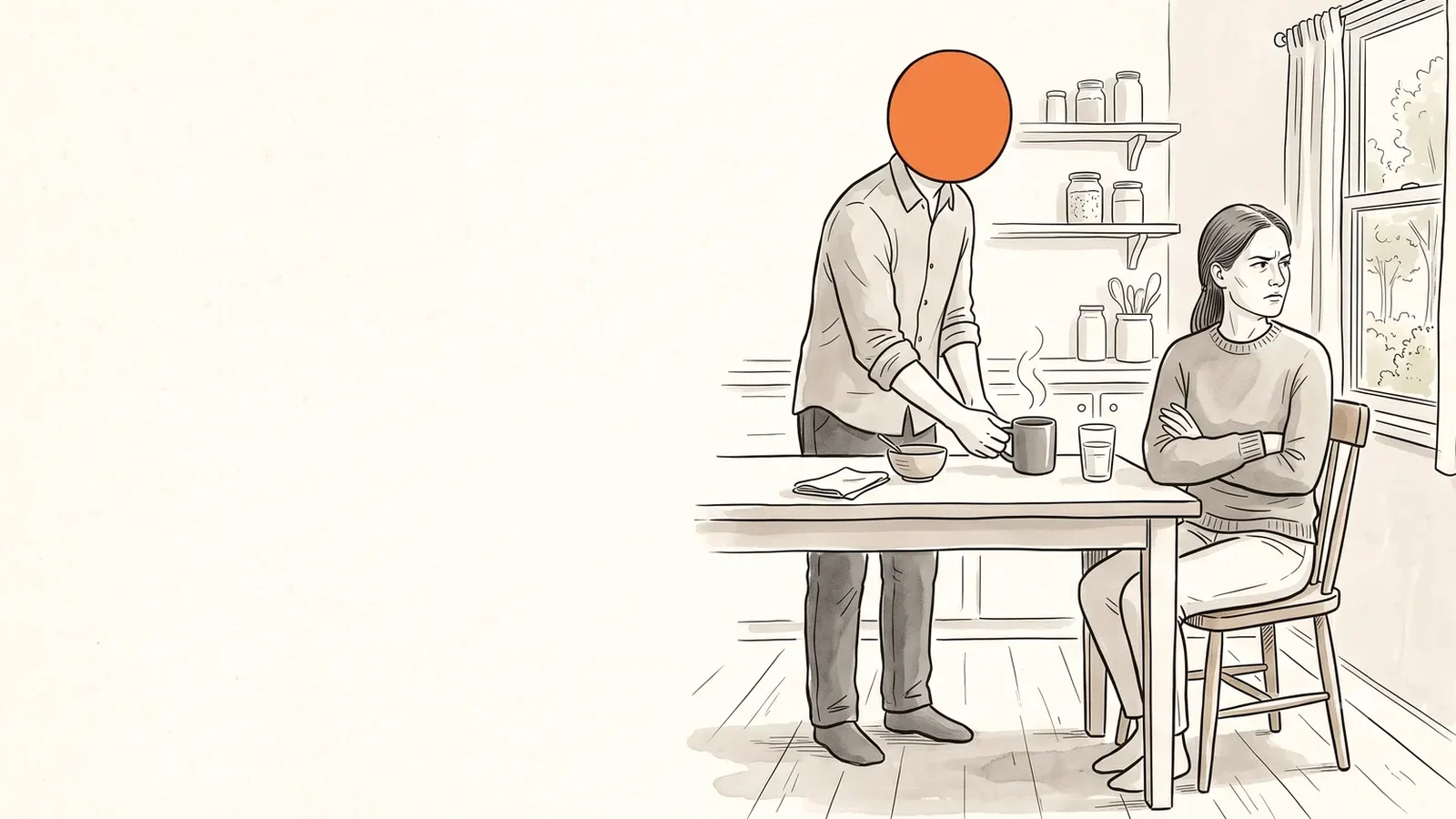
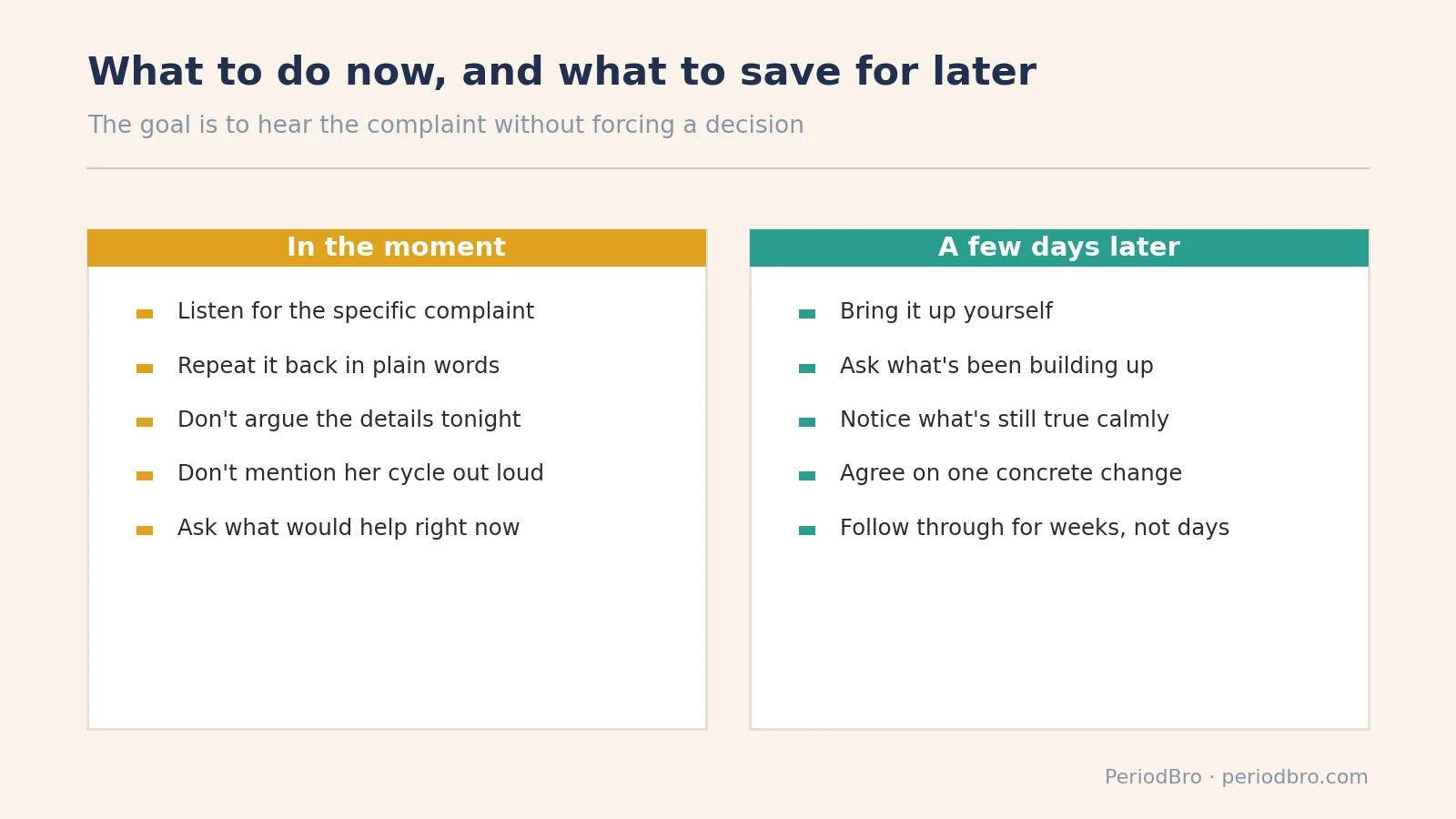
When the conversation starts, keep it short and calm. A few things tend to go better than others:
- Listen for the specific complaint under the big statement. “I don’t think this is working” often means “I’m tired of being the one who plans everything.”
- Repeat it back in plain words so she knows it landed.
- Don’t argue the details tonight. You can disagree later, when you’re both rested.
- Don’t make it about the calendar out loud, even if you know where she is in her cycle.
- Ask what would help right now. Sometimes the answer is space, sometimes it’s a hug, sometimes it’s taking a chore off her plate.
If things get heated, it’s fine to pause. Saying “I want to keep talking about this, but I’m getting defensive, can we pick it up tomorrow?” is a reasonable thing to do, and it usually keeps the next talk calmer. Our guide on handling arguments before her period has more on keeping these talks from spiraling.
The follow-up conversation is the one that matters
A few days after her period starts, most people with ordinary PMS feel noticeably better. That’s the window for the real talk. Bring it up yourself, so she doesn’t have to carry it: “Last week you said you weren’t sure about us. I’ve been thinking about it. What’s been building up?”
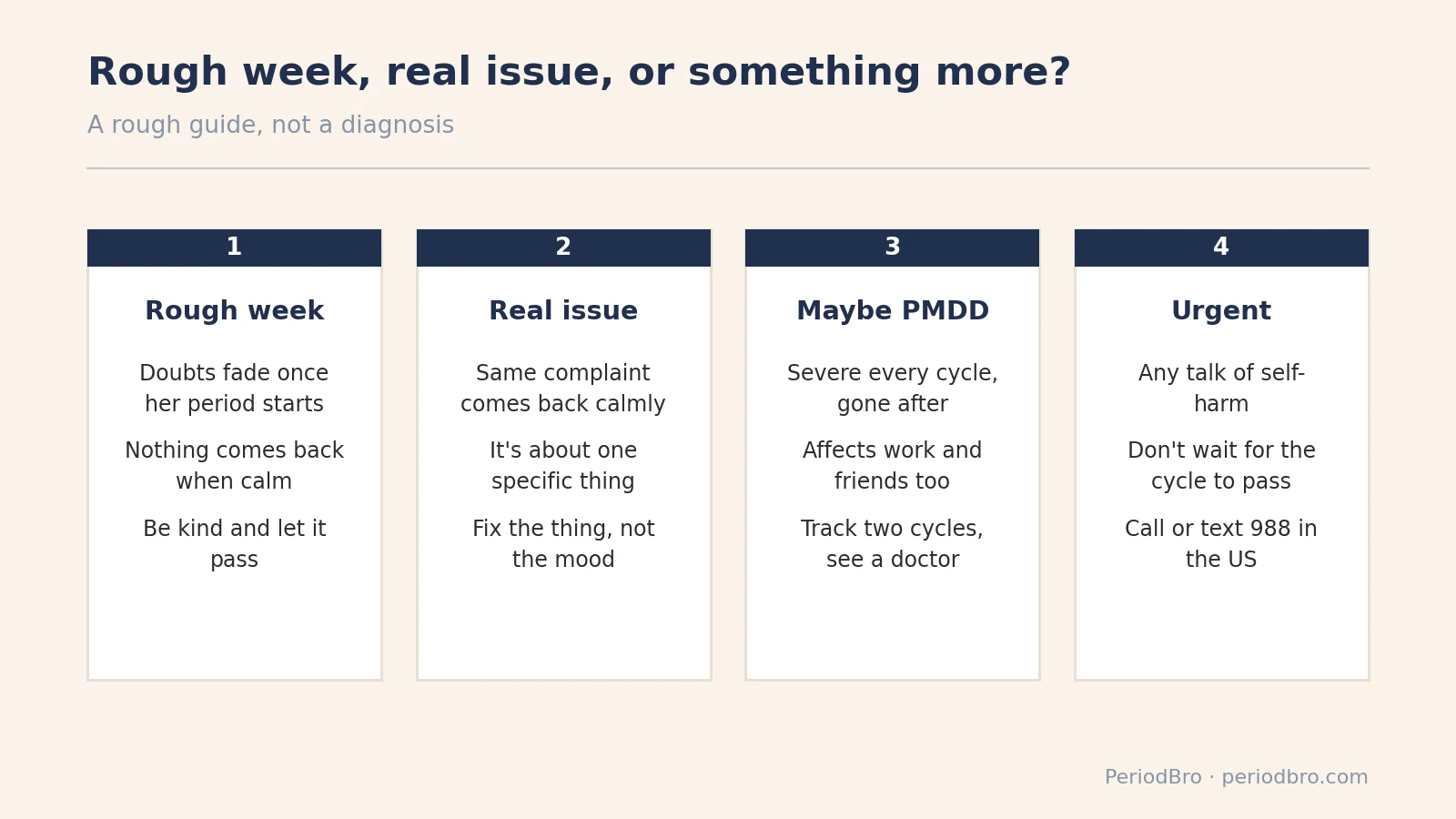
Pay attention to what’s still true once the mood has lifted. If she says “honestly, I was just having a rough week,” good, believe her. If the same complaint comes back calmly, that’s the one to work on. Our piece on when to have a hard conversation with her goes deeper on timing.
Couples work seems to help here. In the Ussher and Perz trial, 83 women with significant premenstrual distress were randomly assigned to one-on-one therapy, couple therapy or a waitlist. Both therapy groups improved compared with the waitlist, and the couple group showed more active coping and a better sense of being supported by their partner (PLOS ONE, 2017). In plain terms, it helped when the partner was part of the plan.
Look for the pattern, together
If the “maybe we should break up” talks keep landing in the same week of her cycle, it’s worth noticing, carefully. The point is to help her see the pattern. Pulling it out as a trump card in an argument will backfire. A shared log can do a lot here: the date of a big argument, where she was in her cycle, how she felt a week later. Two or three months of notes usually tell you more than any single fight.

Do this only if she’s on board. Tracking her cycle behind her back and bringing out the data mid-argument is a great way to lose trust. Our guide on tracking her cycle with consent covers how to set it up as a team thing. If the arguments keep circling back to the same topic no matter the timing, the hidden cause of recurring arguments might be worth a read too.

When it might be PMDD
For most people, premenstrual mood changes are annoying but manageable. For some, they’re severe. Premenstrual dysphoric disorder, or PMDD, affects up to 10% of people who have periods, according to Cleveland Clinic, and brings intense depression, anger, anxiety or hopelessness in the week or two before a period, easing soon after bleeding starts (Cleveland Clinic).
Signs it’s worth raising with a doctor:
- The relationship doubts, rage or despair show up nearly every cycle and are gone within a few days of her period.
- The symptoms are bad enough to affect work, friendships or daily life, not just your relationship.
- She describes feeling like a different person that week.
- Any thoughts of self-harm or suicide. That’s urgent. In the US, call or text 988.
PMDD is treatable. Options include certain antidepressants, hormonal approaches and therapy, and a diagnosis usually starts with tracking symptoms for two cycles (ACOG). We’ve covered how to get a PMDD diagnosis and PMDD and relationships if this sounds familiar.
What happened with my friend
On that Saturday he asked her what had been building up. It turned out to be one thing: she felt like she was always the one planning their weekends, their trips, their time with friends. She’d mentioned it twice before, lightly, and he’d agreed and then changed nothing. The premenstrual week made it harder for her to keep swallowing a resentment that was already there.
He took over planning for the next couple of months. She still had rough weeks before her period, but the “I’m not sure about us” talks stopped, because the thing underneath them was handled. They’re still together.
What I took from it: the hormones made the complaint louder, but the complaint itself was real. Once he dealt with it, the hard weeks got a lot easier to live with. For the bigger picture, read how cycle awareness changes a relationship.
I built PeriodBro so partners can see where she is in her cycle and get a heads-up before the harder days. If that sounds useful, you can try it free here.
PeriodBro provides educational information and is not a substitute for professional medical or mental health advice. If you or your partner are in crisis, contact a healthcare provider or call or text 988 in the US.