Blaming Her Hormones: Why It Backfires
Early in my marriage, I had a move I’m not proud of. Any time an argument started going somewhere I didn’t want it to go, I’d ask, casual as I could manage, “is this about your period?” It wasn’t really a question. It was an exit door, and I used it more than once before someone finally called me on it.
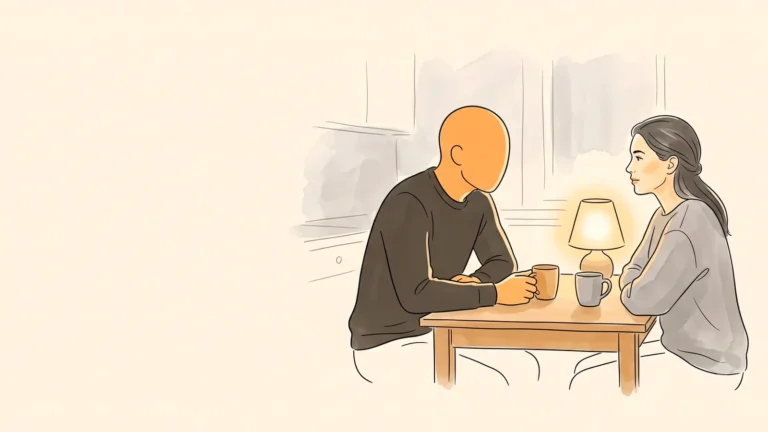
The one I remember clearest was about the car insurance. She’d asked me three times to call and switch us to a better plan, and I kept saying “yeah, this week,” and not doing it. When she finally brought it up with some real heat behind it, I didn’t apologize. I asked if she was “getting close to her period.” I still remember the look on her face, because it wasn’t anger. It was more like she was recalculating who she was talking to.
She didn’t yell. She said, “you know that’s not an answer, right?” and she was right. I wasn’t confused about what we were actually arguing about. I just wanted the argument to feel smaller than it was, and blaming her hormones was the fastest way I knew to shrink it.
Blaming her hormones is one of the most common moves a partner makes without clocking that he’s making it. It can even feel a little caring, like you’re handing her a reason instead of a criticism. What it actually does is end the conversation before it’s finished, whether or not her cycle has anything to do with what she’s upset about.
Why blaming her hormones shuts the conversation down
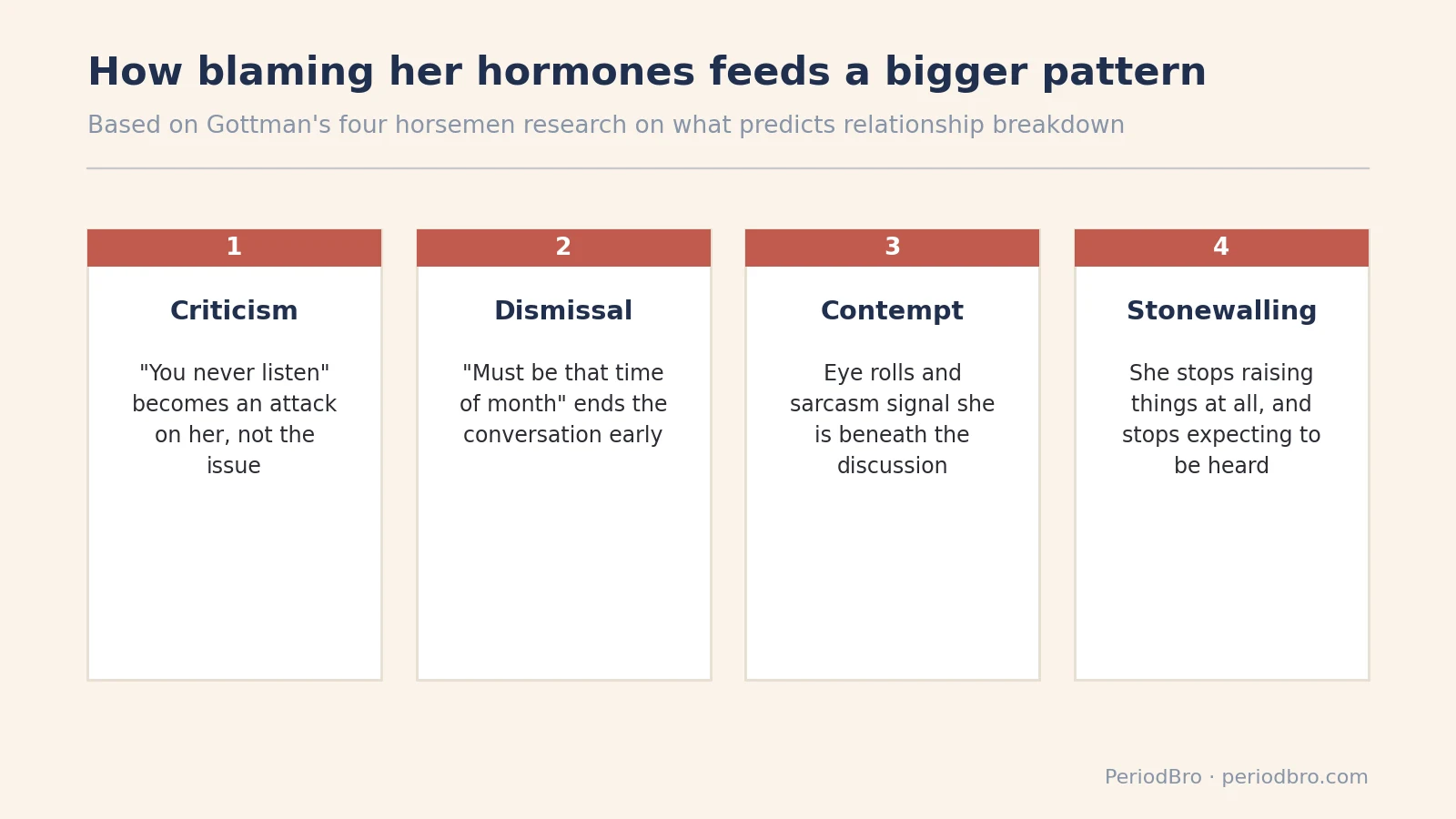
John Gottman’s decades of research on couples names dismissing or minimizing a partner’s feelings as one of the clearest paths into contempt, and contempt is the single behavior his research found most reliably predicted divorce among everything he measured. Contempt rarely shows up as a shouted insult. More often it’s smaller: an eye roll, a sigh, a flat “you’re being dramatic,” or “must be that time of month.”
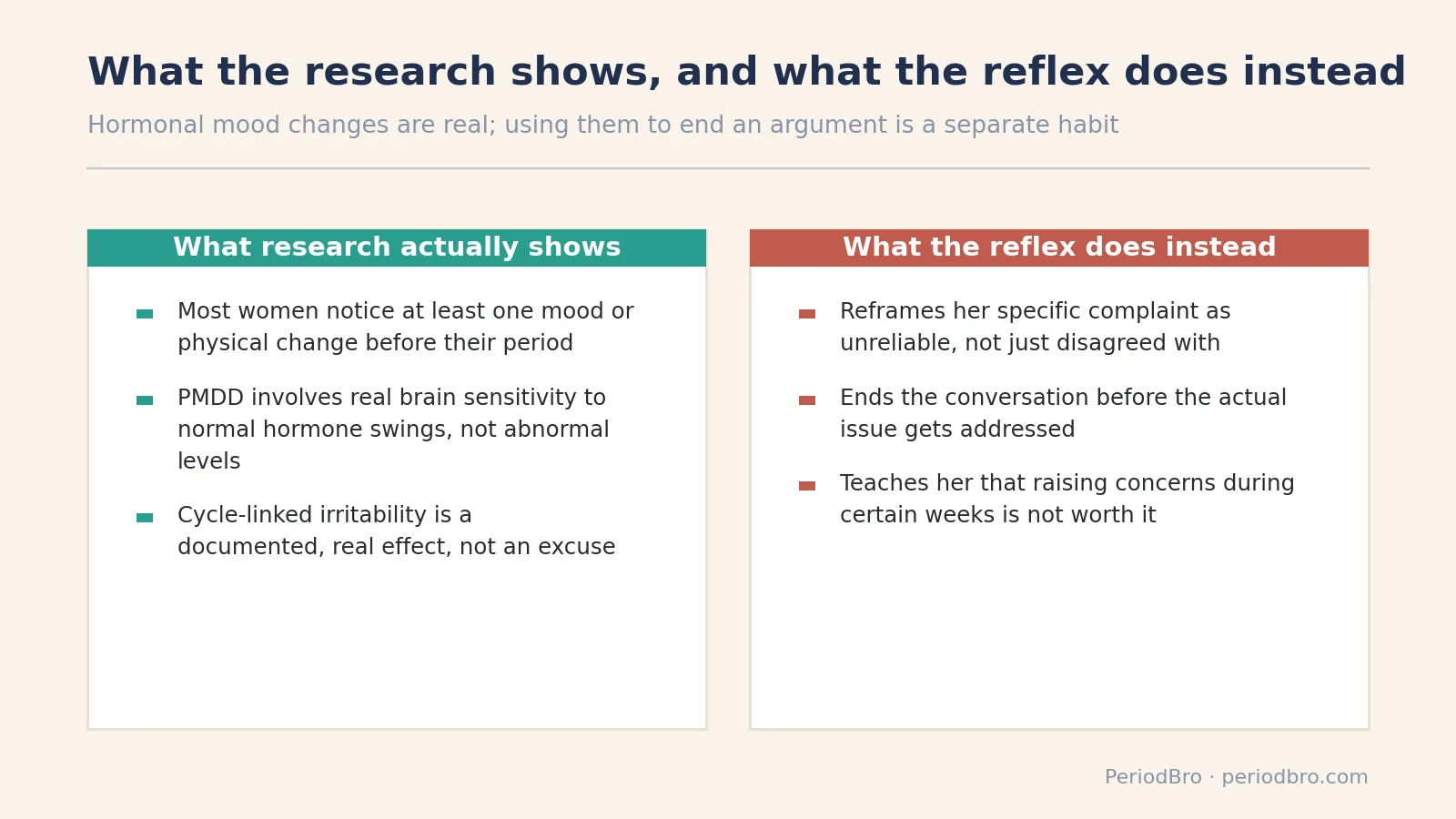
None of those lines respond to what she actually said. They reframe her as an unreliable narrator of her own feelings, which is a different move than disagreeing with her. Disagreement says “I see it differently.” Blaming her hormones says “your read on this doesn’t count,” and she notices the difference even when you don’t.
That reframe didn’t come from nowhere. A chapter in the Palgrave Handbook of Critical Menstruation Studies traces a media pattern going back decades that consistently depicts premenstrual women as irrational and out of control, repeated so often in advertising, comedy, and casual conversation that it reads as common sense instead of what it actually is: a stereotype most of us picked up without ever examining it.
Most men who do this are not trying to run a psychological playbook on their partner. It usually shows up in a specific moment: you feel caught, or tired, or you know she has a point and you do not want to deal with it right now. The hormone line is fast, it sounds almost medical, and it gets you out of the room without having to admit any of that. The cost shows up later, when she stops bringing things up at all, because she has learned what happens when she does.
What the biology actually says
None of this means her hormones never affect her mood. They can, and pretending otherwise is its own kind of dismissal, just aimed the other way. The American College of Obstetricians and Gynecologists notes that most women notice at least one physical or emotional change in the days before their period, and a smaller share meet the fuller criteria for premenstrual syndrome. Mayo Clinic lists irritability, anxiety, and mood swings among the most commonly reported symptoms in that window.
For a smaller group of women, the swings are severe enough to be diagnosed as premenstrual dysphoric disorder. Research summarized by the Cleveland Clinic points to something specific about what’s happening there: it isn’t that these women have abnormal hormone levels. It’s that their brains are unusually sensitive to the same hormonal swings everyone goes through. That’s a real, measurable difference, not an excuse and not an exaggeration.
The hormones are real. What’s not automatically true is that they explain the specific thing she’s upset about tonight. A harder week can shorten someone’s patience without being the reason a promise got broken or a chore got skipped twice. Real mood changes before her period and a fair complaint about something you actually did are not the same category, and collapsing them into one is the reflex worth catching, not the biology underneath it.

What turning toward the conversation looks like
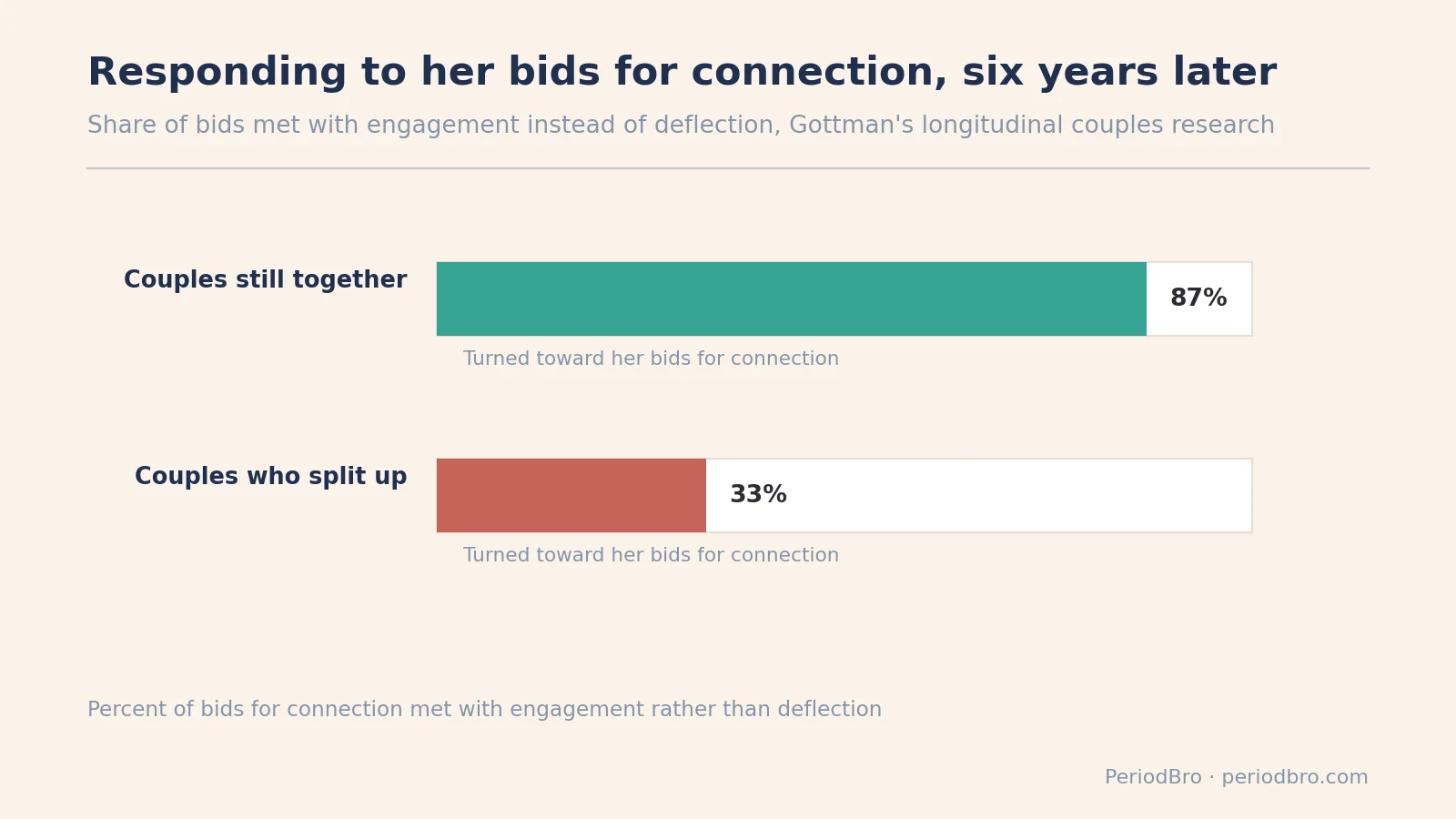
Gottman’s research on how couples respond to each other’s bids for connection found something specific: couples who were still together six years later had responded to each other’s bids by “turning toward” them, engaging instead of deflecting, in roughly 87 percent of those moments. Couples who had since split up were doing that in only about a third of them.
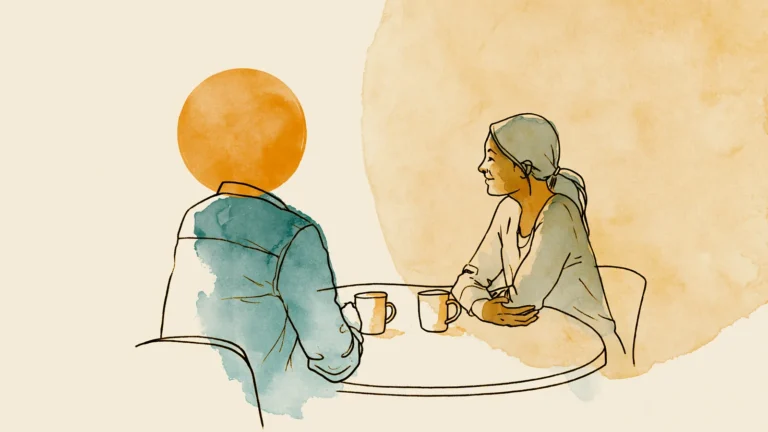
In practice, turning toward a hard conversation instead of blaming her hormones for it looks smaller than people expect. It’s asking “what happened” instead of “what’s wrong with you.” It’s saying “I hear that this matters to you” before you say anything about whether you agree. A few specific lines go a lot further than most men assume, mostly because they signal that you’re staying in the room instead of looking for the door.
With the insurance thing, the version that would have actually worked was something like: “you’re right, I’ve put this off three times, I’m sorry, I’ll call tomorrow morning.” That’s it. No mention of her cycle, no defense of my own scheduling, just taking the thing she said at face value and answering it. It took me years to notice that the honest response was almost always shorter than the deflecting one. I just did not want to say it, because it meant admitting I was wrong instead of making the conversation about her mood.

Sometimes the most useful thing is not saying the hormone line at all and sitting with the discomfort of not having a tidy explanation ready. Irritability before her period is real, but naming it out loud in the middle of an argument almost never lands as insight. It lands as a verdict.
When it’s really about timing, not dismissal
There’s a real version of this that isn’t dismissal at all. Some conversations go better a day or two later, once a rough patch has passed and there’s more bandwidth on both sides. Knowing when to wait is a legitimate skill, and it isn’t the same thing as using her cycle to avoid a conversation indefinitely.
The difference is whether the topic actually comes back. If you’re genuinely proposing “let’s talk about this tomorrow,” and then you do, that’s timing. If “let’s talk about this later” quietly turns into “let’s never talk about this,” the hormone line was never about timing. It was the exit door again, just slower.
A simple test: name a specific day when you bring it up again, out loud, in the moment. “Let’s pick this back up Thursday, once things have settled” is a plan. “Let’s talk about this some other time” is usually a way of hoping the whole thing quietly disappears, and most people can tell the difference between those two sentences even if they can’t articulate why.
One more thing worth naming plainly: if “it’s your hormones” has become the answer to every disagreement, regardless of what she’s actually raising, that’s worth taking seriously on its own. Research on relationship invalidation links a steady pattern of it to eroding trust and rising resentment over time, and repeated dismissal like that can shade into a form of emotional harm a therapist would want to know about. An occasional bad reflex is one thing. A pattern that always ends the same way, with her feelings ruled out of bounds every time, is worth bringing to a couples counselor rather than trying to fix alone.
Reading this once will not retrain the reflex. Mine took longer to unlearn than I expected, mostly because it had worked for years, in the narrow sense that it did end arguments. It just never ended them well.
What actually changed things for us was not a script. It was noticing her cycle enough to stop being surprised by it, so a hard week did not automatically get mistaken for a hard conversation. That is most of why I built PeriodBro in the first place: not to explain her away, but to see the pattern early enough that I could show up instead of guessing.
If you have caught yourself reaching for the hormone line more than once, that is not a verdict on you either. It is just worth noticing the next time it is on the tip of your tongue, and asking what you are actually trying to avoid.
PeriodBro provides educational information and is not a substitute for professional medical advice. Always consult a qualified healthcare provider for personal medical decisions.