
PMDD and Work: Getting Her Through a Hard Week
PMDD and work do not share a calendar. Hers can crash mid-quarter, mid-deadline, mid-anything, and there is no clean way to tell a manager that her hormones are picking a fight with her brain today. If you are partnered with someone who has PMDD, you have probably watched her white-knuckle through a workday that any reasonable person would have called in sick for. She did not call in, because calling in meant explaining why, and explaining why felt worse than the symptoms.
Premenstrual dysphoric disorder is a real, diagnosable condition, not a bad mood with a label stuck on it. The clinical picture is specific: symptoms show up in the last week or two of the luteal phase (the stretch between ovulation and her period), they hit hard enough to disrupt daily functioning, and then they lift within a few days of her period starting, leaving at least a week where she feels like herself again. That pattern, symptomatic then clear, symptomatic then clear, is what separates PMDD from general anxiety or depression, and it is why doctors ask patients to track two full cycles of daily symptom ratings before confirming the diagnosis rather than going on a single bad month. Estimates put PMDD at roughly 3 to 8 percent of people who menstruate during their reproductive years, which sounds small until you remember that is still millions of people cycling through this every single month, many of them showing up to a job the next morning like nothing happened, running meetings and answering client emails on a brain that is quietly working twice as hard to do it.
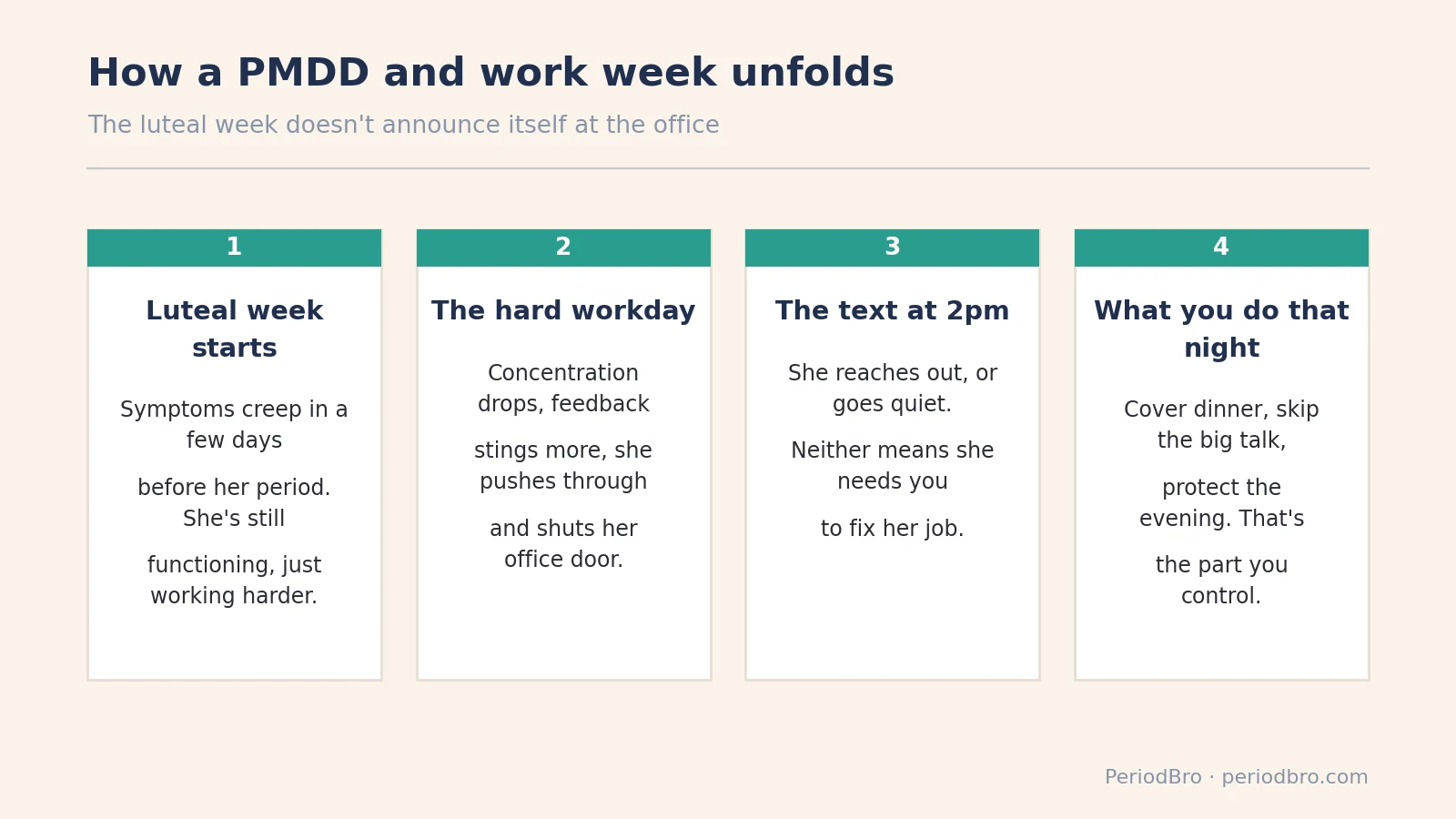
None of that severity shows up on a résumé or a performance review. It shows up as a closed office door, a canceled lunch, a curt reply to a Slack message that would normally get a full paragraph, and coworkers read all of it as mood when it is closer to a medical event that happens to land inside a workday.
Cleveland Clinic is blunt about the distinction: PMDD is not “PMS but worse,” it is a separate, biologically driven disorder that responds to real treatment, from certain antidepressants to hormonal options to therapy. That matters for how you show up this week, because if you are treating it like a mood she should be able to push through with willpower, you are working from the wrong model.

What PMDD and work actually do to a Tuesday
Ask people who live with PMDD what it does at the office and the same words come up: concentration disappears, self-doubt spikes, ordinary feedback starts to feel like an attack, and small irritations turn into outbursts she immediately regrets. A qualitative study of women with PMDD in the workplace, published in the Journal of Psychosomatic Obstetrics and Gynecology, found this exact cluster showing up again and again: difficulty concentrating, paranoia, fatigue, tearfulness, and a heightened sensitivity to everyone around her. It’s a nervous system running on hormonal static, doing its best to answer emails anyway, not a character flaw.
The pmdd guide for partners goes into the mechanics of why the luteal week hits so hard. What matters here is narrower: the version of her that shows up to a 9am standup during that week is running a harder shift than the version of her who shows up any other week, and nobody in the room knows it.
Why she is not telling anyone at the office
Most people with PMDD do not disclose it at work, and the reasons are not mysterious. Saying “I have a hormonal condition that affects my mood and concentration for a week every month” to a manager still sounds, to a lot of ears, like a liability. People worry about being seen as unreliable, overemotional, or a legal risk to route around at review time. So instead they say they have a migraine. Or a stomach bug. Or nothing at all, and just grind through with the door of their office (or their camera) shut.
A guy I used to work with told me his partner spent two years telling her boss she had migraines rather than say the word “period,” let alone “PMDD,” anywhere near the building. Her read on the workplace turned out to be accurate. A coworker had disclosed a different condition and it became an ongoing office punchline within a month. Whether she ever tells her employer the real reason is entirely her call. Your job is to make the week survivable regardless of what she decides to say, not to push her toward honesty at work.
What helps her get through this week
This is the part you actually control. A few things that consistently help, according to both the clinical literature and the people living it:
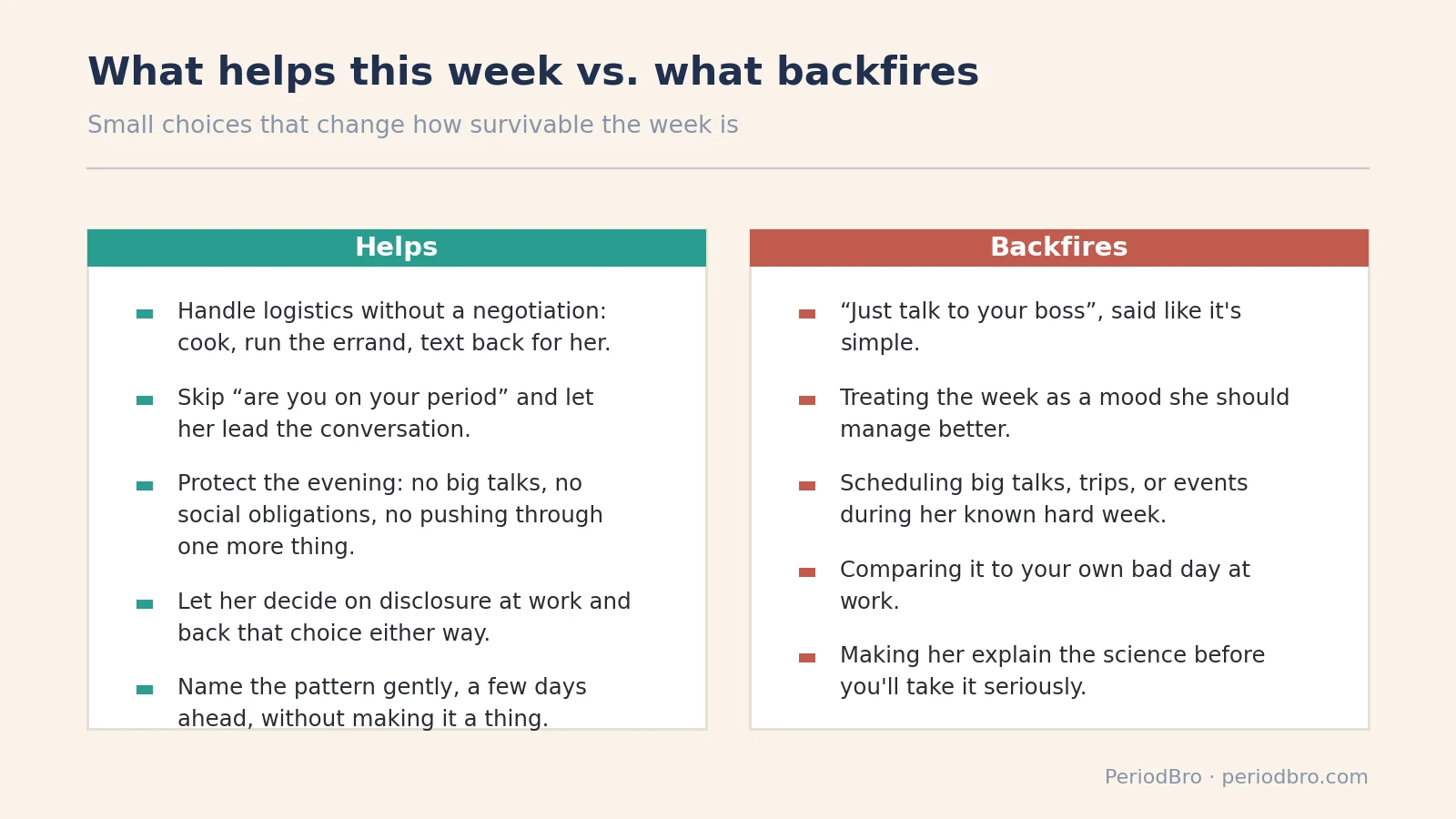
Take logistics off her plate without a negotiation. Cook something. Handle the errand she has been putting off. Text back for her if she asks you to. The goal is one less decision in a week where decisions already cost more than usual.
Skip the diagnosis at the door. “Are you on your period” rarely helps, and it hands her a second thing to manage: your reaction to the question. If she wants to talk about what is happening, let her lead.
Protect the evening. If she has survived a full workday on PMDD, the last thing she needs is a heavy conversation, a social obligation, or a request to “just power through” one more thing. How to support a partner with PMDD has more on reading which nights need quiet and which don’t.
Let her make the call on disclosure and back it either way. If she wants to tell HR, support that. If she wants to say nothing and grind it out, support that too. It is not your name on the sick day.
Know that treatment exists. If this is a recurring pattern every single cycle, not a one-off rough patch, it is worth knowing that PMDD treatment options that actually help are real and often underused, mostly because so few people realize what they are dealing with has a name.
Notice the pattern out loud, gently. If you track her cycle even loosely, you will start to see the hard week coming a few days before she does. Mentioning it once, without making a thing of it (“this is usually a rough stretch for you, want me to handle dinner this week?”), can take the edge off before the workday even starts.

What backfires
A few moves that feel helpful and usually are not: telling her to “just talk to your boss,” treating the week as a mood she should manage better, scheduling anything important (a big talk, a family event, a trip) during her known hard week if you can avoid it, or comparing it to your own bad day at work. None of those are cruel, but they miss what is happening in her body that week, and most of them hand her a second job on top of the one she is already struggling through, managing your reaction along with her own.
The numbers behind the bad week
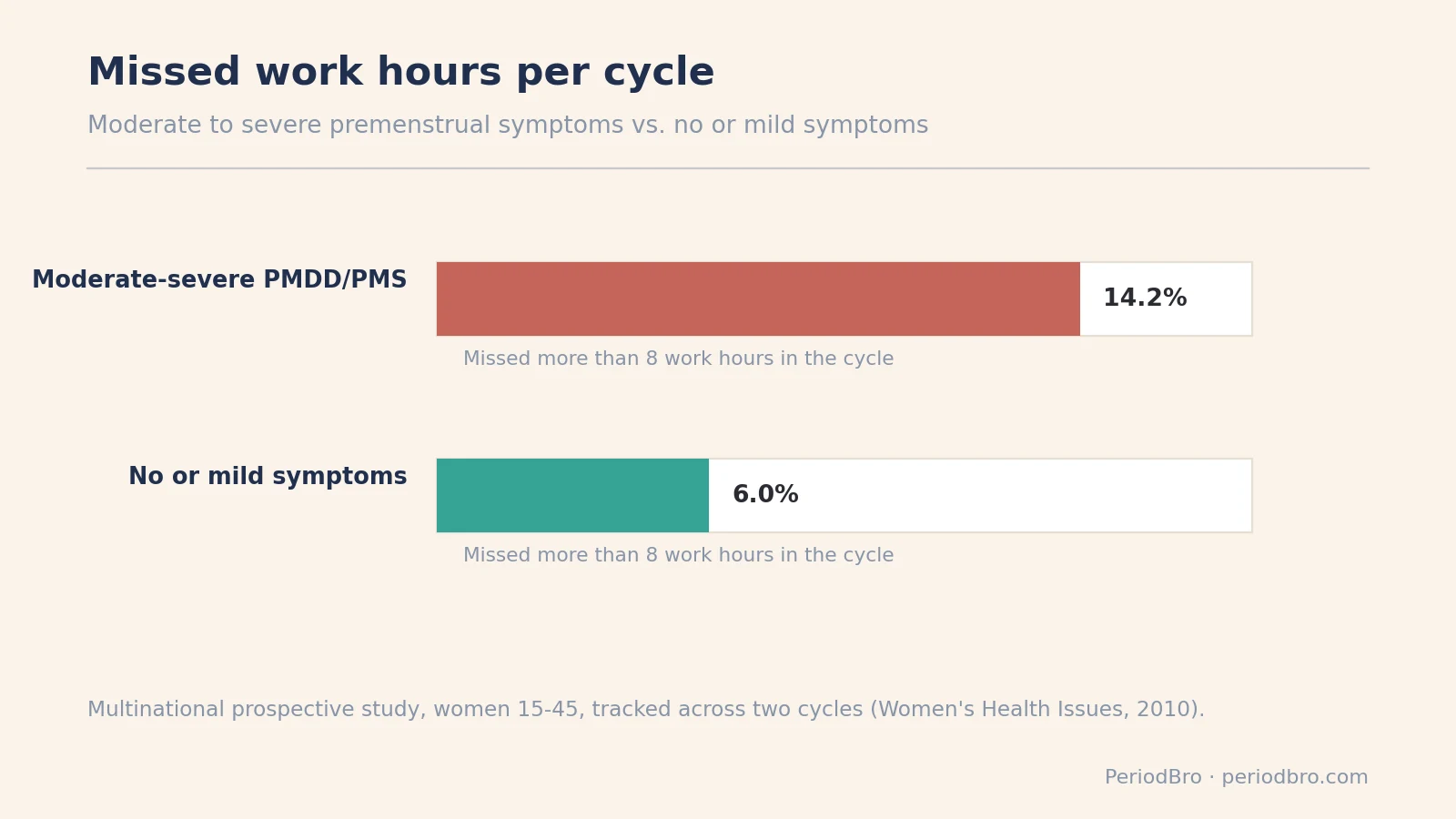
This is not anecdotal. A multinational study of women aged 15 to 45, tracked prospectively across two months using a validated daily symptom scale, found that women with moderate to severe premenstrual symptoms missed more than 8 hours of work per cycle at a rate of 14.2 percent, compared with 6.0 percent among women with no or mild symptoms. The same group also logged an average of 5.6 days per cycle with at least a moderate drop in productivity, versus 1.1 days for the comparison group. A separate cross-sectional study of working women found premenstrual disorders were consistently linked to more disrupted workdays overall, across concentration, decision-making, and interactions with coworkers. It’s a documented, measurable pattern, not her being dramatic, and most workplaces have no idea how much of it they’re absorbing.
When it is more than a bad week
Everything above assumes this is a known, recurring pattern, the kind you can both see coming on the calendar. If her symptoms are severe, cyclical, and genuinely impairing (missed work, damaged relationships, thoughts of self-harm, or anything that scares either of you), that is a conversation for a doctor, not a blog post or a partner doing his best at home. A gynecologist, a primary care provider, or a therapist familiar with PMDD can confirm the diagnosis with proper tracking and talk through real treatment. How to be a better partner through her cycle can help you build the everyday awareness, but it is not a substitute for professional evaluation when the symptoms are this severe.
If you are trying to get better at spotting the pattern before it flattens her week, or her job, that is exactly what the PeriodBro app is built for: quiet, practical nudges that flag where she is in her cycle so you are not guessing which Tuesday is going to be the hard one.
PeriodBro provides educational information and is not a substitute for professional medical advice. Always consult a qualified healthcare provider for personal medical decisions.