Period Tracker for Irregular Periods: What Works and What to Expect
For about a year I trusted a calendar app that kept telling me my girlfriend’s period was “due in 2 days.” Some months it was right. Some months it arrived a week early, and once it showed up nineteen days after the app’s guess. I’d planned a weekend away around that guess. Her cycles were irregular and my tracker assumed they weren’t, so I kept getting caught out.
If you’re looking for a period tracker for irregular periods, whether for yourself or to keep up with a partner, the most useful thing to know is what these apps can and can’t do when cycles move around. Below is what research says about app accuracy, what to log so the data is worth something, what to look for in an app, and when a pattern deserves a doctor instead of a better algorithm.
What counts as an irregular cycle
NICHD puts the typical adult cycle at 21 to 35 days, citing ACOG, and describes cycles more than 35 days apart as infrequent periods (NICHD). How much the length changes matters as much as the length itself. A cycle that’s always 34 days is regular. A cycle that jumps between 24 and 40 is irregular, even though each number sits inside the “normal” range on its own. Clinicians tend to look at how much it varies from month to month.
Some variation is normal for everyone. A 2019 study of more than 600,000 cycles logged in the Natural Cycles app found that only 13% were exactly 28 days long, and the average was 29.3. The same paper found that the first half of the cycle, before ovulation, varied far more than the second half (Bull et al., npj Digital Medicine). So when a period comes early or late, it’s usually because ovulation moved, and that’s exactly the part an app has to guess.
Common reasons for bigger swings include PCOS, thyroid problems, stress, weight changes, intense training, the teen years after a first period, and perimenopause. Cleveland Clinic lists many of the same triggers for cycles where ovulation doesn’t happen at all (Cleveland Clinic). We cover the most common one in PCOS and periods.
How period trackers handle irregular periods
Most apps start from averages. Log a few periods and the app works out a typical length, then counts forward. Many assume ovulation happens about 14 days before the next expected period. For a steady cycle that guess works reasonably well. For a cycle that swings by a week or more, it often misses.
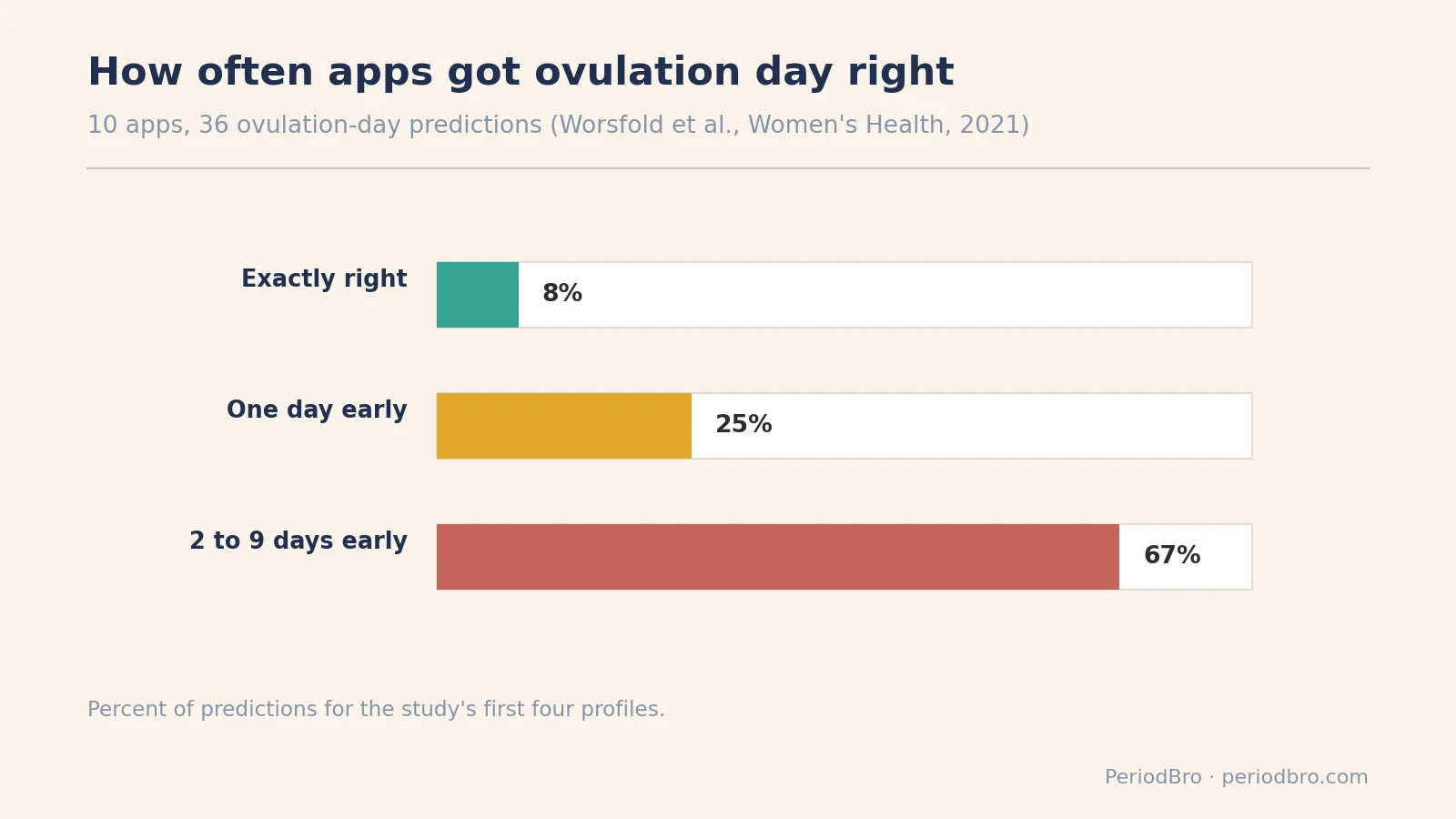
A 2021 study in Women’s Health tested this directly. Researchers fed six cycles of data from five made-up users into ten popular apps. Every app got the steady 28-day profile right. For the other four, cycle-length predictions were off by up to eight days. Across the first four profiles, only 3 of 36 ovulation-day predictions were exactly right, 9 were a day early, and two-thirds landed 2 to 9 days early. The apps also disagreed with one another about the same data (Worsfold et al., Women’s Health).
Researchers at the University of Sydney and University of Newcastle made the same point in 2024. Apps that only use period dates are guessing ovulation from the calendar, while apps that also use body temperature, cervical mucus or urine hormone tests have a real signal of ovulation to work with (University of Sydney). The more irregular the cycle, the bigger that gap gets.
A tracker is still worth having. With irregular periods its real value is the record it builds up month after month, which you can read for patterns and hand to a doctor. Our broader take is in do period tracker apps work.
What to log so the data is actually useful
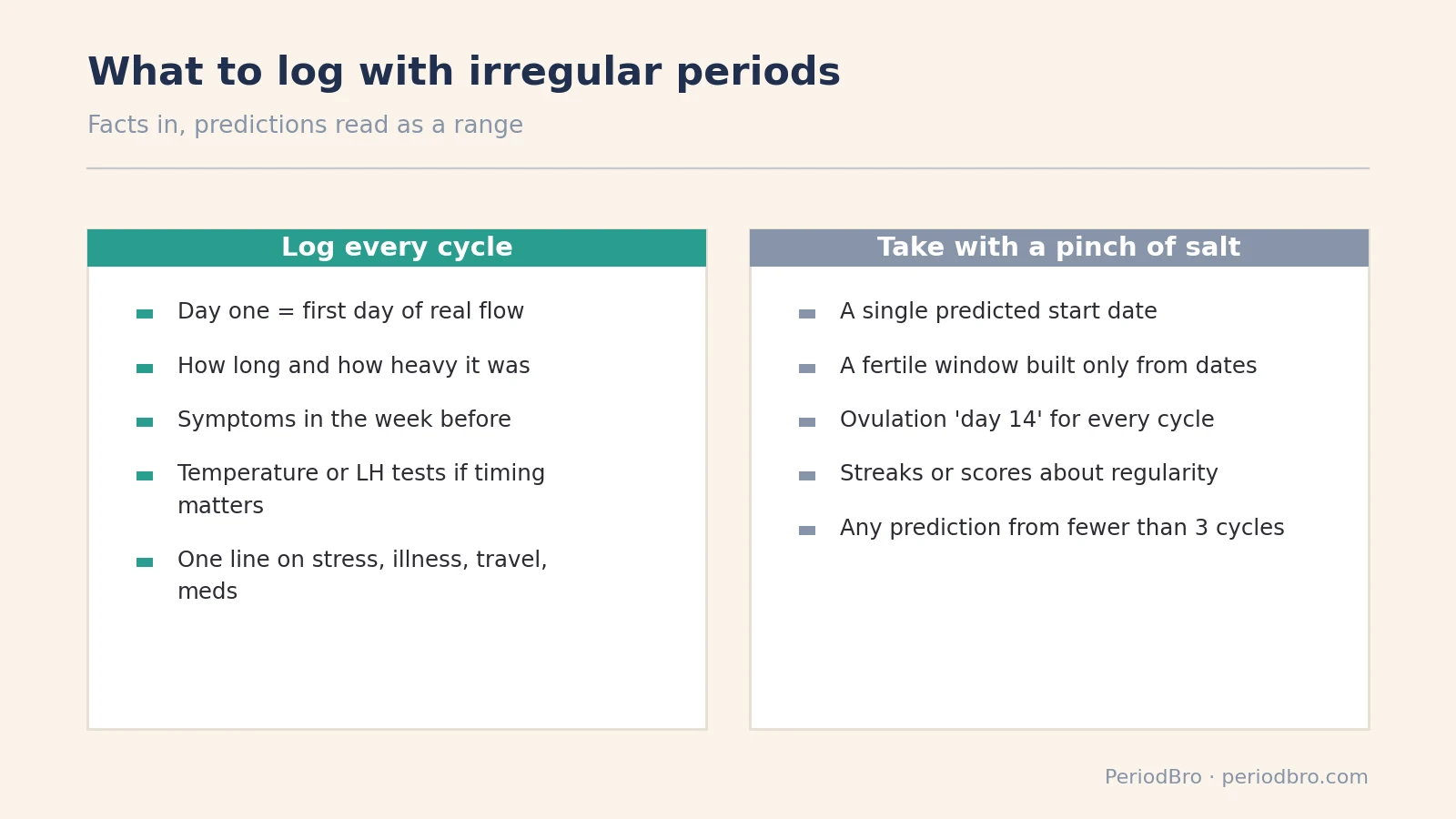
The period start date matters most. Log it the day it happens, every time, even when the cycle feels like a mess. Spotting doesn’t count as day one. The first day of real flow does.
Next, the length and heaviness of each period, and the symptoms that tend to come before it, such as breast tenderness, bloating, cramps, headaches, mood. Over a few months these often form a better early warning than any date prediction. A run of sore breasts and short temper may say “about a week out” more reliably than the calendar does.
If she wants to know when she ovulates, for trying to conceive or just for the picture, body temperature and LH strips add the signal that a calendar can’t. We walked through that in basal body temperature tracking. And it’s worth noting the context in a sentence: illness, travel, a brutal month at work, a new medication. Those notes are what turn a confusing chart into an explainable one.
What to look for in a tracker
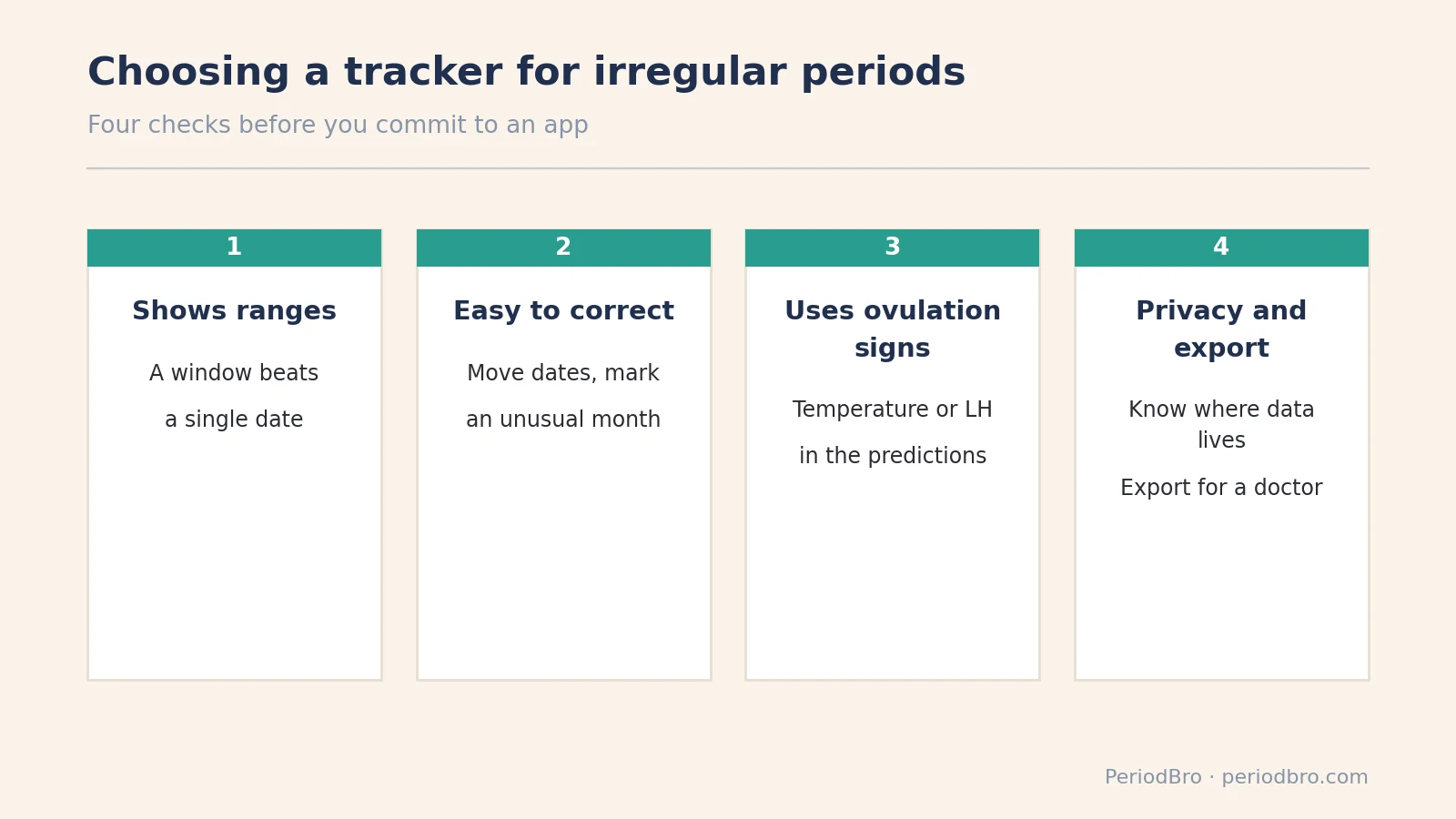
Ranges over single dates. An app that says “likely between the 12th and the 19th” is being honest. One that names a single day for an irregular cycle is overselling.
Easy corrections. You should be able to fix a wrong prediction, move a start date and mark an unusual month. Some apps make that harder than it should be.
Room for real ovulation signs. If ovulation timing matters to her, choose one that uses temperature or LH tests in its predictions, not one that just stores them.
Privacy and export. This is sensitive health data. Check what’s stored, where, and whether you can export it for a doctor. We looked at this in are period tracker apps safe.
For partners, consent first. If you’re tracking a partner’s cycle, it only works if she’s in on it and chooses what to share. How to track your partner’s cycle without being creepy covers how to set that up.

If you’re the partner, not the one tracking
When her cycle is irregular, a partner’s job is mostly about planning loosely. Treat the predicted window as a soft zone. If a trip or a big event lands inside it, mention it early and let her decide whether it matters. Keep a spare box of her usual products in the car or your bag, since “it came a week early” is the whole problem with irregular cycles.
Skip the “are you late?” check-ins. With irregular periods she’s late all the time by an app’s standard, and being asked about it every few days gets old fast. If you’re really worried about pregnancy, say so once and offer to pick up a test. Our guide on why her period might be late covers the rest.
And let her decide how much you see. Some couples share a full log, others share only the predicted window and a heads-up when symptoms start. Tracking her cycle with consent walks through how to agree on that.
When the pattern needs a doctor, not an app
A good log is a great thing to bring to an appointment, and some patterns are a reason to book one. The ACOG guide on abnormal uterine bleeding lists bleeding between periods, cycles shorter than 24 days or longer than 38, and cycles that vary in length by more than 7 to 9 days among the patterns worth checking (ACOG). Missing three periods in a row, very heavy bleeding, or a sudden change from her usual pattern are good reasons to call.
For teens the rules are looser, since cycles often take a few years to settle. If you’re tracking for a daughter, our guide on teenage daughter irregular periods explains what’s expected. For cycles changing in her 40s, see period tracking in perimenopause.
What I’d tell myself back then
Eventually I stopped treating the app like a weather forecast. I started noticing her pre-period signs, and I kept a note of the months that went sideways and why. A trip, a sinus infection that dragged on, the month her dad was in the hospital. After half a year, the “random” cycle had a shape. Stressful months ran long. Calm months were close to 30 days. I only saw it once there were enough months in the log to compare.
A period tracker for irregular periods can’t force a cycle into a schedule, but it can show you how that particular cycle behaves. Log the facts, read predictions as a range, add real ovulation signs if timing matters, and bring the history to a doctor when the pattern changes. For more on picking an app as a partner, see the best period tracker app for partners.
I built PeriodBro for the partner’s side of this: knowing roughly where she is in her cycle without making her explain it every month. If that sounds useful, you can try it free here.
PeriodBro provides educational information and is not a substitute for professional medical advice. Always consult a qualified healthcare provider for personal medical decisions.