Period Symptoms but No Period: What It Can Mean and What to Do
My friend Marco texted me at 11 p.m. on a Tuesday. His girlfriend had been cramping for two days, her breasts were sore, she’d snapped at him over the dishwasher, and her period was nowhere. “Is she pregnant? Is something wrong? Do I ask?” I didn’t have an answer for him. A few years earlier I wouldn’t even have known which questions to ask.
Period symptoms but no period is one of the most searched worries about the cycle, and it’s usually less scary than it feels at 11 p.m. The same hormones that bring cramps and mood swings before a period can do their thing even when the bleed is late or skipped. Below are the common reasons, the order to check them in, and what a partner can usefully do while she figures it out.
Why period symptoms but no period happens at all
Most premenstrual symptoms come from the hormone swing in the second half of the cycle, after ovulation, when progesterone rises and then drops. ACOG describes PMS as symptoms that show up in the one to two weeks before a period and fade once bleeding starts (ACOG). If you want the plain-English version of that phase, our guide to the luteal phase walks through it.
The bleed itself is the last step in a chain. The lining builds up, hormones fall, the lining sheds. If something interrupts the chain, she can get the build-up feelings (bloating, sore breasts, cramps, short temper) without the finish. So the symptoms on their own tell you the cycle is moving, and very little about where it’s headed.
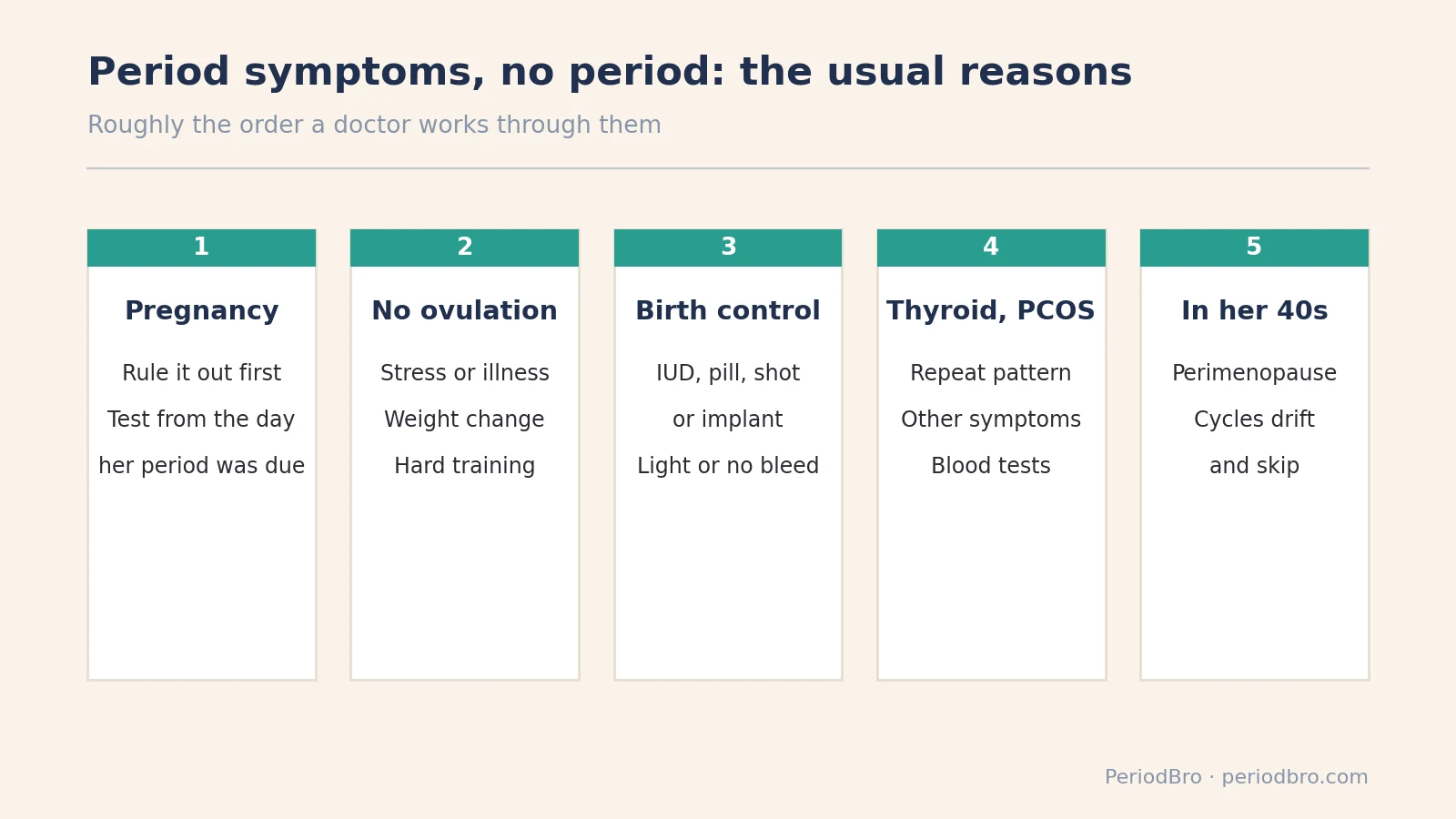
The list of usual reasons is fairly short. A few of them deserve a proper check, and doctors start with the same one every time.
Pregnancy comes first on the list
Mayo Clinic is blunt about it: for someone who has had periods before, pregnancy is the most common reason they stop (Mayo Clinic). Early pregnancy and PMS overlap almost perfectly. Both run on progesterone, so both can bring sore breasts, bloating, tiredness and mild cramps. We compared them sign by sign in PMS vs pregnancy symptoms.
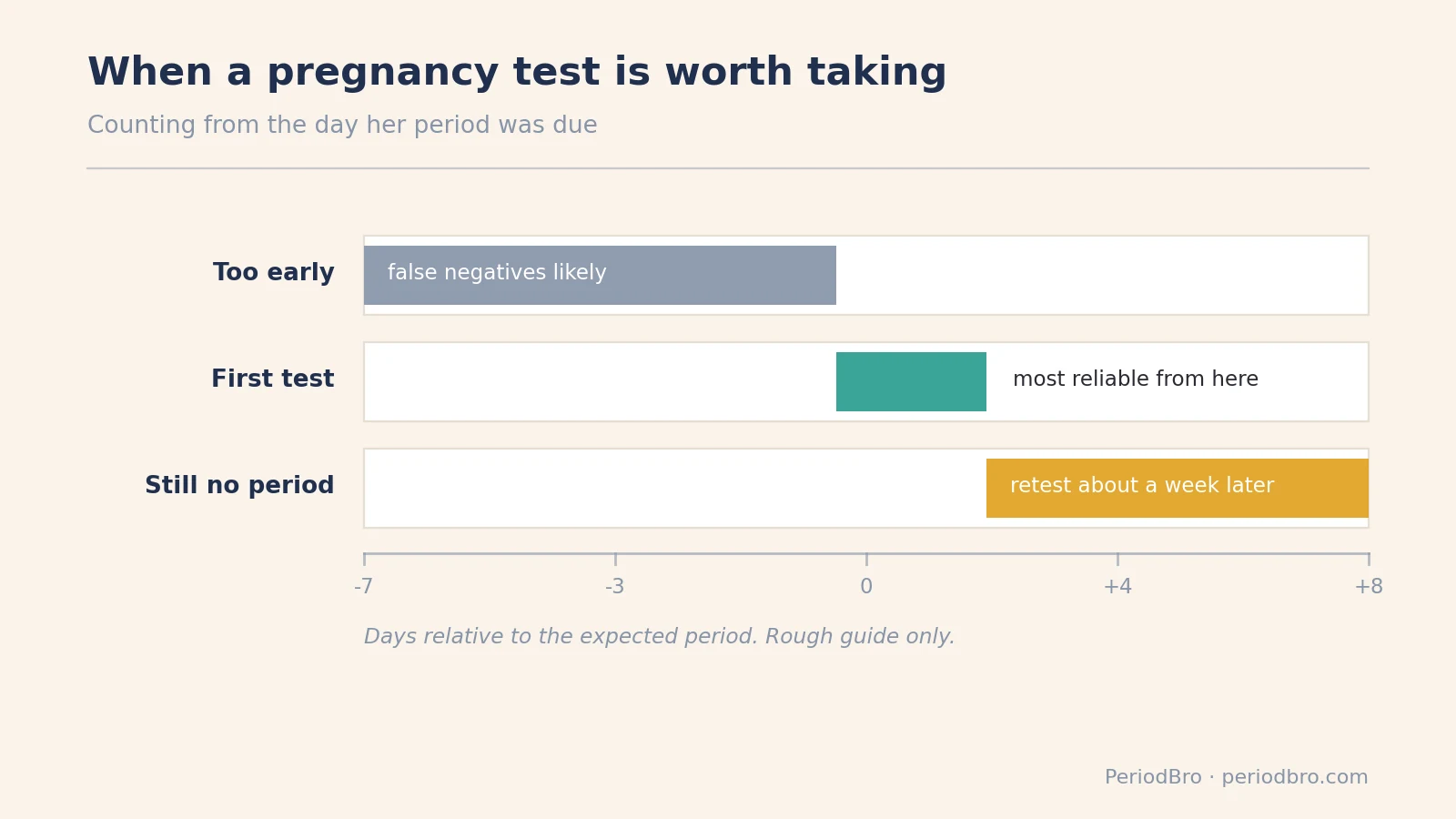
Timing matters. Mayo Clinic notes that home tests are most reliable from the first day of a missed period, and that testing too early is a common cause of false negatives (Mayo Clinic). If the first test is negative and the period still hasn’t come, testing again in about a week is a reasonable plan. Cleveland Clinic adds that first-morning urine gives the most concentrated sample (Cleveland Clinic).
Partners tend to miss here in one of two ways: panicking out loud, or acting like it’s none of their business. Whatever result you’re hoping for, she shouldn’t be the only one holding it. Offer to buy the test, offer to be in the next room, and keep your face neutral while she reads it.

A cycle where she didn’t ovulate
If the test is negative, the next most common story is an anovulatory cycle, a month where no egg was released. Cleveland Clinic explains that hormone imbalances usually cause it, and lists stress, big changes in weight, intense exercise and PCOS among the triggers (Cleveland Clinic). Without ovulation the usual hormone handoff doesn’t happen on schedule, so the period can come late, come light, or skip, while she still feels some of the build-up.
One odd cycle after a rough month is common. A move, a deadline, a long illness or a new training plan can all do it. If it happens three or four cycles in a row, it’s worth a look. We explained the mechanics in anovulatory cycles explained, and the bigger list of reasons a period runs late is in why is her period late.
Birth control, thyroid, PCOS and perimenopause
Hormonal birth control changes the picture. Cleveland Clinic says about 2 in 10 people using a hormonal IUD like Mirena or Liletta stop having periods within the first year, and that this is considered fine (Cleveland Clinic). The pill, the shot and the implant can also make bleeding lighter or absent, while some cyclical symptoms stick around. Our piece on period tracking on birth control covers what’s worth logging.
Then there are the slower causes. Mayo Clinic lists hormone problems such as PCOS and thyroid disease, along with some antidepressants, antipsychotics and blood pressure drugs, among the reasons periods can stop. It also lists symptoms worth mentioning to a doctor, such as headaches, vision changes, milky nipple discharge, extra facial hair and acne (Mayo Clinic). We have separate guides on PCOS and periods and thyroid and periods.
Age changes the odds too. For someone in her 40s, skipped periods with PMS-like symptoms are a classic early sign of perimenopause. NICHD notes that cycles commonly become irregular in the years before menopause (NICHD). Our perimenopause guide for partners is a good next read if that’s your situation.
Less often, cramps without a period come from something that isn’t a period problem at all: an ovarian cyst, endometriosis, a urinary infection or a gut issue. Those need a proper exam, so leave the diagnosing to a doctor. If you want the background, see ovarian cysts and periods.
When to wait and when to call a doctor
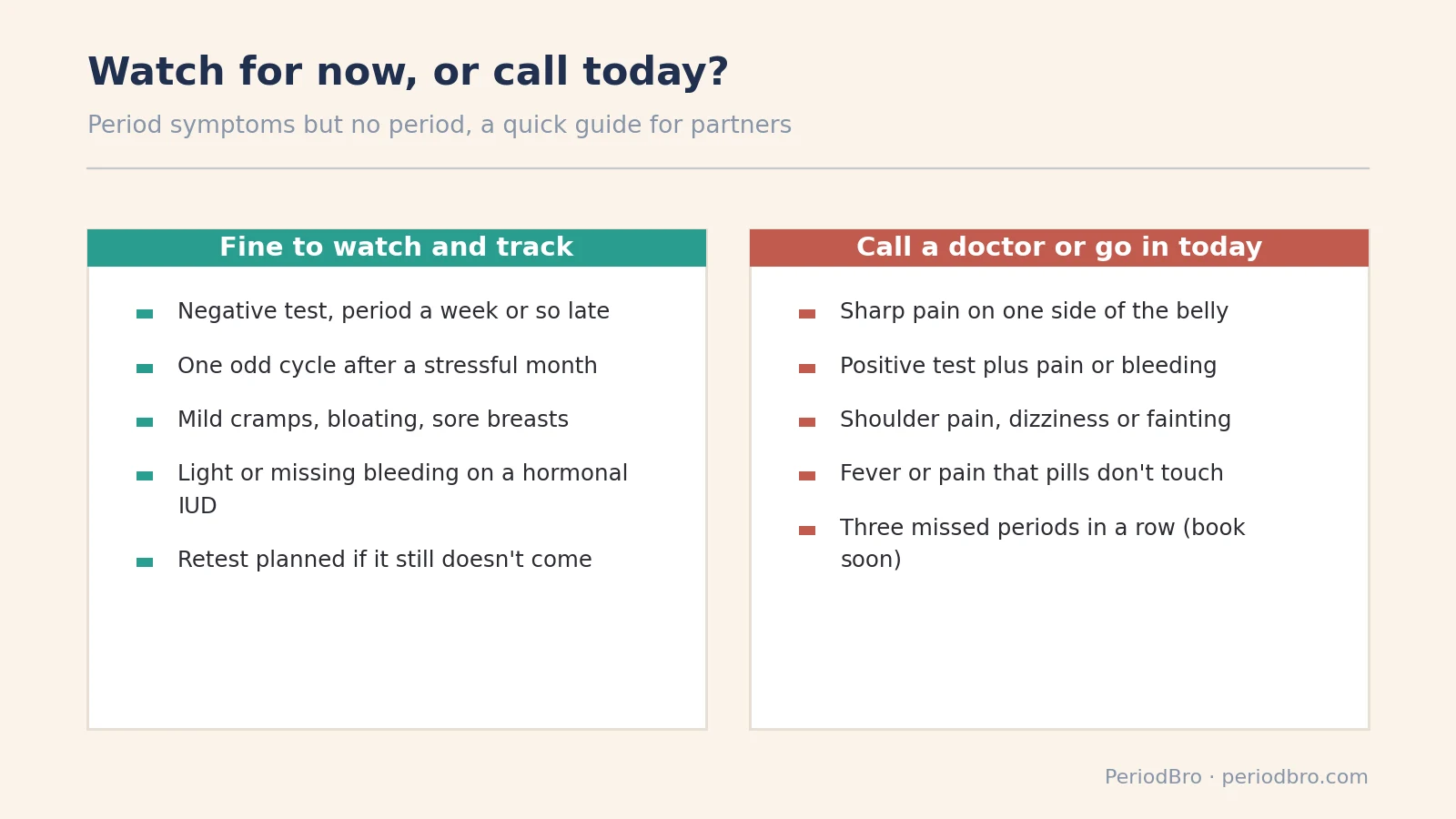
Mayo Clinic’s line is to see a doctor after three missed periods in a row (Mayo Clinic). Sooner makes sense if she’s trying to conceive, if the cycles have been off for a while, or if new symptoms show up alongside the missing period.
Some situations shouldn’t wait at all. ACOG warns that an ectopic pregnancy, one growing outside the uterus, can cause sharp pain on one side of the belly, shoulder pain, light bleeding, dizziness or fainting, and that it’s an emergency (ACOG). Severe pelvic pain, fever, fainting, or a positive test with one-sided pain means calling a doctor or going in today, not tracking it for another week.
What the doctor will probably check
If she does book an appointment, it helps to know it’s usually straightforward. Mayo Clinic describes the standard workup for missed periods: a pregnancy test first, then a pelvic exam and blood tests that often look at thyroid function, ovarian hormones, prolactin and androgens, with an ultrasound if something needs a closer look (Mayo Clinic). Prolactin is the hormone behind milk production. It can rise for reasons that have nothing to do with pregnancy and quietly switch periods off.
The doctor will ask about the last few months too: weight changes, training, sleep, stress, new pills. A short written list of dates and symptoms makes those questions easy to answer. If she wants company, offer to come along. Some people like a second set of ears in the room, and others would rather go alone and fill you in after, so ask which she prefers.
What a partner can actually do this week
Start with the question. “How are you feeling about it?” works better than “So are you pregnant?” She’s probably already run the same list in her head, so let her tell you where she’s at before you add your own theories.
Then take the small jobs. Buy the test, or two, since a retest is likely. Keep the evening low-key. If she has cramps, bring the heating pad without being asked; our guide on helping with period cramps has the rest.

Write things down. When was the last period? When did the symptoms start? Any big stress, illness, travel or new medication in the last two months? A doctor will ask exactly these questions, and nobody remembers dates under pressure. If she’s fine with it, a shared note of dates and symptoms takes two minutes and saves a lot of guessing.
And keep your own nerves out of her lap. If you’re scared, that’s normal, and you can say it once, calmly. What doesn’t help is checking on her every hour or making the wait about your plans.
How it turned out for Marco
I told Marco to ask how she was doing and to offer to pick up a test on his way home, nothing else. She said yes to the test, it was negative, and so was the one a week later. Her period arrived ten days late after the most stressful month of her year at work. What stuck with him afterwards was her saying she was glad he hadn’t made a thing of it.
Most months, that’s what the job looks like. Know the short list, make the test easy, write the dates down, and know which symptoms mean you stop waiting. For the bigger picture of how her cycle fits together, start with menstrual cycle phases explained for men.
I built PeriodBro because I wanted to see these patterns coming instead of googling them at midnight. If a quiet way to keep track of her cycle sounds useful, you can try it free here.
PeriodBro provides educational information and is not a substitute for professional medical advice. Always consult a qualified healthcare provider for personal medical decisions.