
Birth Control Responsibility: How Couples Can Share It
A friend of mine found out by accident how much work his girlfriend’s birth control took. She was away for a week, her pill pack ran out, and she asked him to pick up the refill. The pharmacy needed a new prescription, the prescription needed a doctor’s visit, and the insurance had changed in January. He spent two lunch breaks on the phone and said afterward, “She’s been doing this every few months for eight years?” That moment is where most conversations about birth control responsibility start: one partner quietly carrying a job the other didn’t know existed.
Most couples never sat down and decided she’d handle it. It just landed there because most methods go in her body. The good news is that a lot of the work around birth control can be shared, even when the method itself can’t.
How birth control responsibility ends up on one person
Look at the options. Pills, patches, rings, shots, implants, IUDs: all of them are hers. On the male side there are condoms, withdrawal and vasectomy, and nothing else on the market yet. By default, the person using the method also ends up doing everything that comes with it.
Many women feel that imbalance. In a survey of almost 1,900 women at family planning clinics in Scotland, China and South Africa, more than 65% said women carry an unfair share of the contraceptive burden, and only 2% said they wouldn’t trust a partner to use a male pill if one existed (review in PMC). A newer US survey of 1,029 women found more than two-thirds were interested in a partner using a new male method, partly to share the responsibility and partly to avoid side effects of their own (Contraception).
Side effects are a big part of that load. Depending on the method, she might deal with mood changes, spotting, headaches, lower libido or irregular bleeding. How birth control changes her cycle goes through the common ones method by method. You can’t take those on for her, but you can know about them and take them seriously.

The work that comes with a method
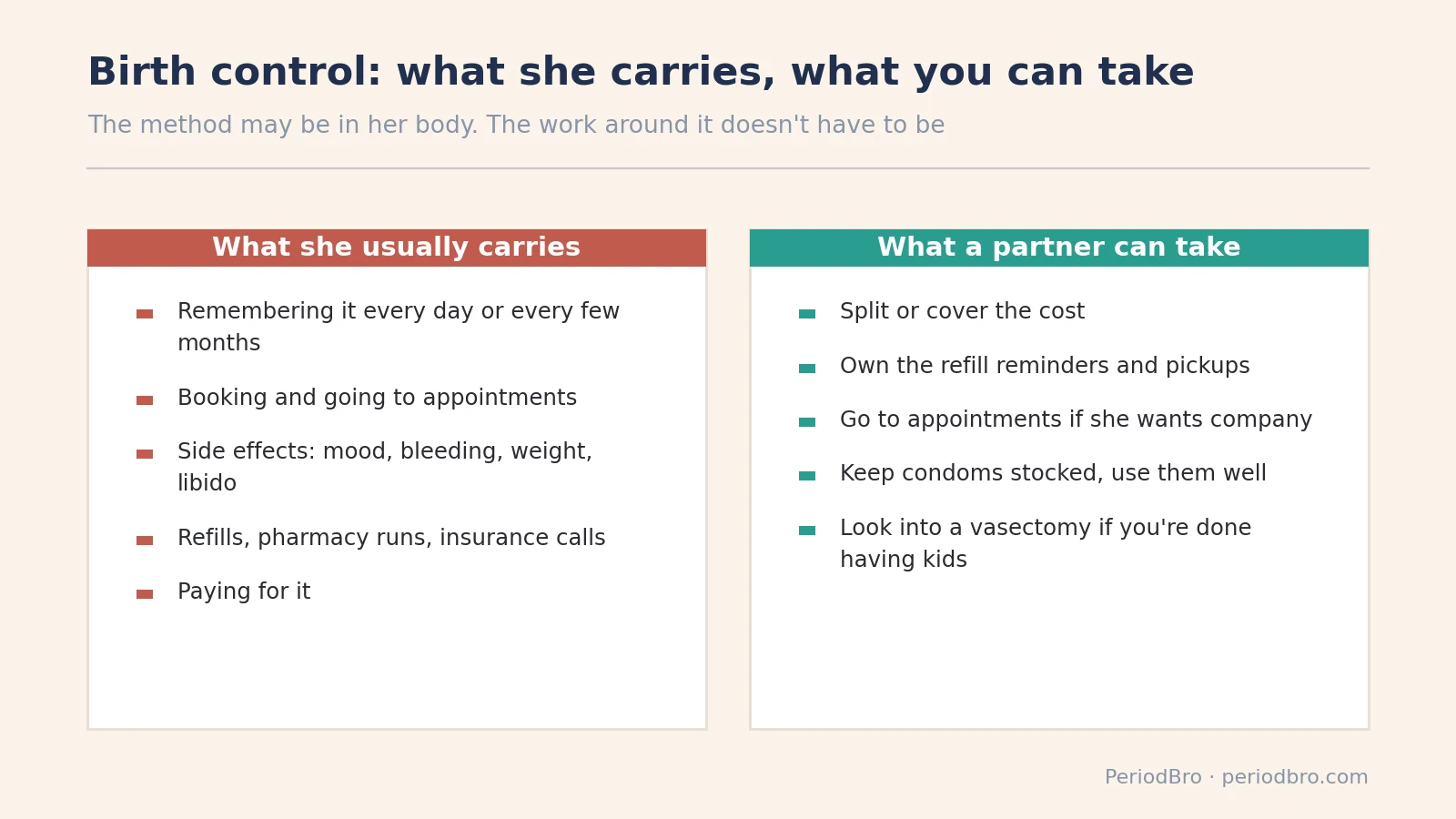
When people talk about birth control, they usually mean the pill or the device. The work around it is what wears people down:
- Remembering a pill at the same time every day, or tracking when a ring, patch or shot is due.
- Booking appointments, getting time off for them, and going.
- Refills, pharmacy runs and insurance calls.
- Paying, which can add up depending on coverage.
- Managing side effects, and deciding whether to switch.
- Thinking about the next step: when to stop, what to use after, how it fits with plans for kids.
Apart from the method itself, almost everything on that list can be shared.

What a partner can actually take on
Money. If she pays for it, split it or cover it. It’s protecting both of you, so it makes sense to share the cost.
Logistics. Put refill dates in your own calendar. Pick up the prescription. Call the insurance when something changes. If her method has a schedule, like a ring every three weeks or a shot every three months, set the reminder on your phone too.
Appointments. Offer to come, especially for things like an IUD insertion, which can hurt. She may want company, a driver, or just someone to handle dinner that night. What to expect at an IUD insertion is a good read before the day.
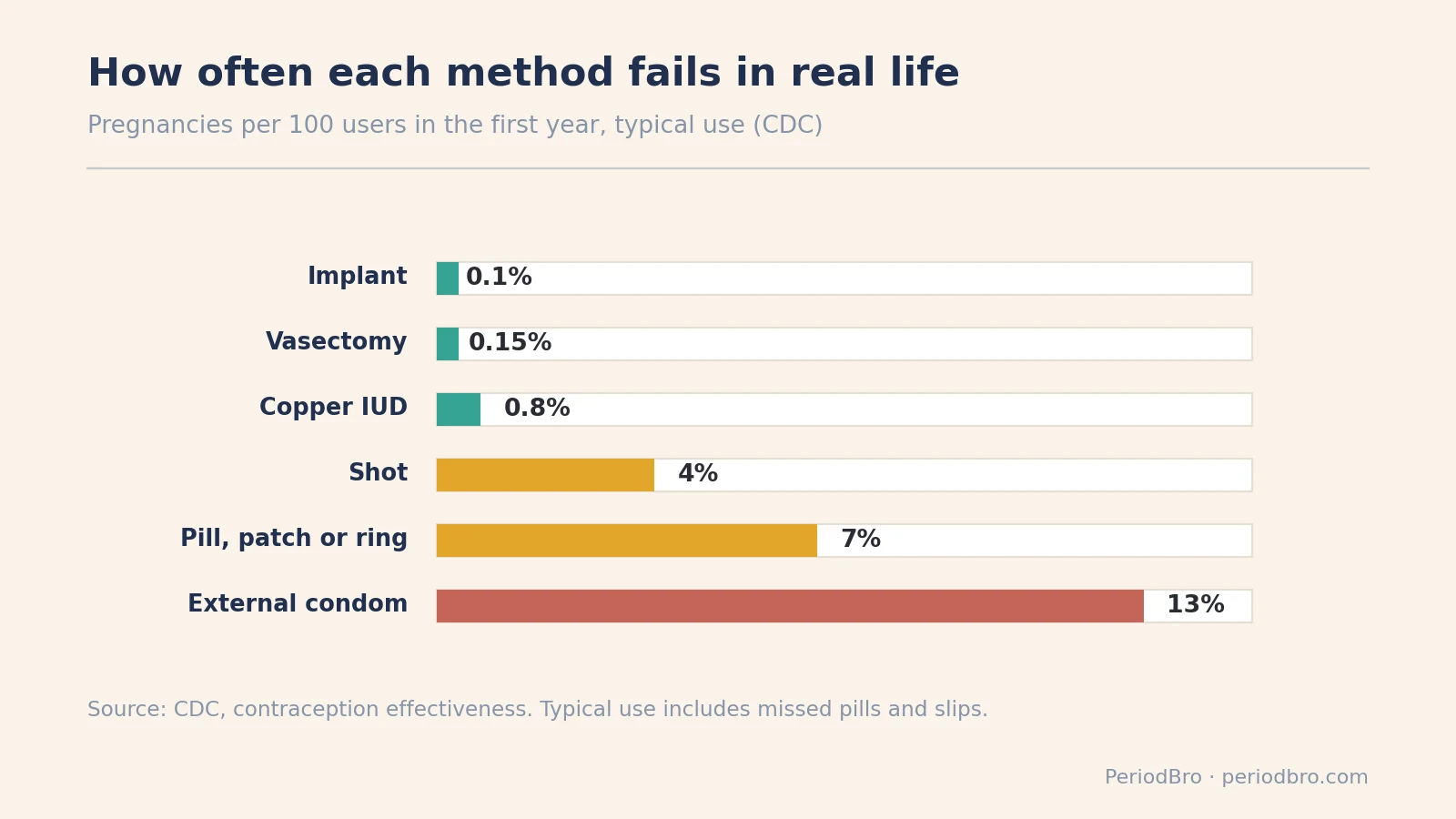
Condoms. If they’re part of your plan, buy them, keep them in stock and learn to use them properly. The CDC puts typical-use failure for external condoms at 13 pregnancies per 100 users in the first year, compared with 7 for the pill (CDC). A lot of that gap comes from how they’re used: putting one on late, the wrong size, no lube, or skipping it once.
Paying attention. If she’s been on a method for a while and seems off, ask how she feels on it. Some side effects build slowly and are easy to blame on other things. Logging her cycle and mood together can make patterns clearer, and period tracking on birth control explains what’s worth noting.
Where vasectomy fits
If you’re sure you’re done having kids, a vasectomy is the most direct way to take over the method itself. It’s a short outpatient procedure, usually under local anesthetic. The CDC puts typical-use failure at 0.15 per 100 in the first year, in the same range as an implant or IUD (CDC).
Two things to know before you book. A vasectomy isn’t effective right away. You need backup contraception until a follow-up semen test confirms no sperm, which usually happens 8 to 12 weeks after the procedure (Cleveland Clinic). And it’s meant to be permanent. Reversals exist but don’t always work, so this belongs in a long talk about whether more kids are on the table, not a quick decision.
Male birth control is getting closer
Male contraception has been “five years away” for decades, but one option has made real progress. A once-daily gel combining two hormones, nestorone and testosterone, has finished a Phase 2b trial with hundreds of couples, and results presented at ENDO 2024 showed it suppressed sperm faster than expected (Endocrine Society). Phase 3 is the next step. It isn’t on pharmacy shelves yet, but it might be within the next several years.
Men are open to it as well. An exploratory online survey found men with more gender-equal attitudes were more willing to use a new male method (Contraception). For now, the gel is a reason to keep an eye on the news, and a good thing to bring up when you talk about the long-term plan.

When the plan changes
Birth control decisions don’t stay fixed. She might want a break from hormones, you might start trying for a baby, or she might reach her 40s and wonder what still makes sense. Each of those is a moment to share the planning again.
If she stops a hormonal method, her cycle can take a few months to find its own rhythm, and that’s worth knowing before you read too much into an odd month. Her period after stopping birth control covers what’s typical. And if a method fails, like a condom breaking or a missed pill, the morning-after pill is time-sensitive. Knowing where to get it and offering to go is part of sharing the job. The morning-after pill and her period explains what to expect afterward.
How to start the conversation
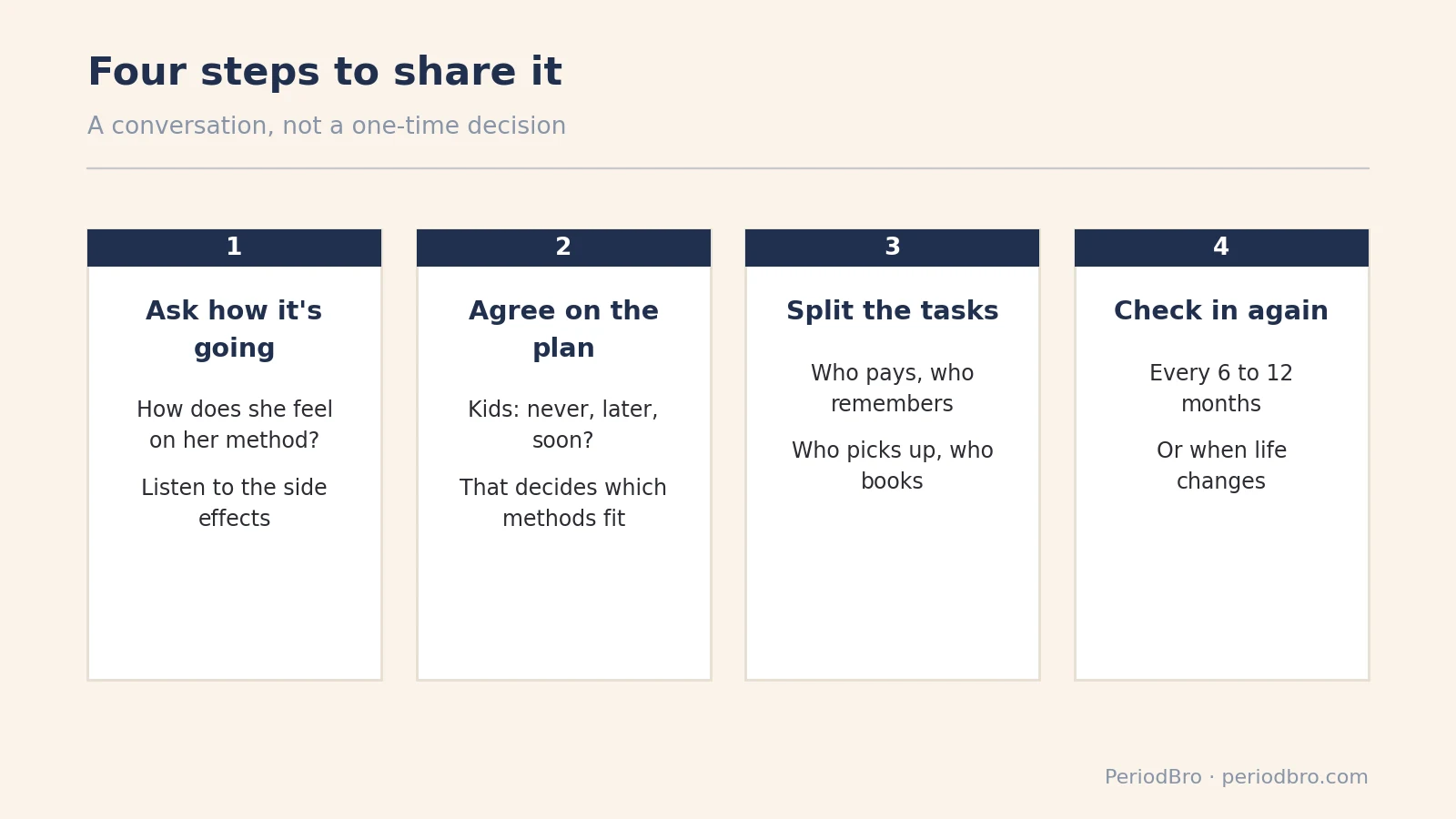
You don’t need a big sit-down. A simple opener works: “I realized I don’t know much about your birth control. How’s it going for you?” Then listen. You might hear she’s been unhappy with side effects for a year, or that it’s fine and she’d just like you to pay half. Either answer is useful.
From there, a few questions cover most of it. What’s the plan around kids: never, later, or soon? That decides which methods make sense. Which tasks could you take? And when should you check in again? Life changes, and a method that suited her at 24 may not at 34. Every six months to a year is a reasonable rhythm.
If talking about this kind of thing feels awkward, how to talk to your partner about her period has tips that carry over, and when to have a hard conversation with her covers timing. Picking a calm week helps.
What my friend changed
After the pharmacy saga, my friend took over refills and set the dates in his own calendar. They split the cost. A year later, when her doctor suggested trying a different pill because of headaches, he went to the appointment with her. He told me the biggest surprise was how little effort it took. A few calendar reminders and a shared bill changed how the whole thing felt for both of them.
Birth control responsibility works best as a shared decision, with the tasks split in a way you both agree on. It doesn’t have to be 50/50 on every item. If you want to understand what her method is doing to her cycle month to month, start with birth control and her cycle.
PeriodBro provides educational information and is not a substitute for professional medical advice. Talk to a qualified healthcare provider about which contraception methods are right for you and your partner.