Why Her Asthma and Allergies Get Worse Before Her Period
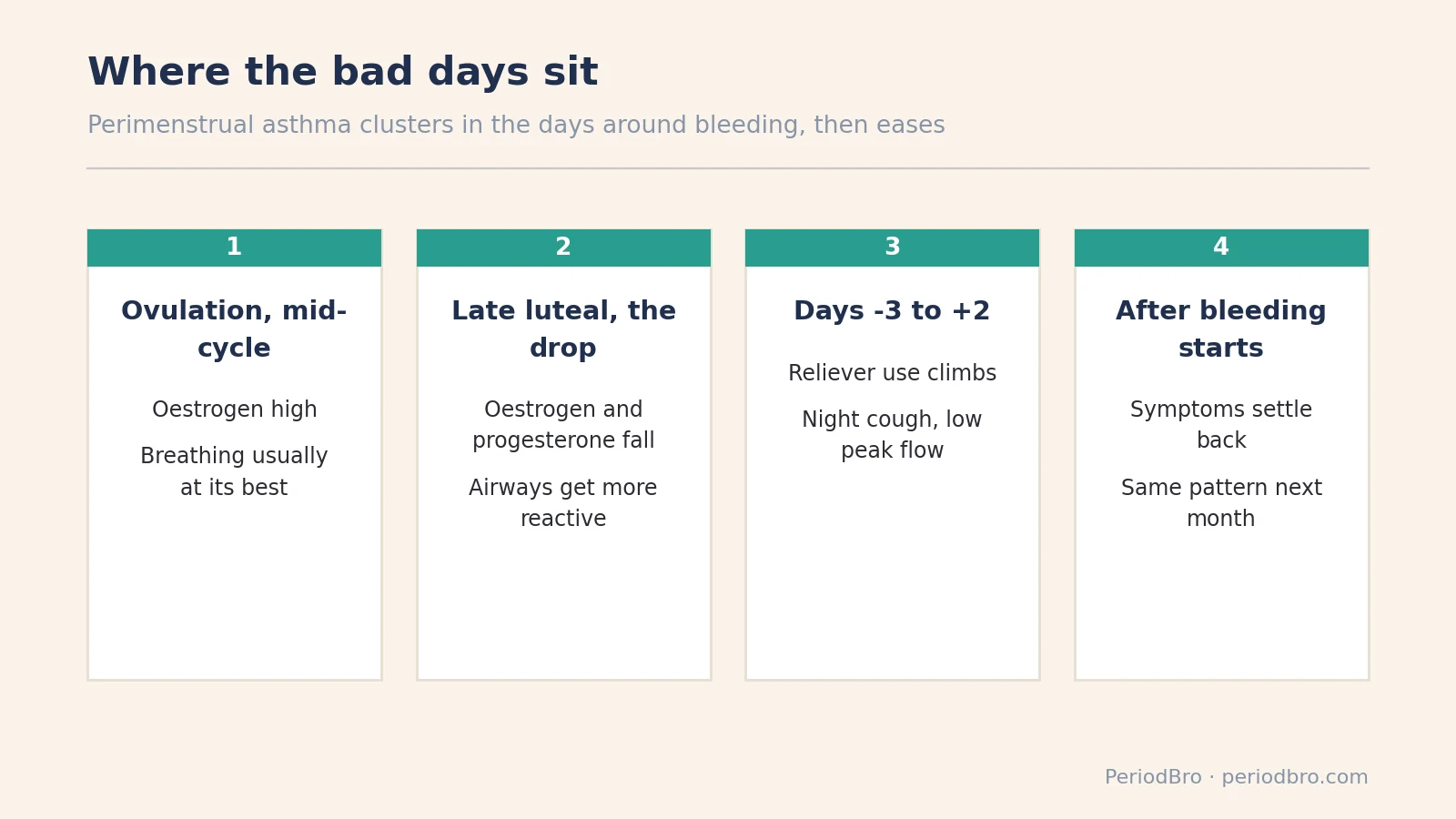
Her asthma has been quiet for months. Then a few days turn up where the rescue inhaler comes out twice as often, the cough is back at night, and the stairs she climbs every day leave her short of breath. Check the dates against her cycle and there’s a fair chance those days sit in the week before her period. Doctors have a name for asthma worse before her period: perimenstrual asthma, and they’ve been studying it since the 1980s.
This one deserves more attention than the average cyclical symptom, because the stakes run past comfort. Women with this pattern turn up in emergency departments more often than women with similar asthma who don’t have it. The first useful step is something you can help with directly, and it costs nothing but a bit of attention to dates.

Asthma worse before her period: what drives it
In the last days before bleeding starts, both oestrogen and progesterone fall away. That drop is the working explanation for the whole phenomenon. A 2016 review in Multidisciplinary Respiratory Medicine puts the emphasis on the swing rather than on any single hormone sitting too high or too low, which is why the same woman can breathe easily around ovulation, when oestrogen is up, and badly ten days later.
The cells doing the work carry hormone receptors. Mast cells, the ones that dump histamine into airway tissue, respond to oestrogen directly, so a hormonal shift lands on an inflammatory system rather than passing it by. The same review notes that perimenstrual asthma looks different from ordinary allergic asthma under the microscope and in the clinic: less atopy, more aspirin sensitivity, lower lung capacity. That points at the prostaglandin pathway rather than at pollen, which also explains why an antihistamine often does very little in that particular week.
None of this means her asthma is hormonal rather than respiratory. She has asthma. The cycle is turning a dial that was already there.
How common it is, and who tends to get it
Estimates vary because the definitions vary. That same review puts the figure between 19 and 40 percent of women with asthma. When researchers in the Severe Asthma Research Program asked a large cohort directly, 17 percent said yes. In a registry of women with aspirin-exacerbated respiratory disease, 24 percent of 322 reported it, which fits the prostaglandin story neatly.
The number that surprised me sits in teenagers. A 2024 pilot study of 50 adolescents with asthma found 75.5 percent reporting perimenstrual worsening, and the ones reporting it also reported more symptoms, more medication use, and more disruption to daily and home activities. It’s a small clinical sample rather than a population figure, and the group was skewed towards severe asthma. Still, if you’re the dad in this scenario rather than the partner, that number is worth carrying into the paediatrician’s office.
It often isn’t only her chest
Partners tend to notice the breathing and miss the rest. In that aspirin-sensitive registry, sinus symptoms worsened in the same week as the asthma, so the blocked nose and the facial pressure belong to the same pattern rather than to a separate cold that keeps arriving suspiciously on schedule.
Further along the same spectrum sits a condition worth knowing by name. Progestogen hypersensitivity, described in a case series of 24 patients from Brigham and Women’s Hospital, is a cyclical allergic reaction to a woman’s own progesterone. It shows up as hives, angioedema, eczema-like rashes, sometimes asthma, and in rare cases anaphylaxis, arriving a few days before bleeding and clearing once it starts. In 42 percent of those cases the trigger was her own hormone rather than a medication. It’s uncommon, and it’s also the explanation for cyclical hives that get written off for years as stress or a new washing powder.
Cyclical patterns cluster. If she already gets migraines in the same window, or the run-down, achy days people call period flu, a breathing pattern on those same dates is less of a leap than it sounds.

Why this one isn’t worth waiting out
Most cycle symptoms are a comfort problem. This one has a harder edge. The Severe Asthma Research Program found that 52 percent of the perimenstrual group met criteria for severe asthma, against 30 percent of the women without the pattern, and that the association with more symptoms and more urgent healthcare use held up after adjusting for severity. The 2016 review goes further and links the pattern to emergency department visits, hospital admissions, and emergency treatment including intubation.
Read that as an argument for getting it named at an appointment rather than as a reason to worry. Uncontrolled asthma is a treatable problem once someone knows which days to treat.

The two-cycle record that changes the appointment
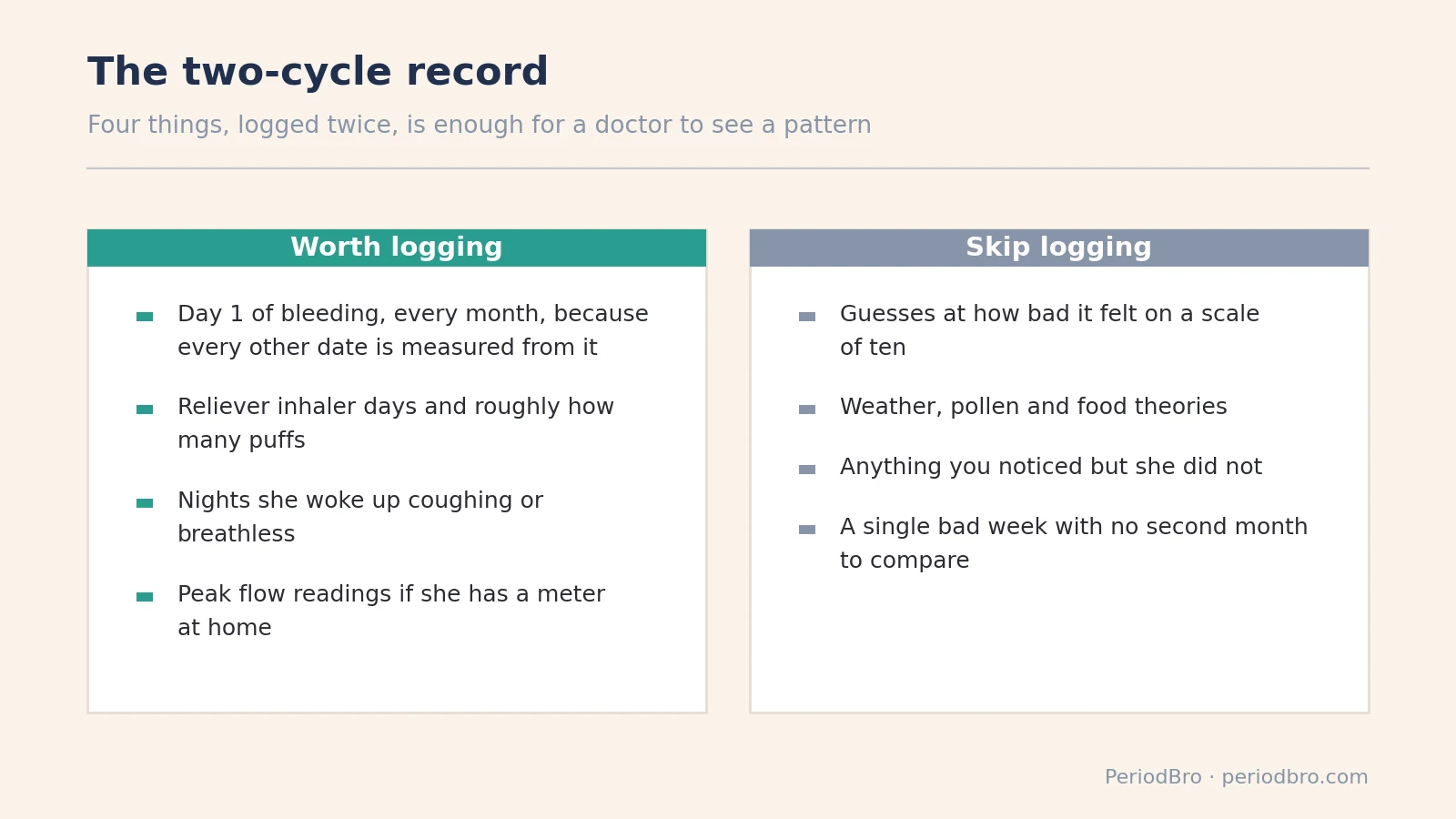
Here’s where you’re actually useful. A doctor hearing “my asthma feels worse sometimes” has nothing to work with. A doctor looking at two months of dated entries has a pattern. The entries don’t need to be elaborate.
Log the first day of bleeding each month, because every other date is measured from it. Then log the days she used the rescue inhaler and roughly how many puffs, any night she woke up coughing, and the days a peak flow meter reads low if she has one at home. If she doesn’t, it’s worth asking for one at the appointment, since a number carries further than a description of how the stairs felt.
Two cycles is the minimum that means anything. One bad week before one period is a bad week. The same week showing up twice is a pattern with a name attached, and it changes what a doctor can prescribe. If asthma worse before her period turns out to be her shape, that page of dates is what gets it treated as a respiratory problem with a schedule rather than a run of bad luck.
What actually helps that week
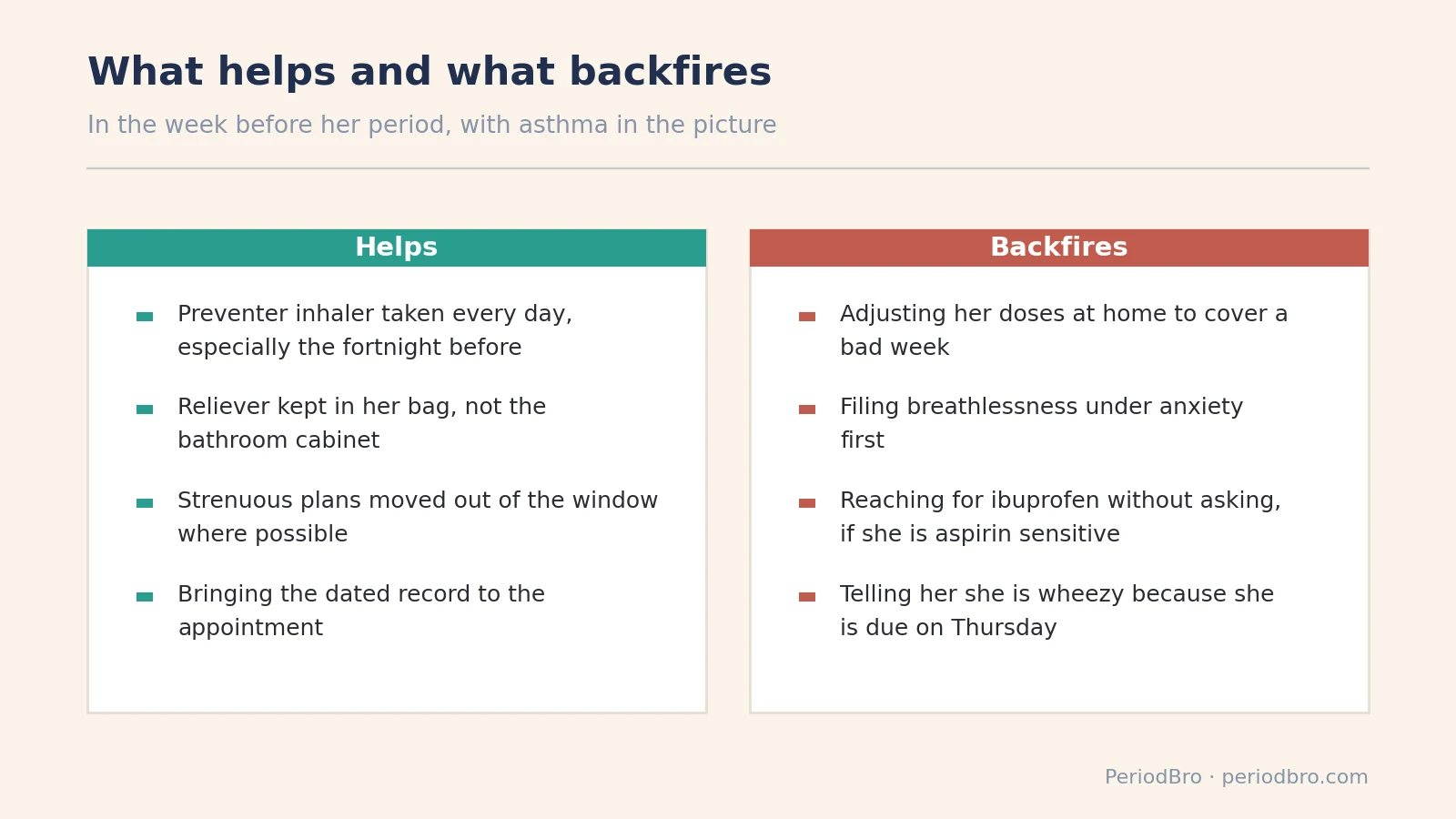
The preventer inhaler is the part people get wrong. Feeling fine for three weeks is what a working preventer feels like, so the temptation to skip it lands exactly when stopping does the most damage. If she’s already inconsistent with it, the fortnight before her period is the worst possible stretch to be casual about.
Practical things that cost nothing: the rescue inhaler goes where she is, not where it usually lives, and that means the bag rather than the bathroom cabinet on the days you both know are coming. Book routine appointments and anything strenuous outside that window where you can. Keep an eye on ibuprofen, because a slice of this group is aspirin sensitive and non-steroidal painkillers can make the chest worse in the same days her cramps make her reach for them. Worth raising with her doctor rather than deciding at home.
There’s a hormonal angle too. The 2016 review discusses smoothing the oestrogen swing with continuous hormonal contraception and a shortened hormone-free interval, on the logic that a flatter curve gives the airways less to react to. The evidence is thin enough that it’s a conversation to have with a clinician who knows her history, not a plan to arrive with. If she’s already on hormonal contraception, mention the type and the schedule at the appointment.
What to skip
Don’t adjust her doses at home. Doubling a preventer or stretching a rescue inhaler to cover a bad week is a clinician’s decision, and getting it wrong in either direction has real consequences.
Don’t file it under anxiety. Breathlessness and a tight chest belong to both asthma and anxiety, and the week before her period can produce both at once. The order matters: treat the airway, then talk about the anxiety. Reaching for the psychological explanation first is how women with this pattern end up in an emergency department, and it’s a big part of why getting dismissed at appointments stays such a common story.
Don’t turn the calendar into an argument. “You’re due on Thursday, that’s why you’re wheezy” lands badly even when it’s accurate. Bring the record to the appointment instead, and let a doctor say it.
When it needs help the same day
Get urgent help if her reliever isn’t working or wears off within a couple of hours, if she’s too breathless to finish a sentence, eat, or sleep, if her lips or fingers look blue, or if her peak flow drops well below her usual best. A cycle pattern is useful context for a planned appointment. It’s never a reason to wait out an attack, and the emergency numbers in this research exist because some women did.
If you want the wider map of what shifts across the month and when, the menstrual cycle explained for men covers the hormonal shape that this sits inside.

PeriodBro logs symptoms and inhaler days against her actual dates, which is what turns “it feels worse sometimes” into a record a doctor can read. Try it free.
This article is general information, not medical advice. Worsening asthma, a rescue inhaler that stops lasting, or cyclical hives and swelling all warrant a doctor’s appointment rather than a change you work out between you at home.