Iron Deficiency From Heavy Periods: Why She Is Tired All the Time
For about a year I thought she just ran on a lower battery than the rest of us. Work, then done. Flat on the couch by eight, apologising for it, saying she didn’t know what was wrong with her. I filed it under stress and bad sleep, because those were the explanations I had. It never crossed my mind that the answer was how much she was bleeding every month.
Her heavy periods and her exhaustion sat in two different mental folders, and they were the same fact. Iron deficiency from heavy periods runs quietly in a lot of houses where it has never been named, mostly because finding it takes a blood test that gets ordered less often than it should.
What a heavy period actually costs her
Blood carries iron. Iron builds hemoglobin, and hemoglobin is what moves oxygen around her body. Every heavy period takes iron out of the system. If it leaves faster than food can put it back, the tank runs down month after month, and it never gets a chance to refill.
The scale of it is bigger than most people assume. Cleveland Clinic puts heavy menstrual bleeding at 27% to 54% of people who menstruate, and lists what counts: periods running longer than seven days, soaking a pad or tampon every hour for several hours, doubling up on products, getting up at night to change, passing clots the size of a quarter several times a day.
Very few people know where they sit on that list, because there is nothing to compare against. She has never seen anyone else’s period, so hers is the baseline. Bleeding through a super tampon in an hour is just a Tuesday if it has always been a Tuesday.
Iron deficiency from heavy periods starts before anemia does
This is the part I had wrong for a year.
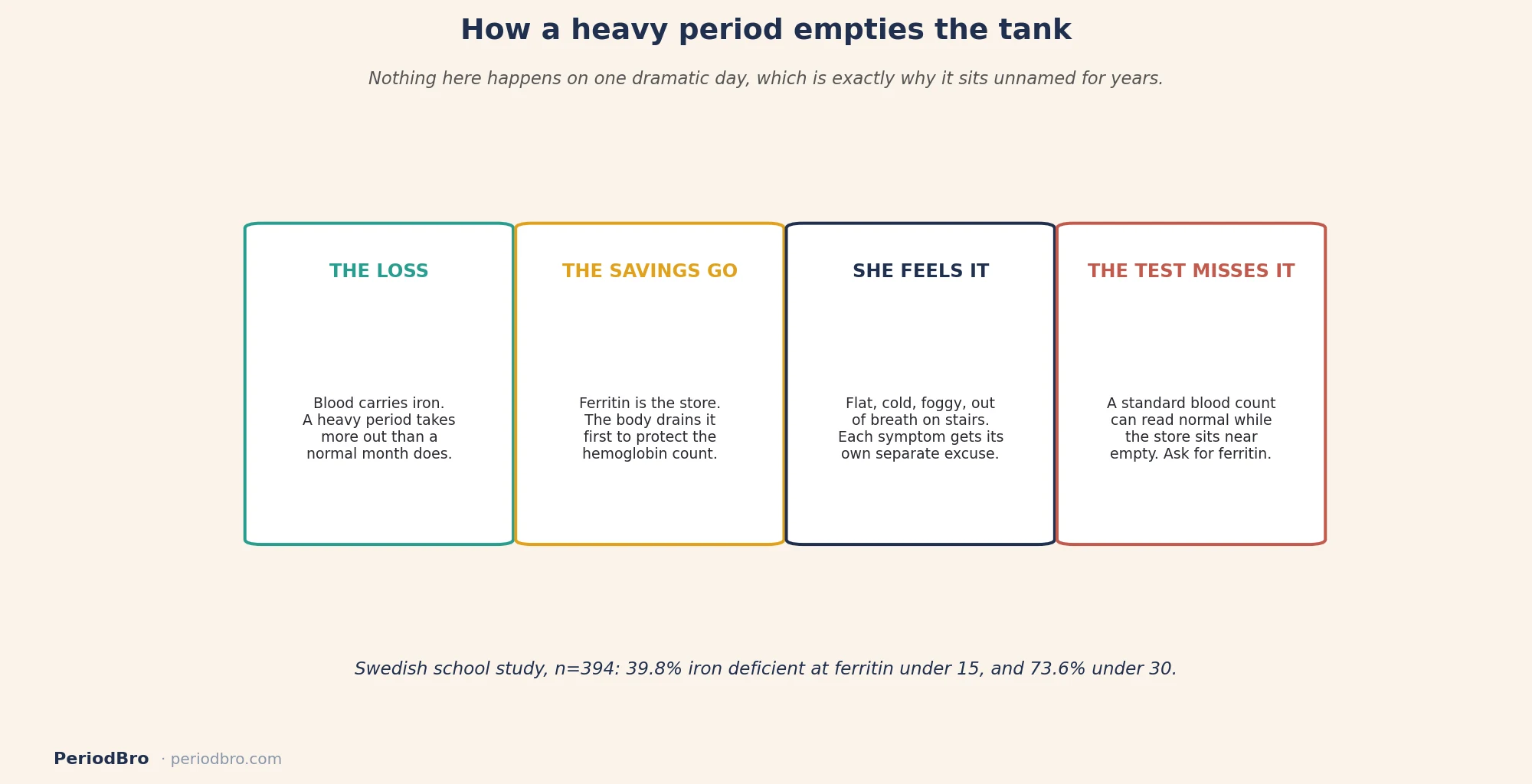
Think of it as two accounts. Ferritin is the savings. Hemoglobin is the paycheck. The body will protect the paycheck for as long as it can, so it drains the savings first. That means she can be genuinely iron deficient, with the fatigue and the fog and the cold hands, while a standard blood count still reads normal. Her hemoglobin is being propped up by reserves that are almost gone.
By the time anemia shows up on a routine test, the deficiency has usually been running for a long time. Cleveland Clinic lists what that ends up looking like: fatigue, headaches, irritability, muscle cramps, pale skin, a sore tongue, spoon-shaped fingernails, shortness of breath and a fast heart rate. It also notes the symptoms tend to get worse over time, which is exactly why it gets normalised. Nothing arrives on a single dramatic day.
The numbers, put side by side
A 2025 cross-sectional study out of two high schools in southern Sweden screened 394 post-menarchal girls, median age 16 (full text). Two of its findings belong in the same sentence.
52.8% screened positive for heavy menstrual bleeding. And 39.8% were iron deficient at the World Health Organization threshold of ferritin under 15 micrograms per litre. Loosen the threshold to under 30, which is what a 2022 expert panel recommends for this age group, and 73.6% of them were deficient. That is roughly three in four teenage girls in an ordinary Swedish high school.
Diet stacked on top of it. Among girls with heavy bleeding who also restricted meat, 70.9% were iron deficient, against 45.1% of the omnivores who bled heavily. Put both together and the odds of deficiency ran 13.5 times higher than for an omnivore with ordinary periods.
Those are teenagers, but the mechanism doesn’t change at 25 or at 38. For anyone in their reproductive years, heavy bleeding is the leading reason iron runs out. It just gets more years to compound.
What it looks like from where you are standing
You see this from outside, which is an advantage she does not have.
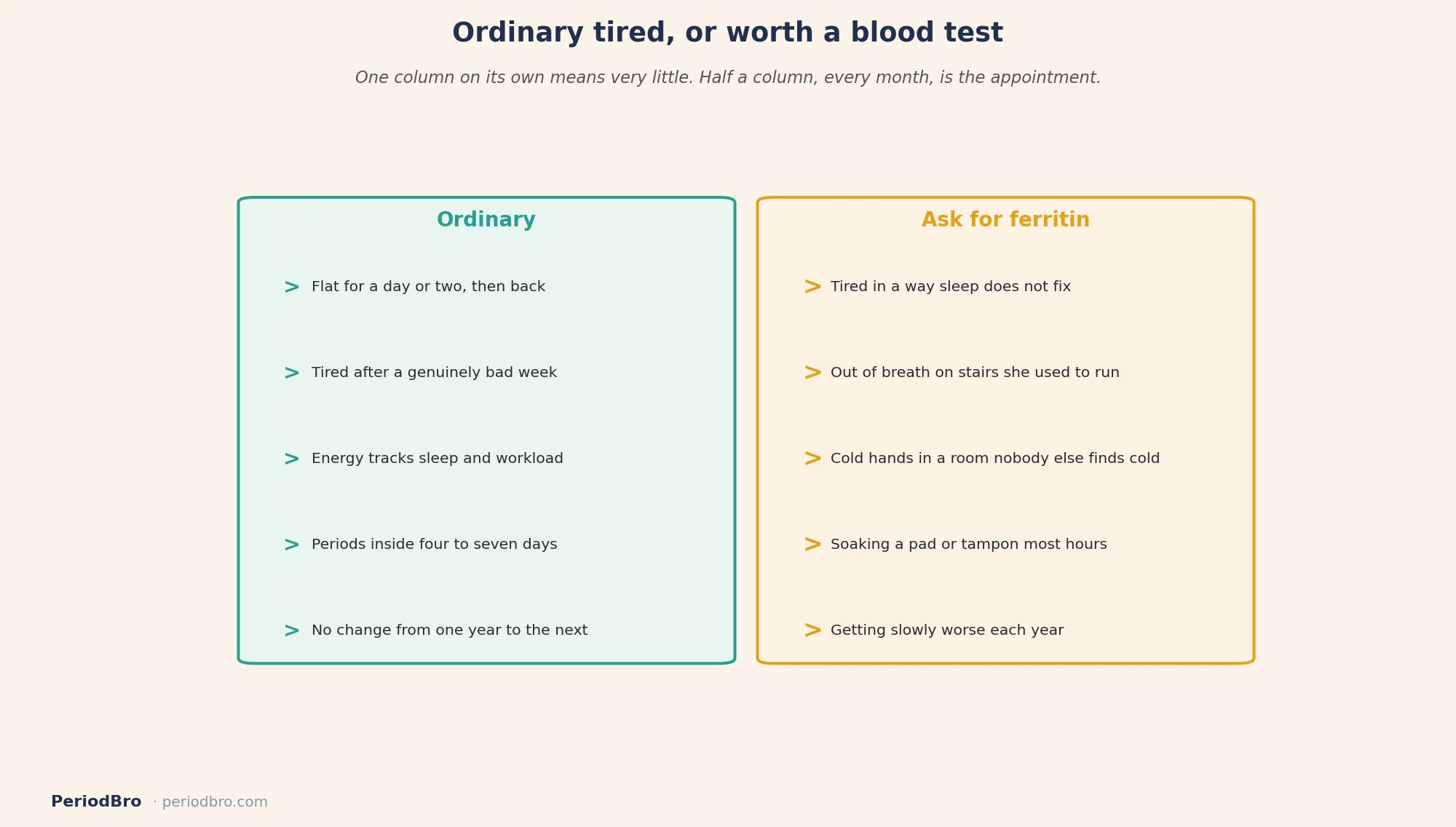
She experiences each symptom in isolation and adapts to it. The third coffee is a coffee habit. Being out of breath on the stairs is being out of shape. The cold hands are just how she runs. The couch at eight is a personality trait now. Every one of them has a reasonable stand-alone explanation, and she has had months to build one for each.
You see them stacked. You also see the calendar, which she cannot see from inside her own week, and if you have been paying any attention you can say something like this out loud: the flat days start in the week she bleeds heaviest, and they have been getting a little worse each year. That sentence is worth more at an appointment than any symptom on its own.
The one word to say at the appointment
If she goes in and says she is tired, she will very likely get a basic blood count, and a basic blood count can come back clean while her stores sit near zero.
The word that changes the appointment is ferritin. Cleveland Clinic lists the tests that actually sort this out: iron level, ferritin, and total iron-binding capacity. Asking for ferritin by name is a small thing that routinely gets skipped, and it is the number that shows the savings account rather than the paycheck.
Two things make that appointment land better. Bring the bleeding record, because “heavy” is a word and “seven days, doubling up on days two and three, changing at 3am” is data. And treat the fatigue and the bleeding as one question rather than two, since presenting them separately is exactly how they end up with two separate non-answers.

Fixing the iron is only half of it
Low iron is downstream of the bleeding, and refilling a tank with a hole in it works for a while and then stops working.
That is where the rest of the cluster comes in. Fibroids, adenomyosis, PCOS, an underactive thyroid and inherited bleeding disorders all cause heavy periods, and all of them are treatable once named. Cleveland Clinic lists hormone imbalance, growths in the uterus, bleeding disorders and certain medications among the causes worth ruling out. A low iron result is often what finally gets the bleeding itself investigated, after years of it being filed as just how her periods are.
On the iron itself, expectations matter. Cleveland Clinic notes that people taking oral iron may notice a difference in about two to three weeks. Feeling better is not the same as being refilled, though, and stopping the moment the fog lifts is the standard mistake. Intravenous iron works faster and exists for a reason when tablets are not tolerated or not keeping up. All of that is her clinician’s call, not yours and not mine.
Food helps at the edges rather than at the centre. Iron from meat and fish absorbs more readily than iron from beans, lentils and greens, which is exactly what showed up in the Swedish data. Vitamin C in the same meal helps the plant-based kind along, and a mug of tea or coffee with the meal works against it, so moving the coffee an hour later is a free win. None of this out-runs a heavy period on its own, and pretending otherwise wastes months.
What you can actually do this month
Four things, and only one of them involves talking about feelings.
Keep the record. Days of bleeding, how many products on the worst day, whether she is changing at night, clots. Four data points on a phone. This is the job that is genuinely yours, because it is the one she cannot do from inside the week.
Say the word out loud once. Not a diagnosis. Something closer to: you have been wiped out for a while, your periods are heavy, those two things are usually connected, will you ask for a ferritin test.
Go with her if she wants that. A second person in the room who can say “it has been like this for two years” is the difference between a shrug and a blood draw.
Carry the week. The cooking, the laundry, the school run, whatever the equivalent is in your house, across the heaviest few days. This one is not a gesture. Running on empty and then running a household is the exact arrangement that keeps the problem invisible.
My part of this story ends badly and then fine: a friend of hers asked a blunt question over dinner, and there was a blood test three weeks after that. I had every piece of the pattern in front of me for a year and never put them together, which is most of why I write things like this down now.
If you want the calendar half of it handled without asking her to install anything or explain herself twice, that is the thing I built. PeriodBro tracks the cycle from your side, so the record exists when the appointment finally happens.
The ferritin number is the thing to go and get. Once it exists, the rest of the conversation has somewhere to start.

Medical disclaimer: this article is general information, not medical advice. Iron supplements are not harmless and should not be started without testing, because taking iron when you do not need it causes its own problems. Any bleeding through two or more pads or tampons an hour for two to three hours in a row needs urgent medical attention, not a supplement.