How Cycle Awareness Changes a Relationship
Six months into tracking, I noticed I’d stopped having a particular argument. Not resolved it. Stopped having it. The one that starts on a Tuesday over nothing and ends at midnight with both of you exhausted and neither of you sure what it was about.
That’s mostly how cycle awareness changes a relationship. Something gets subtracted rather than added. A category of fight quietly leaves the house and you don’t notice for weeks.
I want to be specific about what actually shifts, because most writing on this either promises too much (“understand her cycle, fix your marriage”) or too little (“be nice when she’s on her period”). Neither is useful. Here’s what changes, what doesn’t, and roughly how long it takes.
What cycle awareness is, and what it isn’t
Cycle awareness means you know roughly where she is in her month and what that tends to mean for her specifically, which is a different thing from what it means on average for women.
It isn’t a personality decoder. It doesn’t tell you what she’s thinking. It gives you one variable you were previously missing, in a system that has about forty of them.
The medical world got here first. ACOG and the American Academy of Pediatrics have argued since 2015 that the menstrual cycle should be treated as a vital sign, tracked and reviewed like temperature or blood pressure, because it carries real information about what’s happening in the body (ACOG Committee Opinion 651). If a clinician treats it as data, treating it as data at home isn’t strange. It’s overdue.
Change one: you stop mis-filing the conflict
Around 90% of people who menstruate report at least one premenstrual symptom, and roughly 20% to 30% meet the criteria for PMS proper, meaning the symptoms interfere with daily life (ACOG guideline summary, The ObG Project). Irritability is on that list. So is a shorter fuse, worse sleep, and less tolerance for noise, mess, and vague plans.
Without the timing, you file her irritation under “she’s unhappy with me” or “she’s unhappy with us.” That filing error is the expensive part. You get defensive. She gets more irritated because now she’s managing her body and your reaction to it. The fight is no longer about the dishes.
With the timing, you file it differently. The grievance is usually still real. What’s changed is the volume knob, and volume knobs aren’t arguments. You can hear the content without treating the intensity as a verdict on the relationship.
This is not the same as dismissing her. Saying “you’re just premenstrual” is the single fastest way to make everything worse, and I’ve written separately about the phrases that reliably detonate. The awareness is for you, in your head. It’s not a card you play out loud.
Change two: your support gets specific
Generic support is mostly performance. You hover, you ask “are you okay” four times, and she has to reassure you, which is another job on a day she has no capacity for jobs.
Specific support is different because it’s timed. You know Thursday is likely to be rough, so Wednesday night you do the shopping and clear the calendar and don’t schedule the difficult conversation with the landlord. Nobody announces anything. The week is just easier.
There’s decent evidence that this kind of responsiveness matters physically, not just emotionally. Research on partner responsiveness in people living with endometriosis found that feeling your partner is genuinely tuned in, validating and invested, improves pain coping, because it reframes the pain as something the couple is facing rather than something she faces alone (Frontiers in Psychology, 2024). That study looks at a specific condition, so don’t stretch it further than it goes. The mechanism underneath isn’t exotic though: being properly met by someone changes how much a hard thing costs you.
Change three: she stops explaining herself
This is the change she notices, and the one she almost never says out loud.
Before, every hard week came with an unpaid administrative task: translate her body into terms you’d accept. Prove the tiredness. Justify the low mood. Pre-empt your assumption that she’d gone cold.
Once you’re tracking, that task disappears. She doesn’t have to build a case. She can just have a bad day the way you have a bad day after a bad night’s sleep, without a hearing. That’s a quantity of daily labour coming off her plate, and it compounds.

Change four: you plan the month, not the week
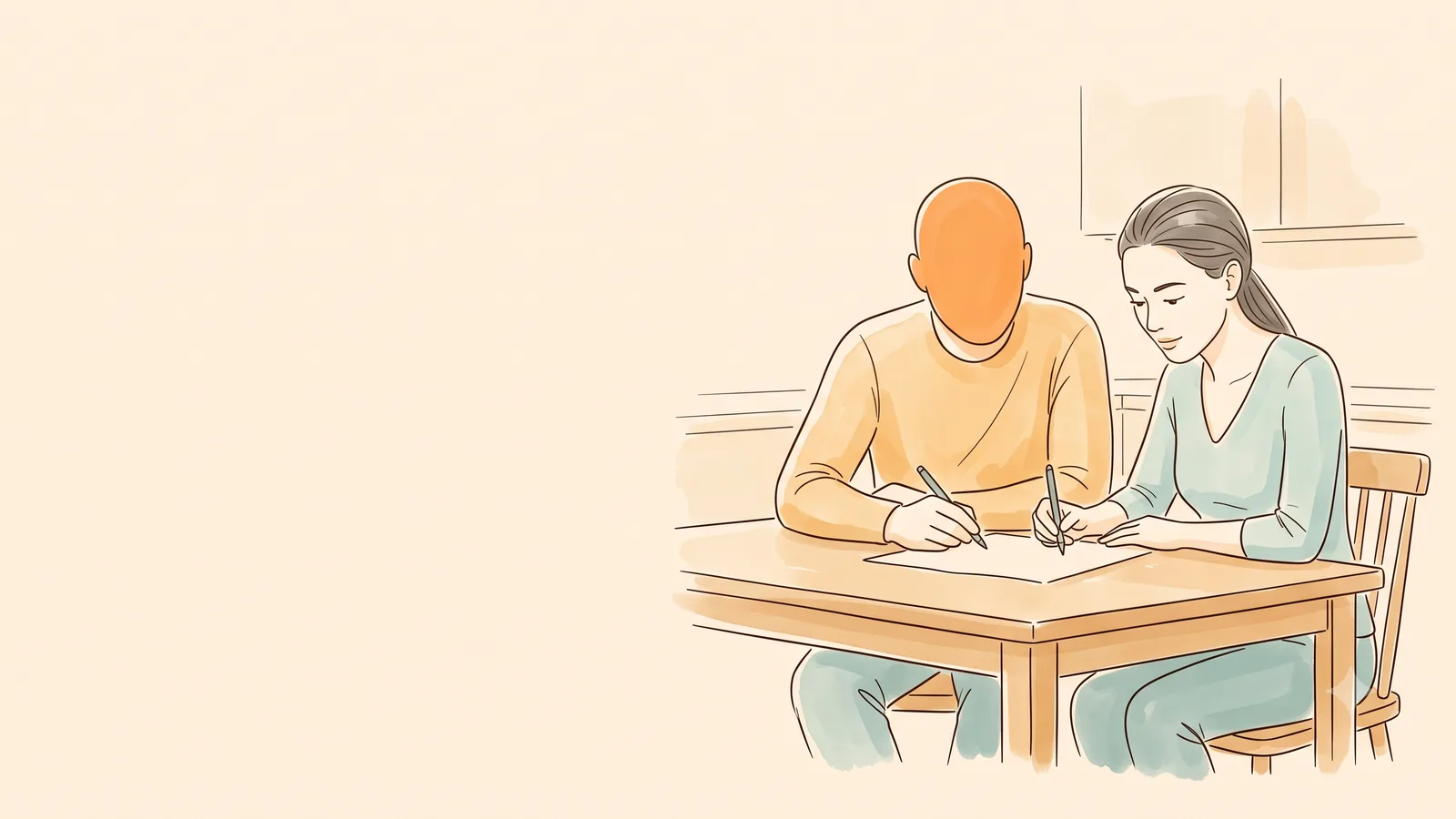
The one that surprised me. Once you can see the shape of a month, you start using it. Hard conversations land in the follicular week, when she has more bandwidth and so, frankly, do you, because you’re not bracing. Big social plans go where the energy is. The dinner with her difficult colleague does not get booked on day 26.
None of that is manipulation. You’re not gaming her hormones. You’re doing what you’d do with any other known constraint, like scheduling around a night shift or a bad back. Anyone would.
What does not change
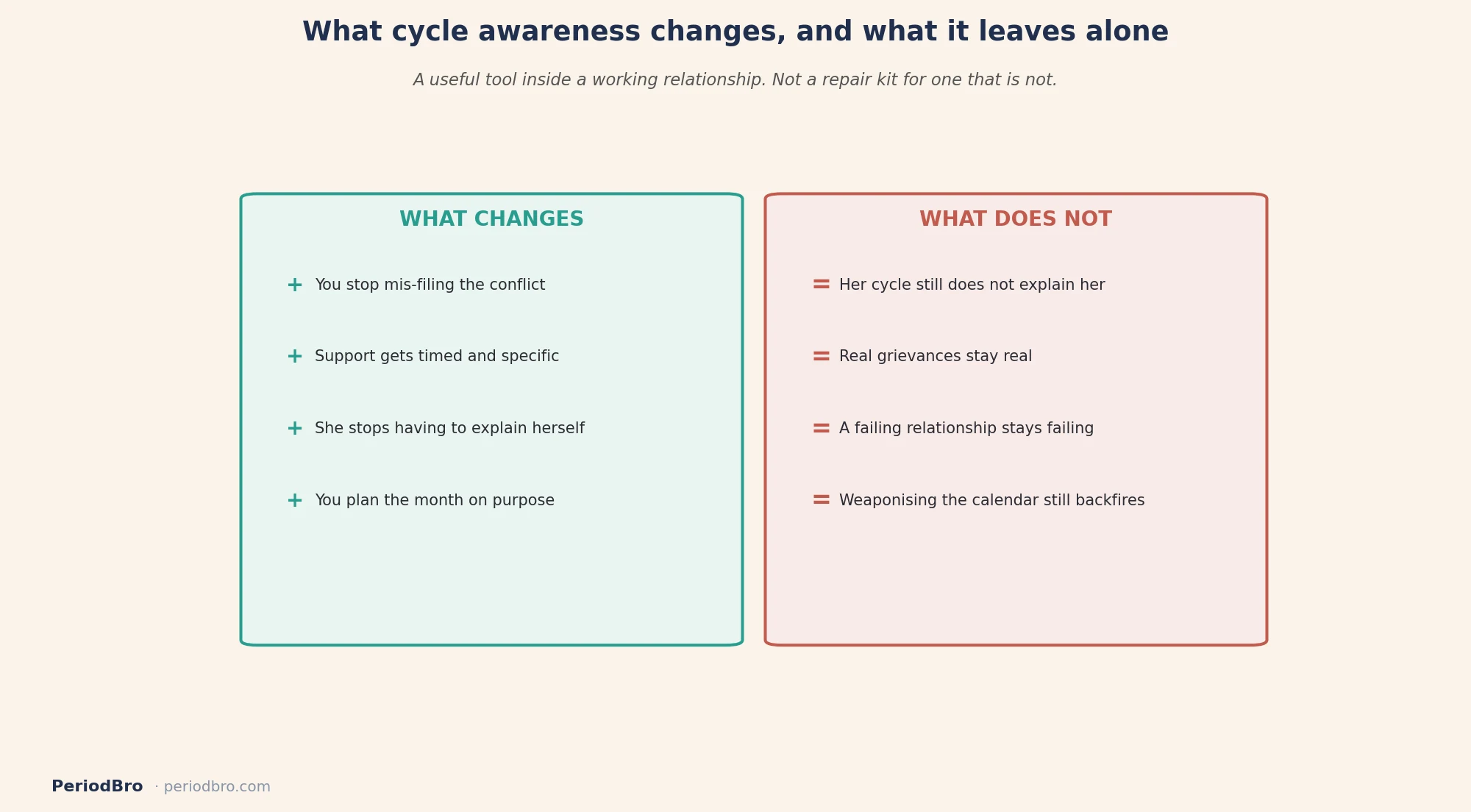
Her cycle doesn’t explain her. If she’s unhappy about something real, the calendar will not make it go away, and looking for a hormonal cause for every disagreement is a way of never taking her seriously. Some Tuesdays she’s right and you’re wrong and it’s day 9.
Tracking also doesn’t fix a relationship that’s failing for other reasons. It’s a good tool inside a functioning partnership. It’s not couples therapy, and it isn’t a substitute for one.
And it can go badly. The failure mode is weaponising the calendar: quoting it back at her, treating her feelings as symptoms, announcing “day 24” like a diagnosis. If you’re doing that, you’ve built a surveillance habit and called it care. The line between the two is consent, and I’ve laid out where it sits in this guide to tracking with consent. She should know. She should be able to stop it.
How long it actually takes
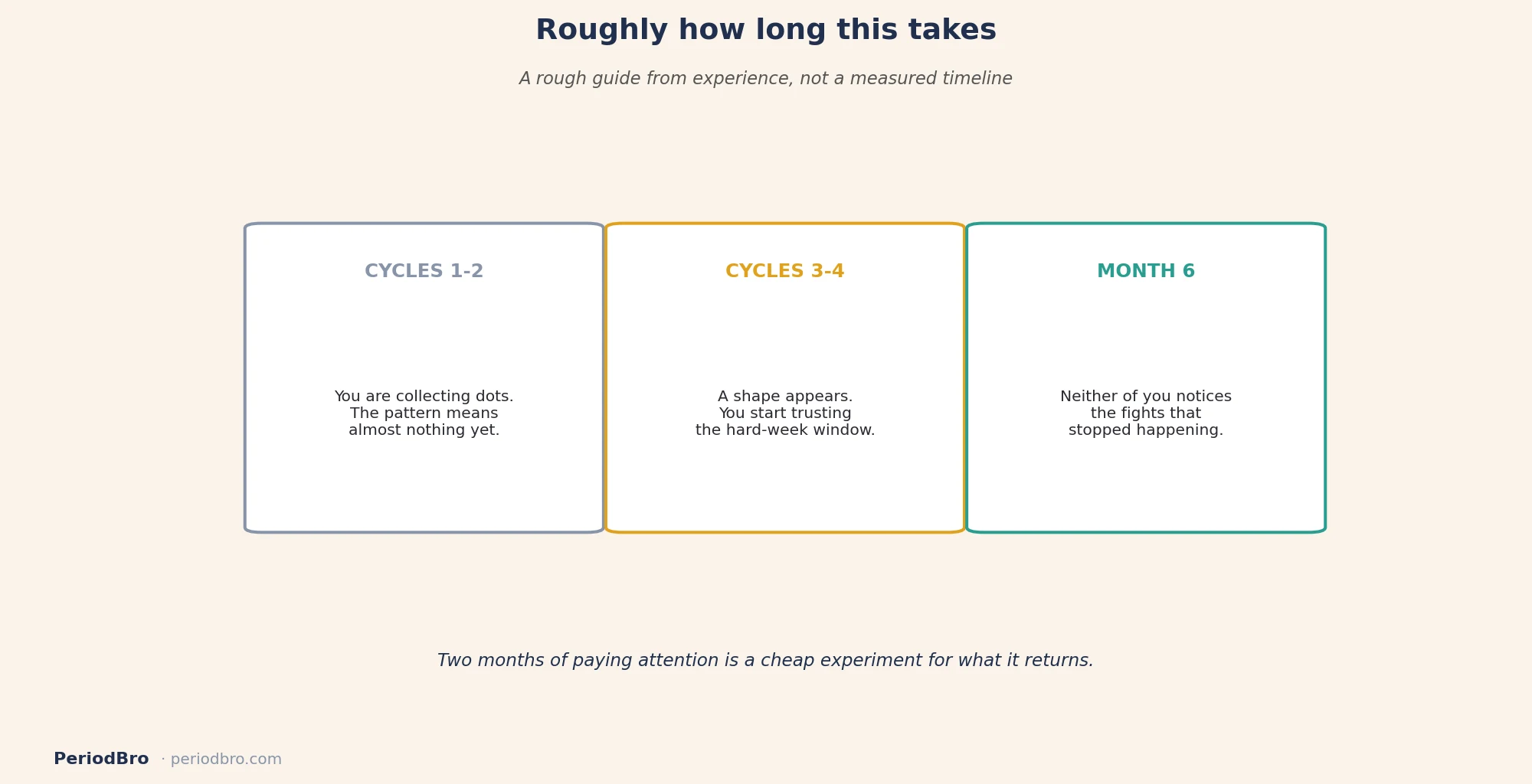
Two cycles before the pattern means anything. Three or four before you trust it. Around six months before the change is visible from outside, which is to say before either of you notices what stopped happening.
It’s slower than you want and less dramatic than the sales pitch. It’s also close to free. Two months of paying attention is a very cheap experiment for what it returns.
If her pattern turns out to be severe, and I mean the kind of severe that ends relationships and jobs, that’s worth naming rather than absorbing. The difference between rough PMS and PMDD is real and clinically meaningful, and I’ve mapped it in PMS versus PMDD.
Common questions
Does she have to be involved?
She has to know and agree. She doesn’t have to do the work. Plenty of setups run entirely on your phone, with her period start date as the only input she provides.
Isn’t this just an excuse for her to be difficult?
If you’re asking this in good faith: no. Awareness of a pattern isn’t permission for it. Cycle awareness makes hard weeks easier to navigate. It doesn’t retire accountability for either of you.
What if she thinks it’s creepy?
Then it is, for her, and that’s the end of it. Ask about the objection rather than arguing with it. Usually it’s about control, not information, and the fix is giving her the off switch.
Do I need an app?
No. A note in your calendar works. An app just does the counting and prompts you, so it’s easier to keep going past month three. That’s the only real advantage.
How cycle awareness changes a relationship, honestly
What actually changes is that a category of avoidable pain leaves. Fewer fights that were never about you. Support that’s specific instead of anxious. One less thing she has to explain. A month you plan on purpose.
Nobody in this story gets a personality transplant. You just stop flying blind. If you want the longer version of how to start, the healthy way to track a cycle inside a relationship covers the mechanics, and my own account of what it did to mine covers what it felt like.
This article is for general information and is not medical advice. If premenstrual symptoms are severely disrupting her life, that’s a conversation for a clinician.