How to Explain Periods to a Child: An Age-by-Age Guide for Dads
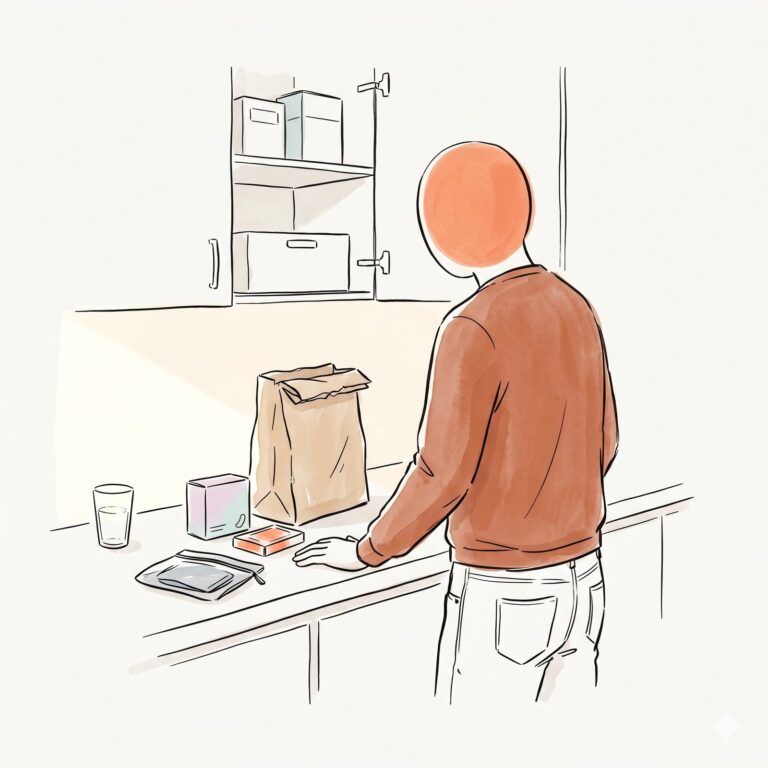
A buddy of mine was brushing his teeth when his five-year-old son pointed at the bathroom bin and asked, very loudly, “Why is there blood in Mommy’s trash? Is she hurt?” He froze, said “she’s fine, buddy,” and changed the subject. Later he asked me how to explain periods to a child that age without either lying or launching into a biology lecture. The answer is simpler than most parents expect.
This guide covers what kids can handle at different ages, the words to use, the questions they actually ask, and why it matters that dads join in, whether the kid in front of you is a son or a daughter.
Why the early, small answers matter
Kids notice periods long before anyone plans to tell them. They see pads in the cupboard, wrappers in the bin, a parent who needs a hot water bottle and a quiet evening. If nobody explains, they fill the gap themselves, and kids’ guesses tend to be scarier than the truth.
KidsHealth, the pediatric site run by Nemours, says periods shouldn’t be one big talk at a set age. Start early, keep it simple, and build on what your child already understands over time (KidsHealth). It also points out that girls who don’t know what a period is can be frightened by the blood when it first happens, which is a strong reason not to wait.
Timing is earlier than many parents assume. ACOG puts the typical age of a first period at around 12 to 13 (ACOG Committee Opinion 651), and puberty can start as young as 8 for some girls (KidsHealth). Our guide to what age girls get their period has the full range.
How to explain periods to a child, age by age
An answer that’s true and sized to the kid works better than any script. A rough guide:
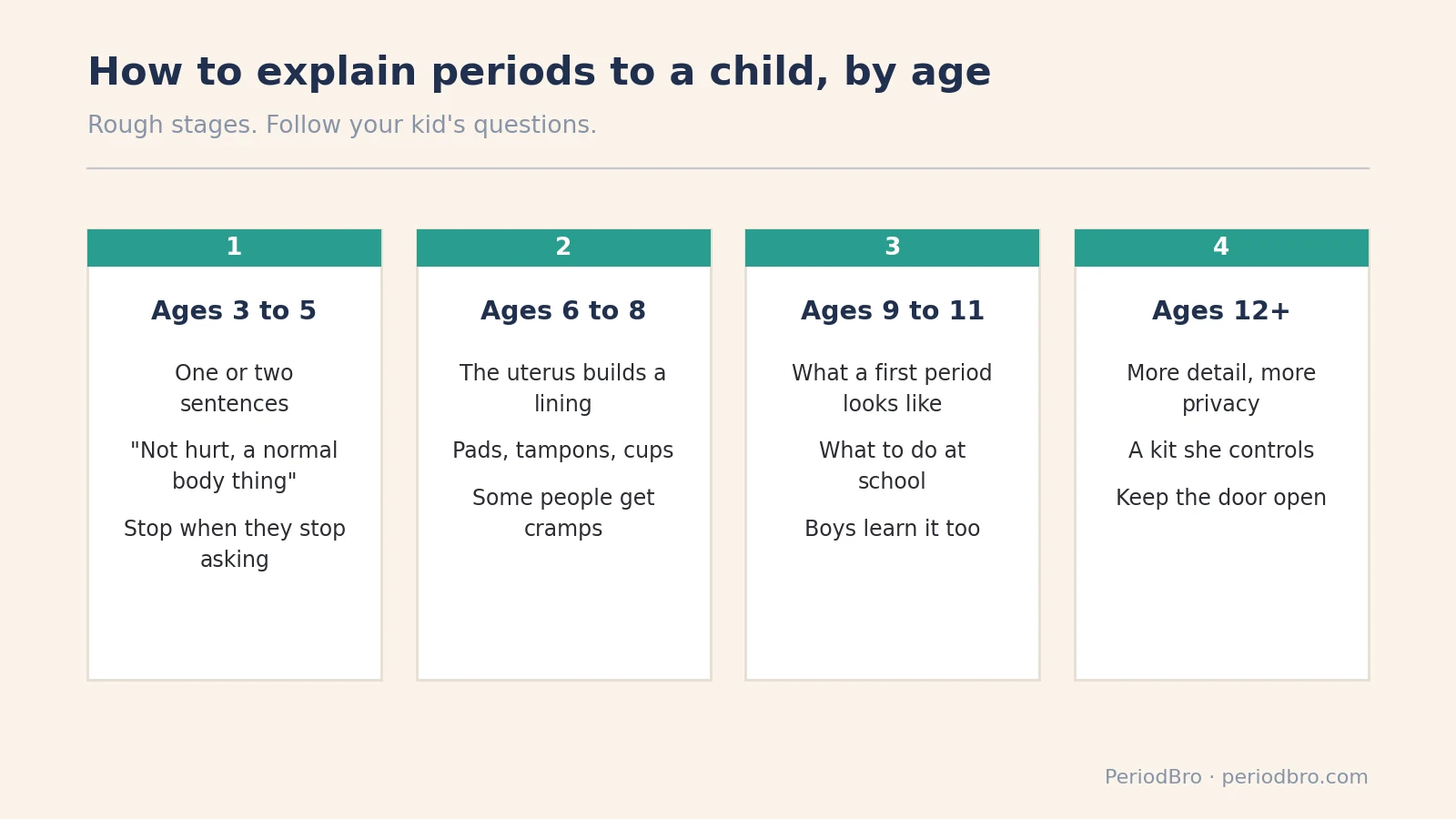
Ages 3 to 5. One or two sentences. “Grown-up women’s bodies have a part called the uterus. Once a month it lets out a little blood. It doesn’t mean they’re hurt, and it’s how bodies get ready to maybe grow a baby one day.” Then stop. If they want more, they’ll ask.
Ages 6 to 8. Add a bit of the why and the what. The uterus builds a soft lining every month in case a baby starts growing. If there’s no baby, the lining comes out as a period over a few days. People use pads, tampons, cups or period underwear to catch it. Some people get cramps, a bit like a tummy ache.
Ages 9 to 11. This is the age to talk about what it’ll be like for them, or for their friends. For a girl, that means what a first period looks like (often brownish, not bright red), what to do if it starts at school, and that everyone’s timing is different. For a boy, it’s knowing that girls in their class will start soon, that it’s normal, and that jokes about it are cruel. Our pieces on signs her period is about to start and talking to your son about periods go deeper here.
Ages 12 and up. More detail, more privacy, and less of the talking coming from you. Our guide to talking to your daughter about periods covers the teen years.
Use the real words
“Uterus,” “vagina,” “period,” “pad.” Say them in the same voice you’d use for “elbow.” Health educators recommend teaching correct names for body parts early, because the later explanations only make sense if a kid knows what’s where (Healthify NZ). Cute nicknames send a quiet message that this part of the body is embarrassing, and that message sticks.
If you stumble over the words yourself, that’s normal. Most of us grew up with “lady time” and a closed bathroom door. Our list of period terms for dads is a quick refresher on what everything is called.

The questions kids actually ask
Kids rarely ask “please explain menstruation.” The questions come sideways, usually at bad moments. A few that come up a lot, with answers that work:
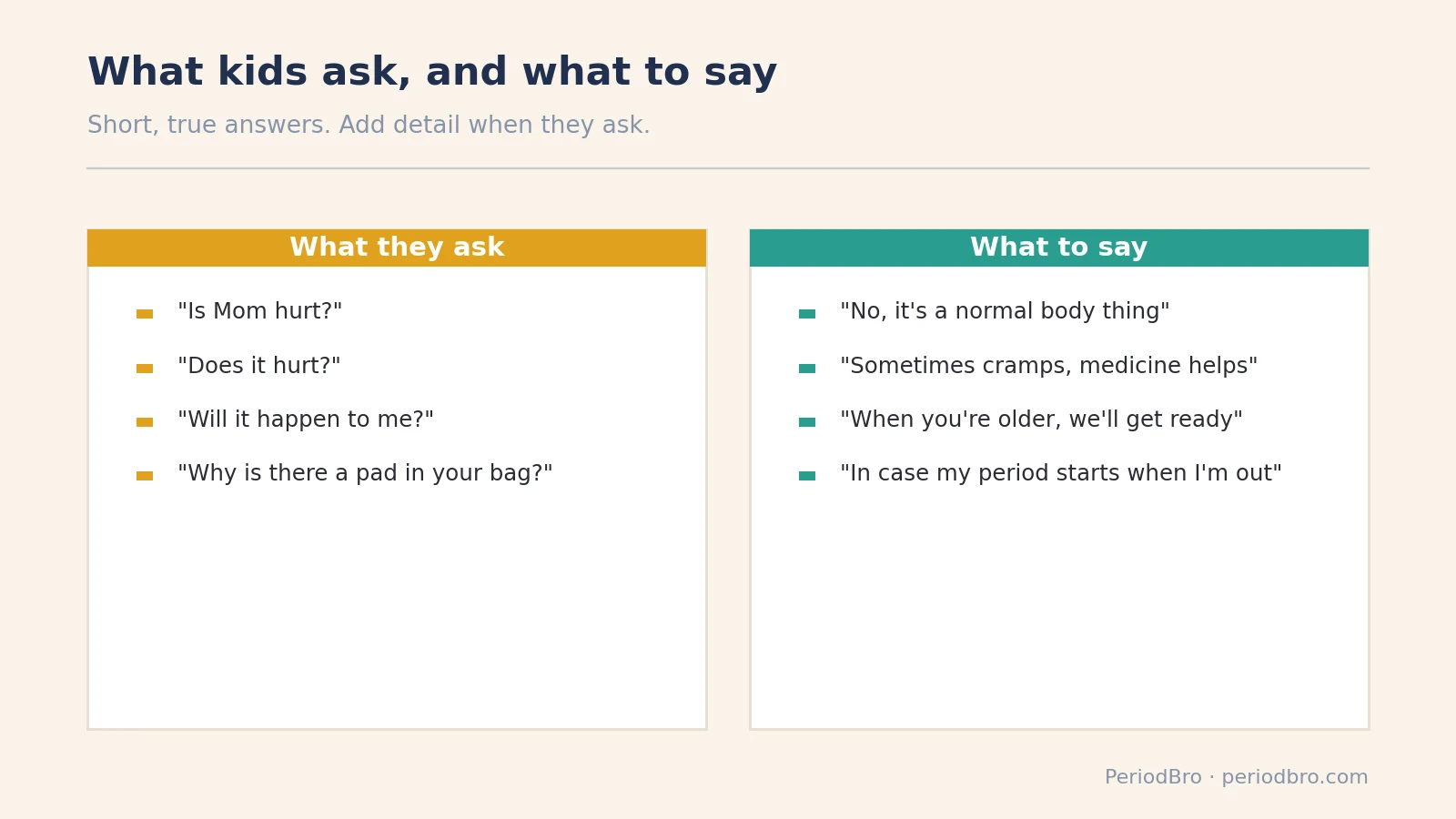
- “Does it hurt?” “Sometimes there are cramps, like a tummy ache. Medicine and a warm pad help. It’s not like getting a cut.”
- “Will it happen to me?” For a girl: “Yes, when you’re older, usually around middle school. We’ll get you ready way before.” For a boy: “No, but lots of people you know will have them, so it’s good to understand.”
- “Why do you have a pad in your bag?” “In case my period starts when I’m out. Like carrying a water bottle.”
- “Is Mom sick?” “No, her body is doing a normal thing it does every month. She might want a quiet night, so let’s make dinner.”
Health guides suggest asking what the child already knows before you answer, then filling in the gaps with simple information (Jean Hailes). “What do you think it is?” often tells you exactly how much to say.
Why it helps when dads talk about it
When only one parent ever discusses periods, kids learn that it’s a topic for some people and off-limits for others. A dad answering “why is there blood in the bin?” calmly teaches a son that periods aren’t gross and teaches a daughter she can bring this stuff to him later, when it really counts. KidsHealth is explicit that boys need reliable information about periods too (KidsHealth).
It also chips away at the shame a lot of us absorbed growing up. Our piece on period stigma covers where that comes from, and the bigger case for dads is in a father’s role in menstrual education.
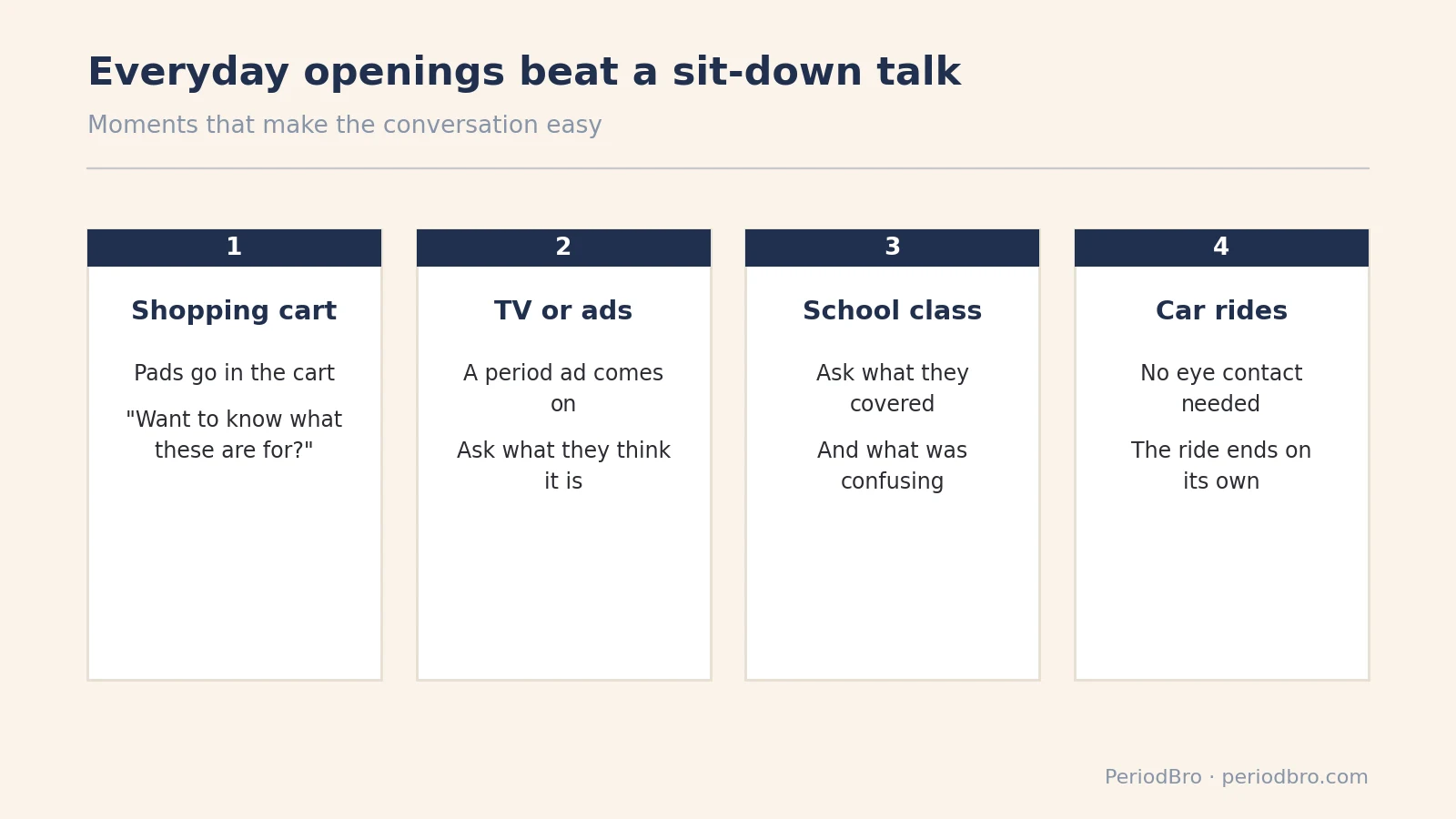
Everyday openings beat a sit-down talk
The easiest conversations happen while you’re doing something else. A few natural moments:
- Putting pads or tampons in the shopping cart. “These are for periods. Want to know what that is?”
- A period ad on TV or a box in a friend’s bathroom.
- A school puberty class. Ask what they covered and what was confusing.
- A parent having a rough day with cramps. It’s a chance to show what looking after someone looks like.
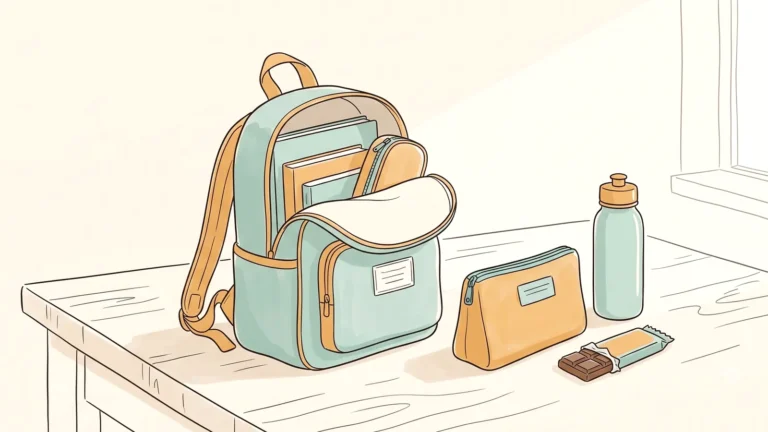
Car rides are great for older kids. Nobody has to make eye contact, and the ride ends on its own. If you have a daughter heading toward the age where it’s likely, putting together a small kit together turns the talk into something practical. Our checklist of what to stock before her first period is a good starting point, and if she starts early covers kids who get there sooner than expected.

What not to worry about
You’ll get some answers wrong, or say too much, or too little. It’s fine. The point is that your kid learns this is a topic they can ask you about. You can always come back with “I thought about your question, and here’s a better answer.”
A few things are worth avoiding: telling a kid it’s “private” in a tone that means “shameful,” making jokes about moods, or letting a child think a period means someone is hurt. Everything else can be fixed in the next conversation.
How my buddy fixed his first answer
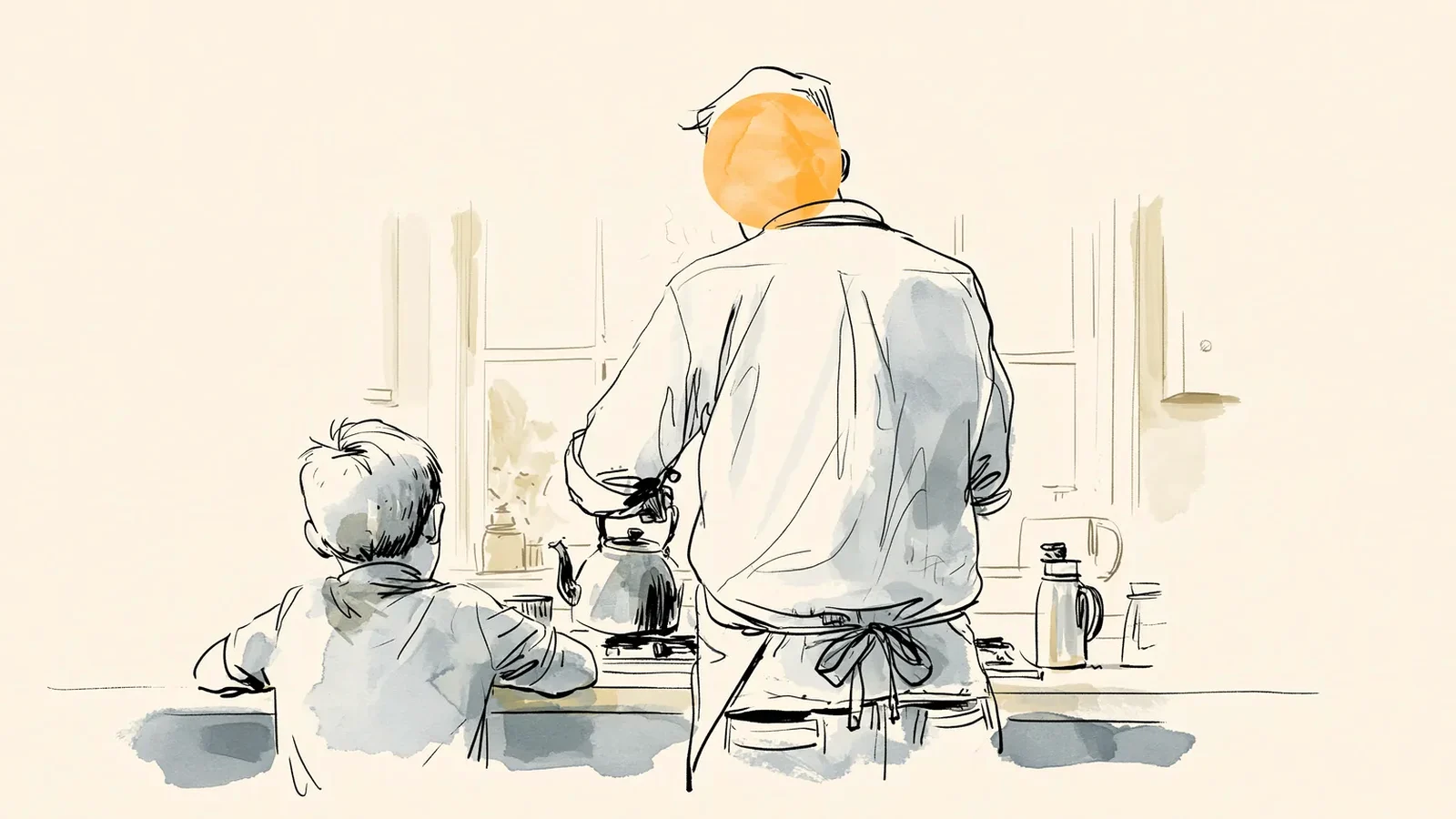
The next morning at breakfast, he went back to it. “Remember the blood in the bin? Mom wasn’t hurt. Grown-up women’s bodies have a period once a month, and that’s what it was.” His son thought about it, asked whether it happened to dogs too, and then asked for more cereal. That was the whole conversation.
A few months later his son told a cousin, with total confidence, that “periods are just a body thing, it’s not blood from a cut.” My buddy said that was the moment he realized the small talk had done more than a big one would have.
PeriodBro helps dads and partners understand cycles and know what’s coming. If that’s useful in your house, you can try it free here.
PeriodBro provides educational information and is not a substitute for professional medical advice. If you have concerns about your child’s development or early puberty, talk to their pediatrician.