
The Morning After Pill and Her Period: What to Expect Next
The condom broke, or it didn’t get used, and now it’s half past midnight and one of you is looking up pharmacy hours. The pill part is straightforward. The three weeks after it are where most of the anxiety actually lives, because nobody explains what her cycle is going to do next.
What follows is how the morning after pill and her period actually connect: the mechanism, the difference between the three options, and what her next bleed is likely to do depending on where in the month this happened.
What it does, in one sentence
Levonorgestrel emergency contraception, the kind sold over the counter, works by stopping or delaying ovulation. That’s the mechanism. A review of 33 studies found that women who took it at or after the LH surge had the same rates of ovulation and conception as controls, and nine of ten studies found no difference in endometrial receptivity to implantation.
Two consequences follow from that. It isn’t an abortion pill, and the same review found no evidence of increased miscarriage or harm to a pregnancy already underway. It also doesn’t work once she’s already ovulated this cycle, since there’s nothing left for it to delay. That second point explains most of what happens to her period afterwards.

Three options, and they are not interchangeable
Most people know one. There are three, and the differences are real enough to be worth five minutes tonight.
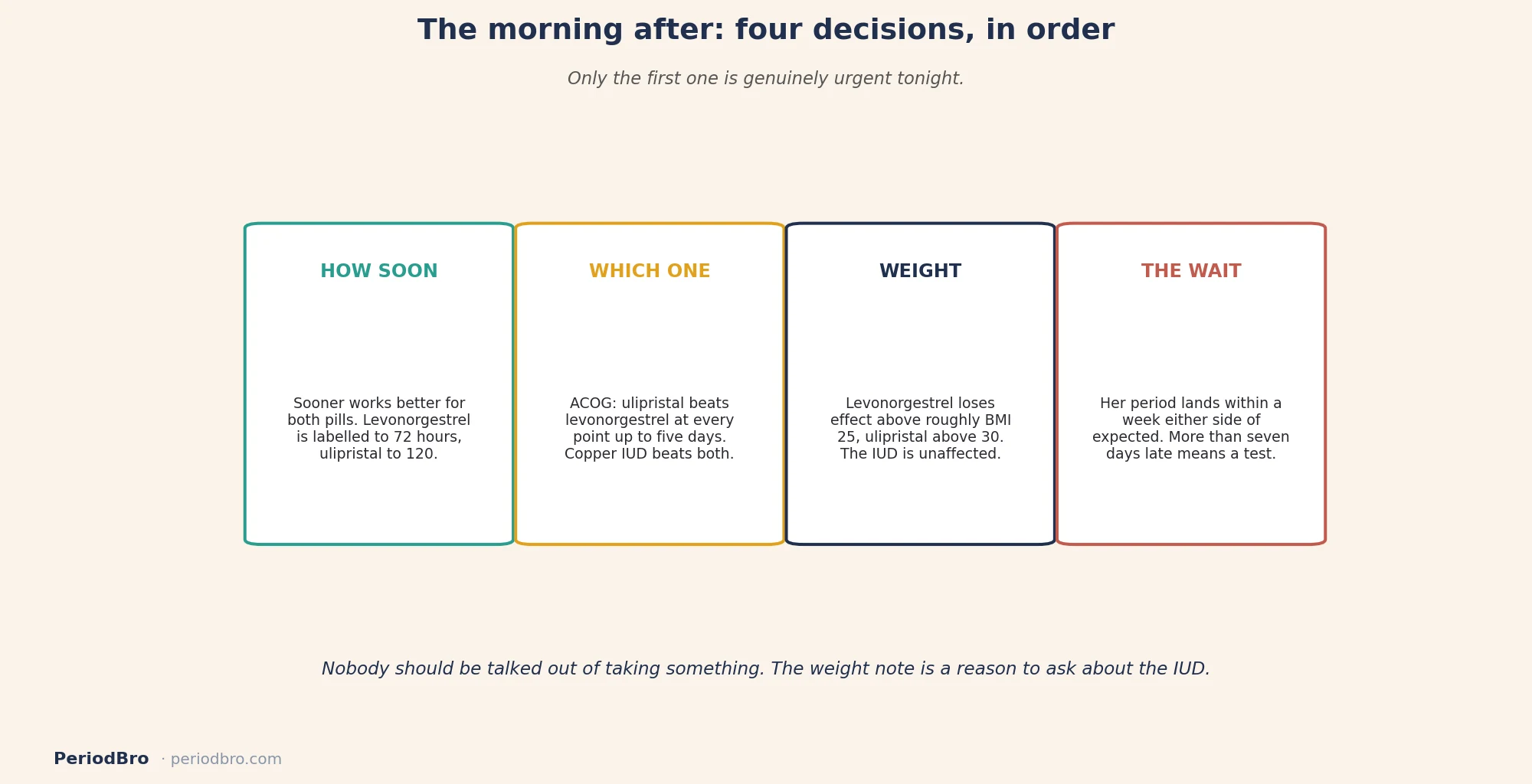
Levonorgestrel is the over-the-counter one, no prescription, no age restriction in the US. Labelled for use within 72 hours, most effective the sooner it’s taken.
Ulipristal acetate needs a prescription in the US and is licensed out to 120 hours. ACOG’s position is that it’s more effective than levonorgestrel at all points up to five days, and at all body weights.
The copper IUD is the one nobody mentions and the most effective by a distance. Fitted within five days, it also becomes ongoing contraception for years afterwards. It needs an appointment, which is the barrier, and what an insertion actually involves is worth reading first rather than at the clinic.
The weight thing, which is awkward and real
This gets skipped in the pharmacy and it shouldn’t. ACOG notes that both oral options may be less effective at higher body weight, with levonorgestrel losing effectiveness at a lower threshold, around a BMI over 25, and ulipristal around a BMI over 30. The copper IUD isn’t affected by weight at all.
What that does not mean is that anyone should be talked out of taking something. ACOG is explicit that women shouldn’t be refused or discouraged from emergency contraception because of their weight. It means that if the numbers apply and an appointment is realistic within five days, the conversation about a copper IUD is worth having rather than skipping.
And this is not a conversation to run for her. It’s a thing to know, so that if she asks what the difference is at one in the morning, you have an answer instead of a shrug.
The morning after pill and her period: what actually happens next
This is the part that generates most of the 3am searching, and the logic behind it is clean.
Because the pill works by pushing ovulation, where she was in her cycle determines what her next period does. Research on bleeding patterns after levonorgestrel found that the earlier in the cycle she took it, the earlier the next period arrived. Taken well before her expected ovulation, the cycle tends to shorten. Taken after ovulation has already happened, the cycle usually runs normally or slightly long, because nothing got interrupted.
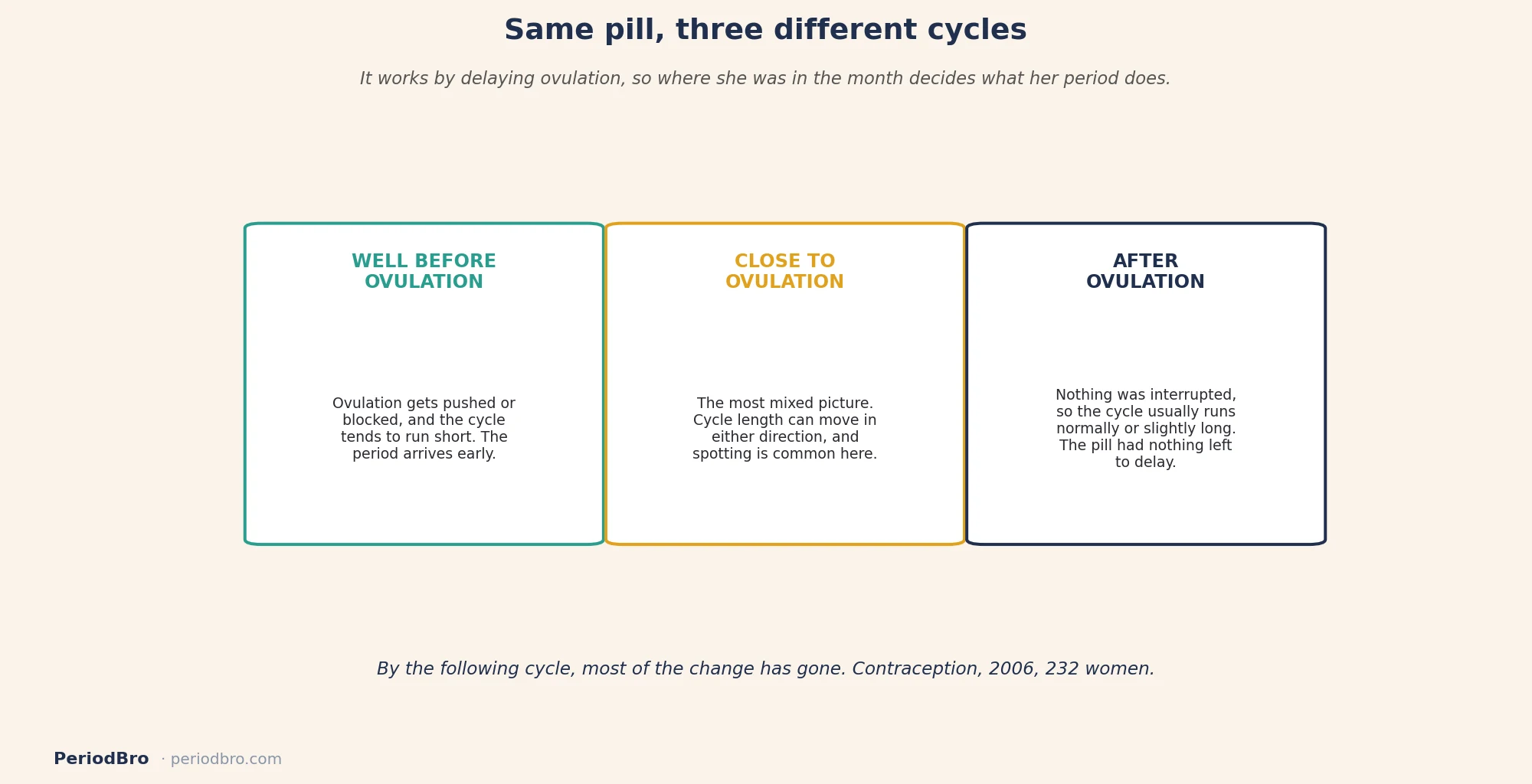
ACOG’s general guidance is that after emergency contraceptive pills, the period usually arrives within a week of the expected time. Earlier or later inside that window is ordinary, and by itself it says nothing about whether the pill worked.
The following cycle is generally back to normal. In a prospective study of 232 women, the changes to cycle length and period length were significant in the treatment cycle and the majority of them had disappeared by the next cycle.
Spotting that isn’t her period
In that same study, just under 15 percent of women had bleeding between periods that they hadn’t had before. It shows up in the days after taking the pill, it’s usually light, and the mistake people make is counting it as the period and then panicking a fortnight later when the real one hasn’t turned up.
The distinction matters practically. Light spotting a few days after the pill is not the period. The period is the proper bleed that follows on its own schedule. If she has a tracking app, this is worth logging as spotting rather than as a period start, or the app’s prediction goes sideways for the next two months. General background on what spotting between periods means is here if it keeps happening.

The seven day rule
If her period is more than a week later than expected, she takes a pregnancy test. That’s the standard advice on every label and from ACOG, and it exists precisely because the cycle shifts described above make “late” hard to read by feel.
Before that seven days is up, testing mostly generates false reassurance or unnecessary panic, because a test taken too early can miss a real pregnancy. Waiting is annoying and it’s still the right move. What “late” actually means covers how much natural variation there is in a normal cycle, which is more than most people assume.
Two other things worth flagging to a doctor rather than to a search engine: severe lower abdominal pain in the three to five weeks afterwards, which needs checking to rule out ectopic pregnancy, and vomiting within a couple of hours of taking the pill, which may mean the dose didn’t land.
What it doesn’t do
It doesn’t protect her for the rest of the cycle. If they have sex again a week later, that’s a fresh exposure with no cover, and this is a genuinely common misunderstanding.
It doesn’t affect her fertility later. The review above found no evidence of disrupted cycles or reduced fertility in subsequent cycles.
It isn’t a form of contraception, in the sense that it’s a worse option than almost anything used routinely. If tonight’s conversation is happening for the second or third time, the useful follow-up isn’t about tonight. How different methods change her cycle is the more productive reading, and if she’s coming off something, what happens after stopping birth control explains the gap that often creates these nights.
Your actual job in the next 24 hours
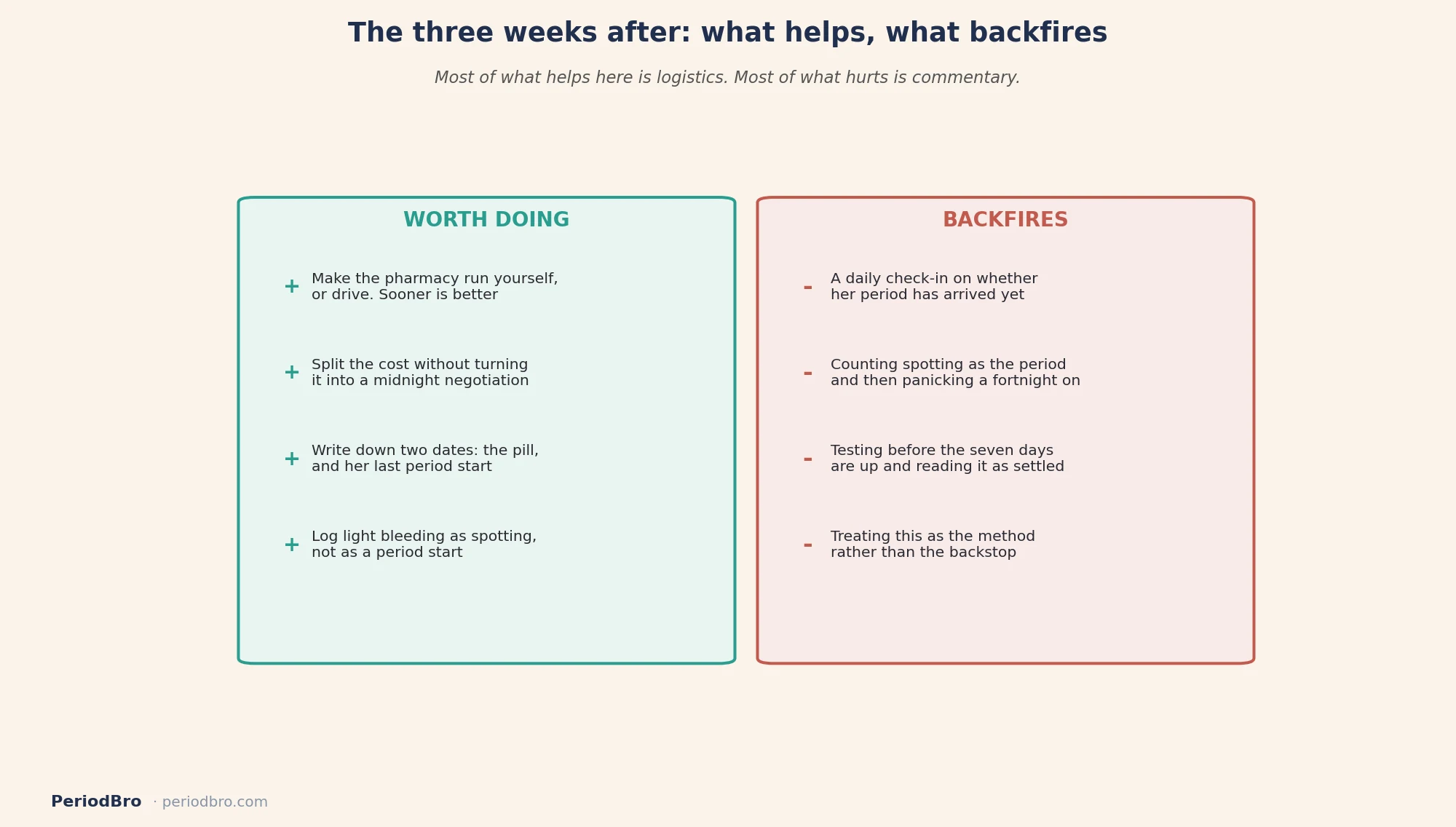
Go and get it, or drive. Sooner is better for all of the oral options and the pharmacy run is the one part of this you can simply take off her plate.
Split the cost without discussion. It’s between forty and sixty dollars over the counter in a lot of places, and making that a negotiation at midnight is a decision she’ll remember for years.
Write down the date. Not in a surveillance way, just the date it was taken and the date her last period started, because in three weeks one of you will be trying to reconstruct it from memory and getting it wrong. If you already share a cycle app, this is what it’s for, and the consent side of that matters more than usual here.
Then stop asking. The single most common complaint about partners in this situation is the daily check-in about whether her period has started. She’s tracking it more closely than you are. Asking adds nothing and turns her body into a status report she has to file. If the wait is hard, say that once, and then let her raise it.
And if this happened early in a relationship, it’s a lot to handle at once, which navigating periods in a new relationship covers in wider terms.
The short version
The morning after pill and her period are linked through one mechanism: it delays ovulation, which is why the next bleed can arrive early, on time, or a bit late depending entirely on the day it was taken. Under a week off expected is ordinary. More than a week off means a test. Spotting in the days afterwards isn’t the period.
Sooner is better, the copper IUD is the most effective option if an appointment is realistic, and the most useful thing you can do afterwards is pay half, write down two dates, and not mention it again. For the wider picture on supporting her through the month, how to be a better partner through her cycle is the place to go next.

PeriodBro keeps her dates in one place, so a shifted cycle is something you can both read off a screen instead of arguing about from memory. Try it free.
This article is general information, not medical advice. Severe abdominal pain in the weeks after taking emergency contraception, or a period more than seven days late, needs a doctor and a pregnancy test rather than a search engine.