Natural Cycles for Partners: An Honest Look
Most cycle apps are a calendar with opinions. Natural Cycles is a different animal, because it is cleared as contraception, and that changes what it asks of both of you. If she is considering it, or already using it, this is the version of Natural Cycles for partners that skips the marketing.
It works better than people assume and worse than the headline number suggests, and unlike every other app we have reviewed, your behavior is part of whether it works at all.
What it actually is
Natural Cycles is a fertility-awareness app that uses basal body temperature to identify where she is in her cycle. Body temperature rises slightly after ovulation because progesterone climbs, so an algorithm watching that pattern over months can work out which days carry pregnancy risk. The app returns green days, when risk is low, and red days, when she is likely fertile or the algorithm does not have enough data to say.
In 2018 it became the first app cleared by the FDA for use as contraception, through the de novo pathway. That clearance is why it sits in a different category from Flo, Clue, or the tracker built into her phone, which are records rather than regulated devices.
How well it works, honestly
The numbers you will see quoted are 98% with perfect use and 93% with typical use. Those come from the peer-reviewed work behind the clearance: a prospective study of 22,785 users published in Contraception reported a typical-use Pearl Index of 6.9, and the FDA review cites 6.5.
Translate that out of statistics and into a year of your life. A Pearl Index around 7 means roughly 7 in 100 couples relying on it for twelve months will have an unintended pregnancy. That is in the same neighborhood as typical use of the pill, and clearly behind an IUD or implant, which sit under 1.
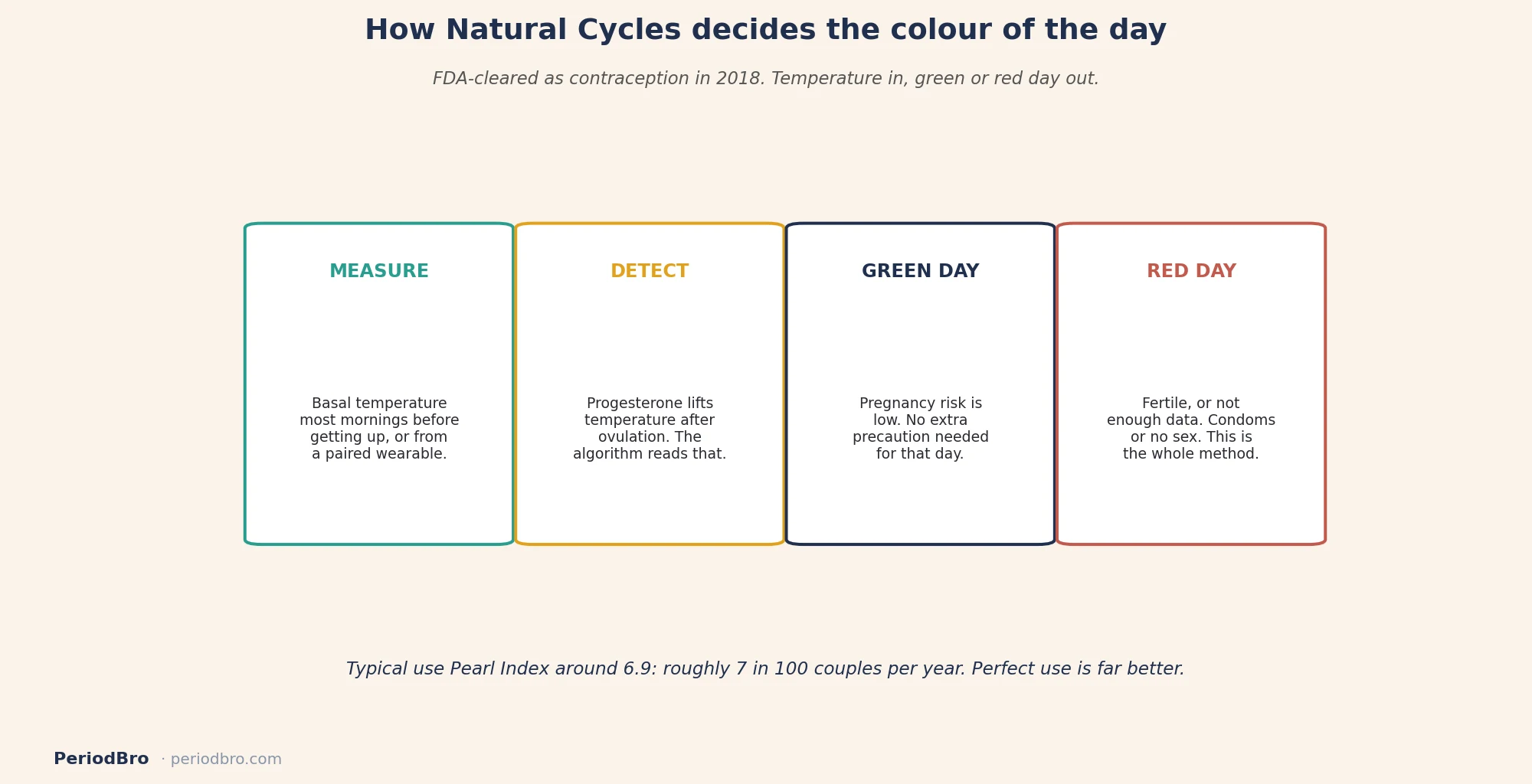
The gap between 98% and 93% is not a rounding error. It is the accumulated cost of measurements skipped, red days ignored, and a hangover or a fever nudging a reading. Every method has a perfect-typical gap, and this one is unusually sensitive to daily habit, because the input is a temperature taken at roughly the same time each morning before getting up.
Where you come into it
Natural Cycles differs from everything else we have looked at on exactly this point. With the pill or an IUD, effectiveness is essentially hers to manage. Here, a red day is an instruction to both of you: condoms or no sex. The method’s real-world success rate runs straight through joint decisions made at inconvenient moments.
Which means agreeing on the rule when nothing is at stake, rather than negotiating it at eleven at night. Couples who treat red days as a hard boundary get the perfect-use experience. Couples who treat them as advisory get the typical-use one, and the difference between those two is measured in pregnancies.
The app also has no partner-facing side. There is no dashboard, no shared view, no version of the setup where you get your own read on her data. If cycle context is what you are after rather than contraception, that is a different tool, and our rundown of period trackers for partners covers those.

What it costs in daily effort
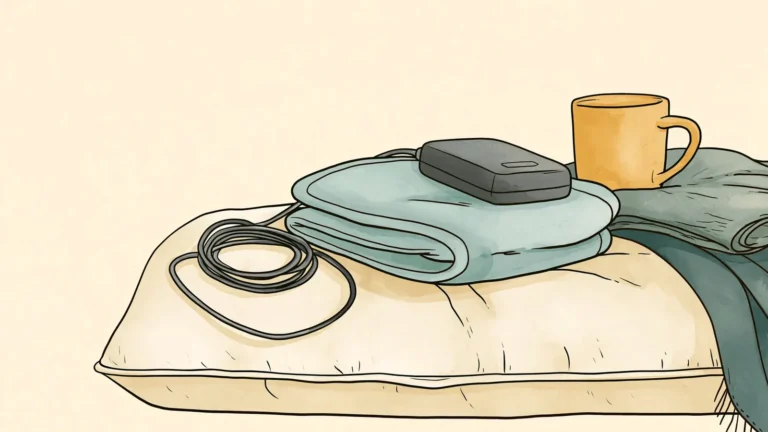
A basal thermometer reading most mornings, taken before getting out of bed, logged in the app. In the US the app can also pull temperature automatically from wearables including the Oura Ring and Apple Watch, which removes most of the friction if she already sleeps in one. Our look at Apple Health cycle tracking covers how that wrist-temperature data is captured.
The algorithm also needs cycles it can learn from. Early on, and whenever the data gets noisy, it hands back more red days, which is the app being appropriately cautious rather than broken. Irregular cycles, night shifts, frequent illness, and heavy drinking all push in the same direction: more red days, less usable signal. If her cycles are irregular for a reason, PCOS and periods is worth reading first.
One practical wrinkle catches people switching off hormonal birth control. The pill suppresses ovulation, so there is no temperature shift to read while she is still on it and often none for a while after she stops. The app needs real cycles before it can call a green day with any confidence, and that settling-in period can run for months. Plan for a bridge method during it rather than discovering the gap after the fact.
Who it fits
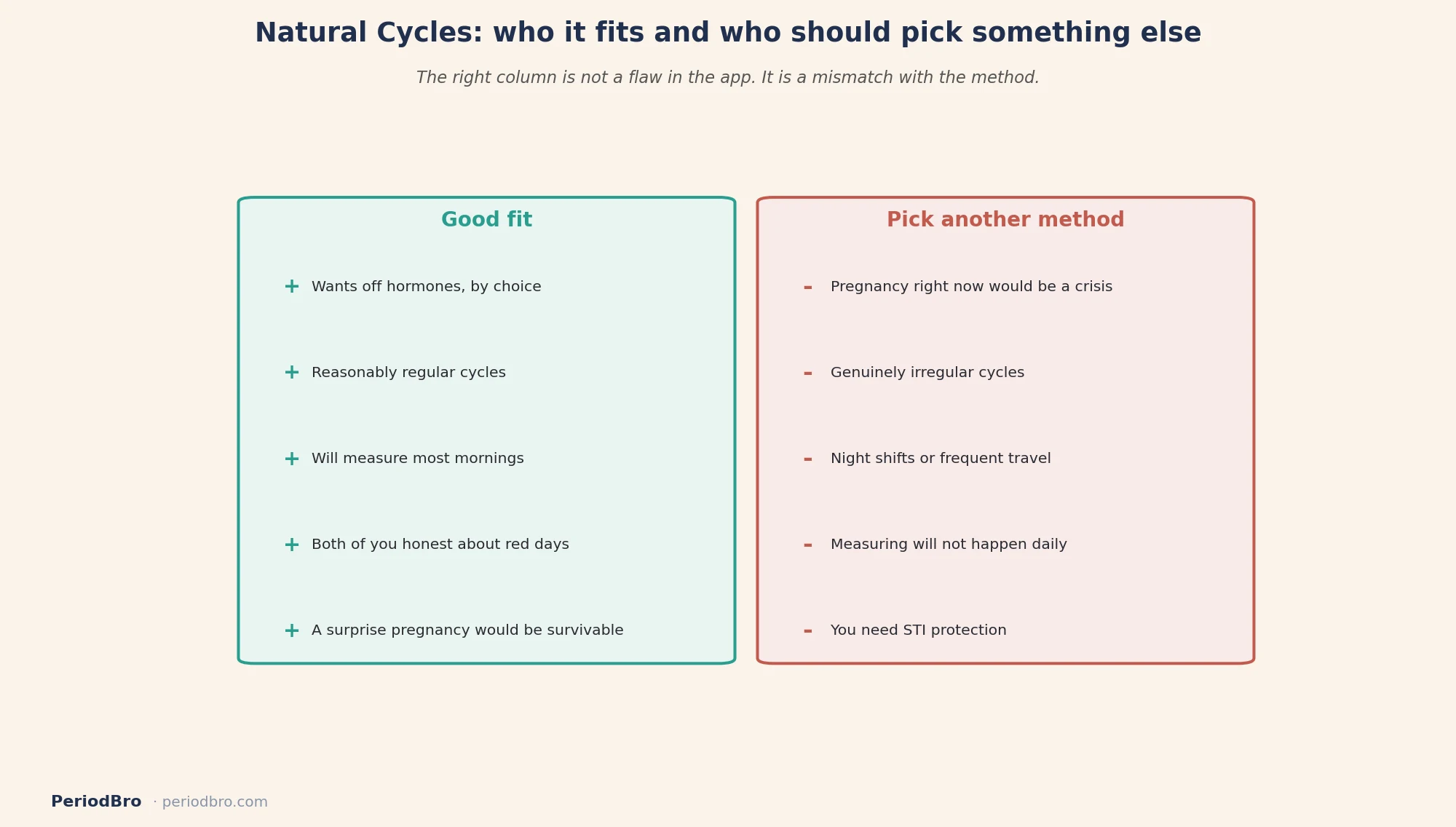
It fits couples in a stable relationship who want off hormones, who have reasonably regular cycles, who can absorb the daily measurement, and who are honest with each other about red days. It also suits people who want to understand their own cycle rather than suppress it, and there is real value in that beyond contraception.
It does not fit anyone for whom a pregnancy right now would be a serious problem, anyone with genuinely irregular cycles, shift workers, anyone who will not measure most mornings, or anyone who needs STI protection. Fertility awareness offers none, and a green day says nothing about infection risk.
One more honest note. Switching contraception is a medical decision, and the failure rates above are averages across thousands of people rather than a prediction about you two. That conversation belongs with her clinician, alongside what she is switching from. Our piece on how birth control changes her cycle covers what to expect if she is coming off hormones.
If you two are already using it
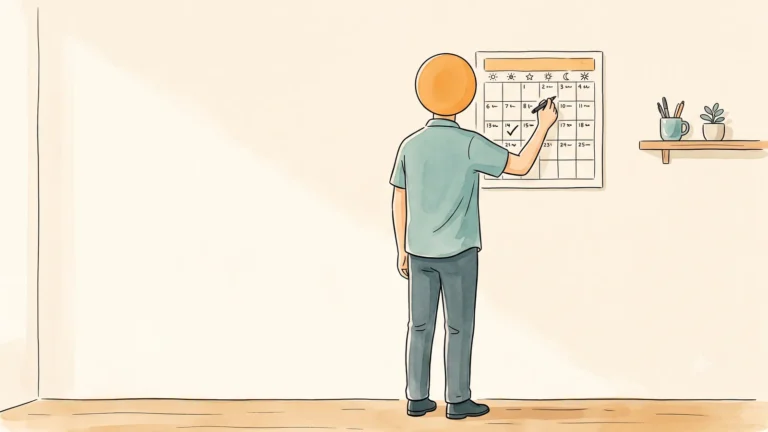
Know the colour of the day. Not by asking every evening, but by agreeing she flags red days early enough for it to be a plan rather than a surprise.
Keep condoms where you actually are. The failure mode is not disagreement about the rule, it is nothing within reach at the moment the rule applies.
Treat a measuring streak as shared. If she is up early and cold-starting a thermometer every morning, that is real work being done on behalf of both of you, and noticing it costs nothing.
Do not push on a red day. Red days are the entire method, and pressure on one is a worse look than you think.
The broader point holds beyond this one app. Knowing where she is in her cycle turns a lot of guesswork into planning, which is what being a better partner through her cycle comes down to. If you want to know how reliable app predictions are in general, we went through the evidence in do period tracker apps work.
Common questions
Is Natural Cycles as effective as the pill?
At typical use the published Pearl Index of around 6.9 sits close to typical use of the pill. Both are well behind an IUD or implant. Perfect use figures for either method are considerably better than typical use.
Does she have to use a thermometer every day?
Most mornings, before getting up. In the US a compatible wearable such as an Oura Ring or Apple Watch can supply the temperature automatically.
Does it protect against STIs?
No. Nothing about a green day says anything about infection risk.
Can it be used to get pregnant instead?
Yes, the app has a mode for that. The same fertile-window detection that flags days to avoid also flags days to aim for.
What happens if she gets sick or travels?
Fever, disrupted sleep, alcohol, and time-zone changes all affect basal temperature. The algorithm tends to respond by issuing more red days rather than guessing, which is the safe behavior.
This article is general information, not medical advice, and is not an endorsement. Contraception choices belong with a clinician who knows her history. Effectiveness figures quoted are population averages from published studies, and no fertility-awareness method protects against sexually transmitted infections.