
How PMDD Affects a Relationship Long-Term: A Partner’s Guide
Most articles about PMDD stop at the hard week. But if you love someone with premenstrual dysphoric disorder, the question that actually keeps you up isn’t “how do I survive this month.” It’s the PMDD relationship long term one: not just this cycle, but years in, does a relationship carry the weight of the same storm arriving every few weeks? The honest answer is that it can go either way, and the thing that tips it isn’t how severe her PMDD is. It’s what the two of you do in the calm weeks between.
I want to be careful here. I’m not a clinician, and PMDD is a real medical condition, not a personality. But I’ve spent a lot of time reading the research and talking to men in exactly this spot, and there’s a pattern worth naming, because nobody hands it to you when you sign up for this.
What the research says about the long haul
Start with the sobering part, because pretending it’s easy helps no one. A large prospective study that followed more than 15,000 women in Sweden for nine years found that those with severe premenstrual disorders had roughly a 20-plus percent higher risk of a relationship ending in separation or divorce (The Conversation, on the 2024 research). That’s not a life sentence. It’s a raised risk, the kind you can push back against once you know it’s there.
The other finding matters just as much: this is a two-person weather system. In one survey study, both the women with PMDD and their partners reported lower quality of life and lower relationship satisfaction across nearly every domain compared to couples without it, with the notable exception of love and commitment, which held (PMC, cross-sectional survey). Read that twice. The love usually isn’t the problem. The wear and tear around it is.
Why the damage is cumulative, not monthly
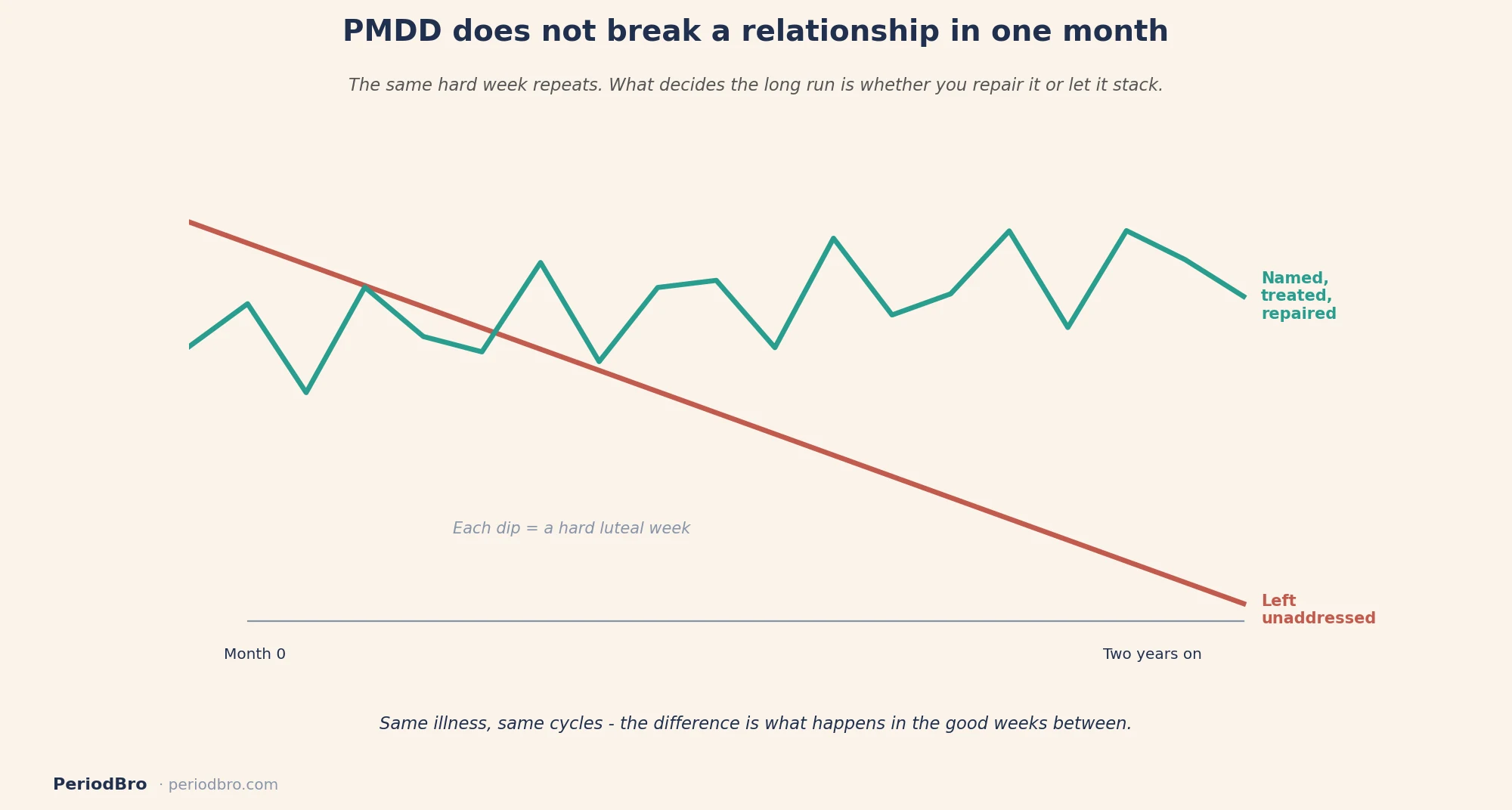
Here’s what took me too long to understand. A single hard week doesn’t end a relationship. What ends it is a hundred hard weeks that never got repaired. PMDD is cyclical, so the storm passes and she comes back to herself. If you use that return to reconnect, the month resets. If instead you spend the good week quietly stewing, or relitigating what she said when she was at her worst, the resentment doesn’t reset. It compounds.
That’s the real shape of the PMDD relationship long term arc. It’s not a steady decline. It’s a sawtooth: down in the luteal week, back up after her period, over and over. Whether the whole line trends up or down depends almost entirely on the recovery, not the crash. The couples who make it aren’t the ones with milder symptoms. They’re the ones who treat the good weeks as the repair window instead of the ceasefire before the next fight. If you want the basic distinction between ordinary PMS and PMDD first, we cover that in the difference between PMS and PMDD.

What holds a relationship together over years
When I look at the couples who are still standing a decade in, the same things show up. They name it as the illness, not as her, so the sharp words in a bad week don’t get filed away as evidence. They back real treatment instead of white-knuckling it, because tracking, a GP, therapy, and sometimes medication change the actual severity, not just the mood in the room. And they repair, every single time, rather than letting a hard week close without a conversation once she’s back.
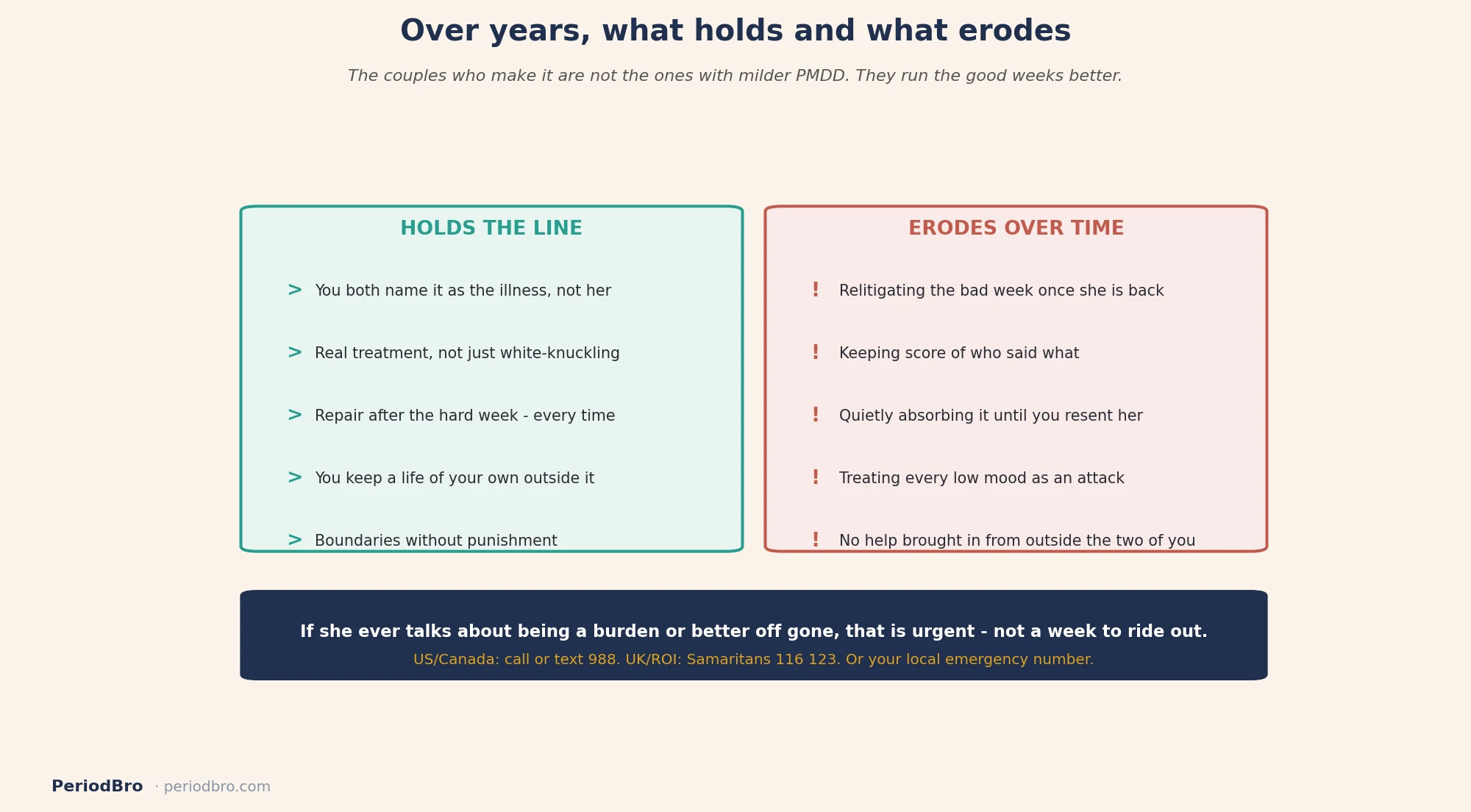
The flip side is just as clear. What erodes a relationship over years is keeping score, absorbing everything silently until you can’t look at her without resentment, treating every low mood as a personal attack, and refusing to bring in any help from outside the two of you. Do enough of that and even a strong bond wears through, not from one storm but from the slow drip. If pulling away is your instinct when things get hard, we wrote about that reflex in what to do when she pulls away.

Don’t lose yourself in the long run
This is the part partners skip, and it’s the part that quietly ends things. Living alongside PMDD for years is a caregiving role, and caregivers burn out. If you spend a decade managing her weather and none of it tending your own, you don’t become a saint. You become resentful, then absent. Keeping one or two things that are just yours, having someone to talk to who isn’t her, and being allowed a boundary in a bad week are not betrayals of her. They’re what let you keep showing up. “I love you, and I’m going to take a walk, and I’ll be back” is a complete sentence.
Tracking helps more than it sounds like it should. When you both know which week it is, the hard days stop feeling like an ambush and start feeling like weather you can plan around. That small shift, from “what did I do wrong” to “ah, it’s that week,” takes a surprising amount of poison out of the long run. Our broader take on that is in becoming a better partner through her cycle.
When to get help, and when it’s urgent
PMDD is treatable, and long-term struggle is often a sign that the treatment plan, not the relationship, needs attention. If there’s no good week anymore, if the symptoms are wrecking work or the relationship, or if either of you is self-medicating to cope, that’s the signal to bring in a professional rather than tough it out for another year.
One thing is never a wait-and-see. PMDD carries a real, well-documented risk of suicidal thoughts in the late-luteal window, and it can be intense (IAPMD). If she ever talks about being a burden, or being better off gone, treat it as urgent, not as a hormone phase to ride out. In the US and Canada you can call or text 988. In the UK and Ireland, Samaritans is 116 123. Anywhere else, use your local emergency number. Getting help in that moment is not an overreaction. It’s the whole job.
Common questions partners ask
Does PMDD get worse in a relationship over time? Not the illness itself, which tends to track her cycle and her overall health. What can get worse is the relationship strain around it, if hard weeks pile up without repair. Handled well, many couples find the opposite: they get better at it, and the bad weeks lose their power to scare either of you.
Is it normal to feel resentful sometimes? Yes, and pretending otherwise is how resentment goes underground and turns toxic. The healthy move isn’t to feel nothing, it’s to have somewhere to put it, a friend, a therapist, a journal, so it doesn’t leak out sideways at her during a week she’s already struggling.
Can a relationship survive PMDD long term? Plenty do, for decades. The research shows a raised risk of things ending, not a guarantee, and the couples who last aren’t lucky, they’re deliberate. Treatment, repair, and both people staying whole are the difference between a hard relationship and a doomed one.
The long game with PMDD isn’t about outlasting a storm through sheer will. It’s about building a relationship that repairs faster than it wears, treats the illness as a shared opponent, and leaves both of you intact. Do that, and the raised risk in those studies stops being your story.
This article is general information for partners, not medical advice, and it isn’t a diagnosis of anyone. PMDD should be assessed and treated by a qualified clinician. If you or your partner are in crisis, contact a local crisis line or emergency services.