What Healthy Cycle Tracking Looks Like in a Relationship
The first time I tracked someone’s cycle, I did it behind her back. Not in a sinister way. We’d been dating maybe two months, and I’d noticed her energy moved in a rhythm I couldn’t quite predict. I didn’t want to ask her to install some app and hand me a login. So I kept a quiet note on my phone instead.
It worked, sort of. But it took me longer than I’d like to admit to see that the quiet note was the problem, not the solution.
Here’s what I’ve learned since. There’s a version of cycle tracking that makes a relationship better, and a version that slowly corrodes it. From the outside they can look almost identical. The difference isn’t the app, and it isn’t the data. It’s whether she knows, whether she’s in, and whether any of it is actually for her. This piece is about that first version: what healthy cycle tracking looks like when it’s working the way it should.
The one line that separates support from surveillance
The line between the two is consent, and it’s not complicated. Healthy cycle tracking is something she knows about and is fine with. Surveillance is something you do to her. That’s the whole distinction, and everything else follows from it.
I get why the secret version is tempting, especially early on. Asking feels awkward. You don’t want to come across as intense or controlling before you’ve earned the trust. But secrecy is exactly what makes tracking creepy instead of caring. The fix isn’t to track better in the dark. It’s to bring it into the light with one honest sentence, which I’ll get to at the end.
This matters more than it used to. Period and cycle data is genuinely sensitive, and it’s not protected the way medical records are. Period-tracking apps aren’t covered by HIPAA, and there’s no federal law stopping companies from sharing what you log with third parties or, in some cases, law enforcement, which is why Consumer Reports and privacy researchers have flagged these apps so hard since 2022. After the overturn of Roe, Privacy International documented real cases of reproductive data being pulled into prosecutions. So part of doing this right is respecting where the data lives: stored privately, on a device, not sold, not floating around a server she never agreed to. Treating her cycle data carefully is part of treating her carefully. (For the deeper version of this, I wrote a whole guide on tracking her cycle with consent.)
What “for her” actually means
The second test is harder than consent, because you can pass the consent test and still get this part wrong. Tracking has to be for her. Not for winning arguments. Not for managing her like a project. Not so you can roll your eyes and think “right, that explains the mood.”
The point of knowing where she is in her cycle is to be more responsive to what she actually needs that week. And responsiveness isn’t a soft, fuzzy thing. It’s one of the most reliable predictors of how good a relationship feels to both people in it. Researchers call it perceived partner responsiveness, the sense that your partner understands, values, and acts on your needs, and studies consistently link it to higher satisfaction and stronger trust over time. Tracking is only useful if it makes you more responsive. If the data changes what you do in her favor, it’s working. If it just gives you a label to file her under, it’s worse than nothing.
So the honest question isn’t “do I know her cycle?” It’s “does knowing it make me a better partner that day, or just a more informed bystander?”
This is also why the early-relationship version is the trickiest. Two months in, you barely know each other’s coffee orders, and here you are wanting to understand a rhythm she’s lived with her whole life. The instinct is to do it quietly so you don’t scare her off. But quietly is precisely the wrong call, because at that stage you haven’t earned the benefit of the doubt yet. The thing that earns it is asking. A guy who says “I’d like to understand this so I can be better at it” reads completely differently from a guy who’s been silently keeping tabs. Same data. Opposite signal.
Healthy cycle tracking is mostly boring
Here’s the part nobody tells you: when healthy cycle tracking is working well, it’s almost invisible. There’s no grand gesture. It just quietly shapes the small stuff.
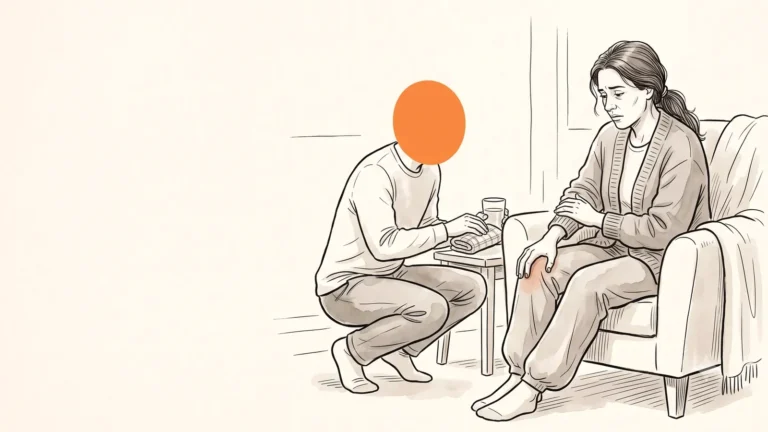
It looks like noticing the low-energy week is coming and not booking the most stressful possible weekend on top of it. It looks like a heads up text instead of a confused argument. It looks like the cupboard already having what she likes before she has to ask. The menstrual cycle runs, on average, somewhere between 21 and 35 days, with a luteal phase of roughly 12 to 14 days before her period when a lot of people feel the energy dip and the mood shift most. You don’t need to memorize the biology. You just need to know enough to time your support instead of reacting blind.
And the support genuinely helps. It’s not just folklore. Women who feel supported through the premenstrual stretch report less severe symptoms, and a communicative model of PMS found that simply being able to talk about premenstrual experiences with a partner reduces distress, while a clear majority of women say PMS strains the relationship when a partner doesn’t get it. A separate study on spousal support found that women whose partners understood and supported them through PMS had a measurably easier time of it. Showing up in the low week isn’t a personality trait you’re born with. It’s a thing you can learn to do on time, and tracking is just the calendar that tells you when.

It’s a two-way street, not a private dossier
The healthiest setups I’ve seen have one thing in common: it’s shared. She knows what you’re tracking, she can see it, and she gets something out of it too. It’s a tool the two of you use, not a secret file you keep on her.
That’s the difference between tracking with her and tracking on her. When it’s open, she can correct you (“actually this month’s been different”), she can lean on it (“can you remind me when my next one’s due, I lost track”), and it stops being your private theory about her body and becomes a shared map. I’ve watched this flip in my own life. The note I kept in secret felt vaguely shameful, like something I’d have to explain if she ever found it. The moment it became a thing we both knew about, it turned into something useful we could actually talk about. Nothing about the information changed. Everything about how it felt did. That openness is also what keeps you honest. It’s a lot harder to weaponize a calendar she can see than one she can’t. If you want the practical mechanics of doing this without it feeling like spying, I broke that down in how to track your partner’s cycle without being creepy.
When it tips into something else
It’s worth naming the red flags, because good intentions don’t make you immune to them.
The big one is using the data to dismiss her instead of support her. The “you’re just PMSing” move. The second you use her cycle to invalidate a real feeling, you’ve turned a tool for closeness into a tool for shutting her down, and she’ll feel it. Her frustration is usually about something real, and the timing doesn’t make it fake.
The second is tracking to avoid rather than to show up. If the whole point becomes predicting the bad week so you can duck it, schedule your work trips around it, and keep your head down, that’s not support. That’s management. Showing up isn’t about avoiding the hard days. It’s about being more present on them.
And the third, again, is secrecy. If you’d be uncomfortable telling her you track this, that discomfort is information. It usually means some part of you knows it isn’t fully for her yet.
None of this is you versus her. It’s the two of you against the gap that nobody bothered to teach you to close. Naming the failure modes is just how you stay on the right side of that line.
How to actually start
If you’ve been keeping a quiet note like I was, here’s the move. You have one short, slightly awkward conversation, and then it stops being awkward forever. Something like: “I want to get better at showing up for you, especially on the harder weeks. Would it be okay if I kept track of your cycle so I know when to step up?”
Most of the time, the reaction isn’t suspicion. It’s some version of surprise that you’d bother. That conversation is the entire game. It converts secret tracking into shared tracking, and it converts a guy who’s guessing into a partner who’s paying attention. If you want the bigger picture of how this fits into being a genuinely better partner, that’s the whole playbook.
I built PeriodBro because I wanted to track this for the people I care about without making anyone install another app or hand over their data to a company I don’t trust. Private by default, on your phone, for showing up, not for snooping. If that’s the version you want to be, that’s exactly who I built it for.
Healthy cycle tracking isn’t a surveillance project. It’s just paying attention, out loud, with permission, for her. Start with the one conversation. The rest takes care of itself.