Premenstrual Exacerbation: When Anxiety or ADHD Flares Before a Period
A friend of mine spent two years sure his wife had PMDD. Every month, about a week before her period, her anxiety went from background hum to loud. Then a psychiatrist asked her to keep a daily diary, and the pages showed something neither of them expected: the anxious days never fully left after her period started. They just got quieter. That pattern has a name, premenstrual exacerbation, and it changes which treatment makes sense.
Premenstrual exacerbation, or PME, means an existing condition such as anxiety, depression, ADHD or bipolar disorder gets worse in the days before a period. Below: how PME differs from PMDD, how a symptom diary sorts the two, what the treatment conversation tends to cover, and how a partner can help without playing doctor.
What premenstrual exacerbation actually means
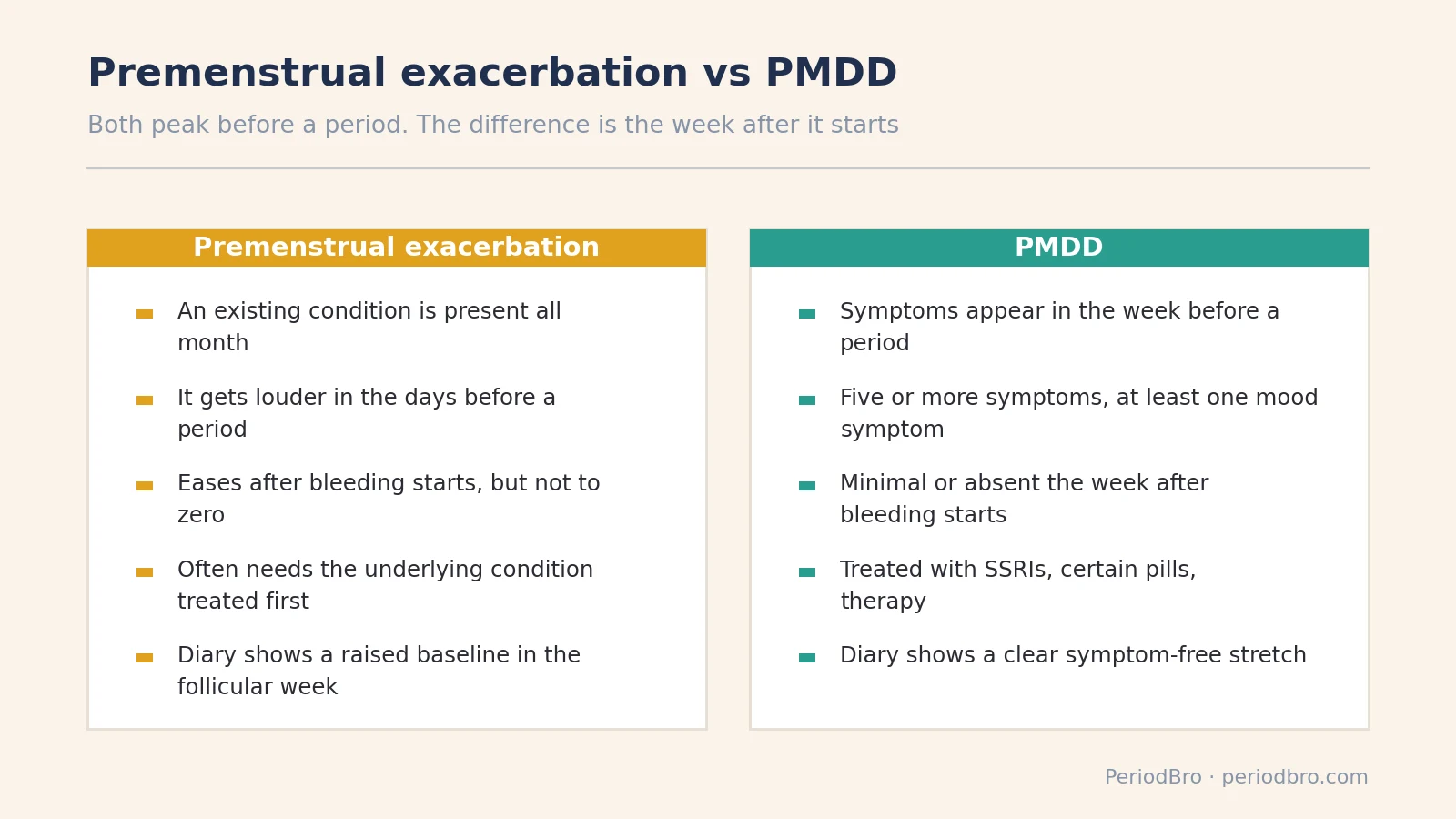
Picture the underlying condition as a volume dial. With PME the dial is never at zero. Something is going on all month, and in the late luteal phase, the stretch before bleeding starts, it turns up. Psychiatric Times describes PME as the worsening of an existing disorder’s symptoms in that premenstrual window, with symptoms often present throughout the cycle. It has been described in depression, bipolar disorder and OCD, and in some people with generalized anxiety or panic disorder, though the anxiety research is thinner.
ADHD belongs in this conversation too. A Dutch study of 209 women with ADHD, published in the Journal of Psychiatric Research, found high rates of PMDD, postpartum depression and menopause-related symptoms. Hormones seem to matter for this group. If you want the teen version, our post on ADHD and periods in teens covers it.
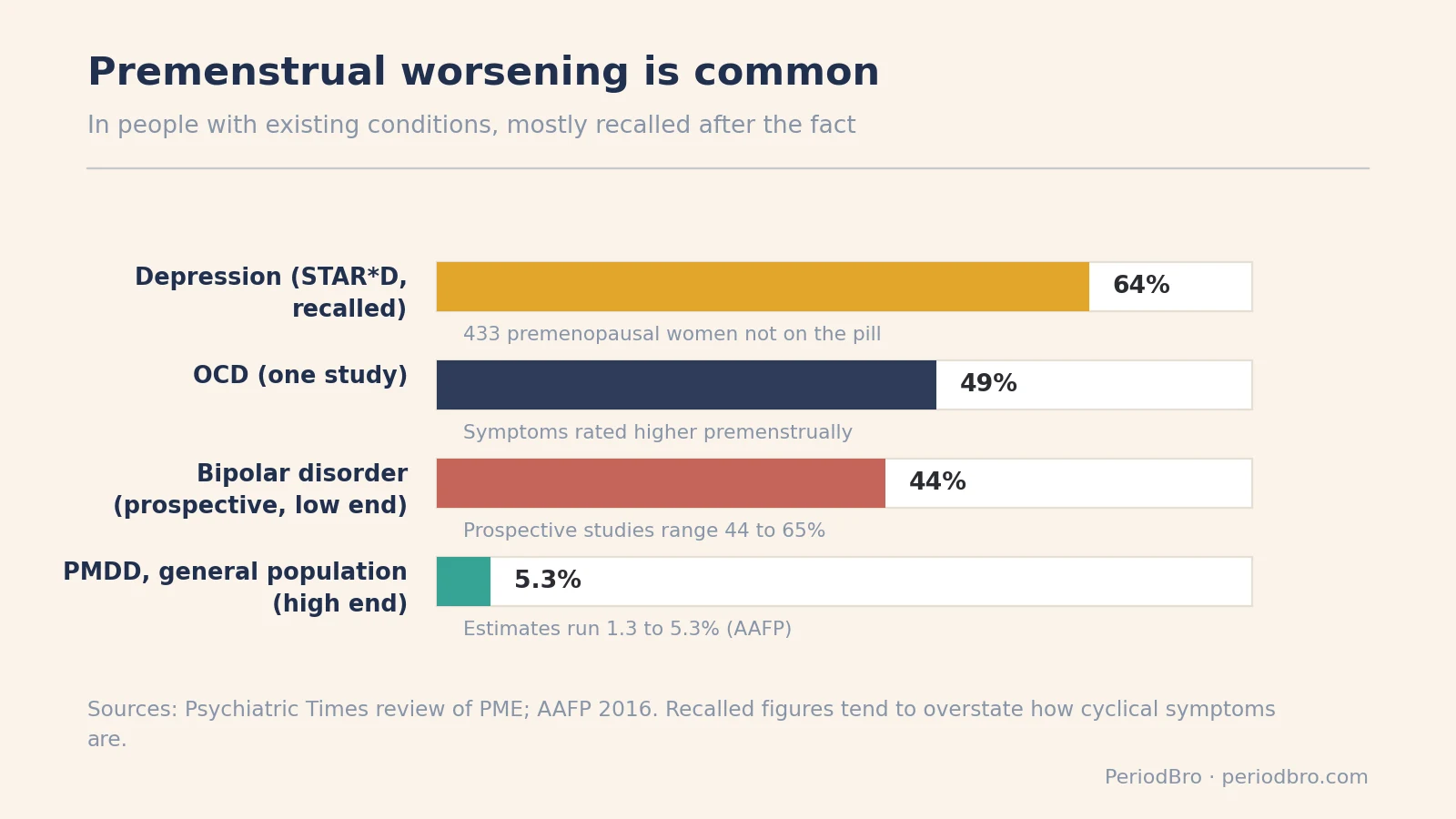
PME is widespread. Among 433 premenopausal women in the STAR*D depression trial who weren’t on the pill, 64% recalled their depression getting worse before their period (Psychiatric Times). Recall has limits, though. People tend to overestimate how cyclical their symptoms are when they look back (AAFP). The number shows how familiar the experience is, and says little about any one person’s pattern.

PME versus PMDD, side by side
PMDD is a premenstrual disorder, and the diagnosis has specific rules. According to the DSM-5 criteria summarized by the AAFP, it takes at least five symptoms in the final week before a period, including at least one core mood symptom such as marked irritability, depressed mood or anxiety. The symptoms should ease within a few days of the period starting and be minimal or absent the week after. Cleveland Clinic adds that symptoms typically begin 10 to 14 days before a period. Estimates of how many people have PMDD run from 1.3% to 5.3% (AAFP).
The DSM says PMDD can’t merely be an exacerbation of another disorder, and it also says the two can exist together. Someone can have depression and PMDD. The useful question is how much of the premenstrual stretch is the existing condition turning up and how much is something new that clears every month. Our PMS versus PMDD guide covers the milder end of the same spectrum.
How a cycle diary tells them apart
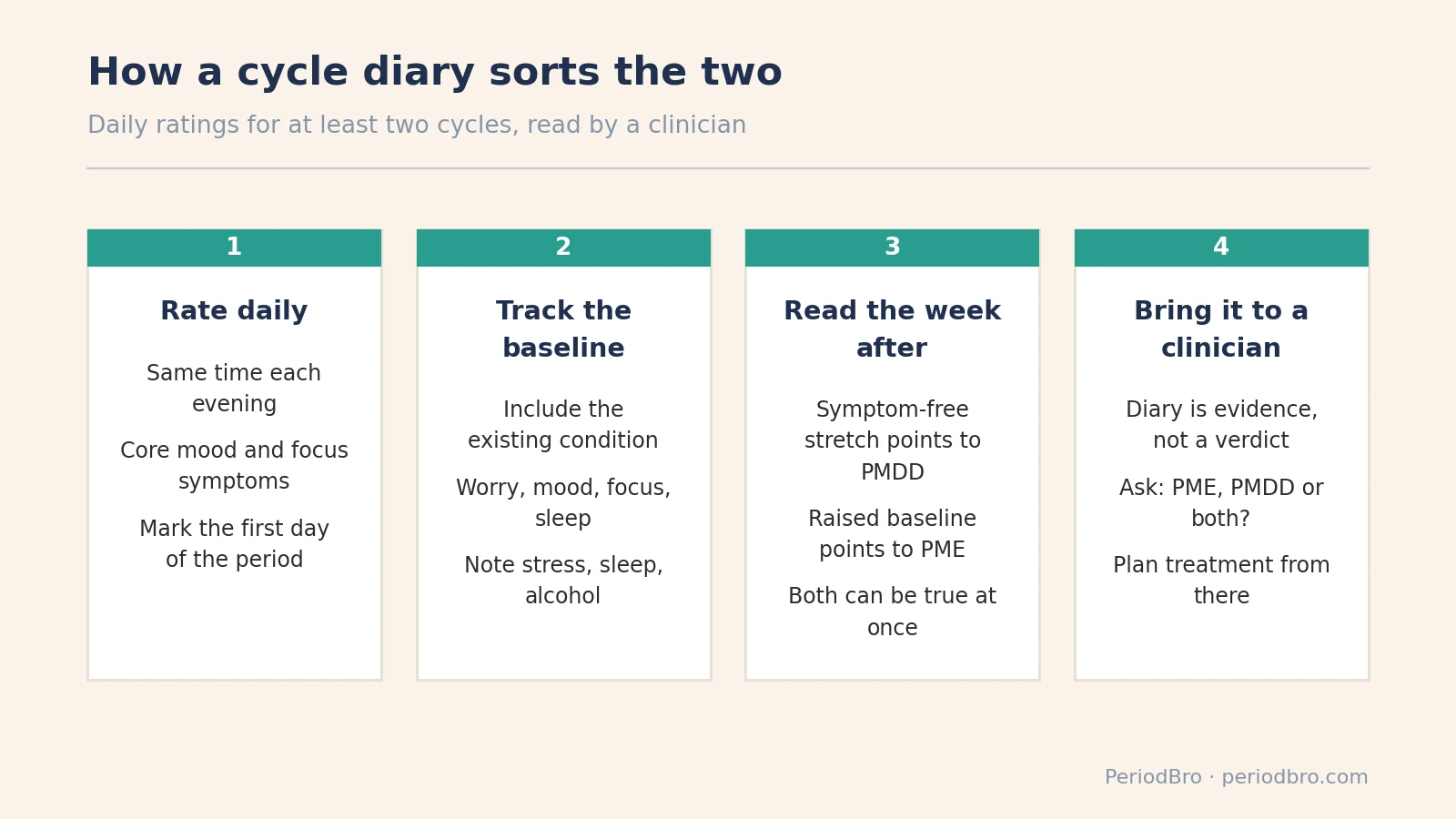
Memory is a poor witness here. People remember the awful week vividly and the decent week barely at all, so a monthly recap makes everything look more cyclical than it was. That’s why the DSM asks for daily ratings across at least two symptomatic cycles, and why a one-time interview misses the pattern (AAFP). The MGH Center for Women’s Mental Health describes daily charting as the best way to tell PMDD from an underlying mood disorder.
A good diary has three habits:
- Rate every day at the same time, usually in the evening, using a validated tool like the Daily Record of Severity of Problems or a simple 1 to 5 scale for each symptom.
- Include the existing condition, not just premenstrual symptoms. For anxiety that might be worry and restlessness. For ADHD, focus and overwhelm. For depression, mood and energy.
- Mark the first day of bleeding and jot down anything else that moves the needle: a bad week at work, poor sleep, alcohol, a medication change.
A sample entry for someone with anxiety might read: worry 4, sleep 2, focus 3, “deadline day.” A week later, with the same deadline pressure, worry 2. That kind of detail is what lets a clinician separate the cycle from ordinary life.
After two cycles, look at the week following the period. If symptoms drop to almost nothing, the pattern points toward PMDD. If the baseline stays raised and only dips a bit, that points toward PME. Both can be true at once. The diary is evidence for a clinician to read, and it beats memory by a wide margin.
The diary belongs to the person keeping it. Offer a nudge if they want one, and ask before you read it. Our post on tracking a cycle with consent covers how to keep that line clear, and how to get a PMDD diagnosis covers what clinicians look for.

What the treatment conversation looks like
The sorting changes the plan. For PME, the existing condition usually gets attention first. Psychiatric Times notes that PMDD-directed treatments, such as drospirenone-containing birth control added to an SSRI or GnRH agonists, may be less effective for PME, and that luteal-phase SSRI dosing, which helps PMDD, may not be enough alone. The evidence is thin. One small crossover study of nine people found that raising the sertraline dose just before a period beat placebo for PME of depression, and the review is clear that few treatments have been properly studied.
For PMDD, the picture is firmer. SSRIs are first-line and can be taken all month or only in the luteal phase, drospirenone-containing pills help some people, and cognitive behavior therapy may help (AAFP). Cleveland Clinic also lists lower caffeine, exercise, and non-medication options like counseling and support groups. More on the options is in PMDD treatment options.
Useful questions to bring to the appointment:
- Does my diary look more like PME, PMDD, or both?
- Should my current treatment plan change in the week before my period?
- Could something else be mimicking this? The AAFP lists migraine, anemia, endometriosis and hypothyroidism as lookalikes.
- When should we review the plan again?
Medication changes belong to the person taking the medication and their prescriber. Don’t suggest a dose, and don’t ask whether they’ve “taken their pill” unless they’ve asked you to be that cue.

How to help without diagnosing or hovering
My friend’s biggest mistake, he told me later, was announcing “it’s your PMDD” in the middle of an argument. It wasn’t PMDD, and even if it had been, a label tossed across the kitchen isn’t help. What worked better was a handful of smaller moves.
- Describe, don’t label. “I’ve noticed the last few months get rough around the same time. Want to look at that together, or not?” Then accept either answer.
- Agree on a menu in a good week. Fewer plans, you take dinner, quiet evenings, a code word for “I need space.” Our PMDD support plan has a template that works for PME as well.
- Ask the two-question version. “When the hard week comes, what’s the most useful thing I can do, and what’s the least?” Write the answers down together. They’re easier to follow than to remember.
- Let them set the check-in rhythm. If your questions feel like hovering, ask what level of contact feels right during the hard days and stick to it.
- Keep your own footing. You can care a lot and still need sleep, friends and a day off. Burning out helps nobody.
PME is the existing condition turning up for a few days, and the rest of the month still counts. Support that covers all four weeks, with a little extra in the hard one, tends to land better than treating the premenstrual week as a crisis you have to survive.

If thoughts of suicide show up
Premenstrual suicidal thoughts are real. In a cross-sectional study of 302 women, 153 endorsed premenstrual symptoms, and 41 of them (27%) reported new or worsening passive or active suicidal thoughts before their period. The strongest predictors were a history of depression, current depressive symptoms and several adverse childhood experiences. If your partner mentions it, even in passing, ask directly and listen.
In the US, call or text 988 to reach the 988 Suicide and Crisis Lifeline, which is free, private and open 24/7. You can also call if you’re worried about someone else (Cleveland Clinic). If there’s immediate danger, call 911 or your local emergency number. Tell their clinician too, and flag the pattern on the diary.
Back to my friend. A few cycles of diary pages later, his wife and her psychiatrist adjusted her anxiety treatment instead of chasing a PMDD plan, and the loud week got a lot quieter. He still jokes he was a bad diagnostician. Mostly he’s glad he stopped. If you’re supporting someone through this, PeriodBro can show where they are in their cycle, with their consent, which makes the diary easier to read later.
PeriodBro provides educational information and is not a substitute for professional medical advice. Always consult a qualified healthcare provider for personal medical decisions, and never change a medication without your prescriber’s advice.