How to Support Her Period From a Long-Distance Relationship
You can’t put the kettle on for her from four hundred miles away. You can’t hand her the heating pad or take the dishes off her plate for the night. Everything you’d normally do when she’s having a rough day on her period runs through a screen instead, and it’s fair to wonder if any of it still counts. Here’s how to support her period from a long distance relationship without pretending the distance isn’t real.
How to support her period from a long distance relationship
Long-distance couples don’t report worse relationships than couples living together, which surprises most people the first time they hear it. Research on the subject, including work by communication researcher Laura Stafford, has repeatedly found comparable or even slightly higher satisfaction, intimacy, and trust in long-distance relationships than in geographically close ones. The distance itself isn’t the problem you’re solving for. What you’re solving for is that the tools which work up close don’t automatically translate.
Long-distance couples also communicate more than most people assume, averaging around 5.5 contacts a day across text, calls, and video. Texting alone makes up roughly 70% of that daily contact. And texting isn’t just filler between calls: more frequent, responsive texting predicts significantly higher relationship satisfaction specifically in long-distance relationships. In couples who live together, that pattern flips. Voice calls predict satisfaction there, while texting volume mostly doesn’t move the needle, probably because presence is already doing that job in person.
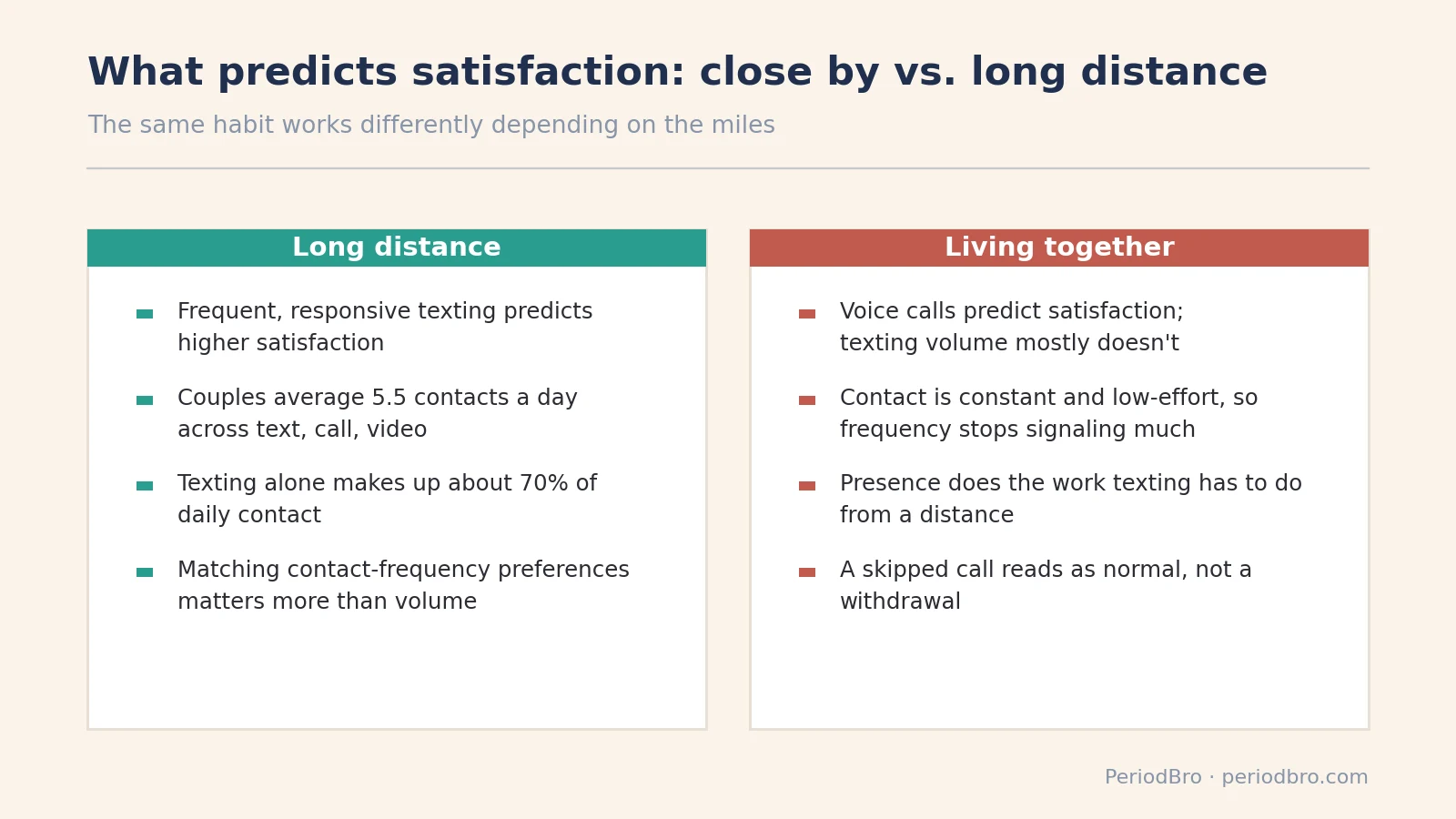
That matters for cycle support specifically, because it tells you where to put your effort. The small, responsive texts on her hardest days carry more weight than the one big weekly video call you’ve been treating as the main event.
What actually transfers when you’re not in the room
You can’t deliver a heating pad, but you can order one to her door, along with whatever she’s running low on, and have it arrive without her having to ask. You can’t sit next to her on the couch, but you can send a voice note instead of pushing for a call on a day when talking takes more energy than she has. Small, specific, low-effort-to-receive gestures do more from a distance than one big check-in ever will.
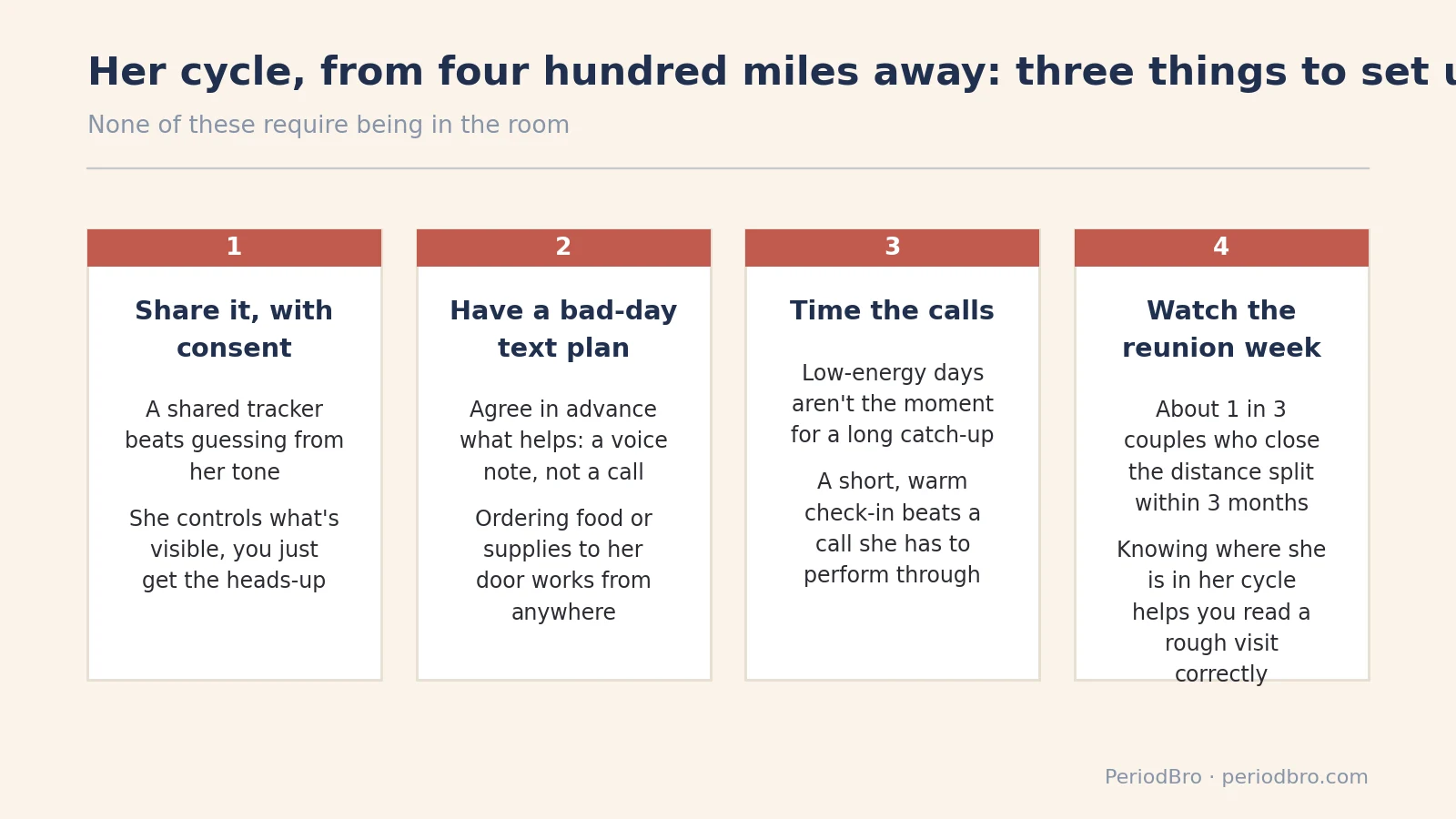
Shared cycle tracking is worth setting up here too, with her consent driving what’s visible to you. It replaces guessing based on her tone in a text with an actual heads-up, and it means you’re not asking “are you okay?” on a day when the honest answer is complicated. Our guide to tracking her cycle with consent walks through how to set that up without it feeling like surveillance, and our piece on sharing a tracker with a partner covers the practical side of the apps that make this easy.
Timing the calls instead of just having them
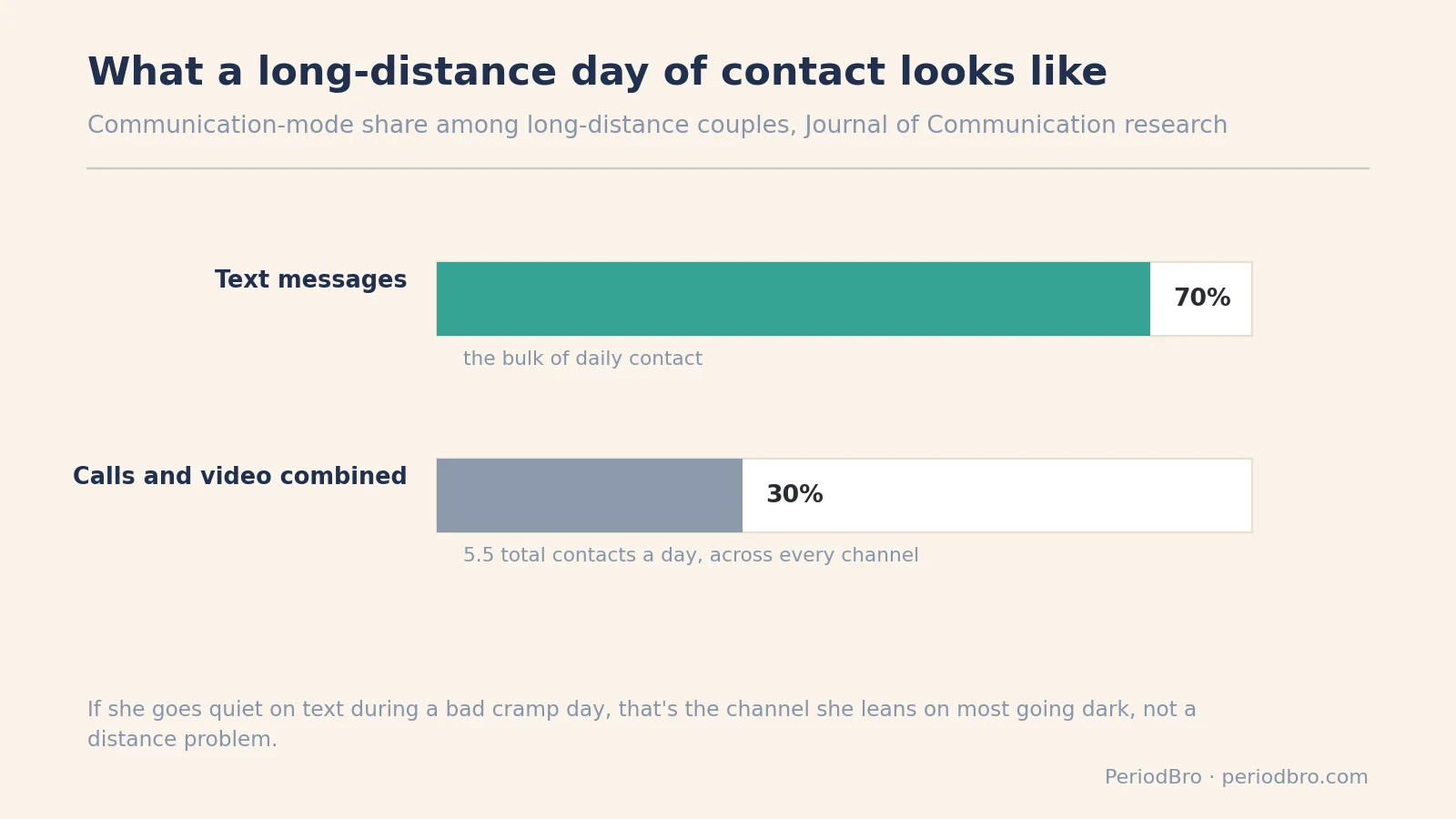
If texting is doing 70% of the work in your relationship’s daily contact, protect it on the days that matter most. That means noticing when a normally chatty text exchange goes quiet, since for a long-distance couple, that channel going silent is a bigger signal than a skipped call would be for a couple sharing a kitchen. It also means being deliberate about when you push for a longer conversation. A low-energy, cramping, exhausted day isn’t the moment for the catch-up call you’ve been meaning to have. A short, warm, low-pressure check-in beats a call she has to perform through.
If you’re not sure what to actually say, our guide on what to text her on her period has specific lines that read as attentive rather than generic, which matters more when text is your primary channel than it would if you saw her every evening.

The mood-versus-hormones trap gets worse with distance
Without daily in-person context, it’s easy to read a short or distracted text as something about you, or about the relationship, or about the distance itself, when it’s actually about where she is in her cycle. That misread is common in any relationship, but it compounds long-distance, because you don’t have the other cues (her posture, her tone in the room, the day she’s had) that would normally tell you it’s not personal. Our explainer on how hormones drive her mood is worth reading together if this keeps tripping you up, since it gives you both a shared vocabulary for “this is cyclical” instead of relitigating the same misunderstanding every month.
A word about reunions
Roughly 1 in 3 couples who close the distance and move in together break up within three months of reuniting, which is worth knowing even though it’s not really about periods. Nobody fully agrees on why, but the shift from curated, high-effort contact to the friction of ordinary daily life is clearly part of it. If a reunion lines up with a rough stretch of her cycle, and you already know how cycle-driven mood shifts show up for her, you’re less likely to mistake a hard week for a verdict on the relationship itself.
None of this means every rough visit is cycle-related; plenty of reunion friction is just two people relearning how to share a bathroom and a schedule after months apart. But if you’ve been tracking together and you can see she’s a few days into a hard stretch when a visit starts, that context changes how you read a short answer or a canceled plan.
If you want the fuller picture on how cycle awareness changes a relationship over time, not just during a long-distance stretch, our piece on how cycle awareness changes a relationship is a good next read. And if you want the broader playbook on supporting a partner day to day, in person or not, our complete guide to being a better partner through her cycle is the hub the rest of this site builds on.
Video calls still have a place, just not every day
None of this means video calls are pointless on a bad cycle day. They’re just not the default tool. A video call works when she wants to be seen and doesn’t have the energy to type out how she’s feeling, since you can read her face in a way text never lets you. It backfires when it’s scheduled at a fixed time regardless of how her day’s gone, because then it becomes one more thing she has to show up for and perform through. The fix is low-tech: ask, don’t assume. “Want to talk or would texting be easier tonight” takes five seconds and respects that her energy on day one of a heavy period is not the same as her energy on a good day.
Quick answers
How do I know if she’s struggling with her period or just going through a rough patch unrelated to it?
A shared tracker, used with her consent, is the most reliable way to tell the difference without asking directly every time. Absent that, a pattern of similar moods or messages landing around the same point in her cycle for two or three months running is a strong enough signal to trust.
Should I bring up her period first, or wait for her to mention it?
Waiting is usually safer for the first few cycles of a new long-distance stretch, since bringing it up unprompted can land as surveillance rather than care if you haven’t established that together yet. Once you’ve talked about tracking or she’s brought it up herself, checking in becomes welcome rather than intrusive.
Does it help to send something physical, or is that overkill for a text-based relationship?
It’s not overkill. A small delivery, tea, a heating pad, her favorite snack, arriving on a day she didn’t ask for it stands out precisely because most long-distance care happens through a screen. The rarity is what makes it land.
Distance changes the delivery mechanism more than it changes what she needs on a hard day: to be noticed, to not have to ask twice, and to know someone’s paying attention even from far away. That part holds up over a phone line as well as it does across a couch.
PeriodBro provides educational information and is not a substitute for professional medical advice. Always consult a qualified healthcare provider for personal medical decisions, including significant or persistent mood or physical symptoms related to the menstrual cycle.