

Laparoscopy for Endometriosis: What Actually Happens
Someone has finally used the word surgery, and the appointment where they said it lasted about eleven minutes. She has a date, a leaflet, and a lot of questions that didn’t get asked. If she’s been offered a laparoscopy for endometriosis, the operation itself is one of the more routine things a gynaecological surgeon does, and almost none of the worry sits in the operation.
Recovery is where a partner makes a measurable difference, and it is the part hospital leaflets cover worst. That section is worth reading even if she is still deciding whether to go ahead.

What a laparoscopy for endometriosis involves
She goes under general anaesthetic. The surgeon makes a small cut near the navel, inflates her abdomen with carbon dioxide gas to create room to see, and passes a camera through. Two or three more cuts, each under a centimetre, take the instruments. The surgeon looks at the pelvic organs directly, and if endometriosis is there, it can usually be treated in the same sitting.
Most women go home the same day. She’ll wake up groggy, sore around the incisions, and bloated from the gas, with a couple of dissolvable stitches or glue holding each cut. On paper it’s day surgery. In her body it’s abdominal surgery, and those two facts are what people get muddled, usually in the direction of expecting her back to normal on Monday.
The rule changed in 2022, and it changes her options
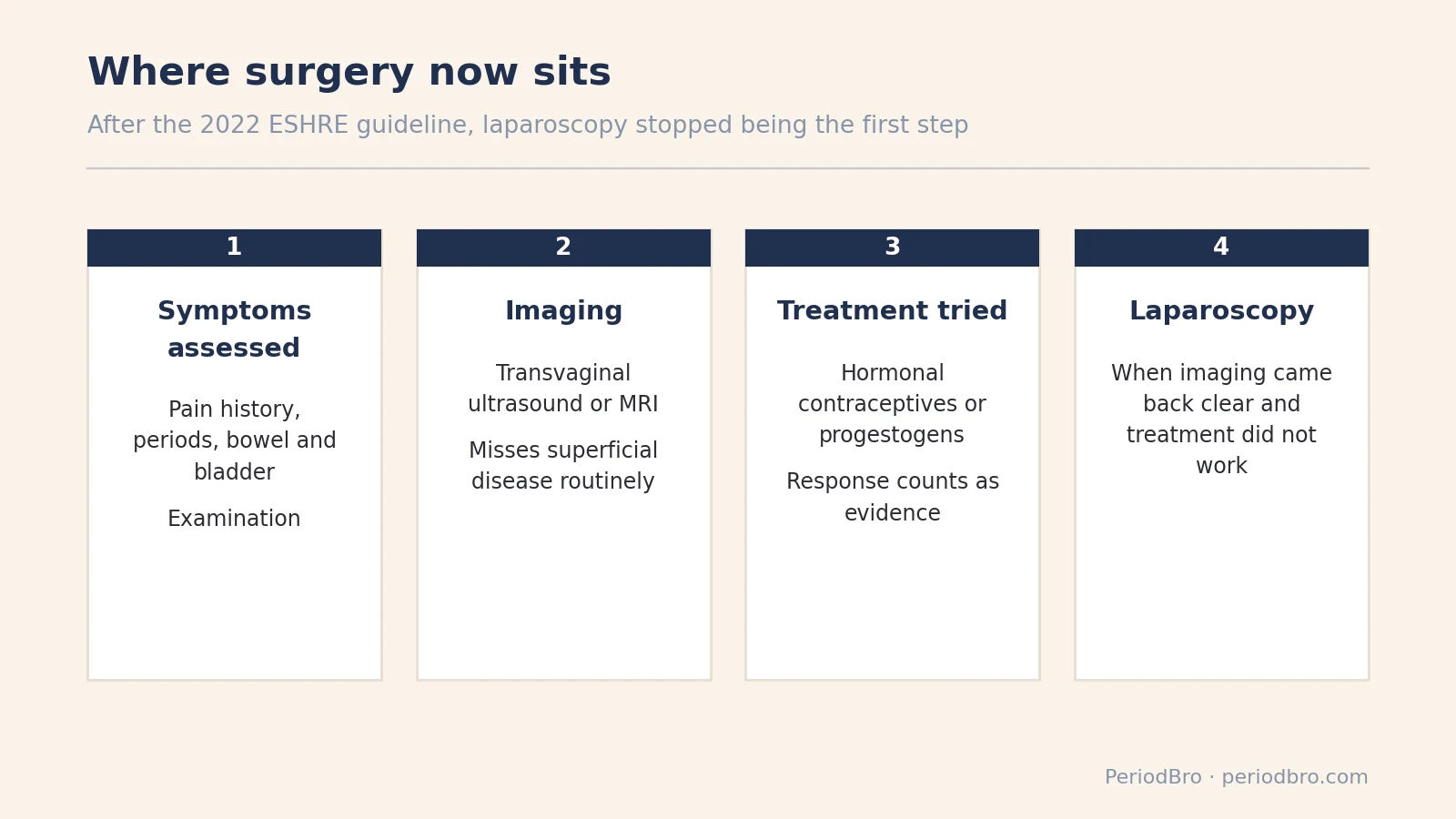
For decades, a laparoscopy was the only way to get a real diagnosis. That’s no longer the position. The 2022 ESHRE guideline stopped treating laparoscopy as the diagnostic gold standard. Diagnosis can now rest on symptoms plus imaging, meaning transvaginal ultrasound or MRI, and surgery is recommended mainly where imaging came back clear and treatment hasn’t worked or doesn’t suit her.
The reason for the change was time. A 2026 study across eleven Dutch hospitals put the median delay from first symptoms to confirmed diagnosis at seven years, with a spread from two to fifteen. When the only route to an answer runs through an operating theatre, the queue for that theatre becomes the queue for being believed. Letting imaging and treatment response count moves the answer years earlier for a lot of women.
Two practical consequences. If she’s been told she doesn’t need a laparoscopy to be diagnosed, that’s current practice rather than a brush-off. And if she’s been offered one after a clear pelvic ultrasound, that also fits the guideline, because imaging misses superficial disease routinely.
Diagnosis and treatment in one operation
If the surgeon finds endometriosis, the usual plan is to deal with it there and then, either by cutting the tissue out or by destroying it with heat or a laser. Those are called excision and ablation, and endometriosis forums argue about them constantly.
The evidence is calmer than the argument. A 2021 meta-analysis of four randomised trials covering 346 women with minimal to mild disease found no significant difference between excision and ablation in pain scores at twelve months or beyond, across period pain, pain with sex, and pain opening the bowels. For the ovarian cysts endometriosis causes, a 2024 Cochrane review looked at the same comparison and reached its own conclusions about recurrence and fertility outcomes.
Useful takeaway for the pre-op conversation: for mild disease, which technique she gets is less important than who’s holding the instrument and how much of the pelvis they’re prepared to look at. Deep or widespread disease is a different conversation and usually belongs with a specialist centre.
What to get answered before the day
The pre-op appointment is short, so it helps if she walks in with the questions already written down. Before a laparoscopy for endometriosis, the ones that change something are these. Will they treat whatever they find in the same operation, or look now and book a second procedure later? How much endometriosis work does this surgeon do, as opposed to general gynaecology? If the disease turns out to involve bowel or bladder, does the case get referred on to a specialist centre, and does that mean stopping mid-operation? And what happens, practically, if they find nothing at all?
That last one is worth rehearsing. A clear result changes the plan rather than ending it, and hearing that in advance from a surgeon is easier than working it out in a recovery bay.
The shoulder pain nobody warns her about
This is the one that generates panicked calls to the ward the next day. The gas used to inflate her abdomen doesn’t all come out, and the residue irritates the diaphragm, which shares nerve supply with the shoulder. So the pain arrives in her shoulder and the tips of her collarbones, nowhere near any incision.
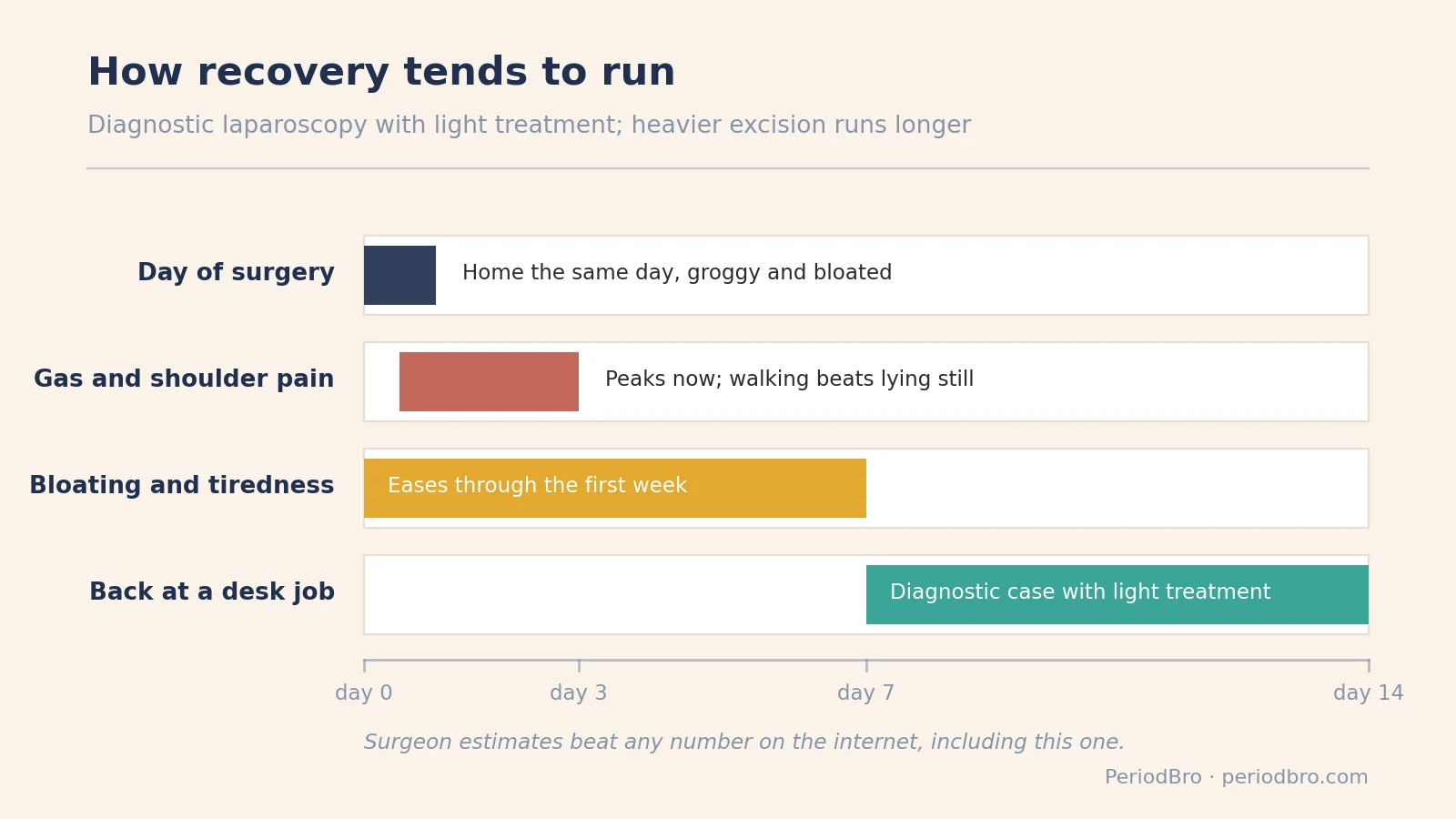
It’s common enough that Cochrane has a whole review of attempts to prevent it. That 2019 review of 32 trials and 3,284 women opens by noting shoulder-tip pain occurs in up to 80 percent of women after gynaecological laparoscopy, and that it drives delayed discharge and readmission. It typically settles over two or three days. Walking around helps more than lying still, which feels wrong and is worth telling her before she’s the one deciding whether to get up.

What recovery actually looks like
For a diagnostic laparoscopy with light treatment, most women are moving comfortably around the house within a few days and back at a desk job inside one to two weeks. Heavier excision work, or anything involving bowel or bladder, stretches that out considerably, and the surgeon’s own estimate beats any number on the internet including this one.
The first two days carry the worst of the bloating and the gas pain. Expect some vaginal bleeding, tiredness that arrives suddenly in the afternoon, and a stretch where her appetite does nothing. Anaesthetic also tends to leave people weepy and short-tempered for a day or so, which is chemistry rather than a verdict on the surgery or on you.
Your job in the first forty-eight hours
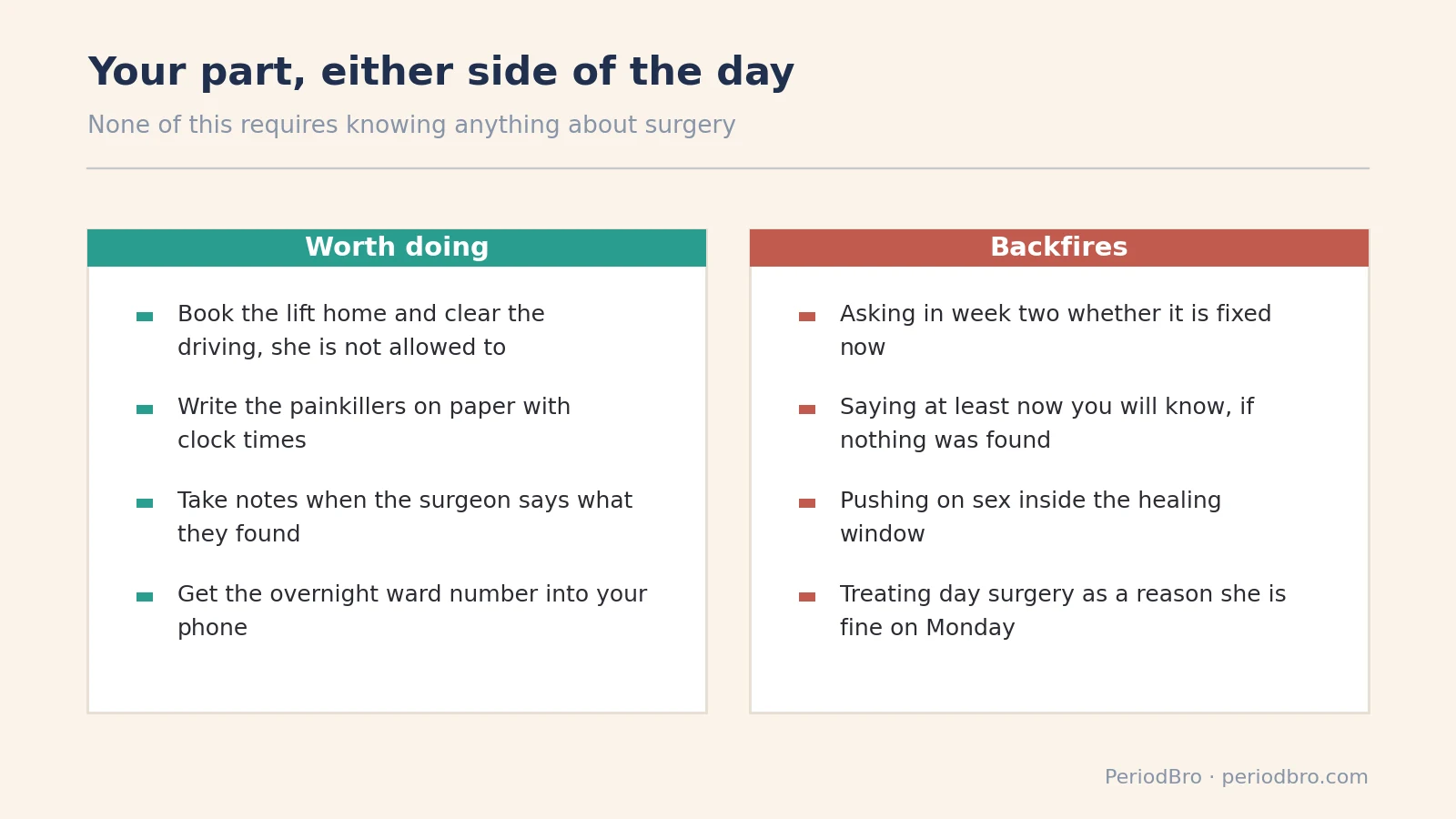
Sort the logistics before the day, because she can’t do them after an anaesthetic. She isn’t allowed to drive, and depending on the hospital she may not be discharged at all without a named adult collecting her. A mate of mine drove his girlfriend back from one of these and spent the entire journey apologising for speed bumps, which is roughly the correct level of attention.
Then the boring, high-value things. Write the painkillers on a bit of paper with clock times, because she’ll lose track and then be in pain and unsure whether she’s allowed more. Keep water within reach of wherever she’s lying. Have soft food in that needs no decisions. Move her phone charger to the sofa, since that’s where she’ll be. Ask the ward before you leave what number to ring overnight and put it in your phone rather than on a leaflet that goes missing.
The part partners skip: take the surgeon’s follow-up conversation seriously and write it down. She’s coming out of anaesthetic when someone explains what they found, and she will not remember it. That written note is what the next appointment runs on, and given how often women report being waved off in appointments, having the findings in her own file is worth the two minutes.
What not to say
Skip “at least now you’ll know.” A clear laparoscopy is a real outcome and a common one, and it lands hard on someone who has spent years being told the pain is normal. Pain with no visible lesion is still pain, and the treatment path continues either way.
Skip any version of “so is it fixed.” Surgery treats what’s there on the day. Symptoms can come back, and asking in week two makes her the one who has to break that news. Ask how she’s doing this week instead.
And don’t push on sex. Most surgeons ask for a couple of weeks with nothing in the vagina while things heal, and if pain during sex was part of why she had the operation, that isn’t a question for the recovery fortnight. The wider picture of living with endometriosis covers that better than a post-op conversation will.
Red flags after surgery
Ring the ward or get urgent care for a fever, heavy bleeding soaking a pad in an hour or less, pain that’s getting worse rather than easing after day two, redness or discharge from an incision, being unable to pass urine, vomiting that won’t stop, or a swollen painful calf. Any sudden severe breathlessness or chest pain means emergency care immediately.
Those are uncommon. Knowing them means the two of you can stop scanning for disaster and get on with the boring business of her sleeping it off. For the longer view of being useful across her whole cycle rather than just this fortnight, the partner’s playbook for her cycle is the place to start.

PeriodBro tracks symptoms and pain against her actual dates, which is what turns a recovery month into something you can both see and compare against before. Try it free.
This article is general information, not medical advice. Her surgeon’s instructions override anything here, and post-operative fever, worsening pain, or heavy bleeding need a clinician the same day rather than a search engine.