

Her IUD Appointment: What to Expect, and the Three Months After
She’s booked in to get an IUD and she’s asked you to come. You’ve got a vague sense it’s a quick appointment and a mild pinch, because that’s how it gets described. That version is wrong often enough to be worth correcting, and knowing what to expect at an IUD insertion is most of what makes you useful on the day.
A guy I know drove his wife to hers, waited in the car because she said it was nothing, and got a text twenty minutes later asking him to come in. He’d brought nothing, planned nothing, and spent the drive home apologising for treating it like a dentist visit. Which it isn’t, and nothing in the booking had suggested otherwise.
What actually happens in the room
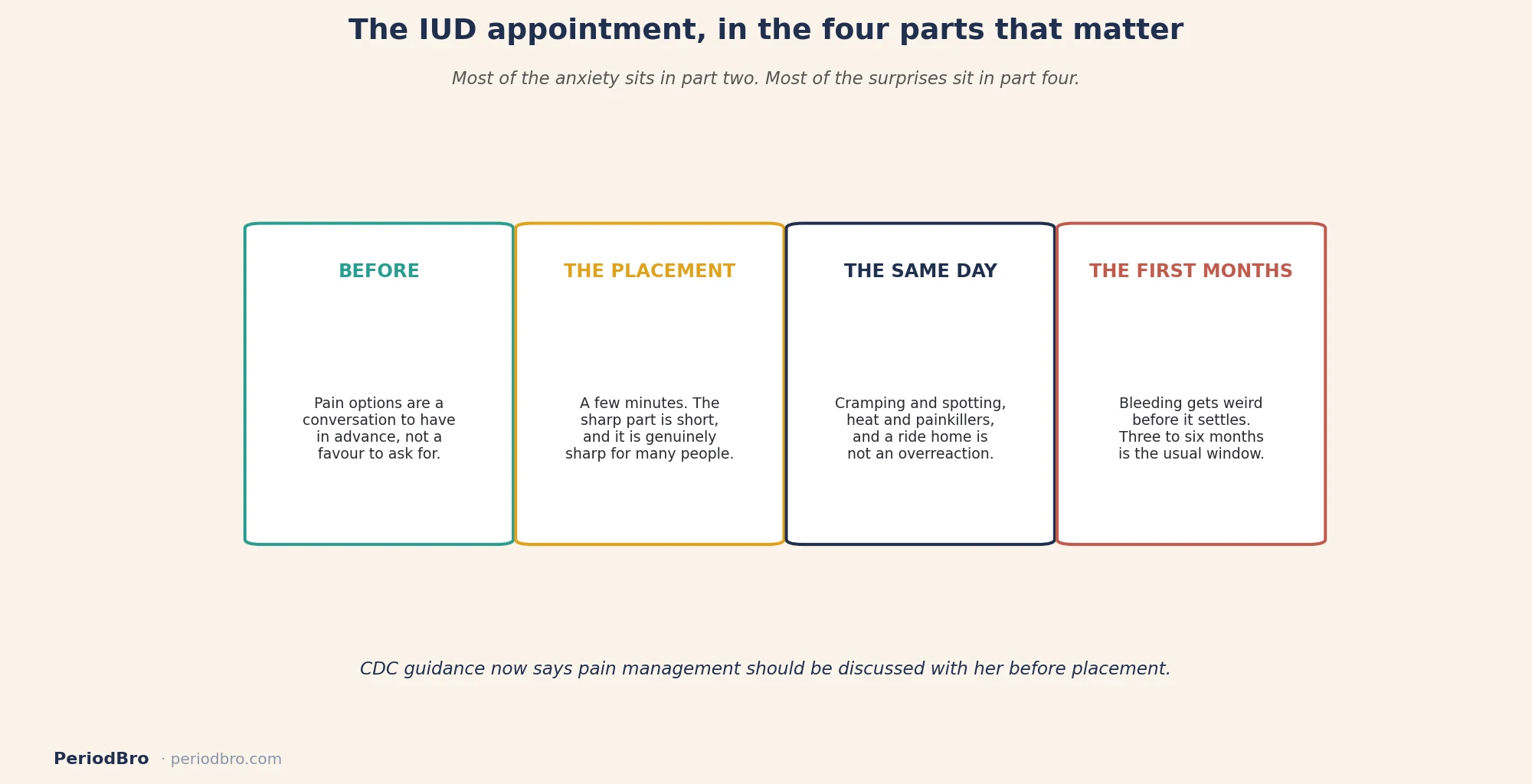
The procedure itself is short, usually a few minutes. A speculum goes in, the cervix gets steadied, the uterus gets measured, and the device goes through the cervical canal and opens inside the uterus. The sharp part is the bit where something passes through the cervix, and it’s brief.
Brief doesn’t mean mild. In a prospective study of young women at a family planning clinic, participants expected a median pain of 6 out of 10 and reported 7 out of 10 afterwards, meaningfully more than they’d braced for. The same study found something worth holding onto alongside that: 78 percent still recommended the method right after the procedure, and 74 percent were still recommending it at six months. Both halves are true. It hurts more than advertised, and most people are glad they did it.

What to expect at an IUD insertion, on the pain question
This is the part that has genuinely changed, and it’s the single most useful thing you can know going in.
For years the standard offer was ibuprofen beforehand, which the evidence never supported very well. In 2024 the CDC updated its Selected Practice Recommendations for Contraceptive Use to say that patients should be counselled on pain management options before placement, and that lidocaine, either as a paracervical block or applied topically, may be useful for reducing pain. Misoprostol, which used to get handed out to soften the cervix, is no longer recommended for routine use. ACOG followed in 2025 with guidance that local anaesthetic options should be offered for in-office cervical and uterine procedures.
A 2025 review of the clinical evidence puts the ranking plainly: the interventions with the strongest support are a cervical block, 10 percent lidocaine spray, and 5 percent lidocaine-prilocaine cream. Despite that, the review notes ibuprofen is still what most people get offered.
The practical move is a phone call before the appointment, not a negotiation during it. What pain relief does this clinic offer, and does she need to ask for it in advance? If the answer is that they don’t do any of it, that’s real information, and there are clinics that do.
Two other things help and cost nothing. Someone driving her home, and nothing scheduled after. Plenty of people are fine an hour later. Some aren’t, and the ones who aren’t tend to be the ones who booked a meeting for the afternoon.
The same day, and the week after
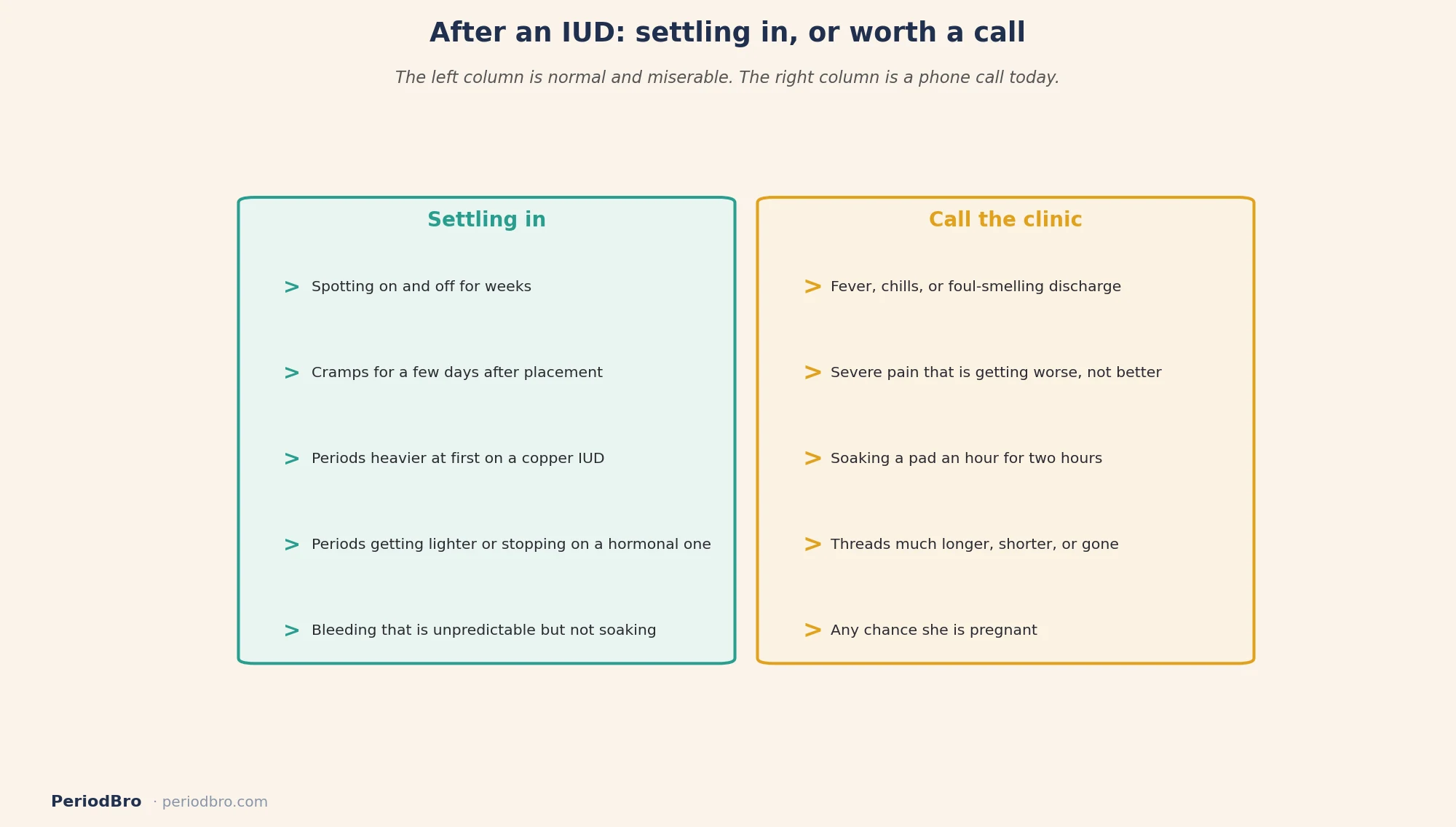
Expect cramping. Often strong for a few hours, then tailing off over a few days, sometimes with a stretch of low-grade ache for a week or two. Heat and the usual painkillers are the tools, and the cramps playbook applies unchanged here.
Spotting is normal and can go on far longer than either of you expects. Have supplies in the house before the appointment rather than making a shop run that evening.
The thing that’s genuinely useful on the day is boring. Don’t ask how she’s feeling every twenty minutes, and don’t disappear either. Get the heat pad going, keep food simple, take whatever was on her list for that evening off her. Being useful when you can’t fix the pain is mostly logistics, and this is a day where the logistics are obvious.
The three months that catch people out
Most of the friction actually lives here, and it turns up long after the appointment has stopped being a topic in the house.
Her bleeding is going to be strange for a while. On a hormonal IUD, spotting and light bleeding through the first three to six months is the expected pattern rather than a complication, and it settles into much lighter periods after that. By the end of the first year a meaningful minority of users have no period at all, which is normal for the device and still unsettling the first time it happens. On a copper IUD the direction is the opposite: heavier and longer periods, plus unscheduled bleeding, in most new users through those same first months.
This rarely gets said clearly at the appointment, so three months in it’s easy to conclude something has gone wrong when the answer is that the thing is doing what it does. What hormonal birth control does to a cycle covers the mechanism across methods, and tracking on birth control covers what the app is still good for once the prediction stops meaning anything.
Two things are worth actually watching through that window. If the copper IUD has made her periods heavy enough to affect her day, that’s a conversation with her doctor rather than something to absorb, and it’s worth reading what counts as heavy and the iron side of it. And if she goes back and gets told it’s fine while it clearly isn’t, a dismissive appointment is a step, not a verdict.

The part where it isn’t working out
Worth saying out loud, because it changes how the first months feel: this is a reversible method and she can have it taken out whenever she wants. Removal is a much quicker and much less painful procedure than placement, and she doesn’t need a reason that satisfies anyone.
That matters because the standard advice through the settling-in period is to give it three to six months, which is good advice and also the kind of advice that can turn into an obligation. There’s a difference between waiting out a known pattern and enduring something because a leaflet said to. If she’s miserable, going back before the six months is up is a legitimate move, not a failure of patience.
Devices also occasionally shift or come out on their own, most often in the first year and most often during a period. That’s part of why the string check gets mentioned, and it’s the practical reason to take her seriously if she says something feels different rather than telling her it’s probably fine.
Your job in all of that is narrow. Don’t be the person arguing for the device. The method is hers, the body is hers, and a partner who’s invested in her keeping it is a genuinely unhelpful thing to have in the room.
The short list of things that need a call
Most of what happens after an IUD is unpleasant and fine. A few things aren’t, and they’re specific enough to keep in your head.
Fever, chills, or discharge that smells wrong. Severe pain that’s getting worse rather than better over the days after placement. Bleeding heavy enough to soak through a pad an hour for two hours running. Any suggestion the device has moved, which usually shows up as the threads feeling much longer, much shorter, or absent. And any chance she’s pregnant, which is rare with an IUD but needs ruling out quickly when it happens.
None of that is a reason to hover. It’s a reason to know the clinic’s number and to take her seriously the first time she says something feels off, which is a lower bar than most people clear.
The short version
Most of what to expect at an IUD insertion comes down to three things. The procedure is quick, sharper than the word pinch suggests, and worth asking about pain relief in advance now that the guidance has caught up. The day itself needs a lift home and an empty evening. The first three to six months are when the bleeding gets weird, and knowing that in advance is the difference between a device settling in and a household quietly panicking.
What she’ll want from you across all of it is unremarkable. Turn up, believe her, handle the evening, and know which five things mean picking up the phone.

PeriodBro keeps a simple private log of bleeding and symptoms, which is exactly what makes those first months legible instead of alarming, and exactly what a clinician asks for at the follow-up. Try it free.
This article is general information, not medical advice. Decisions about contraception and any symptoms after a placement belong with her doctor.