
She Still Has Not Started Her Period: When a Dad Should Ask a Doctor
Every girl in her year seems to have started. She has not, and about four months ago she stopped mentioning it, which is somehow the part that worries you most. You have no idea whether this is ordinary, and you have no idea who you are allowed to ask.
There are actual thresholds for this. They are not vague, they are not a matter of opinion, and most parents never hear them, so the decision gets made on gut feeling and neighbourhood gossip instead. Here they are, along with what usually turns out to be going on and the one sign that should move you this week rather than next term. When a daughter has not started her period and everyone in her year has, the useful question is not whether she is late. It is whether anyone has looked at the clock that counts.
A mate of mine sat on this for the best part of a year with his eldest, mostly because he could not work out whether asking a doctor about it would be an overreaction that his daughter would never forgive him for. It turned out her mother had started at fifteen and so had her grandmother, which he found out in a two minute phone call he could have made the previous September. He still booked the appointment. He just spent a year of low-level dread he did not need to spend.
It runs on a sequence, not a birthday
A period is not the opening event of puberty. It sits near the end of it.
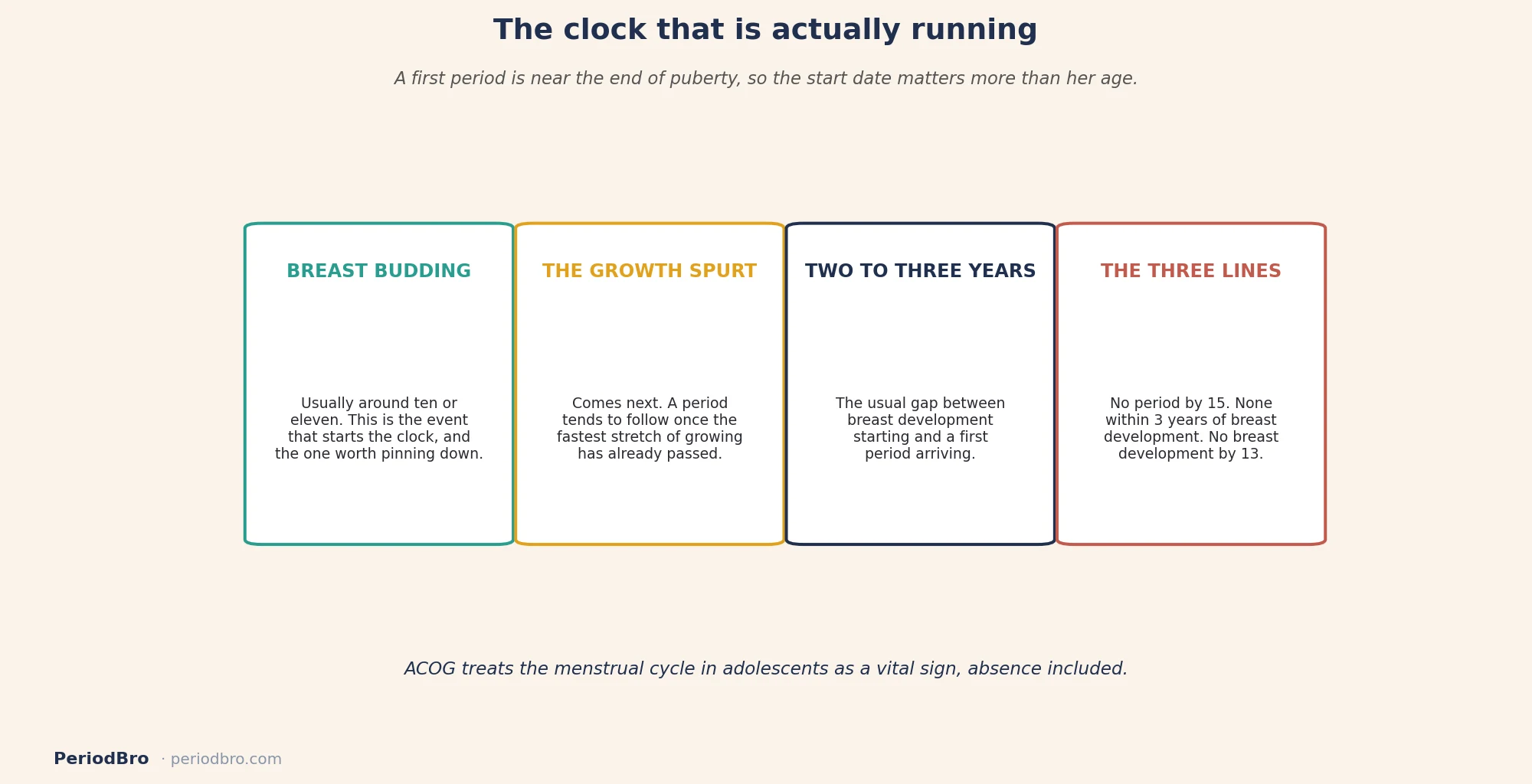
The order is fairly reliable. Breast budding comes first, usually somewhere around ten or eleven. The growth spurt follows. The period arrives roughly two to three years after breast development starts, typically once she has finished the fastest part of her growth. The useful question is when the rest of it started, because that is the clock that is actually running rather than her age. We went through the full range of normal ages in what age do girls get their period, and the early signals that it is coming in signs your daughter’s period is about to start.
If breast development began eighteen months ago, you are early in a normal window and there is nothing to do. If it began four years ago, that is a different conversation.

When a daughter has not started her period, three lines matter
ACOG treats the menstrual cycle in adolescents as a vital sign, and it draws three lines for its absence. Any one of them is a reason to book an appointment.
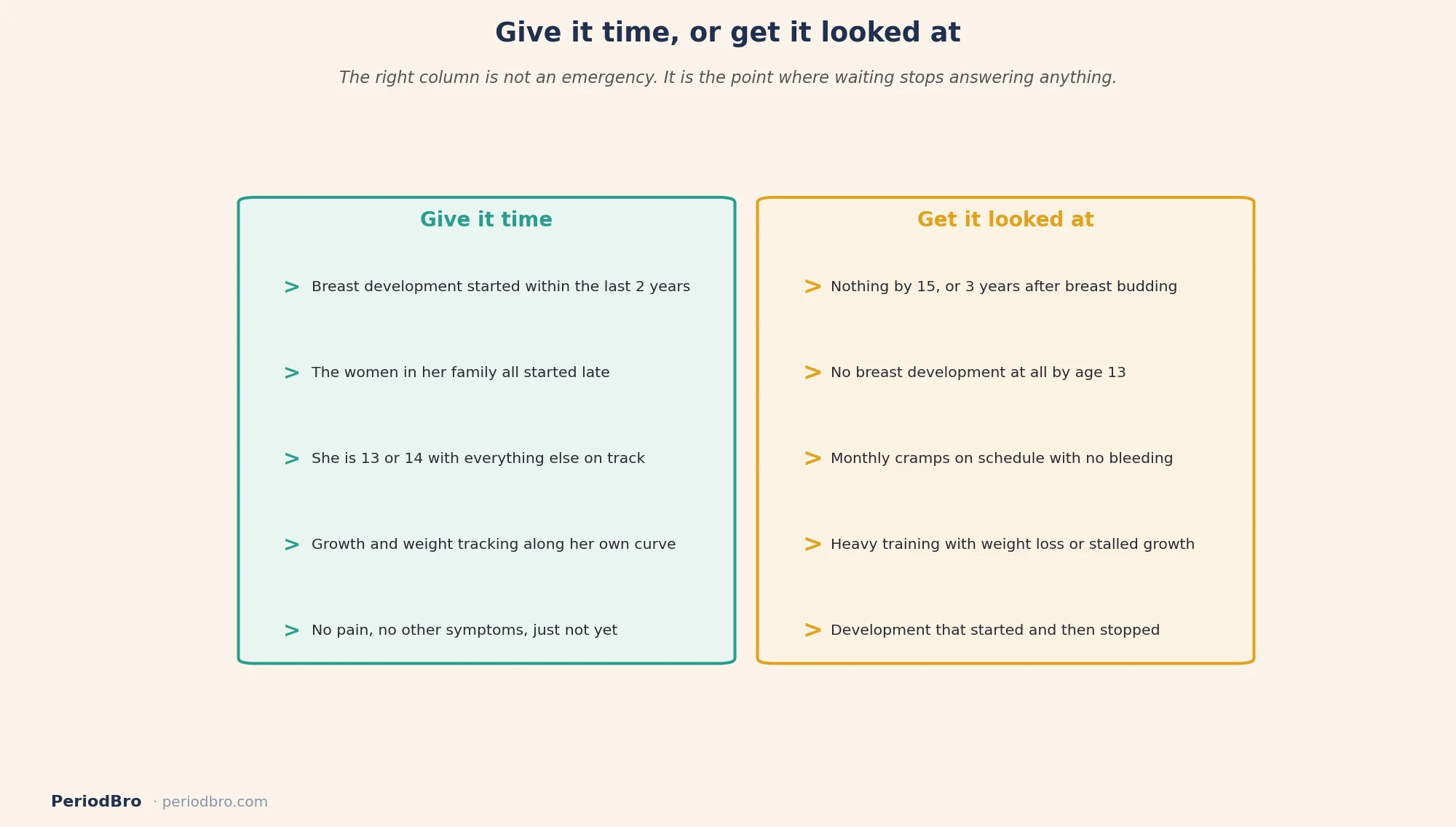
No period by age fifteen. No period within three years of breast development starting. No sign of breast development at all by age thirteen.
That third one catches people out, because it is the one that can trigger before she is anywhere near fifteen. If nothing has started by thirteen, the delay is in puberty itself rather than in the last step of it, and that is worth looking at earlier rather than later.
None of these is an emergency. They mark the point where giving it more time is a decision to not find out. ACOG’s patient guidance on absent periods puts it the same way: it is an evaluation, usually a history, an exam and some bloodwork.
Most of the time it is timing
The reassuring part comes before the list of causes, because it is also the likeliest answer.
The commonest explanation for a late start is constitutional delay: she is on the slow end of a normal distribution, everything is intact, and it arrives in its own time. It runs in families. Which means one of the more useful things you can do costs nothing, and it is asking her mother, or her aunt, or her grandmother, how old they were. If the women in her family all started at fifteen, that reframes the whole thing in one phone call.
The second most likely answer is energy. A body that is not getting enough fuel for what it is being asked to do will shut down the cycle, and in an adolescent that can show up as a period that never starts. Sport is the usual context. The research on relative energy deficiency in sport names delayed first period as one of its presentations, alongside effects on bone that matter a lot at an age when she is still laying down most of her adult bone mass. Treating this as a question about eating disorders will end the conversation before it starts, and most of the time that is not what is going on. A committed swimmer eating like a fourteen year old who does not swim will get there without anybody deciding anything. We wrote about the sport side of the cycle more broadly in daughter, period and sports.

The reasons that are not timing
The rest of the list is short, and a clinician works through it in a fairly standard order. Thyroid problems, which are common, easily tested and easily treated. Polycystic ovary syndrome, which more often shows up as irregular periods than absent ones but can present this way, and which we covered in PCOS and periods. Raised prolactin. Chronic illness, or significant weight loss from any cause.
Then the structural and chromosomal ones, which are rarer and are the actual reason the fifteen line exists. StatPearls’ review of primary amenorrhea lists Turner syndrome, where the ovaries do not develop, and Müllerian agenesis, sometimes called MRKH, where the uterus does not form properly. MRKH affects roughly one in 4,500 people. In that one, puberty looks completely normal from the outside, because the ovaries work fine and produce all the usual development, and the only sign anything is different is that no period ever comes. Which is why “she looks fine, she is just late” is not a diagnosis anyone can make from across a kitchen.
Finding out any of this early is the good version. The bad version is four more years of assuming.
The one sign that should move you this week
If she is getting regular monthly pain, cramps that turn up on a schedule, with no bleeding at all, do not wait for any of the age thresholds. Book something.
Cyclic pelvic pain without a period usually means the cycle is working perfectly and the blood has nowhere to go. An imperforate hymen or a similar obstruction blocks the outflow, and it builds up behind the blockage month after month. Everything else about her development looks normal, which is exactly why it gets missed and why it sometimes ends up presenting as an emergency instead. It is straightforward to fix once someone looks. It is nasty if nobody does.
Monthly pain plus no period is the combination that should get booked rather than watched.
What the appointment actually involves
The picture in most people’s heads is worse than the reality, and that picture is usually why the booking gets delayed.
For a first look at a late start, it is a conversation and some bloodwork. When puberty began, what her growth has done, family history, general health, whether she does a lot of sport, whether there is any monthly pain. Then a physical exam that is mostly about growth and stage of development. Bloods typically cover thyroid, prolactin and the hormones that tell a clinician whether the signal is coming from the brain or the ovaries. An ultrasound is common. Nothing about that first visit is invasive, and an internal examination is not part of a standard workup for a teenager who has never had a period.
Depending on what comes back, the answer is often “nothing to do, come back in a year,” which is a useful thing to be told rather than a wasted trip.
How to raise it without turning it into a project
She has been counting. Assume she noticed before you did, and assume she has been running the maths on herself in a way that is not kind.
So keep it short, keep it flat, and do not make it a summit. Something like: I want to book a check with the doctor about a couple of things, one of them is periods, it is routine and it is not because I think anything is wrong. Then let it go. If she says she does not want to, you can hold the appointment without holding a conversation about it every day, which is usually the thing that makes a teenager dig in. Our piece on how to talk to your daughter about periods has the wider version of that script.
The other move that matters is offering her the room. She should get time alone with the clinician, and hearing you offer that before she has to ask for it does more for her willingness to go than anything else you say. When a girl should see a gynecologist covers what that visit actually involves, which is usually a conversation and not an examination.
Bring three things: roughly when breast development started, the ages the women in her family started, and whether she has had any monthly pain. That is most of the history a doctor needs to know which direction to go.
And have the supplies in the house already. Not staged on her bed, just in the cupboard where she can find them, which is the whole point of stocking up before it happens. The last thing she needs, on a day she has been half dreading and half willing to arrive for two years, is a shopping trip.

PeriodBro was built so a dad can know what is going on without turning it into an interrogation. Try it free.
This article is general information, not medical advice. If any of the thresholds above apply to your daughter, that is a conversation for a clinician who can actually examine her.