Her First Period After the Baby: What Comes Back, and When
Our daughter was fourteen months old when my partner said, from the bathroom, in a completely flat voice: “Well. That’s that back then.” I had genuinely stopped expecting it. Somewhere in the middle of that first year I had filed her period under things that used to happen, like sleeping past six.
A period after pregnancy runs on two clocks. One is the bleeding in the weeks right after the birth, which is not a period at all. The other is her actual cycle restarting, and it can restart quietly, months before any blood shows up.
The bleeding in the first weeks is not her period
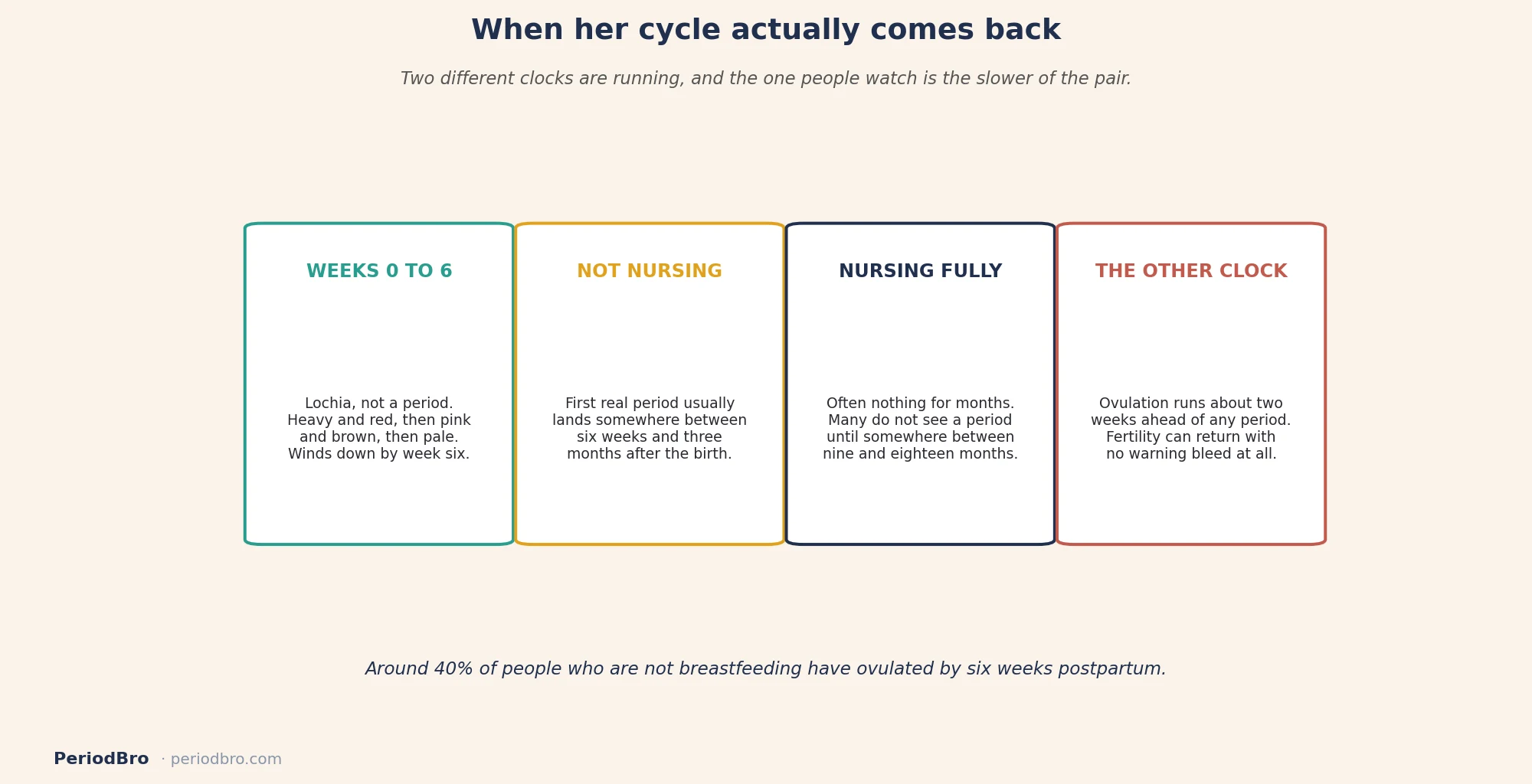
What comes in those first weeks is lochia. It is the uterus clearing out blood, mucus and leftover tissue from the pregnancy, and Cleveland Clinic describes it running in three stages: heavy and dark red for the first three or four days, then a moderate pinkish brown from roughly day four to day twelve, then a thin yellowish white discharge that can trail on to about six weeks.
It is heavier than a period and it lasts longer than a period, and both of those facts catch people out. Lochia is also the reason the first genuine period can arrive without either of you noticing it as an event. She has been bleeding on and off for a month and a half. One more round of bleeding does not announce itself.
The practical marker is direction. Lochia fades. It gets lighter and paler week by week. Bleeding that had settled down and then goes bright red again is not lochia doing its thing, and that one is worth a call rather than a wait.

How soon a period after pregnancy comes back
It depends almost entirely on feeding, and the range is enormous.
If she is not breastfeeding, the first period usually lands somewhere between six weeks and three months after the birth. If she is breastfeeding exclusively, it can be gone for the better part of a year. Cycles are much more likely to return after the six month mark than before it while feeding is still full time, and La Leche League puts the typical return for breastfeeding mothers somewhere between nine and eighteen months.
Every part of that shifts with how feeding actually goes. Night feeds dropping, a longer stretch of sleep, starting solids, a return to work with a pump instead of the baby: any of those can be the thing that tips the switch. Which is why “when will it come back” has no useful answer beyond a shrug and a range. It comes back when the feeding pattern changes enough, and that is different in every house.
The clock that runs ahead of the bleeding
I did not know this part, and it is the one that costs people something.
Ovulation happens about two weeks before a period. Not after. So the first ovulation after a birth arrives with no warning bleed in front of it, which means it is entirely possible to get pregnant again before seeing a single period. People who are not breastfeeding can ovulate as early as 25 days postpartum, and around 40% have ovulated by six weeks. ACOG treats contraception as a core part of postpartum care for exactly this reason, and recommends contact with a clinician within the first three weeks rather than waiting for the old six week check.
Breastfeeding does suppress ovulation, and used deliberately it has a name: the lactational amenorrhoea method. It only holds while three things are all true at once. The baby is under six months old, no periods have returned, and feeding is full or near full with no gaps longer than about four to six hours. Break any one of those and the protection goes with it. It is a real method, not folklore, but it is a narrow one and it expires without telling you.
If the two of you have any view at all on how far apart you want children, this is the conversation to have at about week three, not at month five. We had it late, and late means having it as an argument about risk rather than a decision. Whatever gets chosen will also shape what her cycle looks like when it does return, which is the subject of birth control and her cycle.

Why the first one can feel like a stranger
The first few cycles after a birth are often ragged, and that is ordinary. Cleveland Clinic notes that the uterine cavity is slightly larger after a pregnancy, so there is more lining to shed, and the first period back can be heavier and more painful than anything she remembers from before. It can also go the other way and be lighter and easier. Both happen.
Then there are the changes that stick. Some people come out of a pregnancy with worse cramps than they went in with. Some find their long standing cramps have quietly eased off. Cycle length can reset to a different number and stay there. Two or three untidy months before a rhythm settles is normal, and if you are the one keeping the calendar, expect the app to be useless for a while, because it is averaging cycles that no longer exist.
If heavy is the direction it goes, the practical stuff from how to help with heavy periods applies here as much as anywhere, and so does watching for iron. Blood loss from birth plus heavy periods on top of it is a solid setup for running low, and iron deficiency from heavy periods is the reason a lot of postpartum exhaustion gets written off as new parent tiredness when it is actually a blood test away from an answer.
Periods and feeding can coexist
A period coming back while she is still nursing surprises people, and it worries some of them into thinking they have to stop. They do not. The two run alongside each other perfectly well for as long as she wants them to.
What can happen is a dip. La Leche League describes supply often dropping a little in the few days before a period and during the first day or two, with some babies getting fussy at the breast in that window because the taste changes slightly as sodium and chloride levels shift. It is temporary. Feeding through it is what brings supply back up, and the dip tends to shrink after the first couple of cycles once the pattern settles.
Two things worth knowing if this lands in your house. Nipple soreness in the days before a period is common and not a sign anything has gone wrong. And if the dip is bothering her, calcium and magnesium in the second half of the cycle is a long standing suggestion from lactation support, though the evidence behind it is thin. What is not thin is the value of not treating a fussy feed at day 26 as the beginning of the end.
What is worth a call
Short list, because almost everything here is fine.
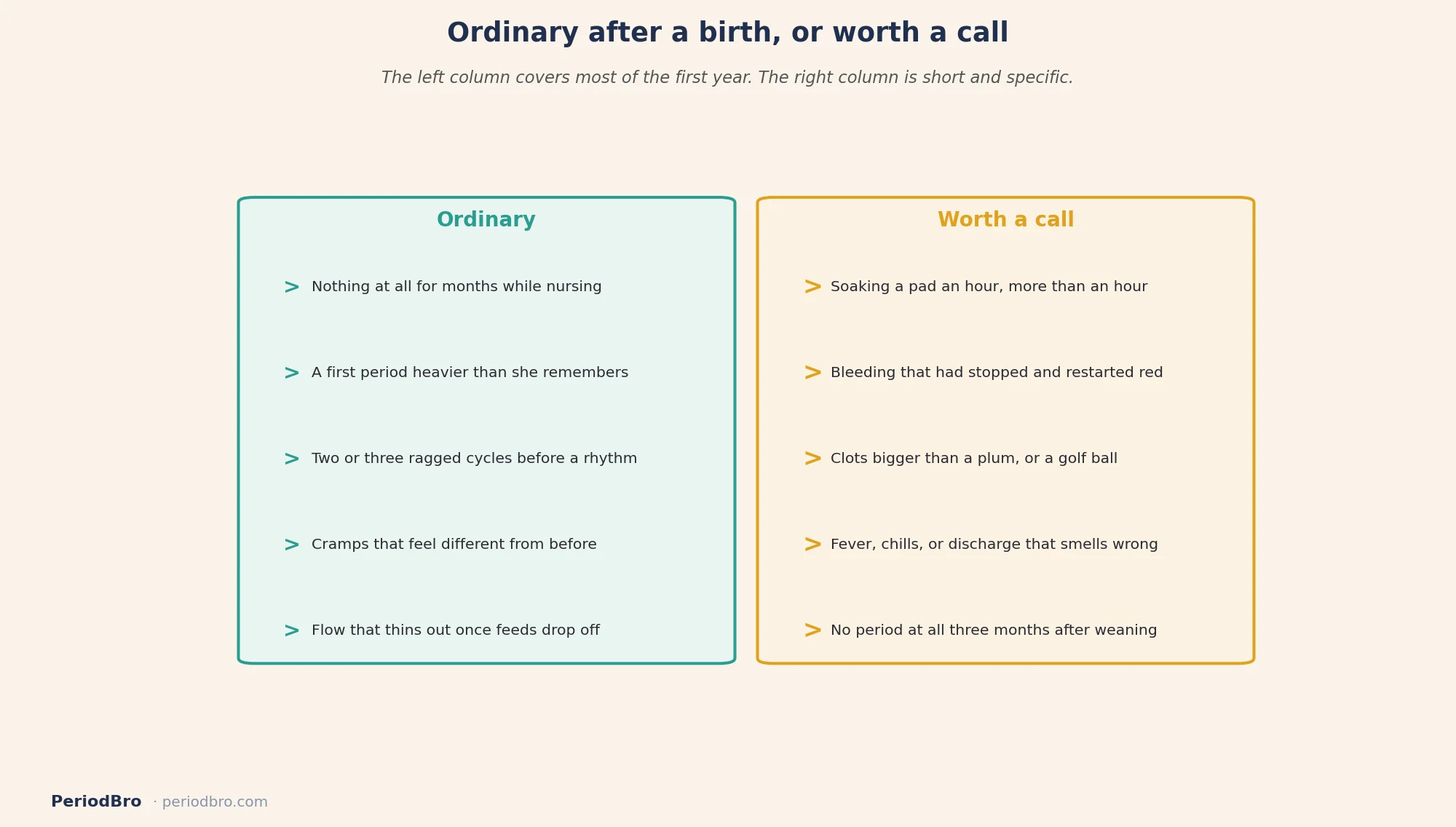
Soaking through a pad in an hour, for more than one hour running. Bleeding that had stopped and started again bright red. Clots bigger than a plum. Fever, chills, or discharge that smells wrong, any of which can mean infection. Severe pain that is new. And on the other end of the range: no period at all three months after weaning, which is worth checking rather than assuming.
None of that is a list to memorise. It is a list to have half in your head so that when she says something is off, you are not starting from zero at eleven at night.
What you can actually do about it
Medically, very little. The useful part of this was never going to be medical anyway.
Say the ovulation thing out loud, once. Most couples never have the “we can get pregnant before her period comes back” conversation because it feels like it belongs to a doctor. It does not. It takes ten seconds and it is the single highest value fact in this entire article.
Keep the calendar yourself for a while. She has enough to hold. If you are the one who notices that it has been forty two days, you are the one who can say so gently instead of her discovering it as a fright.
Do not treat the return as good news or bad news. It is neither, and people feel very different things about it. For some it is a relief and a sign the body is back. For others it is the end of a break they enjoyed, or a reminder of a decision about a second baby they have not made. Let her tell you which one it is rather than deciding on her behalf.
Take the appointment logistics. The postpartum visit that ACOG wants inside three weeks is the same appointment where contraception, bleeding and mood all get covered, and it is also the appointment most likely to get skipped because nobody has the energy to book it. Book it.
My partner’s cycle came back at fourteen months and then took another four months to look like anything regular. I spent most of that stretch quietly convinced something was wrong, because I had not read a single line about any of this. Nothing was wrong. It was just slow, the way most of it is.
If you want the wider map of what the month is doing once it does settle, start with the menstrual cycle guide for men. I built PeriodBro so this stuff sits on your phone before it turns into a search at 2am with a baby on your shoulder.

This is general information, not medical advice. Postpartum bleeding, pain or mood changes that worry either of you are a conversation for a clinician rather than a partner with a search engine.