Can a Smart Ring Track Her Cycle? What Wearables Actually Measure
She bought the ring for sleep. That was the entire reason, and for about two months it did nothing else. Then one morning she said, offhand, that the app had told her she had ovulated on Tuesday, and I remember thinking two things at once: how does a piece of titanium know that, and does this mean I finally get a straight answer about the month.
Yes to the first, mostly no to the second. Smart ring cycle tracking is real, it is better than the calendar guessing most apps do, and it is nothing like the shared dashboard you might be picturing. Here is what these things actually measure, how good they are, and what a partner does and does not get out of it.
No wearable can see a hormone
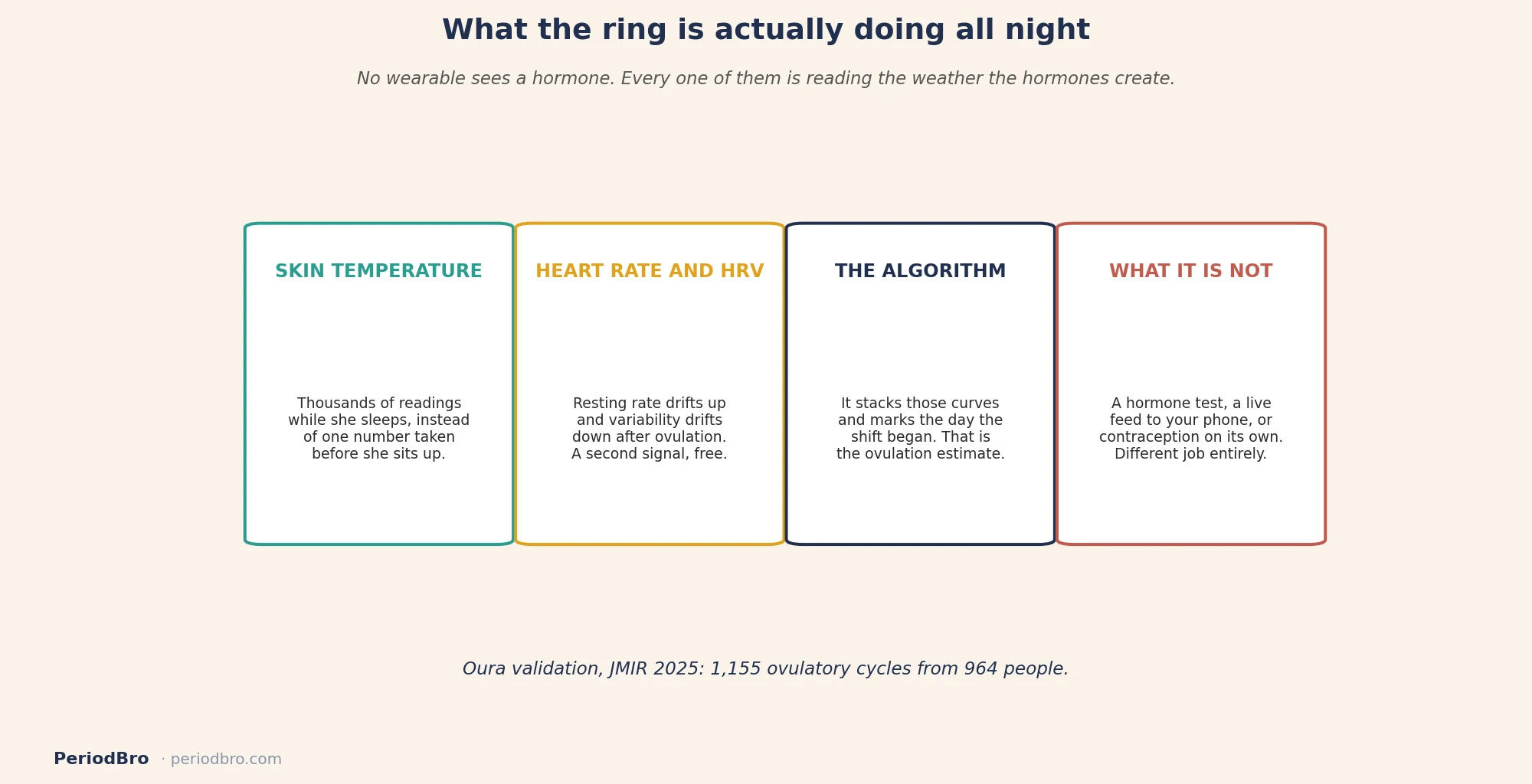
Everything else follows from this one fact. No ring, watch or strap on the market measures estrogen or progesterone. There is no sensor for that. What they measure is the weather those hormones create in the rest of the body.
The main one is temperature. After ovulation, progesterone nudges body temperature up by a few tenths of a degree and holds it there until the period arrives. That has been the basis of fertility awareness for decades, and the traditional version was miserable: a thermometer under the tongue every single morning, at the same time, before sitting up, before speaking, before anything.
A ring or a temperature-sensing watch replaces that ritual with thousands of skin temperature readings taken while she is asleep and not moving. Same signal, no ritual, far less noise from a bad night or a late alarm. Most devices layer on resting heart rate and heart rate variability, both of which drift in the luteal phase, so the algorithm has more than one curve to work with.
How accurate smart ring cycle tracking actually is
Better than I expected, and the study to look at came out in early 2025.
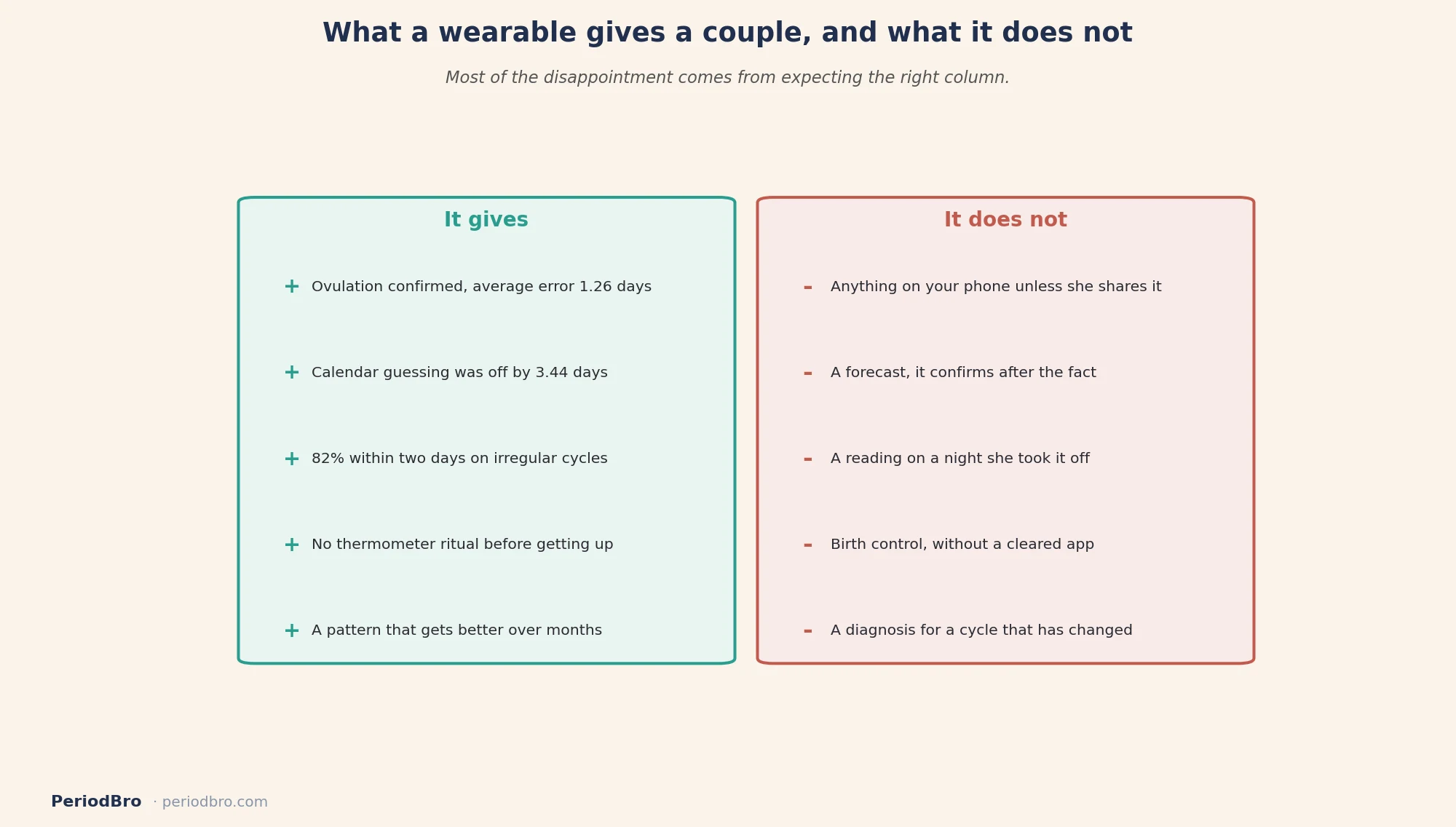
Researchers validated Oura’s ovulation detection against a reference method across 1,155 ovulatory cycles from 964 participants, published in the Journal of Medical Internet Research. The physiology-based method landed within an average of 1.26 days of the reference ovulation date. The calendar method, which is what a plain tracking app does when it has nothing but her past period dates, averaged 3.44 days out.
The gap widens exactly where you would want it to. For people with irregular cycles, 82% of the wearable estimates were within two days of the real thing. The calendar method managed that for 32.5% of them. If her cycles run like clockwork, a calendar app is fine and a ring is a luxury. If they do not, the calendar app has been quietly making things up, and this is the difference that matters.
One catch worth naming. These devices confirm ovulation rather than predict it. The temperature shift happens after the egg is released, so the app tells you what already occurred. Over several months the pattern becomes predictive, but any given cycle is being read in the rear-view mirror. If you want the biology behind why that timing matters, ovulation explained for men covers it.
Which devices people actually mean by this
Three keep coming up, and they are not interchangeable.
Oura. The ring is the one with the published validation work behind its cycle features, and the one that has leaned hardest into this. Its Cycle Insights has been extended to handle members on hormonal birth control, and there is now a separate Menopause Insights experience built around a symptom questionnaire scored against your own long-run biometrics. Worn on a finger, which means it survives sleep better than anything on a wrist.
Apple Watch. Series 8 and later, plus every Ultra, take overnight wrist temperature and feed retrospective ovulation estimates into Cycle Tracking in the Health app. It is quietly good, it is already on a lot of wrists, and it is the cheapest way into this if she owns one. What that does and does not surface for a partner is covered in can you see her cycle in Apple Health.
Whoop and Garmin. Both track cycle phases and both read overnight physiology, and Natural Cycles has extended its cleared integration to select Garmin watches as well. Worth checking the specific model before assuming the feature exists, because it varies more than the marketing suggests.
The device matters less than whether she wears it every night. A cheap watch worn consistently beats an expensive ring that lives on the nightstand four nights a week.
The birth control question, because someone always asks
A ring on its own is not contraception. A ring feeding a cleared app is a different thing, and this is where the regulatory detail matters.
Natural Cycles holds FDA clearance as a Class II medical device, and it has been cleared to take temperature data from an Oura ring since 2021 and from Apple Watch Series 8 and later, including every Ultra model. The wearable supplies the number. The cleared algorithm does the contraceptive job, with the effectiveness rates and the daily discipline that go with it. I went through the honest version of that trade in Natural Cycles for partners.
Treating a ring’s ovulation estimate as birth control without a cleared app behind it removes every safeguard that clearance is meant to provide, and it is the most expensive misunderstanding in this category.

What a partner actually sees, which is nothing by default
This is the part I got wrong for about a week, so I will save you the week.
Her ring data lives in her account, on her phone, and there is no partner view. Oura and Apple both let a member share selected data with someone else, but it is her choosing, her toggle, and she can turn it off on a Tuesday afternoon without telling anyone. Nothing arrives on your phone because you live in the same house.
Honestly, that is the correct design. The moment cycle data becomes something a partner can pull rather than something she offers, the whole thing tips into surveillance, which is the failure mode I keep writing about in tracking her cycle with consent. If you want a shared view, the route is a conversation and then a setting, in that order. The practical options are laid out in how to share a period tracker with your partner.
There is also the mundane failure mode. A ring reads nothing on a night she took it off, and skin temperature gets scrambled by illness, alcohol, a hot room, a red-eye flight or a new baby. One odd night is noise, which is why these devices only get useful across months.
The bit that turned out to be more useful than ovulation
We started this for the fertility numbers and ended up caring about something else entirely.
The same signals that mark ovulation also show the back half of the cycle sagging. Resting heart rate creeps up, variability drops, sleep quality dips, and the device summarizes all of that into whatever it calls its daily score. On the days she was flat and irritable and blaming work, the ring had already been showing a low number since Sunday.
That is not a diagnosis and I want to be careful with it. But it did two useful things in our house. It stopped the argument about whether the tiredness was real, because it stopped being a matter of opinion. And it gave her a reason to plan the heavy weeks around the pattern rather than being ambushed by them, which is most of what working with her cycle instead of against it comes down to anyway.
The failure mode here is obvious and I have done it. A number on a screen is not permission to tell her how she feels. “Your readiness is 42, that explains a lot” is a sentence that will cost you an evening.
So is it worth it
Depends who is asking, and the honest split is roughly this.
Worth it if her cycles are irregular and the calendar apps have been useless, or she is trying to conceive and wants confirmation rather than a guess, or she is already wearing something overnight for sleep and this is a free extra. Perimenopause is another one, since the whole point of that stretch is that the old pattern stops applying.
Not worth it if the cycles are steady, nobody is trying for a baby, and what you actually wanted was a shared calendar. That is a much cheaper problem to solve, and the tracker comparison covers it. Buying a three-hundred-dollar ring to answer “is it this week or next” is a category error.
Definitely not worth it if the plan is to buy it for her as a way of getting data you have not asked for. That gift has a way of being understood exactly as intended.
What I take from the last two years of this: the hardware got good, the algorithms got genuinely better than guesswork, and none of it replaced the part where I ask how she is doing. It just means I stop being surprised. That is what PeriodBro is for as well, on your phone, without a device on anyone’s finger.
This is general information, not medical advice. No consumer wearable diagnoses anything, and a cycle that has changed in a way that worries her is a conversation for a doctor.