
What Age Do Girls Get Their Period? A Dad’s Timeline
You want a number so you know how much runway you have. Fair enough. What age do girls get their period is one of those questions with a clean answer and a messy one, and the messy one is the useful part, because the average has moved and the thing that actually predicts her timing is not her birthday.
So: the number, the signals that beat the number, and what a dad is supposed to do with either.
The short answer
Menarche, the first period, typically happens between 10 and 16, with an average around 12.4 years according to StatPearls.
That is a six-year window, which is not much of an answer if you are trying to work out whether to have the conversation this year. A ten-year-old and a sixteen-year-old are different children in every way that matters, and both are inside normal.
The wide range is the point though. Across most of that band there is no late and no early, just girls arriving at the same place on different schedules.
What age do girls get their period now, compared with when you were at school
It has shifted, and by enough to matter.
A 2024 study in JAMA Network Open tracked 71,341 people in the US born between 1950 and 2005. Mean age at menarche fell from 12.5 years in the 1950 to 1969 group to 11.9 years in the 2000 to 2005 group.
The tails moved further than the middle. Periods starting before age 11 went from 8.6% of that older group to 15.5% of the youngest. Before age 9 went from 0.6% to 1.4%. The researchers also found the shift was sharper among Black, Hispanic, Asian and multiracial participants and among those from lower-income backgrounds.

The practical version for you: if you are calibrating off when your sister or your mum started, you are probably running about six months late, and there is a real chance of being a year or two late. Assume the conversation happens earlier than it did in your house growing up. Our guide on how to talk to your daughter about periods is built for the version where you go first.
The timeline that actually predicts it
Age is a weak signal. Puberty stage is a strong one, and it runs in an order that rarely varies.
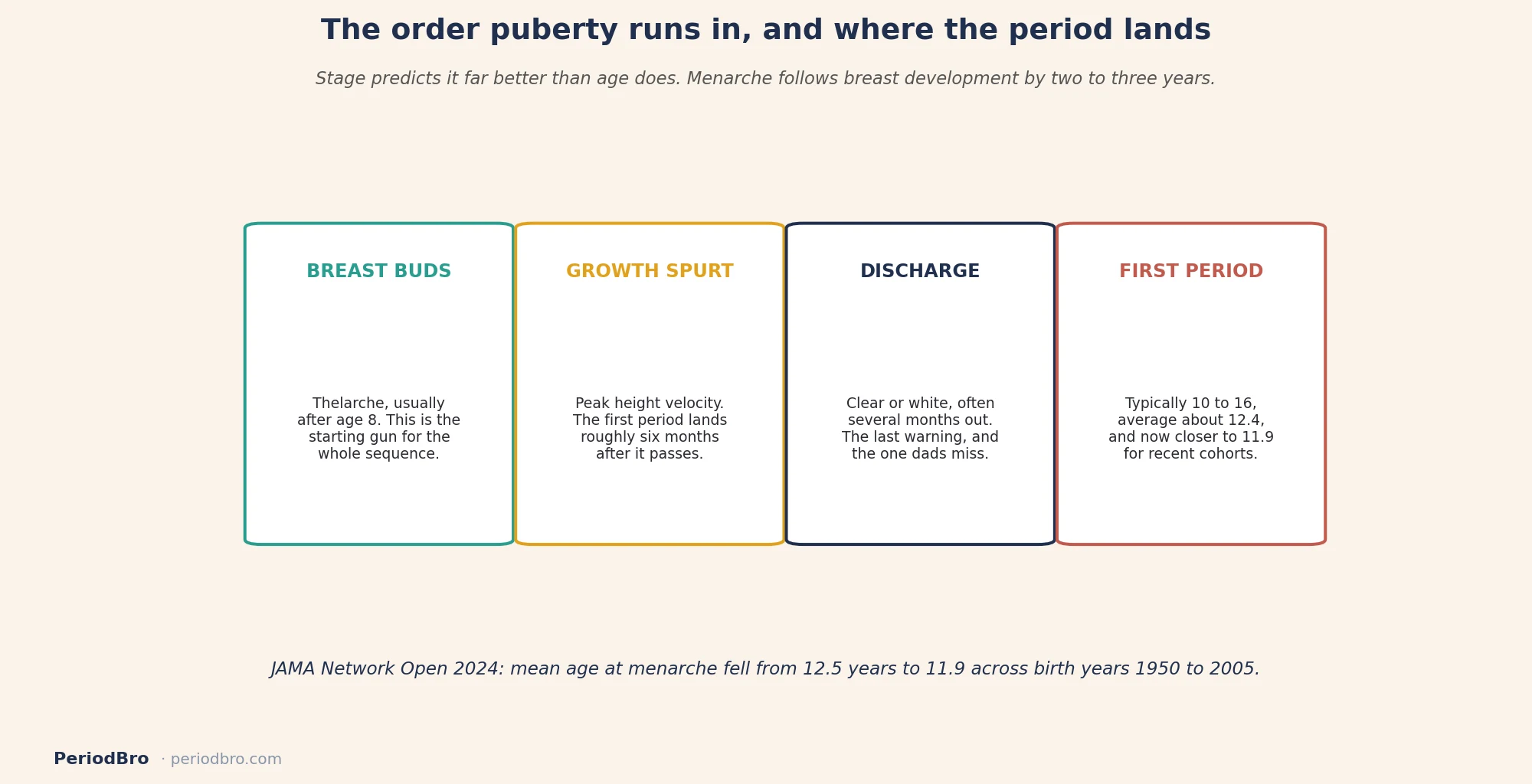
Breast development, thelarche, usually comes first, typically after age 8. StatPearls puts menarche around two to three years after that begins. So if breast development started at nine, a period at eleven or twelve is exactly on schedule, and the average of 12.4 tells you nothing about her.
The growth spurt is the next marker. Menarche lands roughly six months after peak height velocity, which means once she has visibly stopped shooting up, the period is usually close. It also usually falls in Tanner stage IV, which is late in the sequence rather than the start of it.
Clear or white vaginal discharge is the last one before the event, often showing up several months out. It is the signal most dads have never heard of and it is the most immediately actionable, because it means stock the bathroom now. We covered the rest of the tells in five signs her period is about to start, and what to actually buy in what to stock before her first period.
The first two years are supposed to be messy
Here is the part that causes more parental panic than the timing does. Early cycles are often anovulatory, meaning no egg is released, and the result is a schedule that looks broken but is not.
StatPearls describes early cycles running anywhere from under 20 days to over 45, with a mean of 32.2 days in the first gynaecological year. By the third year after menarche, 60% to 80% of cycles have settled into the adult range of 21 to 34 days.
Regularity is also taking longer than it used to. In that same JAMA Network Open study, the share of people reaching cycle regularity within two years dropped from 76.3% in the oldest group to 56.0% in the youngest, and the share who had not reached regularity at all rose from 3.4% to 18.9%.
So a fourteen-year-old whose periods are all over the place two years in is not unusual, and is more common now than in any previous cohort. Our piece on irregular periods in teenagers goes through what that looks like month to month.

When to stop waiting and make a call
Wide normal ranges are not the same as no thresholds. There are a few, and they are specific.
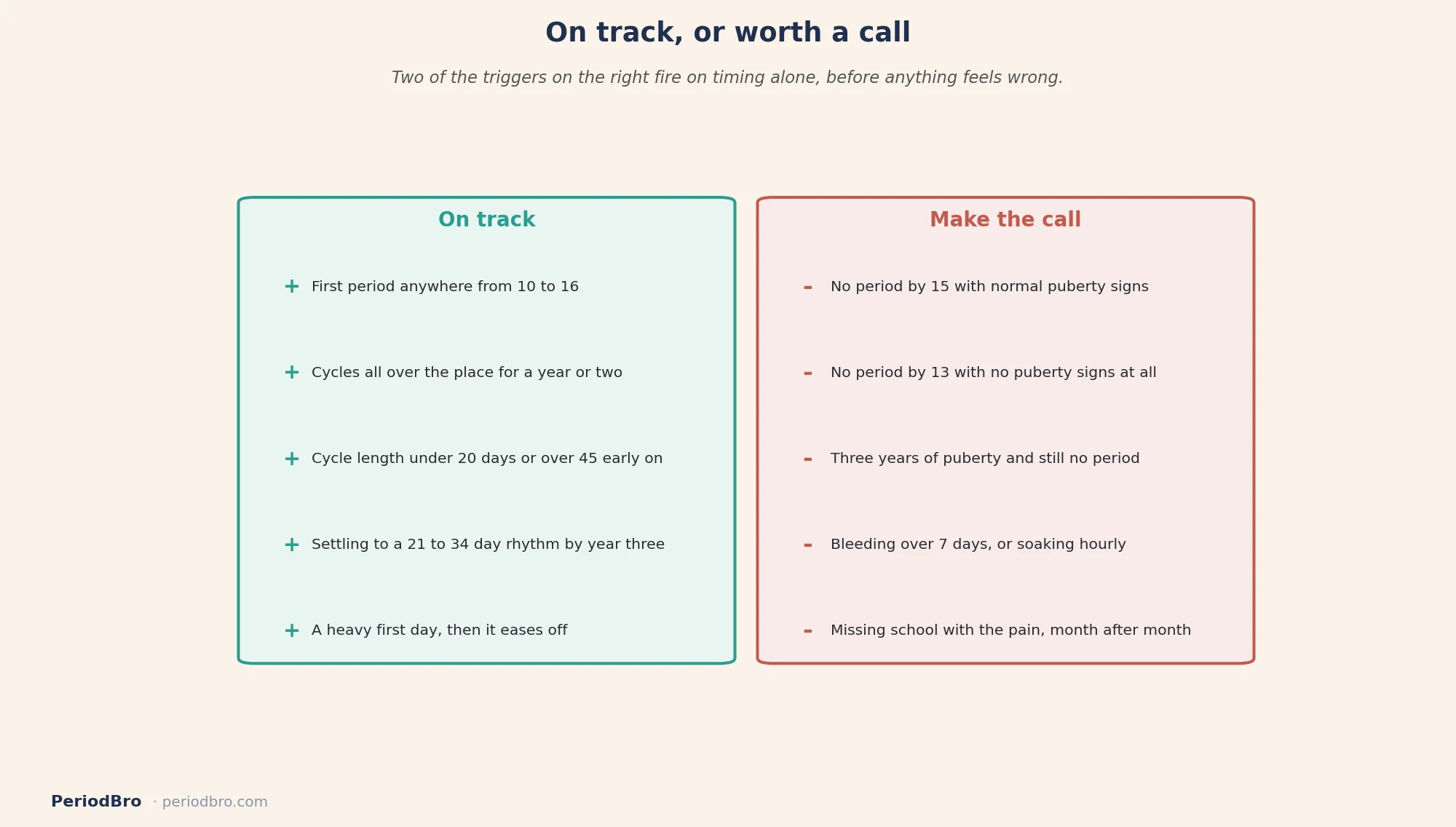
Primary amenorrhoea is the formal term, and StatPearls gives two versions of it. No period by 15 when growth and other puberty signs have been normal. Or no period by 13 when there has been no breast development and no growth spurt either. That second one usually fires first, which is why it is worth knowing.
The one people miss: since periods normally arrive two to three years after breast development starts, three years of visible puberty and no period is a reason to ask, even if she is only 13. You do not have to wait for the calendar to hit 15.
Beyond timing, book if she is bleeding longer than seven days, soaking through protection hourly, missing school with the pain, or has had months of nothing after her cycles had already settled. Our guide on when a girl should see a gynaecologist covers the first appointment in detail, including that ACOG puts the initial visit at 13 to 15 regardless of whether anything is wrong.
What to do with all of this
Nobody needs you to predict a date. The job is just to not be caught out, which is a much lower bar.
Work off the stage, not the age. Breast development plus a growth spurt means a period within a couple of years. Discharge means months. Skip the birthday maths.
Have the conversation before you think you need to. The average is 11.9 and the early band is growing. A ten-year-old who knows what is happening is fine. A twelve-year-old who does not is the outcome nobody wants.
Stock the house early. Pads in the bathroom, a small kit in her bag, a spare in the car. Nothing announced, just present. School and nights away from home both deserve their own version of that.
Start a record when she starts. Dates and days of bleeding, hers to keep or hand over. The first two years of data are what makes a doctor’s appointment worth anything later, and nobody ever wishes they had started logging later.
My own reference point for this was useless. My sister started at 14, so I had 14 filed away as the number. The girl I was actually responsible for started at 11, in a school bathroom, on a Tuesday. Nothing about that was an emergency, and it would have been a lot smoother if the house had been ready two years earlier than I thought it needed to be. Getting ready early costs you a shelf in the bathroom cupboard, and getting it wrong costs her a bad afternoon and costs you a bit of trust you would rather keep. If you want the wider case for dads getting involved in this at all, we made it here.

This article is general information and not medical advice. Puberty timing varies widely and normal ranges are broad, but delayed puberty, very early puberty and heavy or painful periods all have causes worth checking. If anything here does not match what you are seeing, a paediatrician or gynaecologist is the right next step.