When Should a Girl See a Gynecologist? A Dad’s Guide
Pediatricians, dentists, eye exams: somebody tells you when those are due. Then your daughter turns thirteen and you have no idea whether there is supposed to be another appointment on the list. There is, and it lands earlier and far less dramatically than most parents assume.
So when should a girl see a gynecologist? The American College of Obstetricians and Gynecologists puts the first visit between ages 13 and 15, as a normal piece of preventive care rather than a response to a problem.
The short answer, and why that age
Cleveland Clinic states the recommendation plainly: ACOG recommends the first pediatric gynecology visit between the ages of 13 and 15. The point of that window is not screening for anything. It is establishing a relationship with a clinician before there is a problem to solve.
ACOG’s clinical guidance on the initial reproductive health visit frames it the same way: the primary goal is preventive care, education, and guidance, alongside any problem-focused care she actually needs. The visit is an introduction to a clinician she will keep seeing.
That reframing does most of the work for a parent. You are not signing her up for something invasive. You are giving her a doctor she already knows before the day she needs one, which is exactly what you did with her pediatrician a decade earlier without thinking twice about it.

What actually happens at the first visit
Mostly talking, as it happens. ACOG’s patient guidance says the first visit may be just a conversation between her and the doctor, covering what to expect at future visits and how to stay healthy, with room for her questions about her body and growing up.
The exam question is the one every parent quietly worries about, so here is the direct answer. An internal pelvic examination is generally unnecessary at the initial visit. Cleveland Clinic puts it the same way: providers usually will not perform an internal exam at a first visit unless there is a specific reason. What may happen is a general exam, a visual breast check, and an external check, and only if something in her history calls for it.
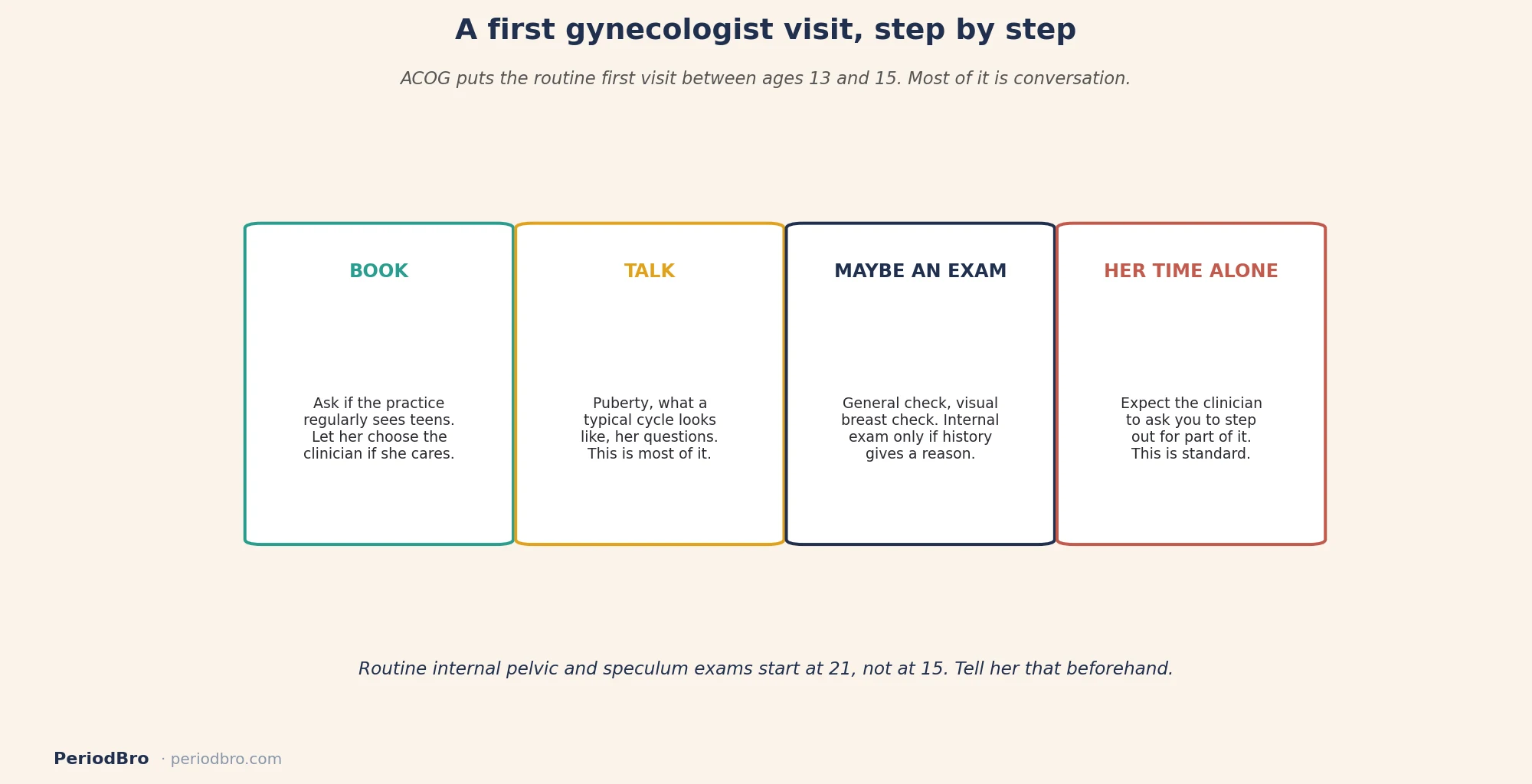
Routine internal pelvic and speculum exams start at age 21, not at fifteen. If she has heard otherwise from a friend at school, that is the fact that will calm her down fastest.
The visit typically covers puberty and what a typical cycle looks like, healthy and risky behaviors, and preventive care including HPV vaccination. The clinician will also ask questions about her health and the family’s. If she has never had to answer a doctor’s questions on her own before, tell her that in advance so it does not catch her off guard.
When should a girl see a gynecologist sooner than fifteen?
The age window is for routine care. Symptoms override it, and some of them override it by a lot.
The clearest one is a period that has not arrived. Clinicians define primary amenorrhea as no period by age 15, or no period within three years of breast development, and either one warrants an evaluation according to StatPearls. Periods usually begin about two to three years after breast development starts, so that second trigger often fires before the age-15 one does. If you have been counting from the wrong milestone, count again from breast development.
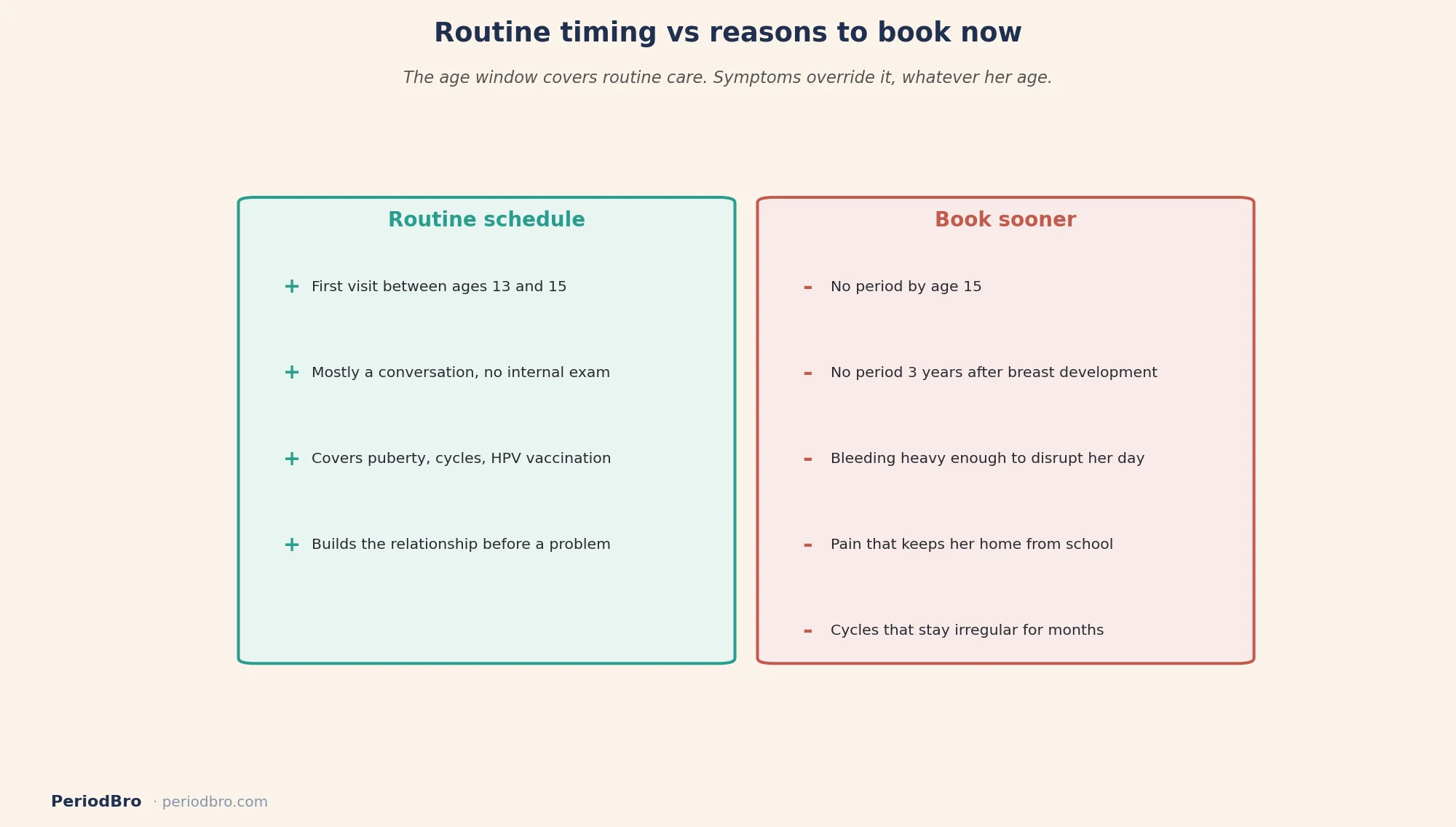
Cleveland Clinic lists the conditions adolescent gynecologists routinely treat, and they double as a reasonable list of reasons to book early: absent periods, heavy menstrual bleeding, painful periods, irregular periods, delayed puberty, ovarian cysts, and pelvic pain.
Two of those deserve extra weight. Heavy bleeding in a teenager is not automatically “just how her periods are,” and pain severe enough to keep her home from school is not something to wait out for another year. Researchers have argued for treating the menstrual cycle as a vital sign in adolescents for exactly this reason. An abnormal pattern carries information the same way an abnormal pulse does. If her cycles are all over the place, we go deeper in our guide to irregular periods in teenagers, and the cramp-specific version is in how to help your daughter with period cramps.

The part where they ask you to step out
At some point in the visit, the clinician will likely want time with her alone. ACOG’s position is that all adolescents should have the opportunity to discuss health issues with a clinician one-on-one, because they may not be comfortable raising them in front of a parent.
That can sting for about four seconds if you are not expecting it. Do not let it. It is not a comment on your relationship, and it is not a signal that she has something to hide. It is standard practice, built on the observation that teenagers ask better questions when a parent is not in the room.
The move is to get ahead of it. Tell her before the appointment that the doctor will probably talk to her alone for part of it, that this is normal, and that you are fine with it. Handing her that in advance turns an awkward moment into a routine one, and it tells her something about how you plan to handle the rest of her adolescence.
How to bring it up without making it a thing
A friend of mine sat on this for a year because he could not figure out an opening line. When he finally said it, he made it sound like a big talk, and his daughter reacted to the framing rather than the content. He tried again a week later in the car, said “you are at the age where there’s a checkup for this, want me to book it,” and she said sure. Same information. Completely different reception.
Treat it as scheduling rather than as a milestone and most of the awkwardness disappears.
Name it as routine. “There’s a checkup girls your age start having” is accurate and unremarkable. Anything that sounds like a speech invites a reaction to the speech.
Say what it is not. Mostly a conversation, usually no internal exam at the first one. That one sentence removes the fear almost everyone brings to this.
Give her a say in the logistics. Whether she wants a woman clinician, whether she wants you in the waiting room or the room itself, whether she would rather her mother or another trusted adult take her. Letting her control the shape of it makes her far more likely to actually go.
Bring the dates. When her last few periods started, how long they lasted, how heavy, any pain that stopped her doing things. Clinicians work from patterns, and memory reconstructs them badly, so if you have been tracking alongside her this is where it pays off.
Then hand it over. Your job is the booking, the ride, and the calm. Hers is the visit. If you have built the groundwork already, covered in how to talk to your daughter about periods and the father’s role in menstrual education, this appointment is just the next ordinary step rather than a leap.
Common questions
Does she need a pelvic exam at the first visit?
Usually not. ACOG’s guidance is that an internal pelvic exam is generally unnecessary at the initial visit and is done only when the medical history indicates a reason. Routine internal exams begin at 21.
Should she see a pediatric gynecologist or a regular ob-gyn?
Either works. Adolescent and pediatric gynecologists specialize in this age group, and plenty of general ob-gyns see teenagers routinely. Ask when you book whether the practice regularly sees adolescents.
What if she has not started her period yet?
The 13 to 15 window still applies, and the visit is still useful. If she has reached 15 with no period, or three years past the start of breast development with no period, that on its own is a reason to be seen.
Can I stay in the room?
Often yes, at least for part of it, but expect the clinician to ask for one-on-one time with her. That is standard and worth supporting rather than negotiating.
What should we bring?
Her period dates and pattern, any symptoms that have disrupted school or sport, family medical history, her vaccination record, and insurance details, ideally written down rather than remembered.
This article is general information, not medical advice. Recommendations vary by country and by individual circumstance, and severe pain, heavy bleeding, or a period that has not started by the ages above should be discussed with a clinician rather than a blog.