
Is My Daughter’s Period Irregular? A Dad’s Guide to What Is Normal
Her first period showed up in March. The next one came seven weeks later. Then two came almost on top of each other. If you have been quietly counting days on your phone and wondering whether something is wrong: for the first few years, uneven is the normal setting, and there are a handful of specific numbers that tell you when it is not.
I did not know any of this when I started paying attention to cycles. I assumed a period was a monthly thing that either happened on schedule or signalled a problem. That is roughly true for a lot of adult cycles and almost completely wrong for a fourteen year old.
What normal actually looks like in the first few years
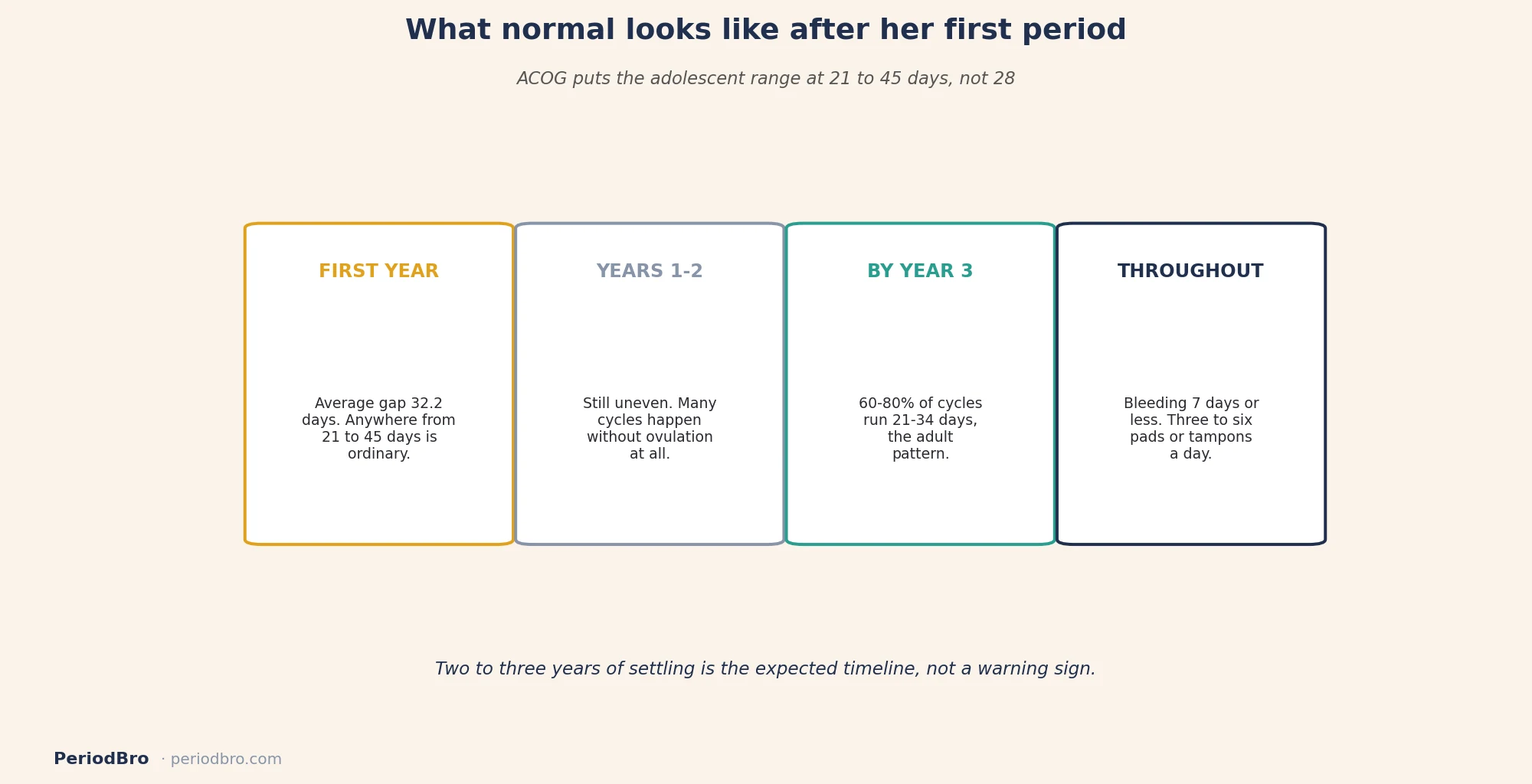
The American College of Obstetricians and Gynecologists puts hard numbers on this in its guidance on using the menstrual cycle as a vital sign, which was reaffirmed in 2025 and is still current. In the first year after her first period, the average gap between cycles is 32.2 days, not 28. The typical range is anywhere from 21 to 45 days. Bleeding lasts 7 days or less, and going through three to six pads or tampons a day is ordinary.
That range is wider than most of us expect. A 24 day cycle and a 44 day cycle can both be completely unremarkable in the same teenager in the same year. ACOG notes that around 90% of cycles fall inside that 21 to 45 day window.
It settles, slowly. By the third year after her first period, 60 to 80% of her cycles run 21 to 34 days, which is the adult pattern. So the honest timeline you can hold in your head is two to three years of genuine unevenness, gradually tightening up.

Why teenage cycles run uneven in the first place
The mechanism is simple once someone explains it. A regular cycle depends on a feedback loop between the brain and the ovaries, and that loop takes years to finish wiring itself. ACOG describes it as immaturity of the hypothalamic-pituitary-ovarian axis, which often results in cycles without ovulation and cycles that run long.
The NIH reference text on the physiology of menarche puts the same thing more plainly: the signal that triggers ovulation matures late, so early cycles are often anovulatory. In girls whose periods start early, about half of cycles in the first year involve ovulation, and nearly all of them do by year five.
So the unevenness is a system still coming online rather than a fault in it. That framing helped me stop treating a late period as evidence of something and start treating it as information, which is exactly what ACOG means when it calls the cycle a vital sign. The point is not that a cycle belongs on a chart next to blood pressure. The point is that you ask about it routinely and you treat a genuinely abnormal pattern as a signal rather than as teenage noise.
When teenage daughter irregular periods need a doctor
This is the part worth saving somewhere. ACOG lists specific patterns that may require evaluation, and they are refreshingly concrete. Book an appointment if her periods:
- have not started within 3 years of her breasts beginning to develop
- have not started by age 15
- come more often than every 21 days, or less often than every 45 days
- are 90 days apart even once
- last longer than 7 days
- soak through more than one pad or tampon every 1 to 2 hours
- are heavy alongside easy bruising, or a family history of a bleeding disorder
The 90 day one deserves its own line. ACOG is explicit that going more than three months between periods is statistically uncommon even in the first year and should be evaluated. It is the single threshold I would not talk myself out of, because “she is a teenager, it is all over the place” is the exact reasoning that gets real problems missed.
Pain has its own line. Cleveland Clinic notes that 5 to 15% of people have period pain severe enough to interfere with daily life, and that pain stopping her from doing normal things is a reason to call, not a reason to hand her another ibuprofen. If she is missing school for it, that is a medical conversation. Our guide to what actually helps period cramps covers the practical side of that.
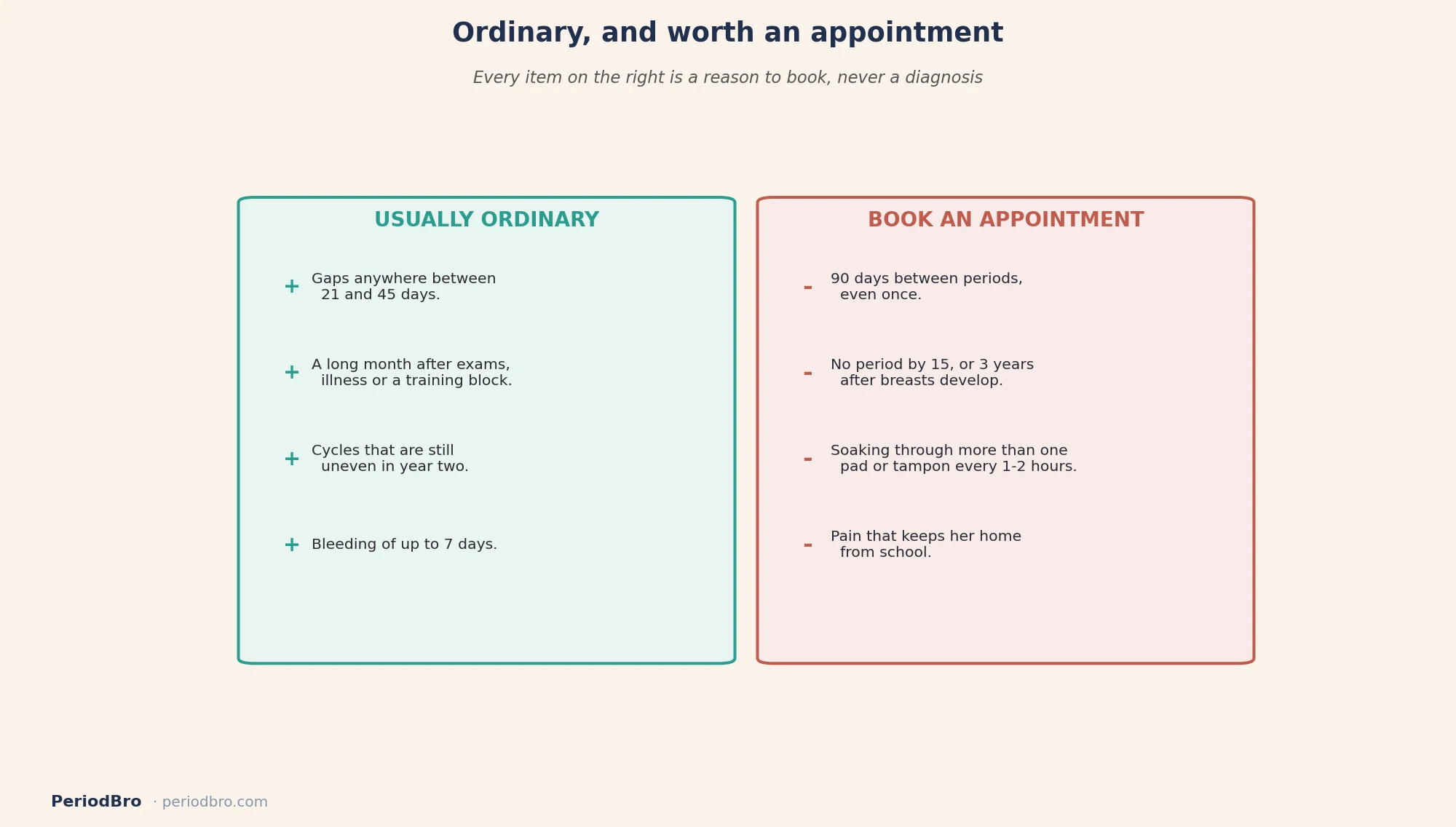
One framing that matters: every item above is a reason to get her seen, not a diagnosis. ACOG titles that list “menstrual abnormalities that may require evaluation.” Your job is booking, not naming.
What is usually behind a stretch of missed or late periods
Most of the time, when a settled-ish teen cycle goes sideways for a few months, the cause is something ordinary happening in her life. ACOG names stress-related hypothalamic dysfunction and significant weight change among the causes of abnormal bleeding in adolescents. Cleveland Clinic lists stress, big weight changes, and intense exercise routines with very low body fat.
Training load is the one dads miss most, especially if she is a serious athlete. A review of menstrual dysfunction in adolescent athletes found reproductive abnormalities reported in anywhere from 6 to 79% of exercising women, driven largely by not eating enough for the training she is doing. Low fuel availability suppresses the hormonal signal that drives the cycle. The practical version: a jump in training volume plus no matching jump in food can stop her periods, and the fix is usually more food rather than less exercise.
Worth saying clearly, though, because it is where this reasoning goes wrong: “she is an athlete” explains a pattern, it does not clear it. The same review is blunt that going more than 90 days without a period should be medically evaluated regardless.

Conditions worth knowing about, without diagnosing anything
Two things are worth having heard of, mostly so you do not panic-google your way somewhere worse at midnight.
PCOS. It affects an estimated 6 to 15% of people of reproductive age, and irregular cycles are part of the picture. But ACOG is unusually direct in its guidance on the hyperandrogenic adolescent: there is no consensus on diagnosing PCOS within two years of a first period, and clinicians are told to be cautious about assigning it early. Most experts want one to two years of watching symptoms before anyone says the word. If a doctor is taking their time here, that is good practice, not foot-dragging.
Bleeding disorders. This is the one I would not have thought of. ACOG’s guidance on von Willebrand disease in women says heavy periods starting right at menarche are often the first sign of it, and that among women with chronic heavy menstrual bleeding, prevalence runs from 5 to 24%. It also contains a sentence aimed straight at the assumption this article started with: if heavy bleeding is put down purely to an immature hormonal axis, an underlying bleeding disorder can be overlooked. Heavy and irregular is a different conversation from just irregular.
How to raise it without making it weird
The information problem here is smaller than the awkwardness problem. A few things that work:
Ask once, plainly, and then stop asking. Something like “I am not keeping tabs, I just want to know if anything has been off, because there are a couple of patterns worth getting checked.” Then let her answer or not.
Make the tracking hers. ACOG’s advice on charting is directed at the patient, with clinicians explaining that a cycle is counted from the first day of one period to the first day of the next. A dad who logs his daughter’s cycle in secret has built surveillance. A daughter who tracks her own and can tell a doctor “about 40 days, mostly” has built something useful. The data is the same either way, and the relationship around it is not. That distinction runs through everything in a father’s role in menstrual education.
Handle the appointment yourself. Book it, drive her, offer to sit in the waiting room rather than the exam room, and tell her in advance that a clinician will ask questions that feel routine to them and personal to her. ACOG notes that pregnancy and infection are excluded as a matter of course even when the history suggests she has not been sexually active. Nobody is accusing her of anything. Knowing that in the car beats finding out in the room.
And keep the supply side boring. A stocked bathroom shelf and a bag in her school backpack take the logistics out of an unpredictable cycle, which is most of what unpredictability actually costs her day to day. We covered that in what to stock before her first period, and the conversational side in how to talk to your daughter about periods.
What to do this month
Nothing dramatic. Know the shape of normal, which is 21 to 45 days and up to three years of settling. Know the seven patterns that mean book an appointment, and treat the 90 day gap and the hourly soaking as the two you never rationalise. Ask her once, without hovering. Keep the shelf stocked.
The reason I built an app around cycles at all is that most of this stuff is knowable and almost nobody hands it to you. Knowing roughly when her period is due means you are not guessing about a mood, a cancelled plan, or a bad week, and if you are a dad reading a red-flag list at 11pm, it means you have a rough record instead of a vague worry when the doctor asks how far apart they have been. If it helps to see the wider picture of what changes and when, start with the signs her period is about to start.
This article is general information, not medical advice, and the thresholds above are reasons to book an appointment rather than diagnoses. If she is soaking through protection every hour and feels dizzy, faint, or breathless, seek urgent medical care. Any concern about her cycle is worth raising with her doctor.