How to Ask Her What She Needs (Without Getting It Wrong)
You stand in the kitchen doorway and say “what do you need?” and she says “nothing,” and you both know that isn’t true. Then you spend the next hour doing small useless things in the next room, feeling like a spare part. I’ve done that more times than I want to admit. The problem isn’t that you don’t care. The problem is that you asked a question she doesn’t have the energy to answer.
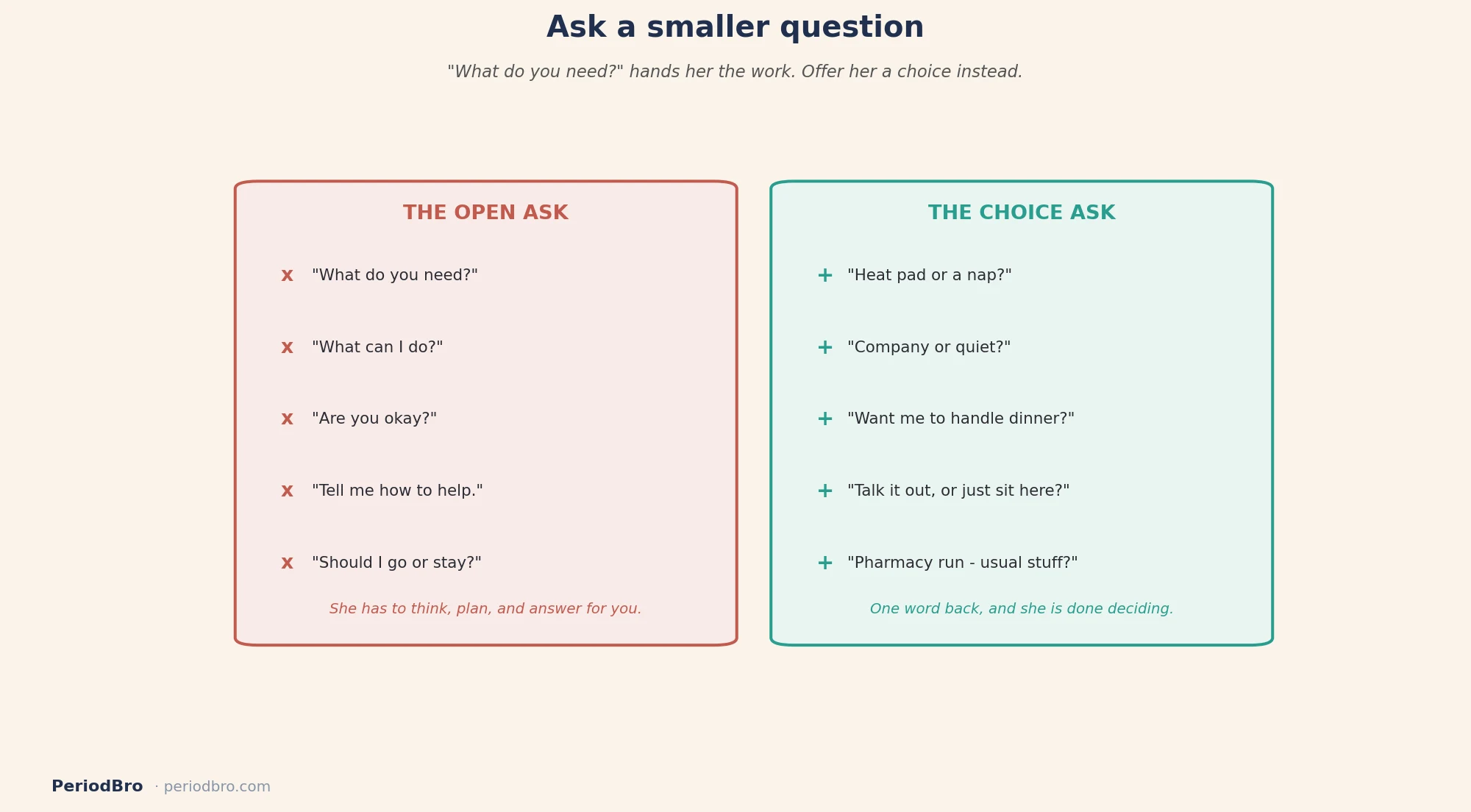
“What do you need?” sounds generous. What it actually does is hand her a job. She now has to audit her own body, imagine what you’re capable of, translate that into a request, and deliver it in a way that doesn’t make you feel bad. She’s got cramps and a brain running at half speed, and you’ve just given her project management.

Ask a smaller question
Swap the open question for a choice. “Heat pad or a nap?” “Company or quiet?” “Want me to handle dinner?” One word back and she’s done deciding. You’ve moved the thinking from her side of the table to yours, which is where it should be, because you’re the one with the working prefrontal cortex today.
This isn’t a trick. It’s the difference between offering help and demanding a specification. A choice question also gives her a graceful exit: “neither, actually” is easy to say, whereas “nothing” in response to “what do you need” usually means “I can’t face explaining.”
What does she need on her period, most of the time
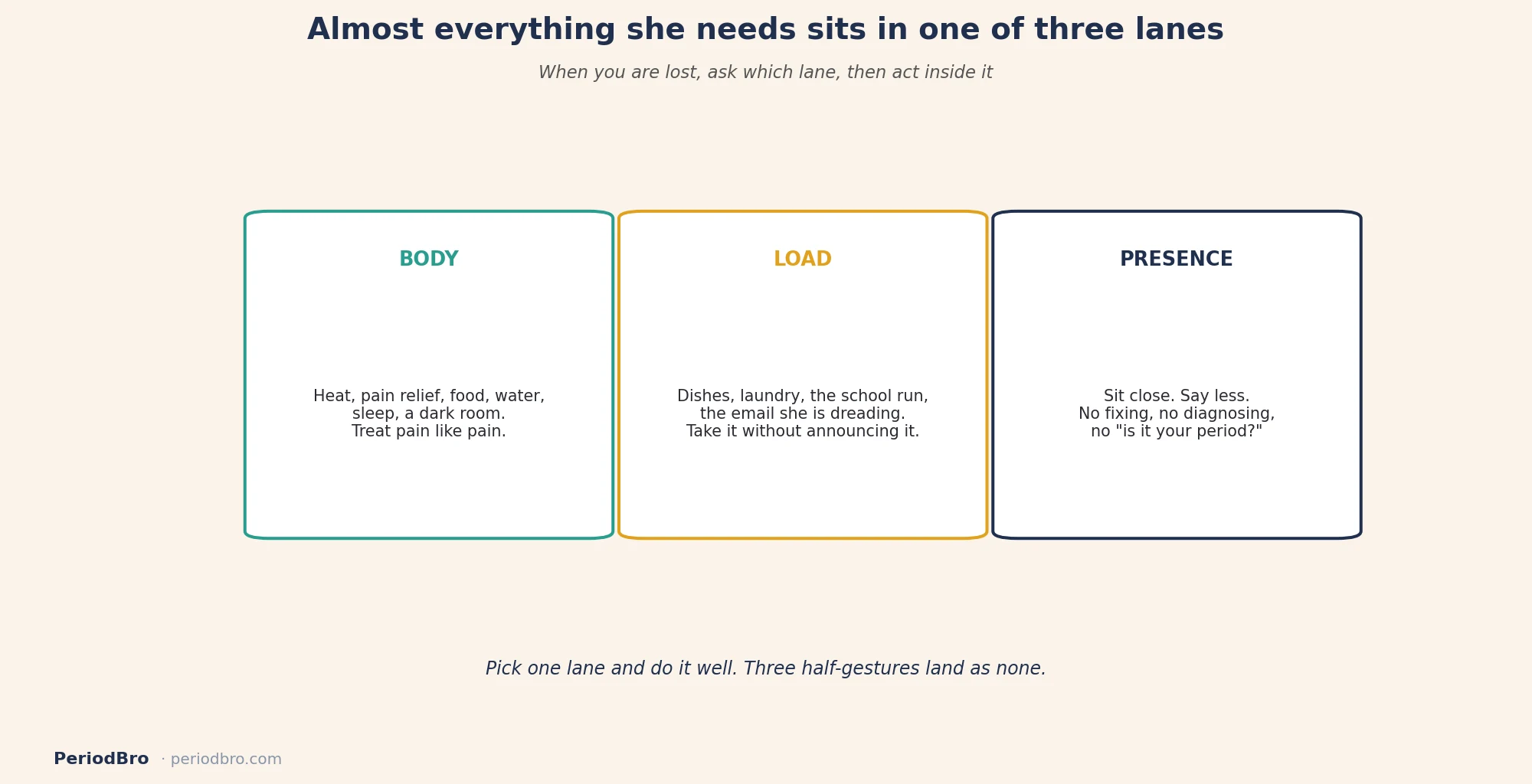
Almost everything sorts into three lanes: her body, her load, and your presence. Once you see them you stop flailing, because you’re no longer choosing between infinite options. You’re choosing between three.
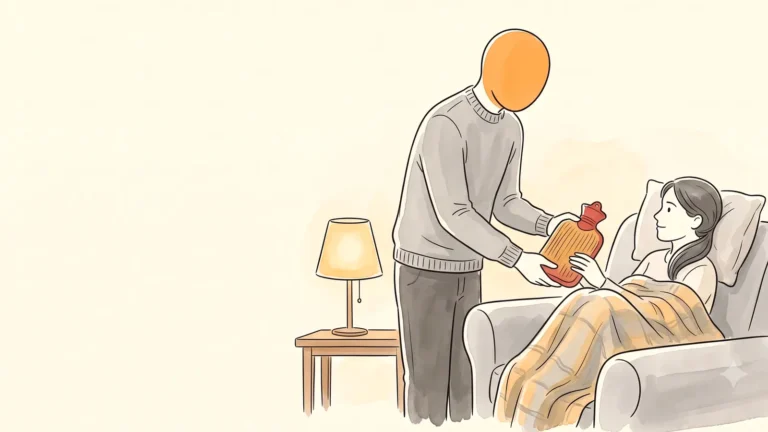
Her body. Cramps are pain, not a mood, and they’re extremely common – dysmenorrhea affects somewhere in the region of 45% to 95% of women of reproductive age, depending on how you count. Treat it like pain. Heat is the highest-value, lowest-effort thing you can hand over: a recent systematic review and meta-analysis of heat therapy for period pain found it performs comparably to anti-inflammatory painkillers, with fewer side effects. A hot water bottle is not a cute gesture. It’s a treatment. NSAIDs remain first-line, and they fail to work for roughly one woman in five, which is worth knowing before you suggest she “just take an ibuprofen” for the third time.
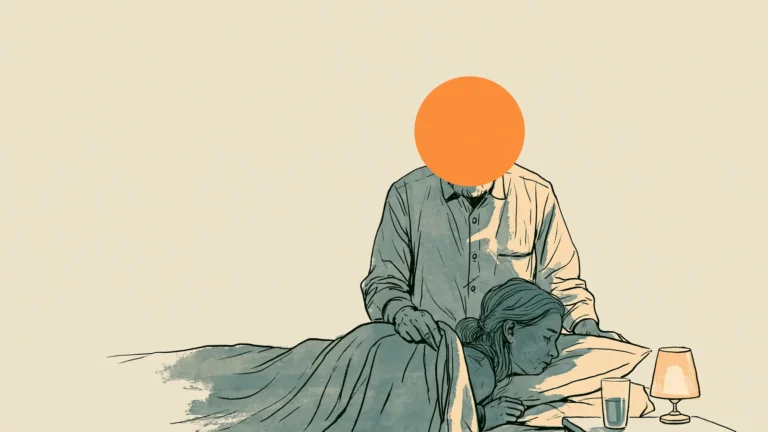
Her load. The dishes, the laundry, the school run, the email she’s been dreading. This is the lane most men underuse because it doesn’t feel like emotional support. It’s the most concrete support there is. Take something off the pile without announcing that you’re taking it.
Your presence. Sit close. Say less. Don’t diagnose, don’t fix, and never, under any circumstances, ask if it’s that time of the month. If you’re not sure what to say, our list of the worst things to say on her period works well as a list of things to not say.
Sometimes the right move is to not ask at all
This part surprised me. There’s a body of research on what psychologists call invisible support – help that arrives without the recipient noticing they were helped. In a set of experiments, Bolger and Amarel found that visible support increased distress in the person receiving it, while invisible support lowered it. The proposed mechanism is uncomfortable and rings true: being visibly helped can carry the message that someone thinks you can’t cope.
Applied here: announcing “I’m doing the dishes for you because you’re on your period” is a worse move than just doing the dishes. The dishes get done either way, but only one version tells her she’s currently a person who needs managing.
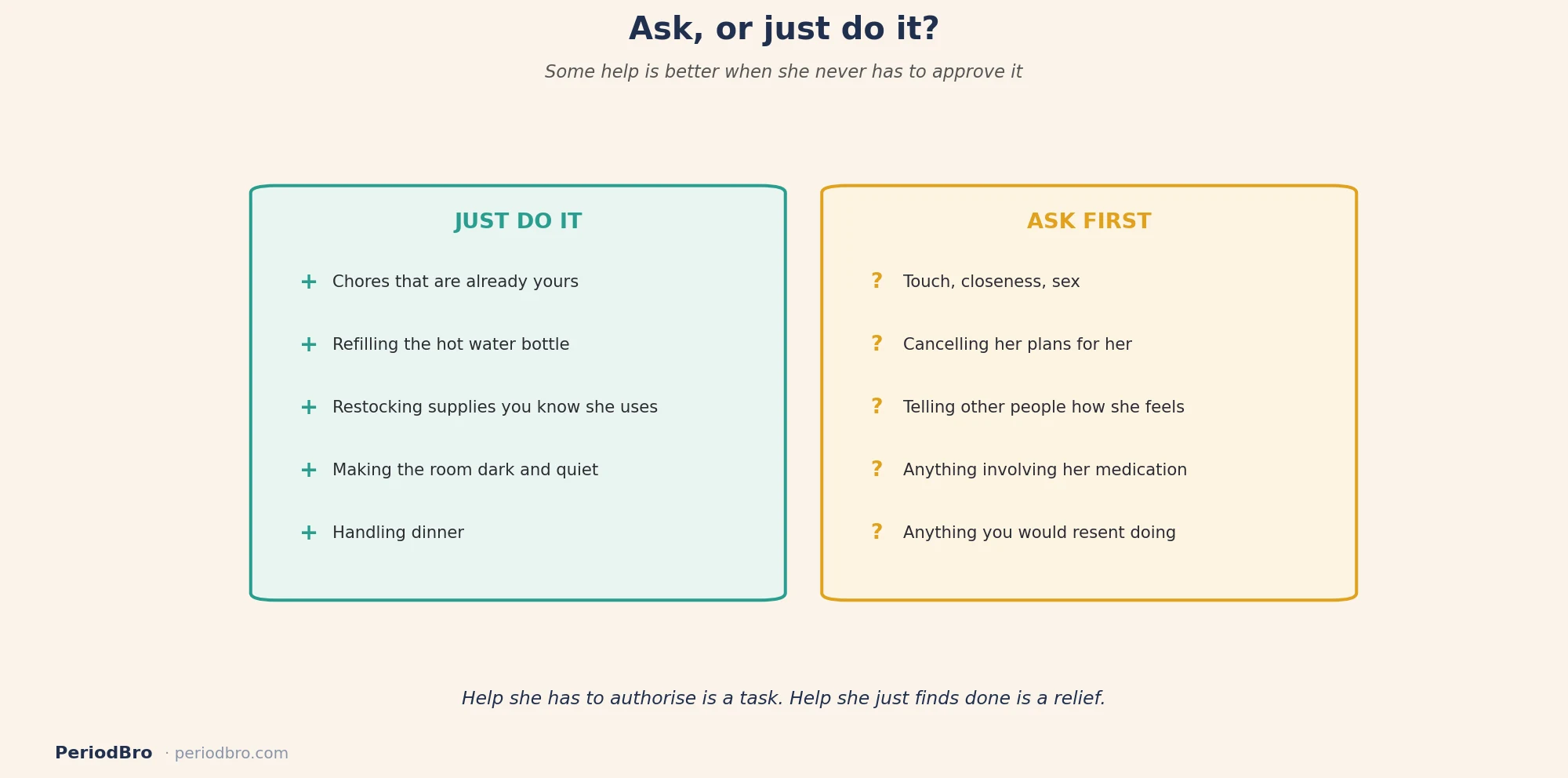
So the rule of thumb splits. Things that are already your job, or that nobody could object to – refilling the hot water bottle, restocking supplies, making the room dark, handling dinner – just do them. Things that involve her body, her autonomy, or other people – touch, closeness, cancelling her plans, telling her mother she’s not coming – always ask. And anything you’d secretly resent doing, ask about first, because a favour delivered with a sigh isn’t a favour.

What she needs changes across the week
Treating “her period” as one undifferentiated blob of five days is where most of us go wrong. It isn’t one thing. Day one and day two are usually the physical bottom: heaviest bleeding, worst cramps, lowest energy. That’s a body lane day. Heat, food she doesn’t have to make, a dark room, no plans, no negotiation about plans.
By day three or four the pain typically eases and something else shows up, which is tiredness. She’s been losing blood and sleeping badly, and it shows. That’s a load lane stretch. She doesn’t need sympathy on day four so much as she needs the week to be slightly lighter than it would otherwise be. Take the thing off the calendar. Do the shop.
Then there’s the run-up, the week before, which for a lot of women is harder than the period itself. That’s when the mood dips and the fuse shortens and you get the arguments that seem to come from nowhere. That’s a presence lane stretch, and the skill is not taking it personally. If that’s the pattern in your house, the hidden cause of your recurring arguments is probably the most useful thing on this site.
You don’t have to memorise any of this. You just have to stop expecting the same answer on day one and day four, and stop being surprised by the week before.
Ask once, on a good day
The best time to find out what she needs on her period is emphatically not while she’s having one. Ask on a Tuesday when she feels fine. “When you’re on your period, what actually helps? What makes it worse?” Write the answer down somewhere. That’s a two-minute conversation that saves you a decade of guessing, and it lands completely differently when nobody’s in pain.
You’ll get specifics you’d never have invented. Some women want the heat pad and the room to themselves. Some want you on the couch not talking. Some want to be asked, every time, because the asking is the point. There’s no universal answer, which is why the advice is to ask her, once, in advance.
Then keep track of when it’s coming, so the day doesn’t ambush you. Not so you can announce it – see above – but so you’re already holding the heat pad when she comes through the door. If you want the wider view of how her needs shift across the whole month rather than just this week, start with how to be a better partner through her cycle. And if you find yourself frozen because you can’t take the pain away, this one is about exactly that.
When “what she needs” is more than you can give
If her symptoms flatten her every single month – if the mood crash is severe, if she talks about not wanting to be here, if she’s losing weeks of her life to this – that’s beyond heat pads and laundry. That may be PMDD or another condition, and it needs a doctor, not a better boyfriend. Our guide to the difference between PMS and PMDD is the place to start. Being a good partner there means helping her get in front of a clinician, not absorbing it silently.
Everything above is general information, not medical advice. For severe pain, cycles that stop, or symptoms that upend her month, she should speak to a healthcare professional.