
How to Stop Apologizing Every Time She Goes Quiet
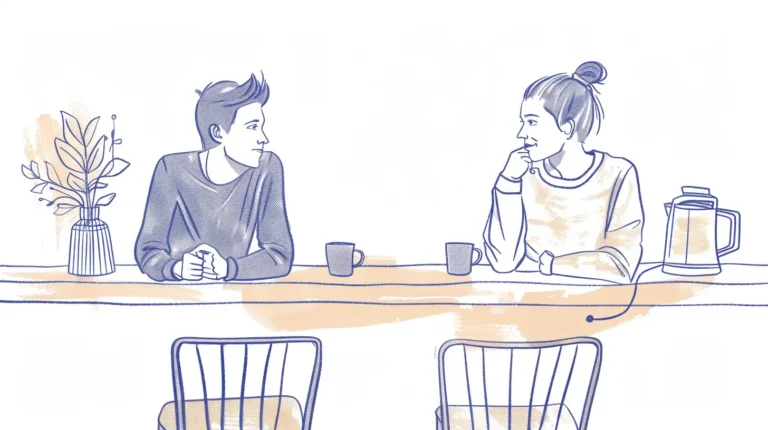
She got quiet around nine, somewhere between dinner and the dishes. Not slammed-door quiet. Just gone behind her eyes. And before I’d even decided to, I heard myself say it: “Sorry – did I do something?” If you want to stop apologizing when she goes quiet, the first thing to understand is what that little “sorry” is actually doing. Because most of the time, it isn’t an apology at all.
It’s a flinch. And it’s usually pointed at the wrong target.
What your reflex “sorry” is really asking for
Here’s the thing I had to admit to myself. When I say “sorry” into her silence, I’m not sorry. I don’t even know what I’d be sorry for. What I’m really doing is asking a question and dressing it up as an apology: Are we okay? Are you mad at me? Tell me we’re fine.
Psychologists have a clinical name for this, and it’s not flattering. It’s called excessive reassurance-seeking – the habit of repeatedly fishing for proof that you’re still valued, no matter how many times you’ve already been reassured. Research on couples has linked it tightly to attachment anxiety, and found that it tends to wear partners down rather than bring them closer (PubMed, 2005). The cruel part is how self-defeating it is: the seeking itself feeds the anxiety it’s trying to quiet, partly by keeping your attention locked on the most negative read of the situation (PubMed, 2019).
So that reflexive “sorry” isn’t kindness. It’s me handing her my anxiety to hold, right at the moment she has the least capacity to hold it.
And it compounds. Apologize for the silence once and it’s a small thing. Do it on a loop – every quiet evening, every short text reply, every time her face goes neutral – and you train both of you to read calm as danger. She learns that her need for a quiet hour will be met with a low-grade interrogation. You learn that her silence is a problem to be solved rather than weather to wait out. Neither of those is the relationship you actually want.
Quiet isn’t a verdict
The story I used to tell myself was simple and wrong: she’s quiet, so I’ve done something. Silence felt like a sentence being handed down, and I was the defendant.
But quiet has a hundred causes, and almost none of them are a courtroom. She might be tired. She might be replaying a conversation from work that has nothing to do with you. She might be in physical discomfort she hasn’t mentioned. And there’s a stretch of most months where going inward is just biology doing its thing.
In the luteal phase – the week or so before her period – progesterone climbs, and it can act like a natural sedative, leaving her sleepy, sluggish, and lower on fuel than usual (Cleveland Clinic). Her body is also burning meaningfully more energy at rest in that window, which on its own can leave anyone feeling drained and less social (Cleveland Clinic). Social withdrawal in the days before a period is common enough that ACOG lists it as a recognized premenstrual symptom, sitting right alongside irritability and fatigue (ACOG).
None of that is a message about you. If you want the full week-by-week map of how her energy and mood shift across the month, I wrote one here: how hormones drive her mood all month long. Once you can see the rhythm, her quiet stops looking like a slammed door and starts looking like a tide going out. It comes back. It always comes back.

Why the apology actually makes it worse
This is the part that stung to learn. My “sorry, did I do something” wasn’t neutral. It was making the exact thing I feared more likely.
Couples researchers describe a loop called the pursue-withdraw pattern. One partner feels the distance and moves toward it, asking, prodding, seeking connection and reassurance. The other partner, already low on bandwidth, feels that pursuit as pressure and pulls back further. The more one chases, the more the other retreats – and round it goes. It’s one of the most studied and most corrosive dynamics in relationship science, strongly tied to long-term dissatisfaction when it becomes the default (PubMed, 2005).
When she’s quiet and I fill the air with “are we okay,” I’m not bridging the gap. I’m pursuing. I’m asking her to stop whatever she’s processing, manage my worry, and reassure me – and I’m doing it precisely when she has the least to give. It’s not that I’m a bad guy for wanting reassurance. It’s that I’m reaching for it from the one person who can’t comfortably hand it over in that moment. This isn’t her against me. It’s both of us against the gap of not understanding what the silence means.
I once kept that loop running for a whole evening. Every twenty minutes I’d circle back with some version of “you sure you’re okay?” By the fifth round she finally said, tired, “I was fine. I’m less fine now because you keep asking.” That landed. I wasn’t soothing anything. I was poking a quiet person until she had something real to be upset about.
What to do with the silence instead
The move that changed this for me was almost insultingly simple: do less, stay close. Presence without pursuit. Here’s what that looks like in practice.
Don’t narrate her mood back to her. “You seem off” and “did I do something” both demand that she now perform an explanation. Skip it.
Offer one low-stakes line and then actually let it sit. Something like, “I’m around if you want company, no rush.” That does the opposite of the apology – it hands her space instead of taking it. Then you go do something. Load the dishwasher, walk the dog, read. Be reachable, not hovering. There’s a real skill to giving room without making the room feel like punishment, and I broke it down here: how to give her space without making things worse.
Do one small, wordless thing that says I’ve got us without demanding a response. Refill her water. Put the kettle on. Take the chore she was about to do off her plate. The point isn’t to earn a gold star – it’s to let your care show up as an action she can ignore, rather than a question she has to answer. Quiet support beats a spoken “are you okay” almost every time, because it asks nothing back.
Watch your own body while you do it. The urge to break the silence usually lives as a physical restlessness – a tightness in the chest, a phone you keep flipping over. Name it to yourself: that’s my reflex, not an emergency. Putting words on it, even silently, takes a surprising amount of the charge out.
And when your brain starts insisting the silence must be about you, treat that thought as a symptom of your own anxiety, not as data. Most of the time, her stepping back has nothing to do with you – and learning to stop reading it as a personal verdict is its own piece of work: how to stop taking it personally when she pulls away.

Stop apologizing when she goes quiet – say this instead
If you take one thing from this, make it a swap. Catch the “sorry, did I do something?” before it leaves your mouth, and trade it for this:
“I’m here when you want me. No rush.”
Say it once. Mean it. Then prove it by being calm and available instead of anxious and orbiting. That single sentence does three jobs at once: it tells her she’s not alone, it asks nothing of her, and it quietly tells your own nervous system that the relationship is not on fire just because the room went quiet.
You’ll feel the pull to check in again. That pull is the reassurance reflex, and the whole point is to not feed it. Sit with the discomfort for ten minutes. It passes. And when she comes back – because she comes back – she’s coming back to a partner who can hold steady when she needs to go inward, not one who needs managing.
The deeper fix is knowing why the quiet showed up in the first place, so you’re not guessing in the dark. When you can see that she’s in the low-energy stretch of her cycle, “she’s quiet” stops being a threat and becomes information you can actually work with. That’s the whole idea behind PeriodBro – it turns where she is in her cycle into a quiet daily heads-up, so the silence reads as a phase, not a verdict. You stop apologizing for the weather and start dressing for it.
She goes quiet. You stay. That’s the entire skill.