Why She Craves Chocolate Before Her Period: The Science
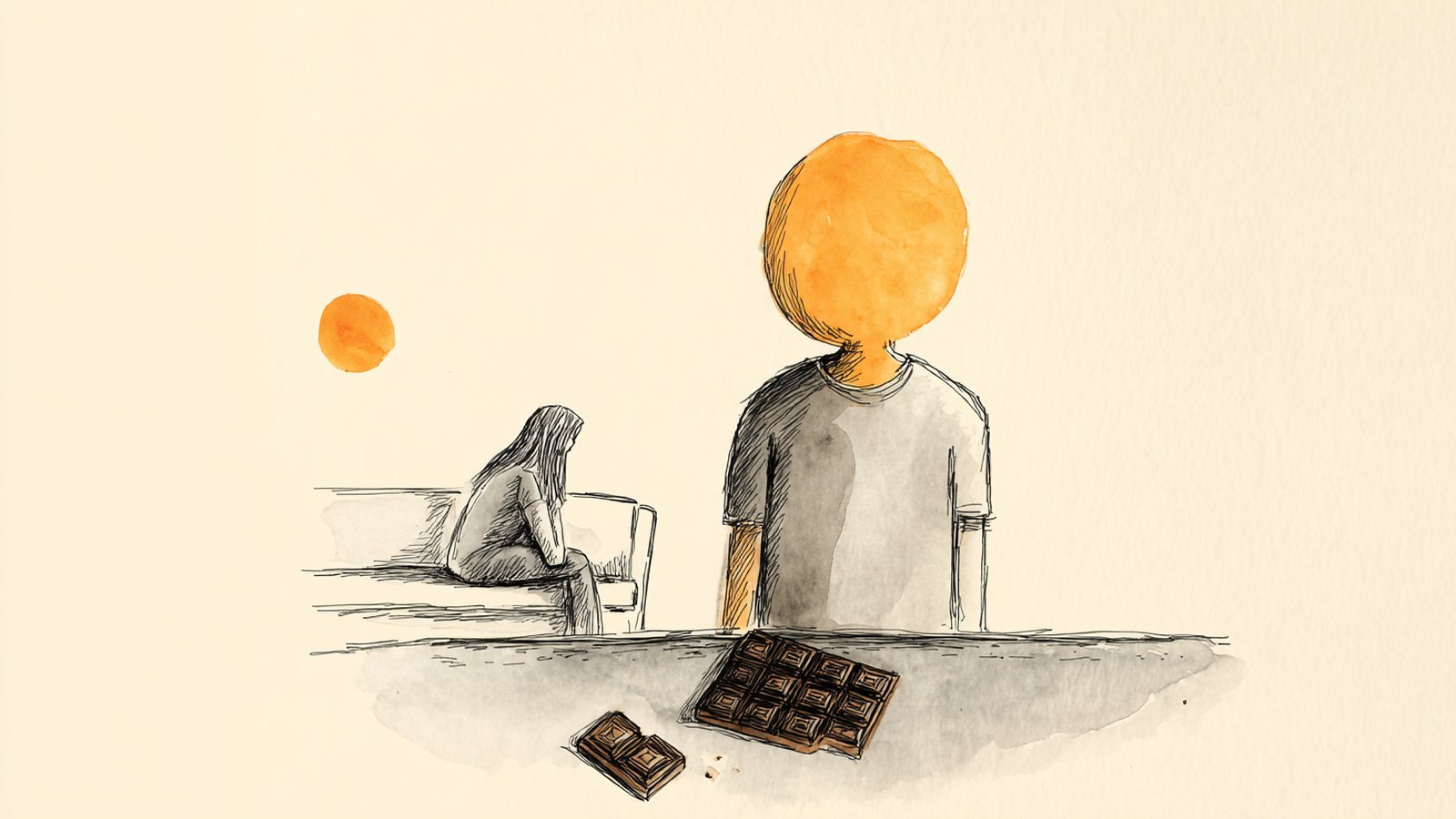
A few years ago, I came home from a long day and noticed the chocolate bar on the counter was almost gone. Suspiciously gone. I’d bought it on Sunday. It was Wednesday.
I made the mistake of saying something. I don’t even remember what — something dim like “wow, you really got into that,” in the same tone you’d use about a kid finishing a tub of ice cream. She looked up at me from the couch in that specific way that means please reconsider your entire approach to this conversation, and I, of course, did not. I doubled down. I asked if everything was okay.
She said yes. The way you say yes to a question you’d really rather not have been asked.
It took me longer than it should have to figure out that the chocolate wasn’t a willpower problem. It wasn’t even really about the chocolate. It was a body in the late luteal phase doing exactly what bodies in the late luteal phase do, and a partner standing in the kitchen with no idea what week it was on the calendar of someone he loved.
This is the article I needed back then.
The 4 ingredients of the craving
Premenstrual chocolate cravings aren’t a stereotype, but they’re not universal either. Surveys done in the US and Western Europe consistently put chocolate at the top of “what do you crave?” lists in the week before a period starts — what we call the late luteal phase. The pattern is much weaker in other parts of the world. But the underlying premenstrual hunger and reward-seeking shift shows up everywhere. People reach for different foods, but for the same biological reasons.
What’s harder to talk about is why. The honest answer is: it’s not one thing. It’s at least four things stacking on top of each other.
1. The magnesium dip
Some research has found that women have lower magnesium levels in the luteal phase compared to the follicular phase — the second half of the cycle compared to the first. Magnesium is involved in muscle relaxation, nerve signaling, and mood regulation. When it dips, the body asks for it back.
And dark chocolate happens to be one of the most magnesium-dense everyday foods available — roughly 65 mg of magnesium per ounce of 70%+ dark chocolate, which is about 20% of the recommended daily intake for women (and around 15% for men).
Whether the magnesium dip causes the craving or just correlates with it is still debated in the literature. But the body is generally pretty good at sending hunger signals that match nutritional gaps. Chocolate cravings during the late luteal phase look a lot like the body asking for magnesium and getting it the most efficient way it knows.
2. The serotonin dip
In the days before a period, estrogen and progesterone both fall sharply. Serotonin — the neurotransmitter most associated with mood stability — tends to fall with them. Lower serotonin means lower mood, more irritability, and stronger cravings for foods that temporarily boost serotonin.
The foods that do that fastest? Carbs and sugar. Chocolate is both. Eating chocolate triggers a small, fast serotonin bump. The body learns this. The next time mood drops in the late luteal phase, the body remembers what worked, and reaches for it.
As Cleveland Clinic’s Dr. Lynn Pattimakiel puts it: “Cravings around your period are real — they’re a physiological response to hormonal changes, not something you’re imagining.” You can stop debating whether it’s “in her head.” It isn’t.
3. Dopamine reward-seeking
Dopamine is the “wanting” chemical, not the “happy” chemical. It’s what makes you feel like I need that thing right now. When estrogen falls in the late luteal phase, the dopamine system gets less of its usual support, and reward-seeking behavior tends to spike. The brain starts looking for things that reliably feel good — comfort food, alcohol, scrolling, sometimes shopping. For many people, chocolate is at the top of that list, because it has a long history of feeling good and rarely lets you down.
4. Blood sugar volatility
The late luteal phase is also when insulin sensitivity drops slightly. Blood sugar swings get more pronounced. You’re a little hungrier, a little crashier between meals, a little more drawn to fast carbs. A chocolate bar at 4 PM is a near-perfect blood-sugar lift — which is part of why chocolate cravings show up at that exact hour on those days specifically, not at breakfast.
Each of these alone could explain a craving. All four stacked explains this craving — the specific, late-luteal, I will fight you for that chocolate craving.
Why specifically chocolate
So why chocolate? Why not crackers, or fruit, or a chicken sandwich?
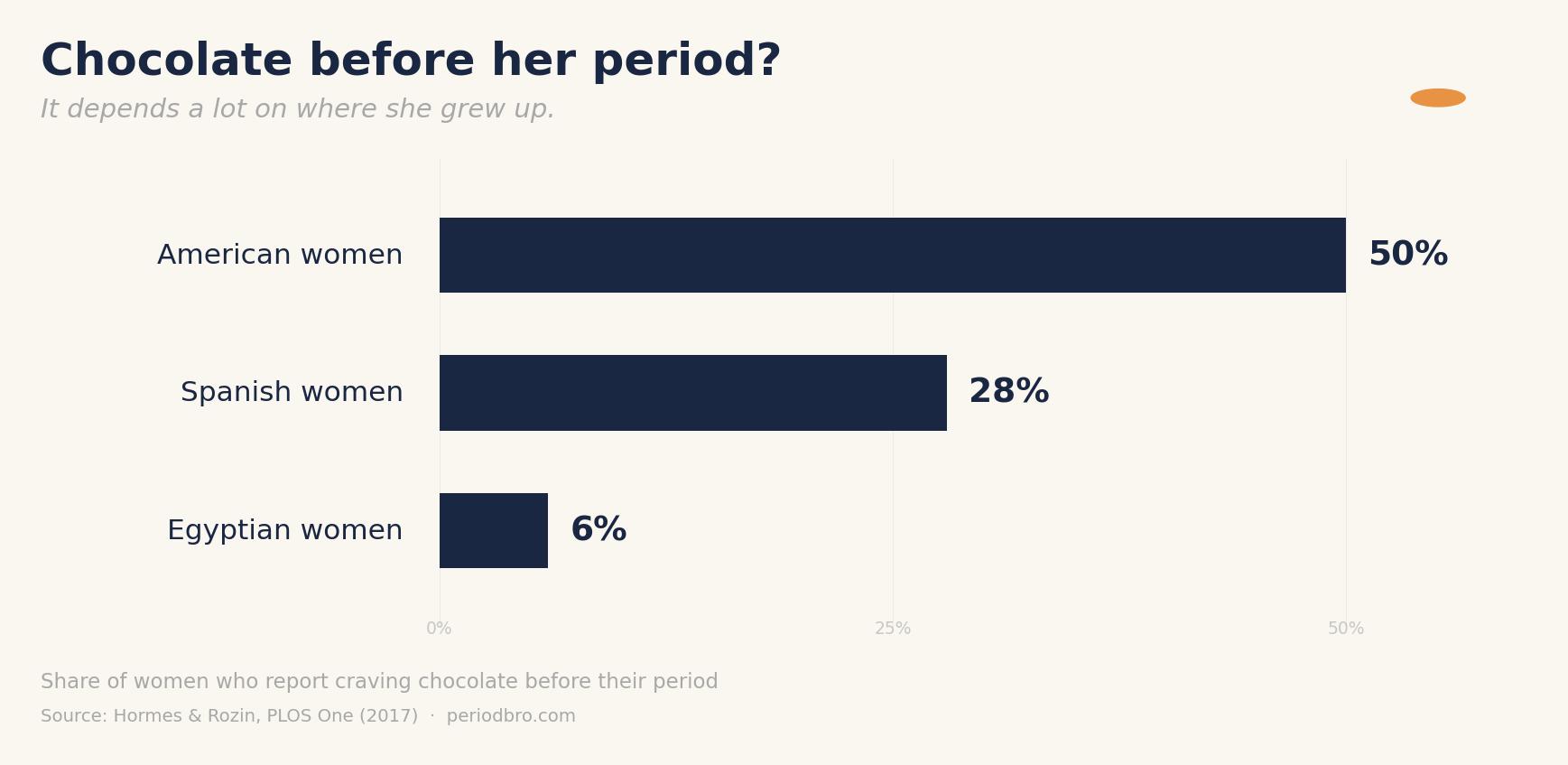
Here’s the part most articles get wrong. The premenstrual craving — the underlying biological pull for something that feels good, lifts mood, releases tension — is real and shows up everywhere. The pick of chocolate specifically as the answer is mostly cultural. American women report craving chocolate before their period at roughly 8x the rate of Egyptian women. That’s not a difference in biology. That’s a difference in what each culture teaches its girls is the legitimate, socially-accepted comfort food.
That said, chocolate is genuinely well-engineered for the job, once a culture lands on it.
Dark chocolate contains theobromine, a mild stimulant chemically related to caffeine, which gently lifts alertness and mood without the sharp jitters or crash of pure sugar. It has magnesium, as mentioned. It has fast carbs and fat together, one of the most reward-dense combinations the human brain knows. And the cultural conditioning runs deep — chocolate is associated with comfort, gifts, love, and self-soothing from childhood onward for most people who grew up in Western cultures.
So in a Western context, when the body asks for something that feels good, lifts mood, releases tension, replaces what’s missing, and is socially acceptable as self-care — chocolate is the most efficient available answer. In a Japanese or Egyptian context, the answer often looks different — savory snacks, rice dishes, fruit. Same underlying biology. Different cultural script.
This is why the standard advice (“just have a piece of fruit instead”) tends to fall flat in the US. Fruit covers maybe one of those needs. And the script the culture taught her doesn’t say fruit, it says chocolate.
What this means for you, the partner
Here’s the part most articles skip: what do you actually do with this information, if you’re the partner standing in the kitchen?
1. Don’t comment on it.
Seriously, don’t. If she’s eating chocolate in the luteal phase, that’s her body sorting itself out. Any version of “again?” or “wow you finished it” or “you sure?” — even meant gently — lands as commentary on her body or her self-control. It is not your moment to be a nutritional consultant. The most loving thing you can do is say nothing about the chocolate.
I have, more than once, made the mistake of thinking I was being playful, light, harmless. I wasn’t. Nobody hears “wow, you really got into that” as light when their body has been pulling them toward sugar for three days running and they already feel slightly out of control of their own appetite. They hear it as one more person watching.
2. Stock the right things proactively, not reactively.
The point isn’t to fix her cravings. The point is to make the house a place where her body has options that aren’t a sugar-crash spiral. Dark chocolate is genuinely great. So are pumpkin seeds, almonds, cashews, spinach, dark leafy greens, beans, and bananas — all good magnesium sources, all fine snacks.
The move is to make these available before the craving phase hits, not to suggest them during it. By the time she’s reaching for chocolate at 4 PM on a Wednesday, it is way too late for you to say “you know what’s also high in magnesium…”
One specific upgrade worth a small amount of effort: better defaults beat more defaults. A small bar of single-origin 70%+ dark chocolate satisfies in two squares where a cheap milk-chocolate bar demands twelve. Same household, same craving moment, much smaller crash on the back end. The goal isn’t a smaller portion through willpower — it’s a smaller portion through better engineering of what’s in the cupboard.
3. Time the conversation right.
The week before her period is not when to bring up nutrition, supplements, or “have you tried magnesium?” That conversation lands very differently three days after her period ends, when mood and energy are climbing back up. Same words, same intent, completely different reception. This applies to almost every conversation about her cycle — the timing matters more than the content does.
The shorter version of all three: become the kind of partner whose house is set up so her body has good options available, and whose mouth is set up to stay closed about which option she picks on which day.

What science is still unsure about
A few caveats, because this stuff is genuinely contested.
Not every study finds a clean magnesium drop in the luteal phase. Some find no change. Sample sizes vary, and “luteal phase” is a window, not a single day — the timing of blood draws matters a lot. The dopamine and serotonin shifts across the cycle are well-documented in animal models and brain-imaging studies, but the magnitudes in everyday human experience are still being mapped.
The biggest caveat is the cultural one. A 2017 study by Hormes & Rozin in PLOS One found that menstrual chocolate craving is reported by roughly 50% of US-born women, 28% of Spanish women, and just 6% of Egyptian women — and that immigrants to the US develop the pattern as they acculturate across generations. That’s a strong signal that “chocolate specifically” is more cultural than biological. The premenstrual hunger and reward-seeking shifts (sections above) are real and physiological. The choice of chocolate as the answer is mostly learned.
The biology is real. The cultural overlay is real. The story we tell about the biology is still being written. Anyone who tells you they know exactly why she wants chocolate on a Wednesday afternoon is selling you something — what she actually wants will depend partly on her body and partly on whoever fed her the script for “this is what helps when I feel this way.”
When the craving signals something bigger
One important caveat, because it matters more than it sounds.
For most people, late-luteal cravings are uncomfortable but manageable — annoying, maybe a little disruptive, but ordinary. For a smaller group — somewhere between 3% and 8% of menstruating people — they cross into something more intense.
Premenstrual Dysphoric Disorder (PMDD) is a more severe form of premenstrual symptoms recognised by ACOG and the DSM-5. One of its features is that late-luteal cravings can become much harder to control, with binge-and-crash cycles that mess with sleep, mood, and how she feels about herself. Recent research has documented that late-luteal food craving is significantly amplified in people with PMDD compared to those with typical PMS.
If her premenstrual experience consistently includes intense, hard-to-control cravings tied to mood crashes severe enough to affect work, sleep, or self-image — that’s worth a real conversation with a clinician. Not something for you to diagnose, and definitely not something to bring up during the late-luteal week. Just something to know exists, so you don’t dismiss what might be a bigger signal as “just PMS.”
The thing under the thing
If you take one thing from this: the chocolate isn’t the point. The point is that her body, every month, goes through a phase where mood, energy, and reward circuitry all shift at once — and if she grew up in a Western culture, chocolate is what she’s been taught to reach for in that moment. Real biology, learned answer.
Knowing that doesn’t change her cycle. But it does change you. It changes what you say when you walk into the kitchen and see what you see. It changes how stocked the cupboard is. It changes the timing of the conversations you bring up and the ones you don’t.
Years later, I bought chocolate for the house every two weeks, kept a small bag of almonds in the pantry, and never said a word about the wrappers. It was, by a wide margin, the easiest thing I ever learned to do, and I wish I’d figured it out about five years earlier.
Related reading
- Pillar: menstrual cycle phases explained for men — the full map of what’s happening week by week
- What’s happening in the luteal phase — the specific phase where these cravings live
- How hormones drive mood and energy — the broader pattern behind the chocolate moment
- How to support girlfriend on her period — the cross-cluster bridge: what to do with all this knowledge in practice
- Best foods to keep at home before her period — the practical companion to this article
Studies cited
- Hormes JM, Rozin P. Does culture create craving? Evidence from the case of menstrual chocolate craving. PLOS One, 2017. Read the study
- Trout KK et al. Changes in insulin sensitivity across the menstrual cycle. Diabetes-related and broader cycle literature. See PubMed summary
- Facchinetti F et al. Magnesium and zinc status during the menstrual cycle. American Journal of Obstetrics & Gynecology / PubMed
- USDA FoodData Central — dark chocolate (70-85% cocoa), magnesium per ounce