
PMS vs Pregnancy Symptoms: How to Tell in the Week Before Her Period
A friend of mine spent most of one October convinced he was about to become a father. His wife was exhausted, her breasts were sore, she cried at a dog food commercial, and she turned down coffee two mornings in a row. He’d already started reading about car seats. Four days later her period arrived right on schedule, and she laughed at him for a week. Every one of those signs was real, and every one of them was PMS.
If you’re trying to read her body in the days before her period, you’ve probably hit the same wall. PMS vs pregnancy symptoms is one of the most searched questions in this whole area, and the short answer is frustrating, because for about a week the two look almost the same. Below is why that happens, the few signs that lean one way or the other, and when a test gives you a real answer.
Why PMS and early pregnancy feel so alike
After ovulation, the empty follicle in her ovary turns into a small gland called the corpus luteum, and it pumps out progesterone. That hormone is behind a lot of what she feels in the second half of her cycle: tender breasts, bloating, tiredness, slower digestion, and mood shifts. If you want the mechanics, our luteal phase guide walks through it.
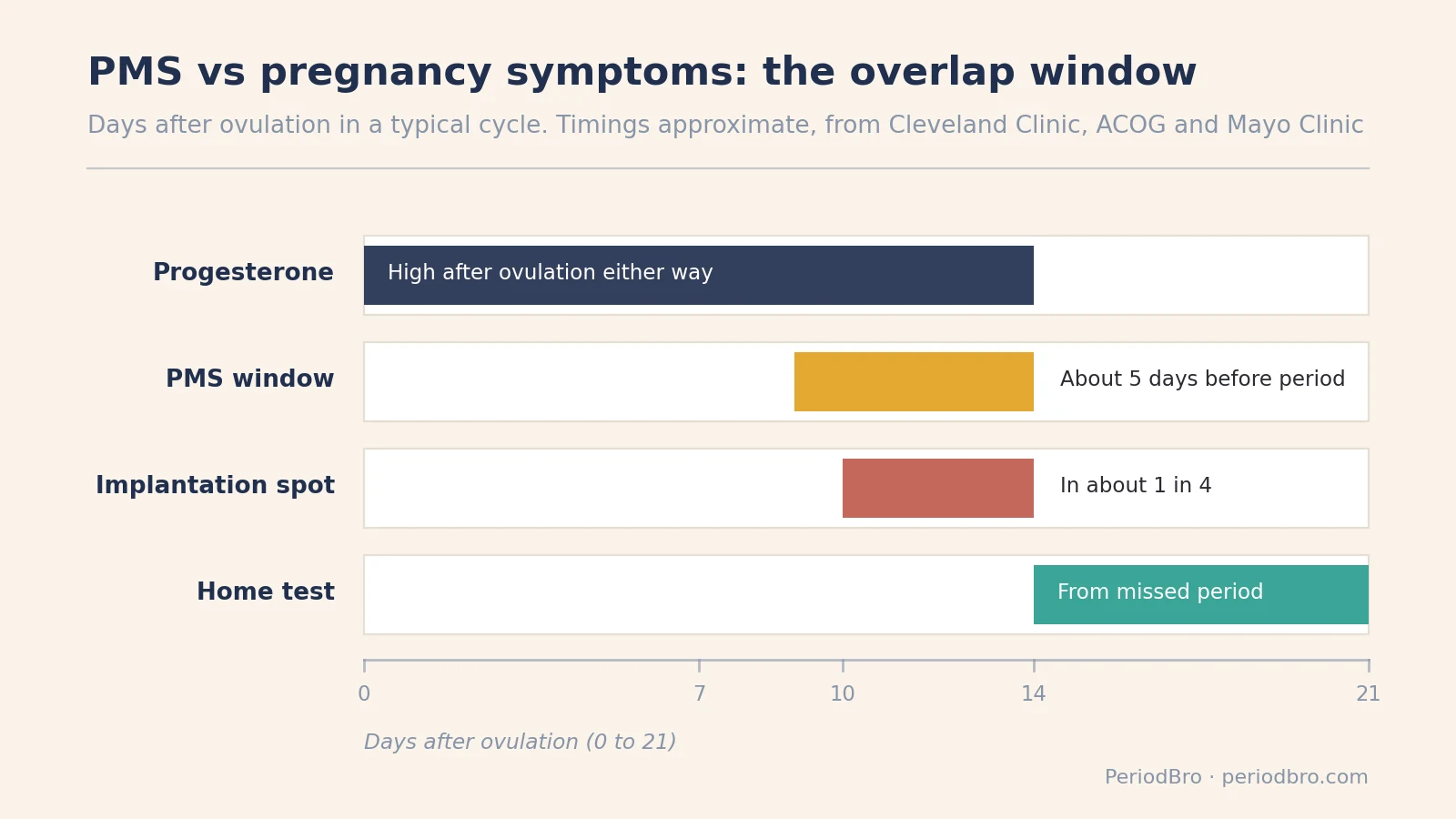
If no egg implants, progesterone drops and her period starts. If an egg does implant, the embryo starts making hCG, which tells the corpus luteum to keep going. Progesterone stays high. So in the days before a missed period, both roads run on the same hormone, and her body gives off the same signals. Clearblue, which makes pregnancy tests and has every reason to get this right, lists fatigue, breast tenderness, mood swings, bloating and mild cramping as the overlapping set (Clearblue).
ACOG defines PMS as symptoms that show up in the five days before a period, month after month, for at least three cycles in a row (ACOG). That timing helps, because PMS follows a pattern. If you’ve been paying attention to her cycle for a few months, you already know roughly what her pre-period week looks like.
PMS vs pregnancy symptoms, sign by sign
No single symptom settles it. A few lean one way, and together they give you a better guess than any one of them alone.
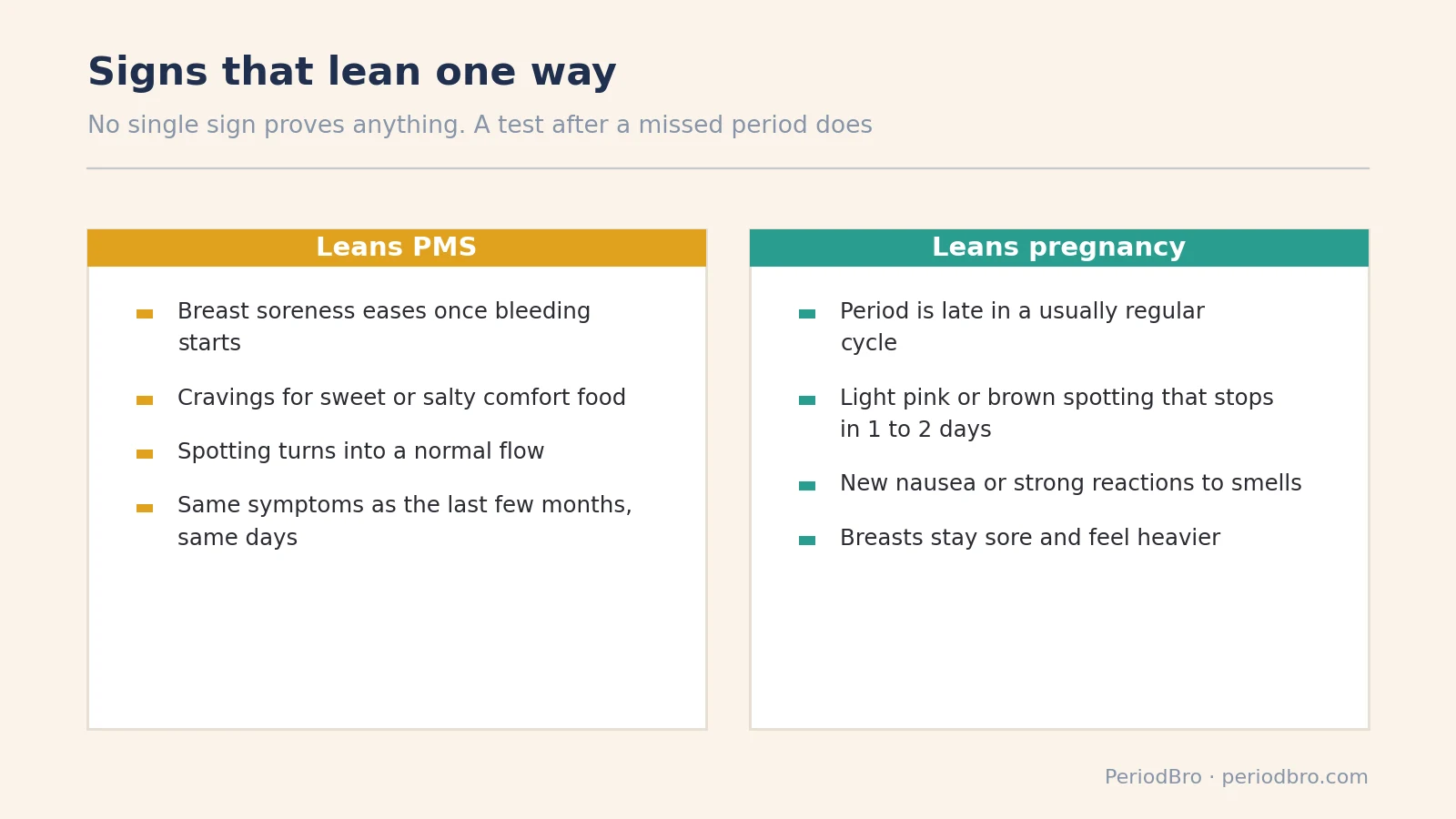
Sore breasts. Common in both. PMS tenderness usually eases once bleeding starts. Pregnancy tenderness tends to stick around and often feels fuller or heavier. We covered the PMS version in sore breasts before her period.
Cramps. Both can bring mild cramping low in the belly. Early pregnancy cramps can feel a lot like period cramps, but they may drag on longer without a period following them.
Spotting. This is one of the few real clues. Cleveland Clinic describes implantation bleeding as light pink or brown spotting that lasts up to two days, usually 10 to 14 days after ovulation, and says about 1 in 4 pregnant women have it (Cleveland Clinic). A period usually starts light and then gets heavier over a day or two. Implantation bleeding stays light and then stops. If spotting between periods keeps happening outside that window, that has its own list of causes.
Nausea. Some women get mild queasiness with PMS, but real nausea, especially with a new sensitivity to smells, leans toward pregnancy. It often starts a little later, around the time of the missed period or after.
Fatigue and mood. Both. Neither tells you much on its own. Period fatigue and early pregnancy tiredness can feel identical from the outside.
Food. PMS cravings usually lean toward sweet or salty comfort food. Pregnancy is more likely to bring aversions, like suddenly hating the smell of the coffee she drinks every morning, or a metallic taste.
The period itself. The clearest signal is a late period. If her period is late and her cycles are usually regular, that matters more than any of the above.
The only thing that actually answers the question
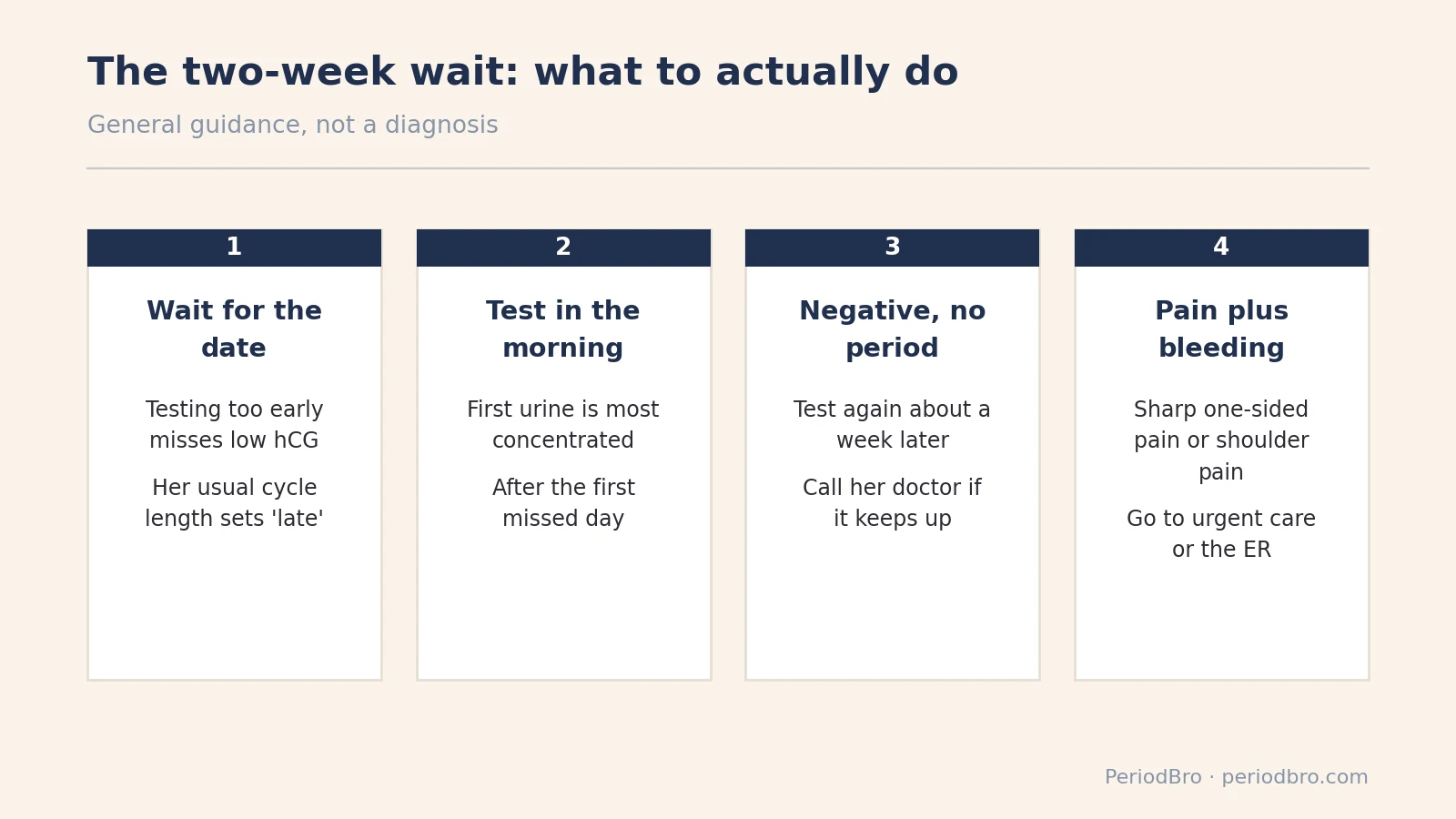
A home pregnancy test looks for hCG in urine. Mayo Clinic says hCG roughly doubles every two to three days in early pregnancy, so timing matters a lot. Their advice is to test after the first day of a missed period, and if the result is negative but her period still doesn’t come, test again about a week later (Mayo Clinic).
Testing earlier is possible, and some tests are sold as “early result,” but a negative a few days before her period is due means less than it looks like. There may just not be enough hCG yet. First-morning urine is the most concentrated, which helps. Cleveland Clinic puts home tests at about 99% accurate when they’re used correctly and at the right time (Cleveland Clinic).
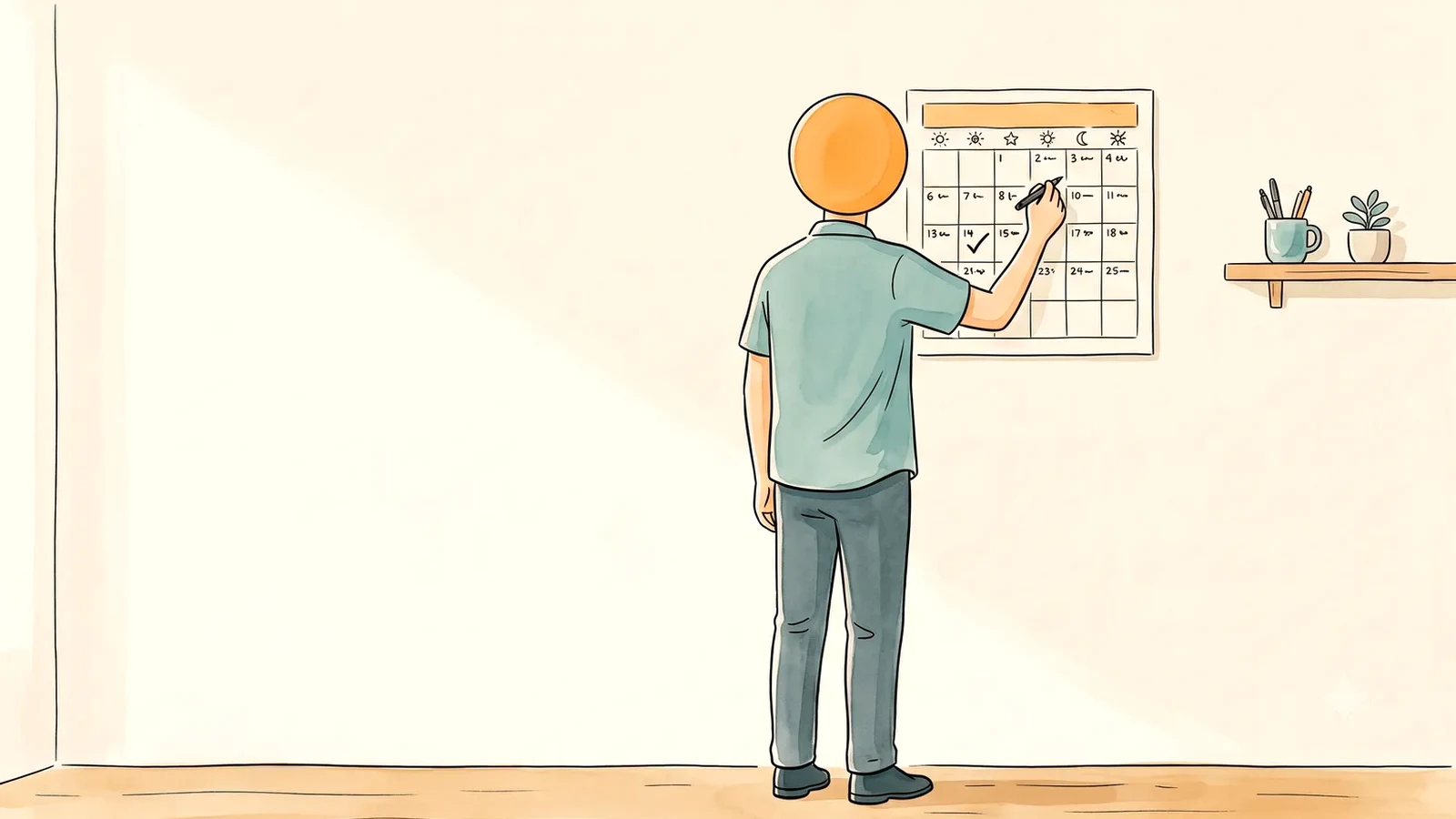
Cycle data helps here. If you know her cycles usually run 29 days, “late” means something specific. If her cycles are all over the place, you’ll want to give it a few more days before reading anything into a missing period. Why her period might be late covers the other reasons, from stress to thyroid issues.
What a partner can do during the wait
The week before a possible positive test is weird for both of you. Depending on where you are in life, it might be hope, dread, or something messier. A few things help.
Ask before you guess out loud. Saying “are you pregnant?” every time she’s tired gets old fast, and it can sting if you’ve been trying for a while. A better opener is “How are you feeling about this month?” and then listening.
Let her decide when to test. Some people want to test the second they can. Others would rather wait so they don’t spend a week staring at faint lines. It’s her body and her call. Your job is to have a test in the cupboard.
Treat the symptoms the same either way. Sore, bloated and wiped out is sore, bloated and wiped out. Take something off her plate, make dinner, keep the evening quiet. You don’t need to know the cause to be useful.
If you’re trying to conceive, watch your own reactions. Couples who’ve been trying for months often start treating every twinge as a sign. That’s exhausting, and a negative test on top of a week of hope lands hard. If that’s you, using her cycle data while trying to conceive might help you both set expectations.

Signs that need a doctor, not a test
Most of the time this is a waiting game. A few situations aren’t. ACOG warns that the first signs of an ectopic pregnancy are often light bleeding and pelvic pain, and says sudden severe pain, shoulder pain, or weakness means going to an emergency room (ACOG). An ectopic pregnancy can still show up as a positive test, so a positive result plus one-sided pain is a reason to call right away.
Other reasons to call her doctor:
- A positive test followed by heavy bleeding or cramping that’s worse than her usual period.
- No period for three months with negative tests.
- PMS symptoms so severe they wreck a week of her life every month. That could be PMDD, which is a different condition with real treatment options. PMS vs PMDD explains the line.
What my friend does now
After that October, my friend started logging his wife’s cycle in an app so he’d stop guessing. The next time she was tired and weepy on day 26, he knew exactly where they were, and he just made pasta and kept quiet. When she did get pregnant about a year later, the first clue wasn’t any symptom. It was a period that was three days late in a cycle that had run like a train for twelve months straight.
You can’t tell PMS vs pregnancy symptoms apart by feel in that last week, and neither can she, most of the time. What you can do is know her pattern well enough that a break in it stands out, and then let a test do the rest. If you’re newer to all this, start with how her cycle phases work.
PeriodBro provides educational information and is not a substitute for professional medical advice. Always consult a qualified healthcare provider for personal medical decisions.