
When Your Daughter Won’t Talk About Her Period
My daughter used to answer every question with a full sentence. Then one morning I asked if she needed more pads under the sink, and I got a one-word “fine” and a look that could strip paint. I stood there holding a grocery list like an idiot, wondering what I’d done wrong. Nothing, it turned out. She was just fourteen.
This is a different problem than the one most dads are Googling. How to talk to your daughter about periods is about getting the first conversation started. This is about what happens after that, when a daughter avoids talking about her period every time you bring it up. Eye roll, monosyllable, sudden urgent interest in her phone. If that’s where you are, you’re not doing it wrong. You’ve just hit a normal, later-stage wall that nobody warns you about.
What it actually means when your daughter avoids talking about her period
It took me embarrassingly long to accept this, but a daughter avoids talking about her period for reasons that have almost nothing to do with you as a father and almost everything to do with being a teenager. Pulling away from parents and guarding personal information is a documented, normal part of adolescent development, not a warning sign. Researchers who study parent-teen communication describe it through something called communication privacy management theory: teens deliberately share less and keep more private specifically because doing so builds the autonomy they need to become adults (Peng et al., Journal of Research on Adolescence, 2026). The American Academy of Pediatrics makes the same point from the clinical side, calling growing privacy needs a developmentally appropriate part of adolescence, not a red flag on their own (AAP, Pediatrics, 2024).
Add in the fact that this particular topic involves her body and you, a parent of a different gender, and the reluctance gets a second layer. A study on father-daughter puberty communication in Uganda found girls consistently said things like “mothers know about menstruation and other women’s things, so it’s easier to talk to them” (Muhwezi et al., Reproductive Health, 2015). A separate qualitative study on mother-daughter puberty talks found shame was one of the biggest barriers even between two women, with one teenage participant saying she was “ashamed of talking to my mother about these things” (Mirzaee et al., Revista Brasileira de Ginecologia e Obstetrícia, 2021). If shame shows up even in same-gender conversations, it’s not surprising it shows up harder when the parent asking is dad.
You picked a topic that sits right at the intersection of two things teenagers are wired to protect: their bodies and their independence. Nothing is broken between you two just because she’d rather not discuss either one with you directly.
It tends to hit harder for single dads and dads whose daughters don’t have a mom or older sister around day to day, because there’s no obvious alternate channel already built in. If that’s your situation, you’re not stuck, you just have to build that channel on purpose instead of assuming it exists.
Stop trying to have “the talk”
The instinct a lot of dads have, myself included, is to try harder. Sit her down. Make eye contact. Ask an open-ended question and wait it out. That approach works fine for some kids. For a daughter who’s already signaled she wants this topic closed, a sit-down conversation is often the worst format you could pick, because it puts her on the spot with nowhere to look and no easy exit.
Indirect approaches tend to land better:
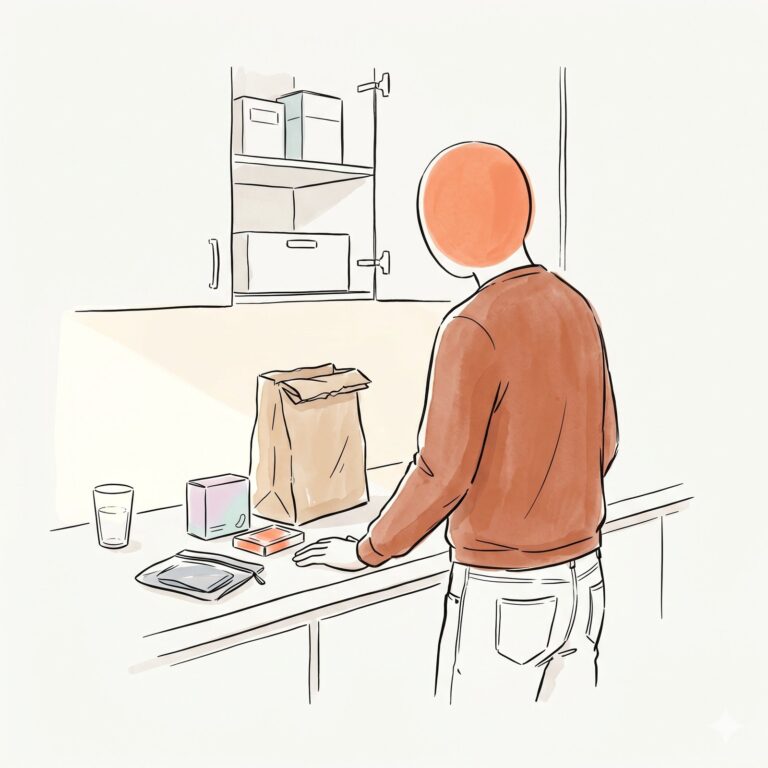
- Stock supplies without narrating it. Keep pads, a heating pad, and ibuprofen where she can grab them, and don’t mention it when you restock. My checklist for what to stock before her first period covers what’s actually worth keeping on hand. The absence of commentary is the point. She gets what she needs without having to ask, and you don’t turn a restock into an event.
- Find her an alternate channel. An aunt, an older cousin, her mom if she’s around, even the mom of a close friend. It doesn’t have to be you delivering every piece of information for her to end up informed. Your job is making sure that channel exists, not personally staffing it.
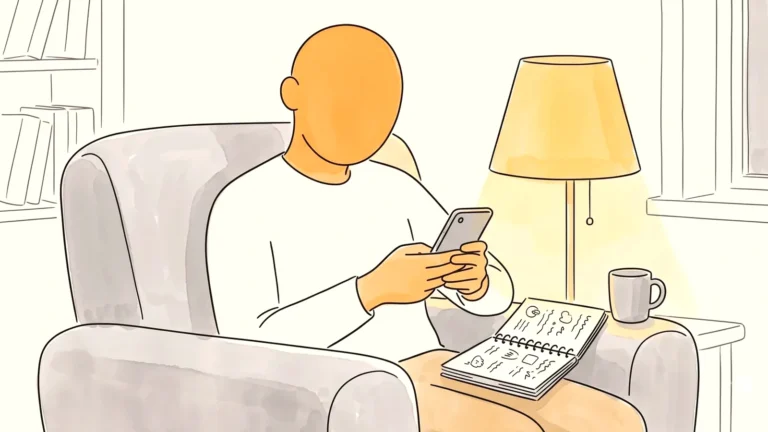
- Text instead of face-to-face. A lot of teenagers who go silent in person will answer a text. Something low-stakes like “left more ibuprofen in your bag, let me know if you need anything else” gets a response where a hallway conversation gets a shrug. There’s less pressure in a text because neither of you has to watch the other’s face.
- Normalize it sideways. Mention periods the way you’d mention anything else mildly inconvenient, in passing, with zero weight on it. Not a sit-down. Not a speech. Just proof that the subject doesn’t make you weird, so eventually it doesn’t have to make her weird either. Repetition does more work here than any single well-crafted conversation ever will.

I switched to this approach about six months after the “fine” incident, mostly out of self-preservation. I stopped asking questions and started just doing things: restocking, leaving a heating pad on her bed during a bad week, texting instead of talking. She never once thanked me out loud. But the supplies kept disappearing at the right rate, which told me everything I needed to know.

What’s fine to let slide, and what’s worth a gentle follow-up
Most of what a dad worries about here is fine to just let go: not wanting to discuss cramps with you in detail, changing the subject the second you bring up her cycle, asking a friend instead of you. None of that is a crisis, and pushing on any of it usually just teaches her to hide things better next time.
A few things are worth checking on regardless of whether she wants to talk about feelings:
- Are supplies actually being used. Not a conversation, just an observation. If the stock never moves and you have other reasons to think her period may not have started or may have stopped, that’s a “mention it to her doctor” situation, covered in more depth in what a dad should know about a daughter who hasn’t started her period.
- Signs she’s hiding real pain. Missing school repeatedly, curling up and not moving, or using far more pain medication than seems reasonable. Silence about feelings is normal. Silence about pain that’s interfering with her life is a different thing, and it’s the one place a direct, non-negotiable conversation (“we’re calling the doctor”) is appropriate even if she resists it.
- Signs of period poverty. If products keep running out faster than you’re restocking, or she seems to be improvising with toilet paper or asking friends to cover her, that’s not a communication problem, it’s a logistics problem, and it needs a direct fix (more supplies, no discussion required) rather than patience.


Her silence isn’t a verdict on your relationship
It’s easy to read a shut-down conversation as rejection, especially if you’ve been trying to do right by her. I read it that way for months, and I pulled back further than I should have because I didn’t want to keep getting the same look. What I eventually figured out is that a fourteen-year-old rolling her eyes at her dad mentioning periods is not meaningfully different from her rolling her eyes at him mentioning curfew, or homework, or anything else that falls under “things my parent brings up that I did not ask about.” It’s a teenager doing what teenagers do, not a verdict on you as a father. Pulling back yourself is the response that actually risks the relationship, because it teaches her that bringing up anything hard makes you disappear too.

For the bigger picture on where this fits into your role as a dad more broadly, a father’s role in menstrual education is worth reading, since it covers the foundation this article builds on. And if her moodiness around this topic has you second-guessing whether something else is going on, why your teenage daughter seems moody is a useful next stop.
I built PeriodBro partly for exactly this situation: a way to quietly track and anticipate what your daughter needs without requiring her to explain herself to you every month. You don’t need her to talk about it for you to show up for it.
This article is educational and isn’t a substitute for professional medical or mental health advice. If you’re worried about your daughter’s physical or emotional wellbeing, talk to her pediatrician.