Teenage Periods and Sleep: What Dads Should Know
She was up until one, she’s impossible to wake at seven, and this is the third morning this week. It looks like a phone problem and a discipline problem. Some of it is. But there’s a second thing running underneath, it’s on a monthly schedule rather than a nightly one, and once you can see it on a calendar the mornings stop feeling random.
Teenage periods and sleep pull on each other in both directions, and two separate forces land on the same week.
One is her body clock, which moved when puberty started. The other is the few days before her period. Neither is laziness, and only one of them is worth an argument.

Her body clock moved, and it isn’t coming back yet
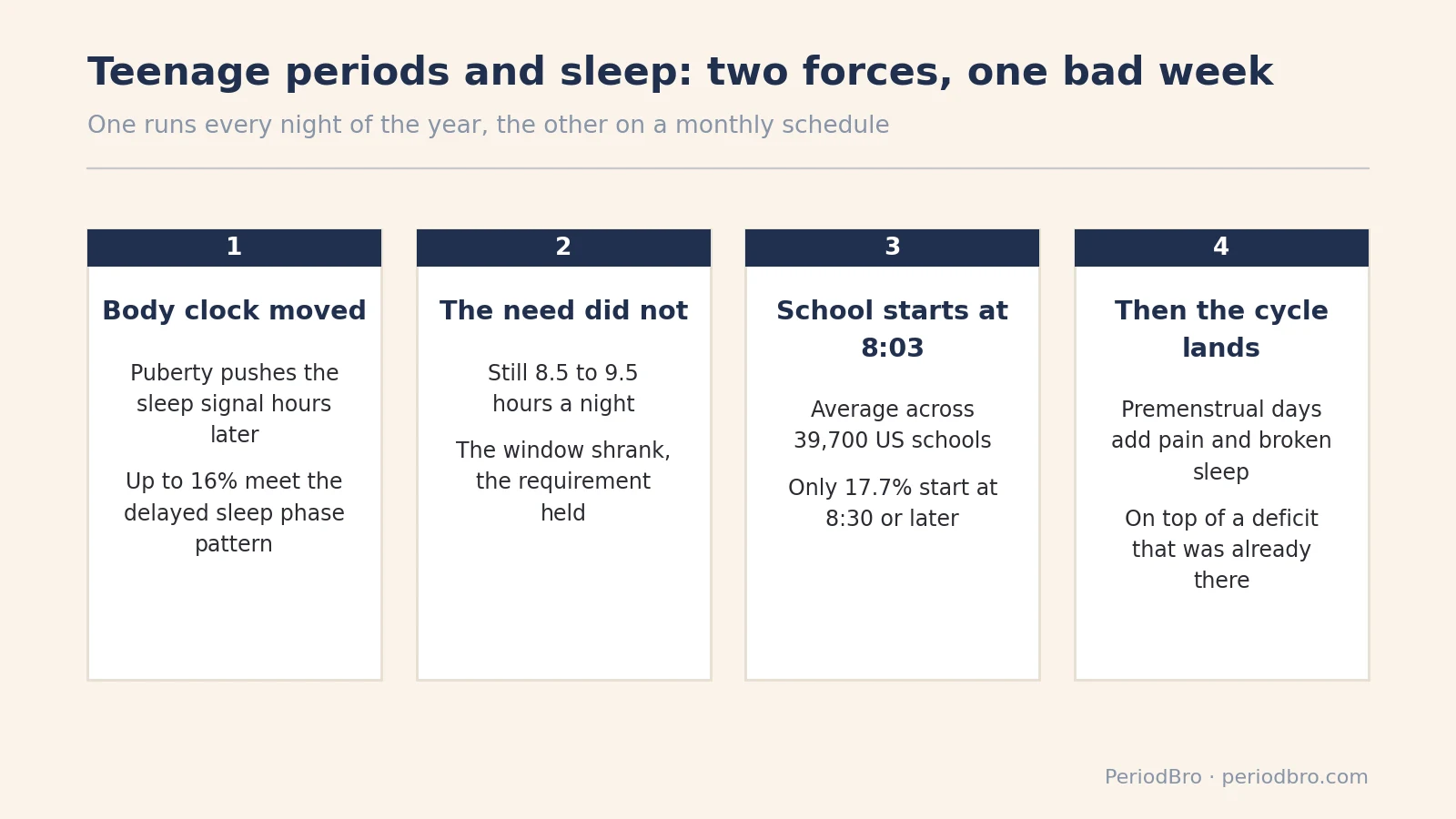
Puberty shifts the circadian phase later, and it does this regardless of her habits. The timing signal that tells her body when to feel sleepy arrives later in the evening than it did when she was nine, and it stays shifted for years. A review of adolescent circadian sleep disorders puts delayed sleep phase syndrome at up to 16% of teenagers, and makes the point that matters most: while the timing moves, the amount of sleep she needs doesn’t. The requirement stays put and the window to get it shrinks.
School is the other blade. The CDC’s survey of nearly 40,000 US public schools found an average start time of 8:03 in the morning, with only 17.7% starting at 8:30 or later, which is the earliest the American Academy of Pediatrics recommends. Teenagers need somewhere between eight and a half and nine and a half hours. Do the arithmetic against a body that won’t feel sleepy until eleven and the shortfall is structural.
So before the cycle enters the picture at all, she’s running a deficit most school nights. That’s the baseline everything else stacks on top of.
What teenage periods and sleep do to each other
The clearest data comes from the ABCD Study, a large American research cohort. An analysis of 3,037 girls who had started their periods, average age thirteen, matched sleep behaviour against menstrual symptoms.
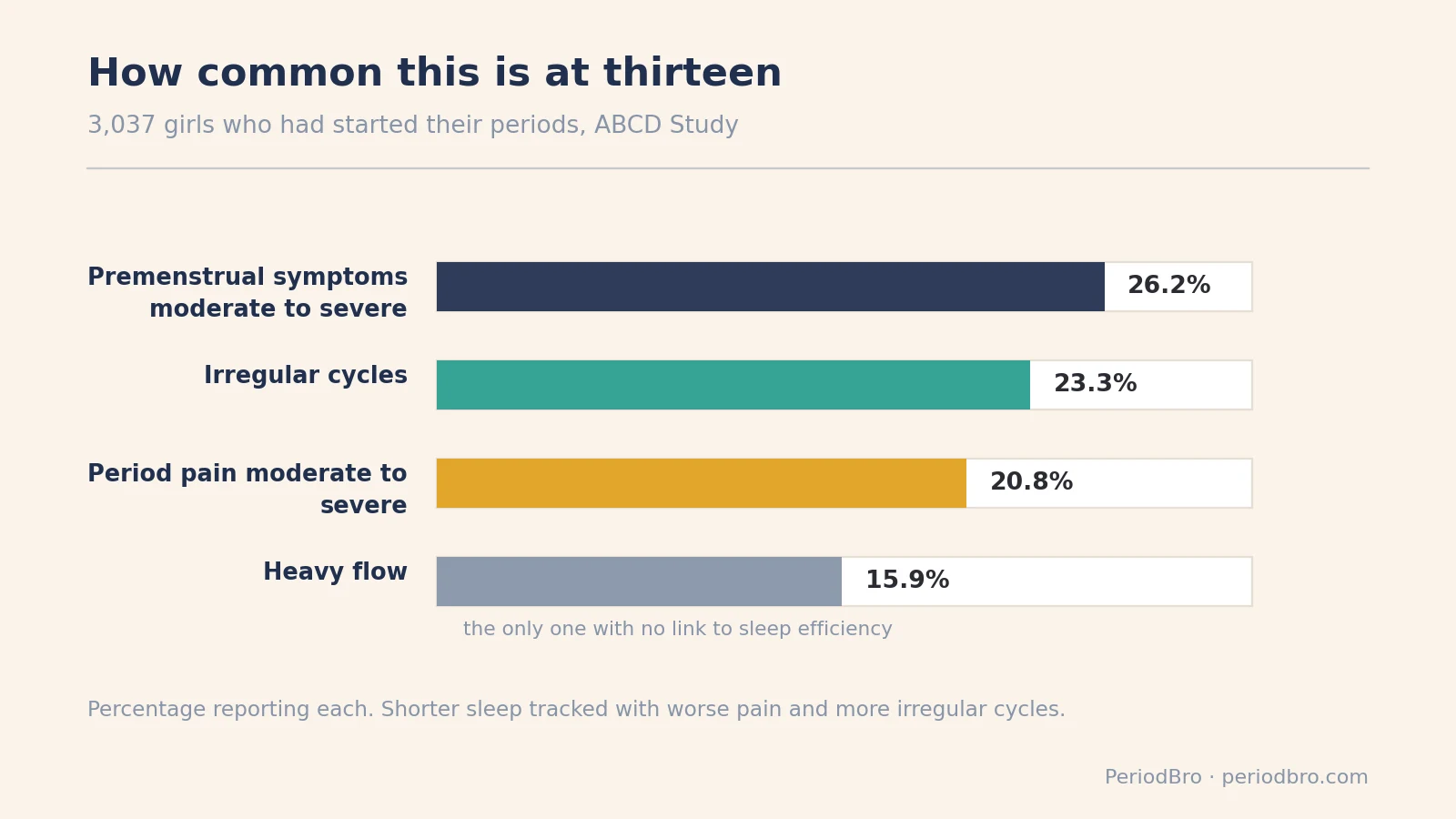
Two findings are worth carrying around. First, how common the symptoms are: 26.2% reported moderate to severe premenstrual symptoms, 20.8% moderate to severe period pain, 23.3% irregular cycles, 15.9% heavy flow. If your daughter has a rough few days a month, she’s in a very large group.
Second, and this is the one that reframes the mornings: girls who had started their periods went to bed later and slept less than those who hadn’t. Menarche itself moved the sleep pattern. On top of that, shorter sleep tracked with more intense period pain, more disruption to daily activities, and more irregular cycles. Higher sleep disturbance scores tracked with worse pain and worse premenstrual symptoms.
Which way the arrow points, the study can’t say. It’s a snapshot, not an experiment. But the two travel together, and the practical read is the same either way: bad nights and bad cycle days are the same story rather than two.
It’s the pain, not the bleeding
A useful piece of precision comes from a 2024 study in the Journal of Pediatric and Adolescent Gynecology covering girls aged twelve to eighteen. Sleep quality scores were significantly lower in those with high premenstrual symptom scores, and lower again in those with period pain and other menstrual symptoms. Heavy bleeding, defined as lasting more than seven days or needing more than five or six pads a day, showed no relationship with sleep efficiency at all.
The pain and the premenstrual load are what wreck her nights, rather than the volume. That’s worth knowing because heavy flow is the thing a parent notices, and cramps are the thing she doesn’t mention.
It also gives you something to act on. Pain that’s bad enough to keep a teenager awake is treatable, and treating it properly is a different conversation from telling her to put the phone down. Cramp relief that actually works starts before the pain peaks, which means the tablets need to be somewhere she can reach at eleven at night.

Why the bad nights cluster
The few days before bleeding starts are the ones that show up in the data, and there’s a mechanical reason for it. Core body temperature runs slightly higher in the second half of the cycle, and a body that can’t shed heat easily takes longer to fall asleep and wakes more often. Add cramping that arrives in waves and the picture is a night broken into pieces rather than a night she never started.
That’s why she can look fine on a Tuesday and be unreachable on a Thursday, with nothing in between to explain it. She isn’t sleeping less because she stayed up. She stayed up because she couldn’t sleep, and the two look identical from outside a closed bedroom door.
It also explains the argument you keep having. You’re pointing at the phone because the phone was in her hand at midnight. It was in her hand at midnight because she was awake anyway.
The two dates that change the appointment
The whole job takes about a minute a month.
Write down two things for three months: the day her period starts, and any night she couldn’t sleep or woke up in pain. Two dates a month, on whatever calendar you already use.
Three months of that turns “she’s tired all the time” into a pattern a doctor can work with. It’s the difference between a five-minute appointment that ends in general advice and one that ends in a plan. The same record does double duty if her cycles are still irregular, which is normal in the early years but worth having written down.
Don’t make her keep the record if she doesn’t want to. You can note the bad nights yourself without knowing anything she hasn’t told you.
What actually helps on school nights
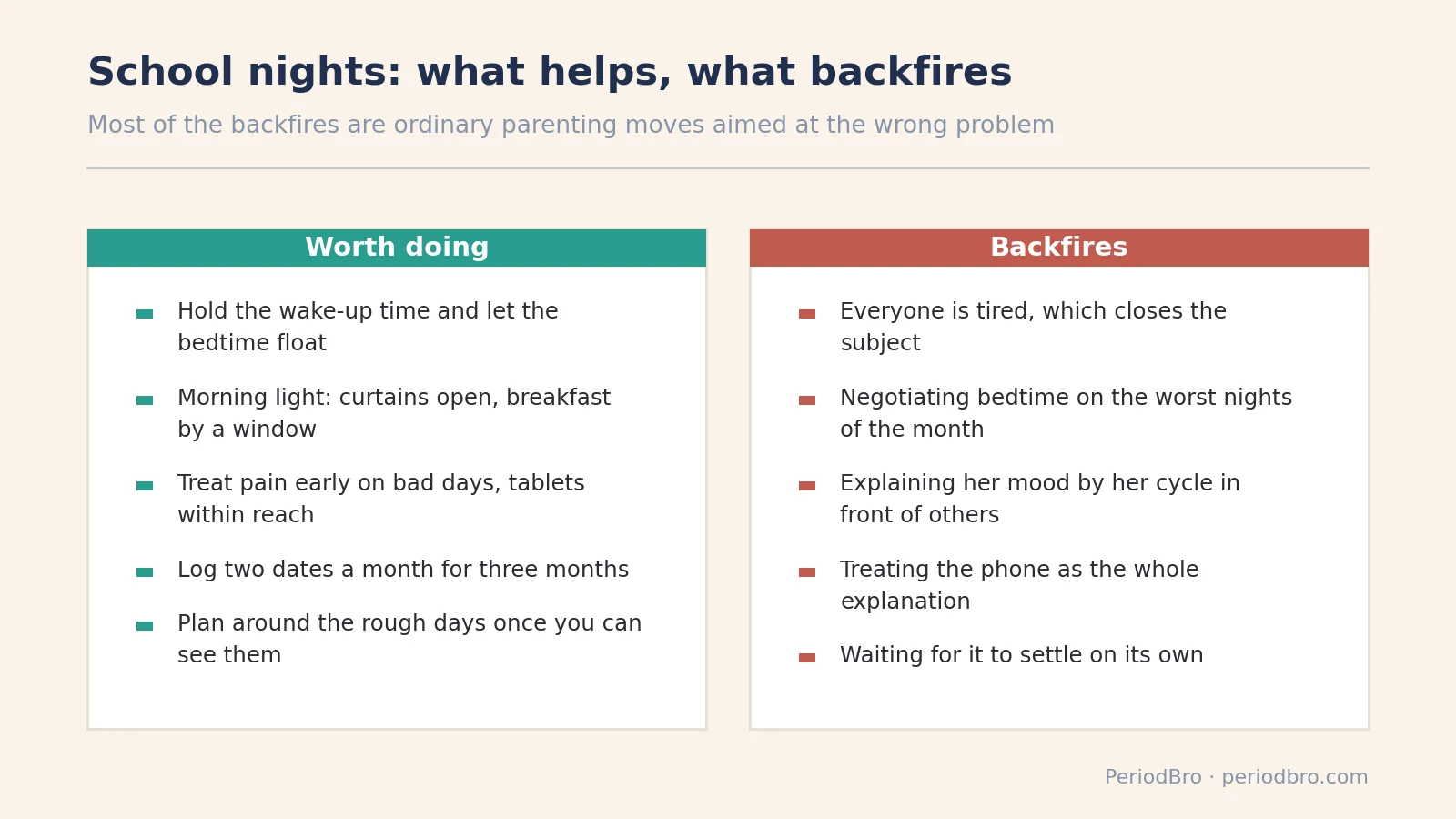
Hold the wake-up time and let the bedtime float. A constant morning anchor does more for a shifted body clock than a bedtime she can’t physically meet. Lie-ins at the weekend that run hours past her school wake-up push the clock later again, which is why Monday is always the worst morning.
Get light into her early. Curtains open, breakfast near a window, walk part of the way if that’s possible. Morning light is the strongest lever you have on the timing, and it’s free.
Treat the pain properly on the bad days rather than waiting to see if it settles. Same goes for a hot water bottle within reach.
Plan the week you can see coming. If the calendar says the rough days land on Thursday and Friday, that’s a bad week for a late-night group project and a fine week to drive her instead of making her walk.
Handle the phone as a separate issue on its own merits, because it is one. It’s just not the whole explanation, and treating it as the whole explanation is how the conversation turns into an argument every time.
What to skip
Skip “everyone’s tired.” She knows adults are tired. It closes the subject.
Skip the negotiation about bedtime on the worst nights of the month. You’ll win it and gain nothing.
Skip discussing her cycle in front of siblings, or using it as an explanation for her mood in company. That’s the fastest way to make sure she stops telling you when it’s bad, and then you’ve lost the only data you had. If the mood side of it is what you’re noticing most, the same rule applies.
Skip assuming it’ll settle on its own. The body clock does eventually, in her twenties. The pain doesn’t have to wait that long.
When to see a doctor
Book an appointment if pain is waking her at night or keeping her home from school, if she’s exhausted in a way that doesn’t track with her sleep, if her periods are heavy enough to need changing overnight, or if she’s falling asleep in class most days.
Two specific things to raise. First, ask about ferritin rather than just haemoglobin: heavy periods drain iron stores, and low iron shows up as exhaustion long before a standard blood count looks abnormal. It can also cause restless legs at night, which keeps a teenager awake for reasons nobody connects to her period. Second, if the pain is severe enough to stop her sleeping or attending school, say that out loud in the room. That sentence changes what gets offered.
Take the three months of dates with you. A doctor asked about teenage periods and sleep in the abstract gives general advice; a doctor handed two columns of dates gives a plan.
If you’re unsure whether this warrants a visit at all, the thresholds are more generous than most parents assume, and heavy teenage periods have a proper workup behind them.
This article is general information, not medical advice. Anything specific to your daughter’s sleep, pain or cycle belongs with her doctor, who can examine her and knows her history.