Teenage Acne and Periods: What Her Skin Is Doing, and What Not to Say
The bathroom light is on again. Mirror time went from four minutes to twenty, she’s wearing her hair forward at dinner, and last Saturday she didn’t want to go out. You’ve noticed her skin, and you’ve worked out that mentioning it is a bad idea, so you’ve said nothing at all.
That’s the right instinct, roughly. There’s a version of this where you’re useful, though, and it starts with knowing what her skin is actually doing. Teenage acne and periods are linked more tightly than most parents realize, and the link is measurable rather than folklore.
At her age, clear skin is the exception
Acne affects around 85% of adolescents, which makes it the most common skin condition of that decade of life. It’s not a hygiene failure, it isn’t caused by chocolate, and washing her face harder makes it worse rather than better.
The mechanism is plumbing. Puberty raises androgen levels in girls as well as boys, the oil glands in the skin respond by producing more sebum, dead skin cells plug the follicle, and bacteria that live there quietly all along start an inflammatory reaction inside a blocked pore. Everything visible on her face is the last step of that sequence.
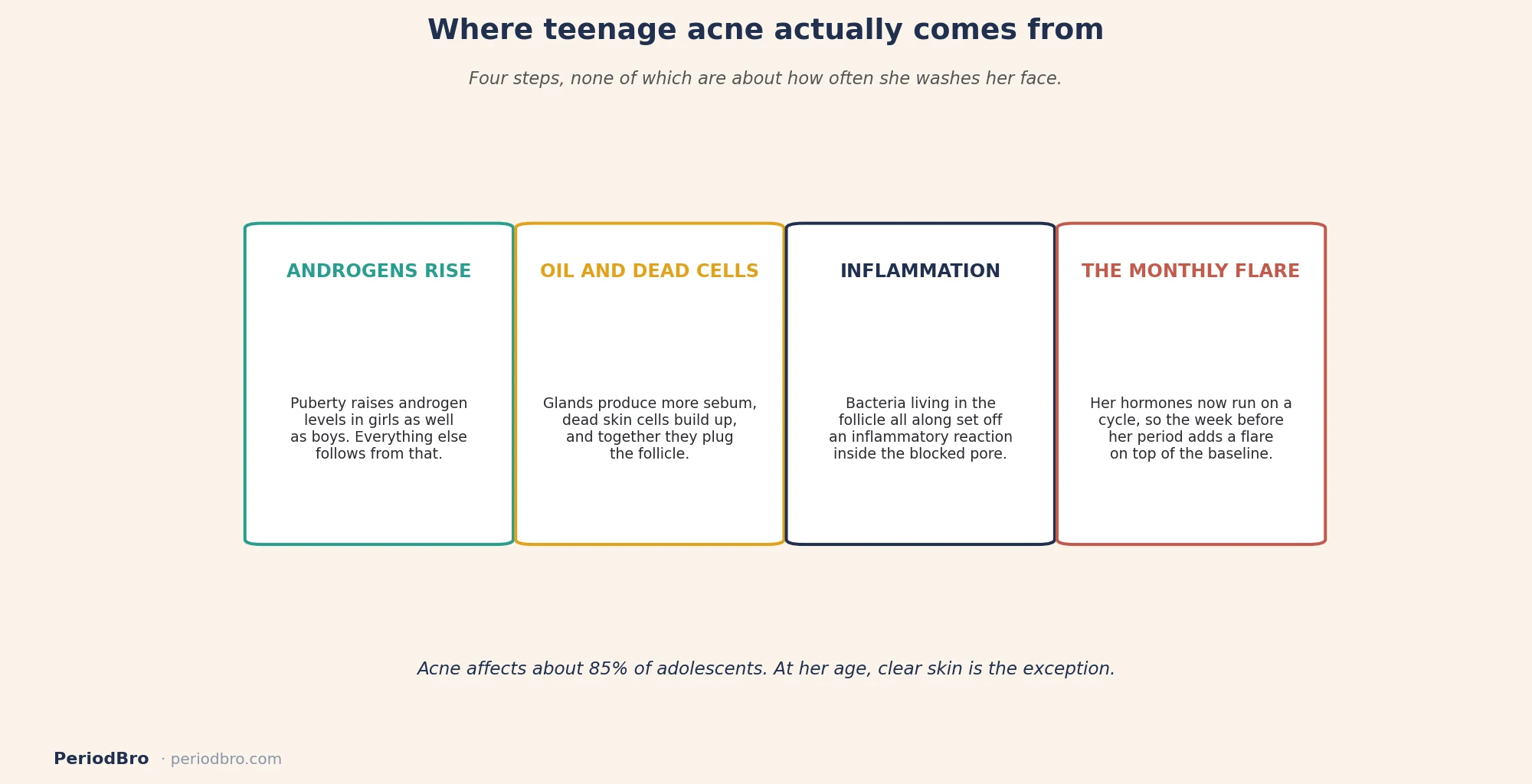
Which means the timing of the flare is downstream of hormones, and her hormones now run on a monthly cycle.

How teenage acne and periods line up on the calendar
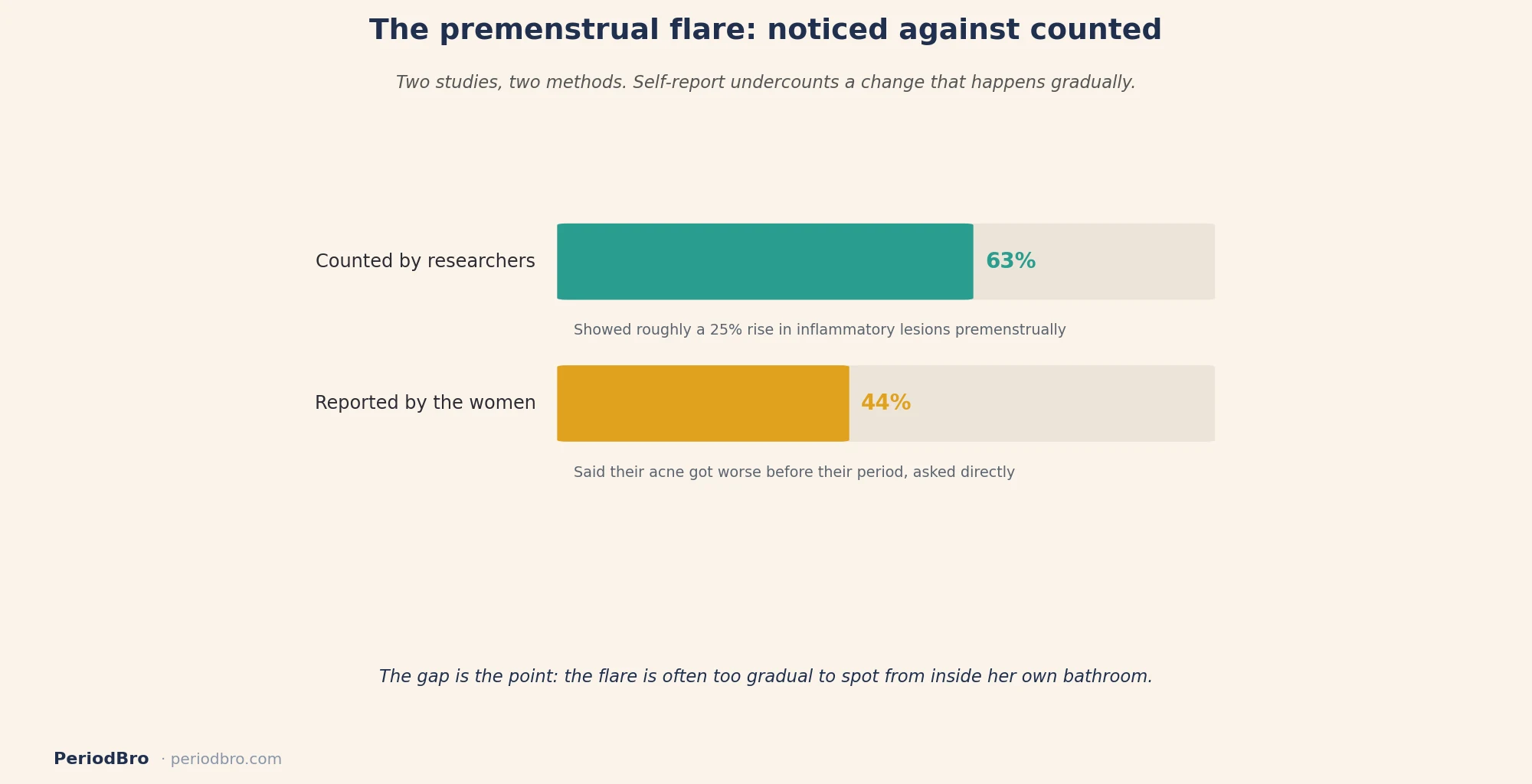
The premenstrual flare is real and it’s been measured twice, in two different ways.
Asked directly, 44% of 400 women reported a premenstrual worsening of their acne in a study published in the Journal of the American Academy of Dermatology. Counted rather than reported, the number goes up: a quantitative study that photographed and tallied lesions found that 63% of participants showed roughly a 25% increase in inflammatory lesions in the premenstrual window.
So a bit under half notice it, and closer to two thirds actually have it. The gap between those two numbers is the useful part: the flare is often too gradual to register as a pattern from inside her own bathroom.
Distribution follows the same hormonal logic. Cycle-linked breakouts favor the lower face, the jawline and the chin, and they tend to be the deeper, sore, inflamed kind rather than blackheads across the forehead. If her worst week is consistently the week before her period, that’s not a coincidence and it’s not something she’s doing wrong. The adult version of the same pattern is in period acne.
One caution before you start pattern-matching out loud. In the first couple of years after her first period, cycles are frequently irregular by design, so a flare that seems random may just be tracking a cycle that isn’t regular yet. That whole picture is covered in is my daughter’s period irregular.
What actually helps
The American Academy of Dermatology updated its acne guidelines in 2024, and the strong recommendations are for benzoyl peroxide, topical retinoids, topical antibiotics used alongside benzoyl peroxide rather than alone, and oral doxycycline for moderate to severe cases. Isotretinoin is strongly recommended for acne that’s severe, scarring, or causing significant psychological burden.
Three practical translations of that, for a parent who’s paying for the products:
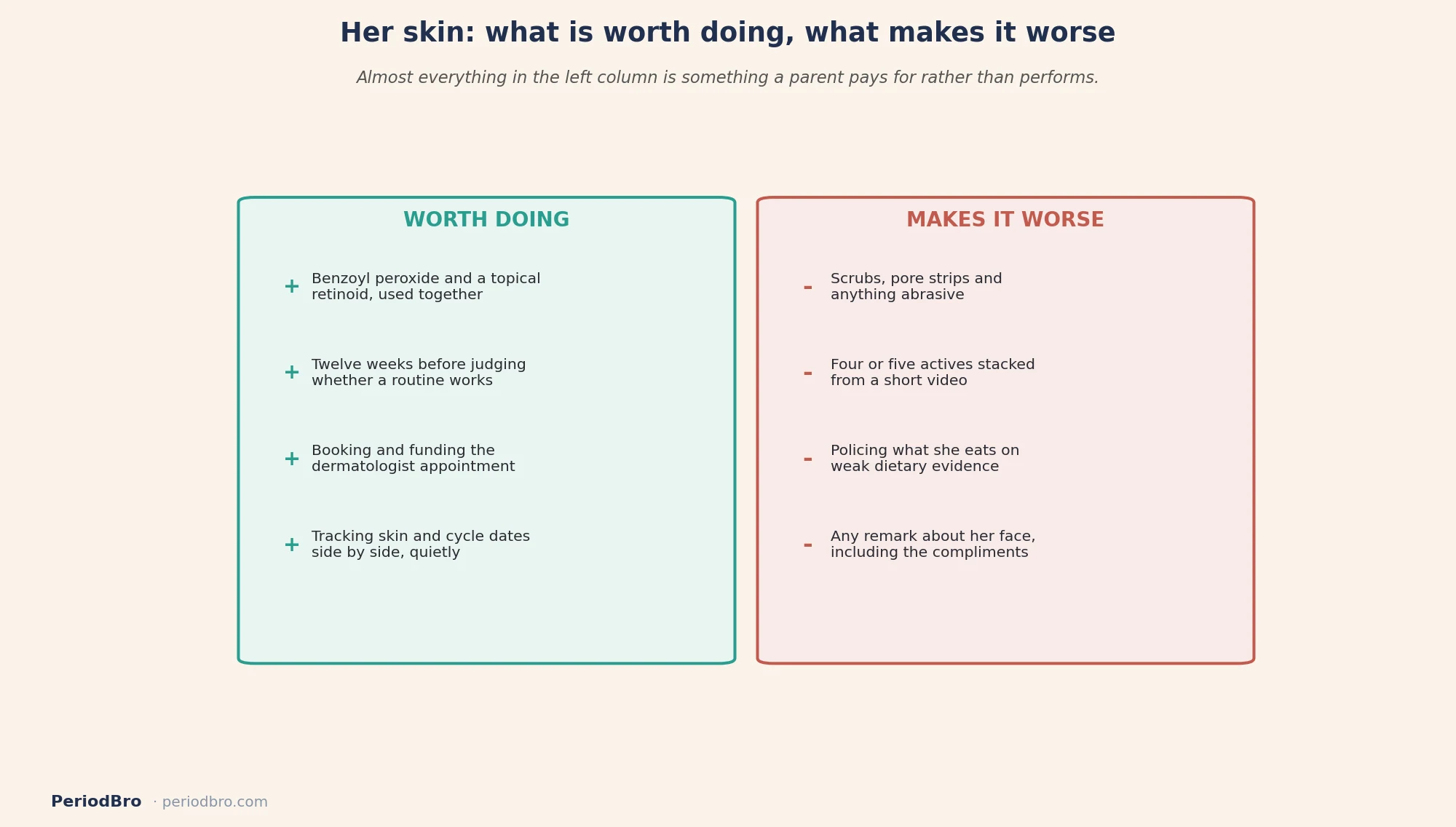
Combinations beat single products. Guideline-level treatment is usually two mechanisms at once, not one miracle cream picked off a shelf.
Twelve weeks is the unit of time. Skin treated properly takes two to three months to show its real response. A routine abandoned after ten days because it “isn’t working” has not been tested, and the churn through five different products is itself a common reason teenagers end up with irritated skin and no result.
Picking causes the permanent part. Inflammatory lesions can scar, and the severity of that scarring is linked to how long the acne went untreated. The spots clear up on their own timeline either way, and the marks they leave behind do not.
Which is the real argument against waiting it out. “She’ll grow out of it” is usually true about the acne and unreliable about the scarring, and that’s why proper treatment now beats proper treatment at nineteen.
What she’ll try instead, and why it backfires
Most of what reaches a fifteen-year-old comes from short videos, and it skews toward whatever looks dramatic on camera.
Scrubs and pore strips work on the surface of a problem that starts several layers down, and the scrubbing irritates skin that’s already inflamed. Long routines stacking four or five active ingredients do the same thing faster, because the actives that treat acne are also the ones that strip the skin barrier when they’re layered without a plan. Toothpaste on a spot is a folk remedy that burns.
Diet is the argument you’re most likely to have, and the honest answer is unsatisfying. The evidence linking specific foods to acne is weak and inconsistent, with a modest signal around high-glycemic diets and a contested one around skim milk. None of it is strong enough to justify a father policing what a teenage girl eats, and the risk of turning skin into a food rule at exactly the age when disordered eating starts is not worth the theoretical gain.
The other one to leave alone is makeup. Covering it is a legitimate coping strategy, not a compounding error, and most modern products are formulated not to block pores.

The combination that earns an appointment
Acne on its own is ordinary. Severe acne together with cycles that stay irregular is a different conversation, because that pairing is how polycystic ovary syndrome presents in adolescence.
The 2023 international evidence-based PCOS guideline is specific about teenagers. Diagnosis requires both signs of excess androgen, which includes severe acne and unwanted hair growth, and ovulatory dysfunction, meaning irregular cycles. It also says pelvic ultrasound and AMH blood levels should not be used for diagnosis within eight years of her first period, because polycystic-looking ovaries are common and meaningless at that age.
The guideline defines irregular by how long she’s been menstruating:
- In the first year after her first period, irregularity is normal pubertal transition.
- One to three years in: cycles shorter than 21 days or longer than 45 days.
- More than three years in: cycles shorter than 21 days or longer than 35 days.
- At any point past the first year: a single cycle longer than 90 days.
If she meets some of that but not all of it, the guideline allows an “at risk” label with symptomatic treatment and re-checks over time rather than a definitive verdict at fifteen. Treatment exists either way, and combined oral contraceptives are one of the recommended options for both the cycle irregularity and the skin, which is a conversation that lands strangely on fathers the first time. There’s a whole piece on that: birth control for teen period pain. The adult picture of the condition is in PCOS and periods, and if you’re wondering who she should see and when, when should a girl see a gynecologist covers it.
The sentence you should never say
Anything at all about her face, and that includes the compliments.
“Your skin looks better this week” confirms that you’ve been assessing it, which means the weeks you say nothing get read as a verdict too. The same applies to remedies offered at dinner, jokes about the bathroom occupancy, and any version of “have you tried washing it more”.
What the dermatology guideline treats as clinically relevant, and what most parents underrate, is the psychological weight. Psychosocial burden appears in the AAD recommendations as a reason to escalate to stronger treatment, on the same footing as physical severity. Her not wanting to go out on Saturday is a treatment indication, not teenage drama.
So the useful moves are logistical. Pay for the dermatologist without being asked twice, and book the appointment yourself if that’s the blocker, since a teenager rarely does it. Drive her there. Keep the products stocked so the routine doesn’t lapse because a tube ran out. Say the one honest sentence available to you, which is that this is extremely common, it’s treatable, and you’ll cover whatever the treatment costs.
Then drop the subject, and let her raise it when she wants to. The broader version of holding that line while her moods run hot is in teenage daughter mood swings, and the general shape of a father’s role here is in a father’s role in menstrual education.
What to do this month
Book the appointment if her acne is inflamed, sore or leaving marks, because that’s already past what a supermarket shelf fixes. Ask, once, whether she wants help getting it looked at, and accept the first answer. And keep a mental note of two things at the same time, her skin and her cycle dates, because the pairing of severe acne with cycles that stay irregular past the first couple of years is the one combination that’s worth pushing on.
Everything else is her business. On teenage acne and periods the fastest way to be useful is to fund the treatment, drive her to it, and stop looking at her face.

PeriodBro helps you keep track of where she is in her cycle without hovering, which is what makes a pattern like this visible before it becomes an argument. Try it free.
This article is general information, not medical advice. Acne that’s scarring, or skin that’s driving her mood down, is worth a doctor’s appointment rather than another product.