
When Training Takes Her Period: What a Missing Cycle Costs
Her times are dropping, she is training six days a week, she looks like an athlete for the first time in her life, and her period stopped four months ago. Somewhere in the background, someone has told her this is what happens when you get serious. Teen athlete missed periods get filed under dedication constantly, and that piece of folklore is wrong in a way that costs bone she will not get a second chance to build.
A guy I know coached his daughter’s cross-country team for three seasons before anyone told him this. He had watched half a dozen girls lose their cycles over the years and had filed it under the same heading everyone else did, which was that hard training does that. Then one of them broke a metatarsal jogging on grass, and he found out what the missing period had been reporting the whole time.
A period that stops is a readout, not a badge
Start with what a cycle actually is from the body’s point of view. Running one is expensive. Ovulation, a thickened lining, and the hormones behind both are a monthly investment that a body only makes when it believes there is enough fuel to spare.
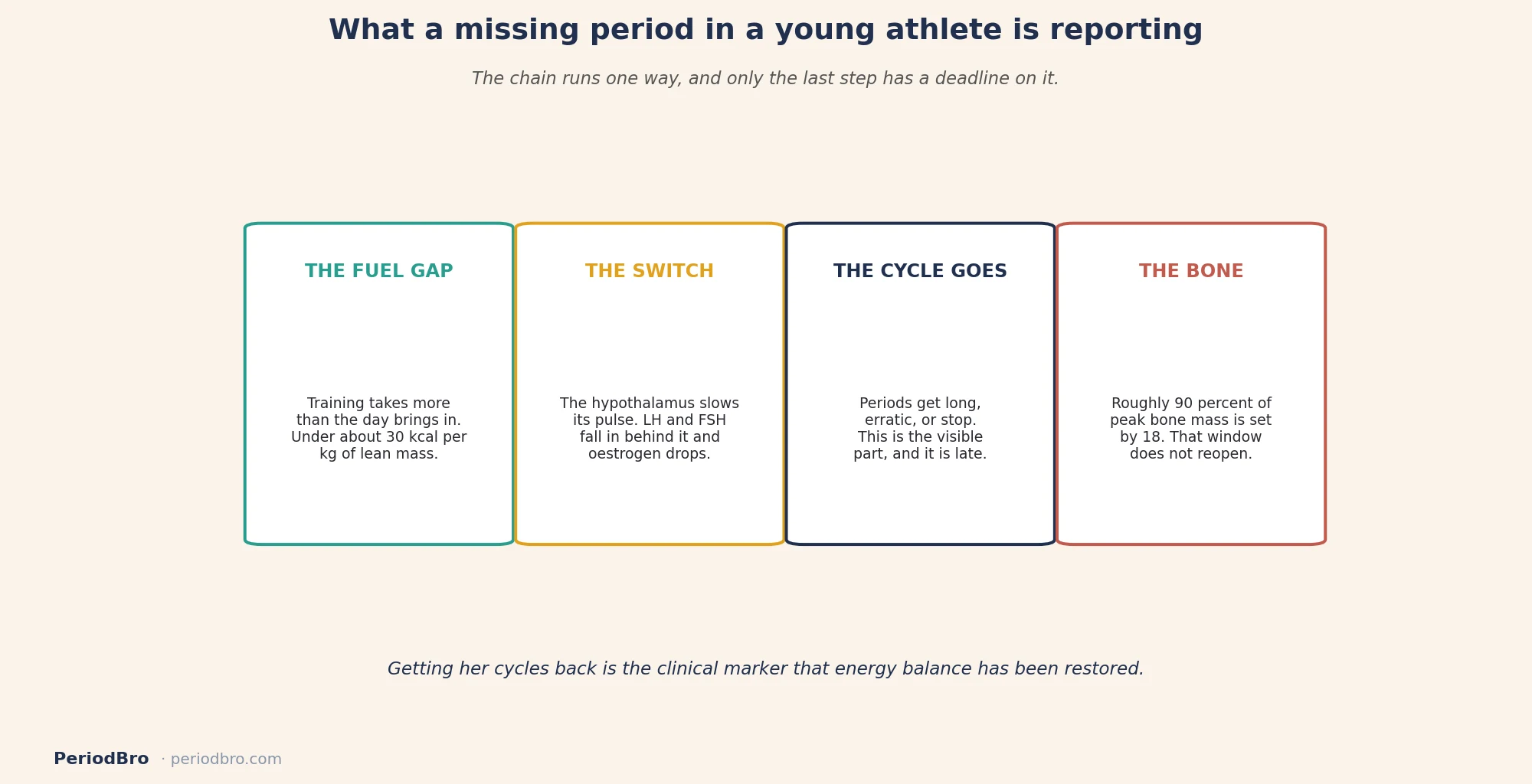
When there is not, it stops making the investment. The mechanism has been mapped fairly precisely: once available energy drops far enough, the hypothalamus slows the pulse of the hormone that drives the whole chain, luteinising hormone and follicle stimulating hormone fall in behind it, oestrogen drops, and cycles get long, erratic, or disappear. Nothing about that is a sign of fitness. It is a body switching off a system it has decided it cannot afford.
The International Olympic Committee gave this a name, Relative Energy Deficiency in Sport, precisely because the old framing kept people looking at the wrong thing. Their 2018 consensus update describes impaired function across metabolic rate, menstrual function, bone health, immunity and cardiovascular health, all downstream of the same energy gap. And it is not rare in her age group: amenorrhoea has been reported in around 13 percent of adolescent elite female athletes.

What teen athlete missed periods actually cost
Adolescence is when a skeleton gets built. Roughly 90 percent of peak bone mass is in place by age 18, and the years around her mid-teens are the densest stretch of that construction.
Oestrogen is central to laying that bone down. So a stretch of missing cycles during exactly those years is not a pause, it is construction time she does not get back. The American College of Obstetricians and Gynecologists committee opinion on the female athlete triad is blunt about the consequence: athletes with absent or irregular cycles have lower bone mineral density than those cycling normally, and are significantly more likely to sustain a bone stress injury.
The injury numbers put a size on it. In work on the triad’s cumulative risk, stress fracture incidence rose from about 15 percent in low-risk athletes to about 30 percent in those carrying several risk factors at once, which is the group a girl with missing periods and a thin diet is already in. The stress fracture is usually the first visible symptom of something that started months earlier.
And the treatment goal tells you how the specialists read it. The stated aim is to get her cycles back, because a returning period is the clinical signal that energy balance has been restored. Her cycle is the gauge on the dashboard, which is why turning the light off is the wrong move.
It is a fuel gap, not a training volume problem
This is the distinction that changes what happens at home, and most people get it backwards.
The measure that matters is energy availability, which is what is left over for the body to run on after training has taken its share. Below roughly 30 kilocalories per kilogram of fat-free mass per day, things start switching off. Which means there are two ways to land in that hole: train much more, or eat somewhat less. Most teenagers get there by drifting into the second one while the first quietly increases, and neither change is dramatic enough on its own to notice.
That matters because the instinct is to tell her to train less, and that is often not the lever. Plenty of these cases resolve by adding food, particularly around sessions, without touching the training schedule she cares about. Framing it as more fuel rather than less sport is not just gentler, it is usually more accurate, and it is the version she will actually agree to.
Worth flagging one adjacent thing while you are here. Heavy periods and low iron end a lot of seasons too, by a different route, and the two problems can sit side by side. The sports and periods piece covers that side, and heavy periods in teens goes deeper on when the bleeding itself is the issue.
Where uneven stops being ordinary
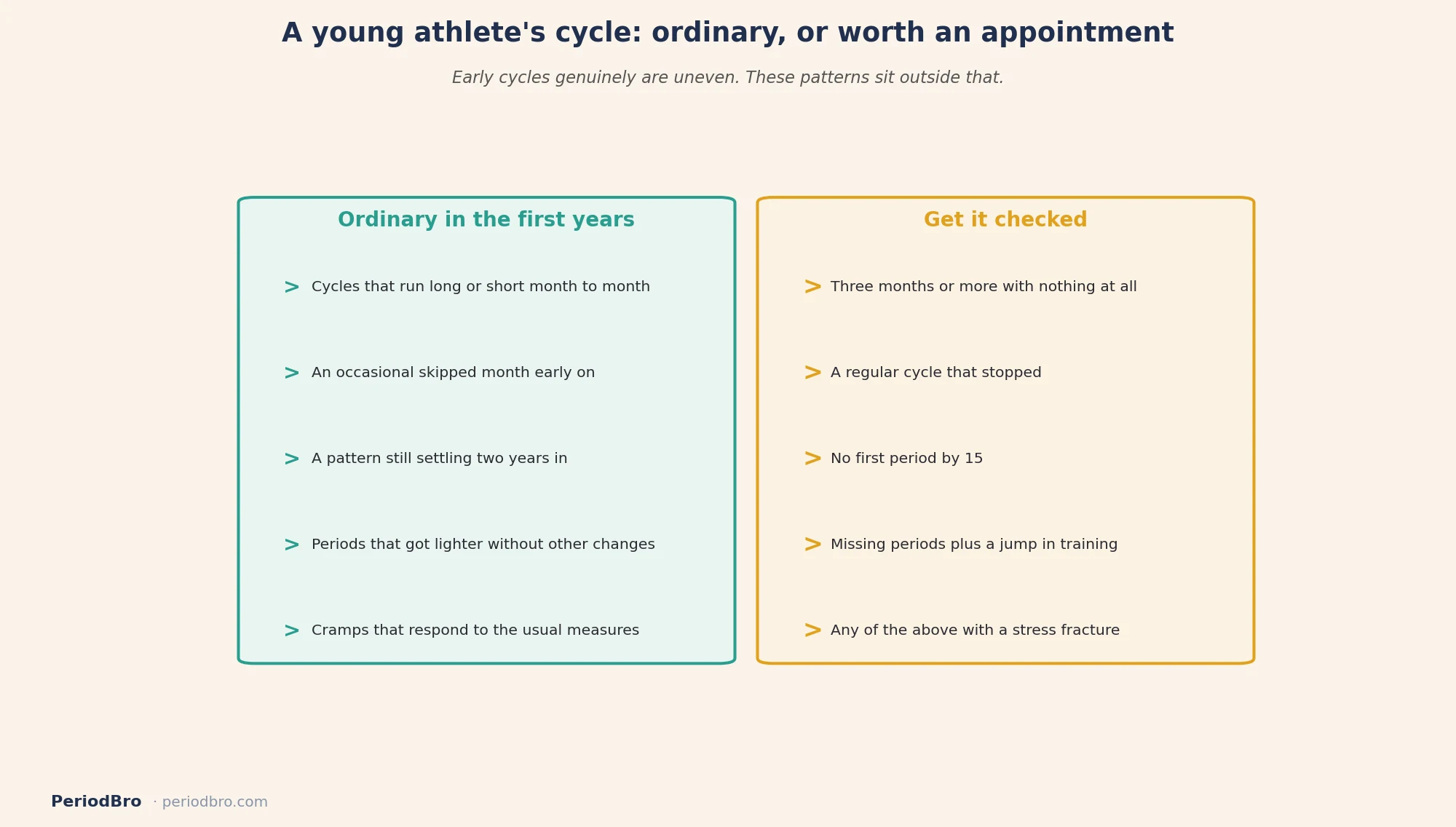
Before anyone panics, the first few years after her first period are genuinely irregular for most girls, and cycles that run long or skip occasionally in that window are usually just a system calibrating. What normal looks like in those first years is worth reading before you conclude anything.
The patterns that sit outside that are reasonably specific. Three months or more with no period at all. A cycle that was regular and then stopped. Periods that never started by 15, or by three years after breast development began, which is covered in the piece on a late first period. Any of those alongside a jump in training load, weight loss, a new eating pattern, or a stress fracture.
That combination is not a wait-and-see. The guidance for clinicians is to assess any active girl showing one component of this and go looking for the others, which is a low bar to clear deliberately, because the components hide each other.
The conversation, and the part you get wrong
Now the awkward bit, since a missing period, food, and body weight is not a comfortable set of topics for most dads and daughters.
Lead with performance, not with her body. “You have been flat in the last k of every race for a month” is a sentence she can engage with. Anything that starts with what she is eating or how she looks will close the conversation and take a few future ones with it. The energy gap shows up in fatigue, stalled times, and getting sick more often, and those are legitimate entry points that happen to be true.
Do not diagnose an eating disorder at the kitchen table. Sometimes that is what is underneath, sometimes it is a girl who added two sessions a week and did not think to add food, and telling those apart is not your job. The job is getting her in front of someone who can.
Say the bone part once, without a lecture. Teenagers discount consequences that arrive in twenty years, but most of them care about a stress fracture in March, and the honest version connects the two in one sentence.
Do not treat the pill as the fix. If her cycles come back because a hormonal method is producing a monthly bleed, the gauge has been covered up rather than repaired, and the underlying energy problem carries on unmeasured. It is a legitimate conversation to have with her doctor, and a bad one to have as a shortcut. What hormonal birth control does to a cycle explains why the bleed stops being informative.
And go with her if she wants you there. This is a visit with a specific agenda: missing periods, training load, and bone health, in that order. The first gynaecologist visit guide covers how those appointments run, including the part where they ask you to step out.

What to do this month
Find out how long it has actually been, because “a while” is doing a lot of work in most households and the answer is often longer than anyone thought. If she tracks, the dates are already there.
Book the appointment rather than raising it repeatedly. This is one of those problems where a second conversation about having a conversation achieves nothing, and a slot in a calendar achieves the whole thing.
Put food where the training is. More before and after sessions, and enough of it on rest days too, since the deficit does not take weekends off.
Then leave the interpretation to the clinic. Teen athlete missed periods is a well-mapped problem with a standard workup and a good prognosis when it gets caught in the same year it starts. The version that goes badly is almost always the version everyone agreed was normal for a serious athlete.

PeriodBro keeps a simple, private log of dates and gaps, which is exactly the information a clinician asks for first and exactly the information nobody can reconstruct from memory. Try it free.
This article is general information, not medical advice. Missing periods in a young athlete have several possible causes, and sorting between them belongs with her doctor.